Where's My Water?
- 29.74K
- 4.3
- Installs
- 1.00M
- Price
- $1.99

Screenshots
Analysis by Reviewed
I like mobile puzzles most when they explain themselves through play: one clear goal, a small set of actions, and feedback that helps me understand what to try next. That is the appeal of Where's My Water?. I guide water through dirt toward Swampy’s bath, and each attempt gives me something concrete to observe. It is an inviting setup for a brief break, though some levels ask for more attention than their cheerful look might suggest.
A small puzzle with a clear goal
What keeps the idea easy to grasp is how directly each puzzle connects an action to a result: you cut a route through dirt and watch water respond. I like that immediate feedback for a quick break, because I can understand what went wrong without needing a long explanation. The satisfying part is often not simply reaching the bathtub, but noticing that a small change in the route lets water reach more of the level.
This makes it a good fit for people who enjoy spatial reasoning but don't want to learn a complicated control scheme. If you prefer word puzzles, trivia, or challenges built around fast reactions, this is a different kind of diversion; the pleasure here comes from planning a route and seeing fluid physics play out. I would also skip it if you want a story-led game or a constant stream of action. Its appeal is the puzzle itself, not a sprawling narrative.
Get Ready for a Splash of Fun!
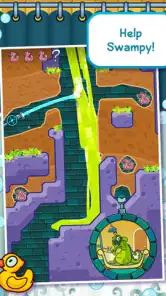
Where's My Water? revolves around the adorable Swampy, an alligator who simply wants to enjoy a good shower. Unfortunately, his water supply is often disrupted, leaving him high and dry. Your mission, should you choose to accept it, is to guide the water through a series of challenging puzzles to reach Swampy's bathtub.
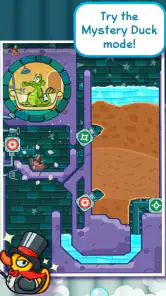
The game has a large collection of levels, each offering a new layout to work through. The early puzzles introduce the basic idea gently, then ask you to think more carefully about how the water will move. You dig through dirt, redirect streams, and encounter elements such as steam and toxic ooze. I enjoy that growing complexity, though it means the game is not always a frictionless two-minute distraction.
The Gameplay Experience
What makes Where's My Water? stand out is its intuitive touch controls. Simply swipe your finger across the screen to carve paths through the dirt. The physics engine ensures that the water flows realistically, adding an extra layer of immersion to the game. It's incredibly satisfying to watch the water trickle down in just the way you planned.
Short sessions, with room to think
The simple swipe-and-observe loop suits short sessions: I can try a route, see where the water goes, and decide whether to adjust it before moving on. A realistic use is playing while waiting for a drink or sitting through a brief commute; each level gives you a self-contained problem rather than asking you to remember a long sequence of events. Still, a tricky puzzle can take longer than expected, so I wouldn't open it when I know I have only a few seconds to spare.
More From Our News Desk

Clash of Clans Is Won Between the Battles

Android Auto Makes the Case for Quieter Car Software

MobiOffice: Transforming Mobile Productivity with Seamless Integration

EA SPORTS FC™ Mobile Soccer: Redefining Mobile Sports Gaming

How Microsoft OneDrive Became a Mobile Productivity Giant

How Google Translate Breaks Language Barriers Effortlessly
One useful habit is to watch the whole flow before making another cut. Water can divide or take an unexpected path, and changing the terrain too quickly may make it harder to tell which decision caused the problem. When a route fails, I find it more helpful to alter one section at a time than to redraw everything. That turns retries into a small experiment instead of guesswork, and it helps preserve the pleasure of working out the solution yourself.
At $1.99, it is a paid game, with optional in-app purchases priced from $0.99 to $4.99 per item. That starting cost matters if you are only curious about the premise and usually sample games before committing. I would first ask whether you enjoy this particular sort of hands-on puzzle; the purchase makes more sense for someone who expects to return to the levels than for someone looking for a throwaway trial.
Making a short break work
In an everyday routine, I can imagine opening a level while waiting for a takeaway order or sitting in a waiting room. The useful part is that I can focus on one compact problem rather than keep track of a match, a timer, or a long quest. If I get interrupted mid-attempt, I can simply stop experimenting and return when I have the attention to watch the water again. That makes it interruption-tolerant in a practical sense, even if a complicated layout is better saved for a calmer moment.
There is a small trade-off in how I use those pauses. If I have only a minute, I choose a level I expect to solve quickly rather than starting a stubborn one and feeling obliged to finish. When I have more time, I can treat the same puzzle as a sequence of tests: make one cut, observe where the flow goes, then change only the part that caused trouble. This approach keeps the challenge legible and reduces the temptation to swipe randomly.
The game’s goal also gives a useful way to judge whether a session has run its course. If I have stopped learning from retries and am repeating the same failed route, I take a break rather than forcing another attempt. Returning later with fresh eyes can make a path easier to read. That is a better fit for this design than expecting every session to end with a long streak of solved levels.
The developers have done a stellar job with the level design, ensuring that each puzzle feels fresh and engaging. Whether you're sliding blocks to change the course of the water or timing your actions perfectly to avoid hazards, there's never a dull moment.
Pause, return, and pick up the puzzle
Its level-by-level structure makes it easier to fit around interruptions than a game that depends on a continuous match or timed run. If a message or errand pulls me away, the sensible approach is to stop at a natural point and come back when I can focus on the route again. The puzzles don't require a long warm-up, but I still prefer a quiet moment for levels where several hazards or water paths need attention.
Compared with the usual mobile puzzle alternatives, this feels more tactile than a number grid or match-based board: I am shaping a physical-looking path, not just selecting a tile. That is a strength when I want a visual cause-and-effect challenge, but it can be less relaxing than a very simple matching game if I am tired and don't want to reason through a layout. The best choice depends on whether I want to plan or switch my brain off.
How the challenge changes with your mood
For a player who enjoys spatial reasoning, the changing routes give more to consider than simply finding a matching symbol or spotting a word. I have to think about where water can travel and how a small cut might affect what happens farther down. That makes the game a better fit than a casual matching puzzle when I want to feel involved in the solution. On the other hand, if I am exhausted and want a game that asks almost nothing of me, a match-based alternative is the kinder choice.
The contrast with fast arcade games is just as clear. There is no need to rely on quick reactions as the main attraction; I can look at the layout and plan before swiping. That slower pace is welcome when I want a calm mental task, but it will not satisfy someone seeking pressure, competition, or a constant burst of action. Its immediate pleasure comes from watching a route work, not from chasing a score or trying to beat another player.
Visuals and Sound
The graphics in Where's My Water? are vibrant and cartoonish, perfectly complementing the lighthearted nature of the game. The animations are smooth, and the attention to detail is commendable. As for the sound, the cheerful background music and quirky sound effects add to the overall charm, making the gameplay experience even more enjoyable.
It's also worth mentioning the adorable character design. Swampy and his friends are brought to life with personality and humor, which adds an extra layer of engagement as you progress through the game.
For a quieter setting, I would treat the sound as a nice extra rather than the main reason to play: the important information is visible in the water's movement and the layout. The cartoon presentation also helps keep failures light. A route that doesn't work feels like an invitation to rethink the terrain, not a punishing setback, which is one reason the game can suit casual players as well as people who like to chase a neat solution.
Replaying without turning it into a chore
The appeal of replaying a level is strongest when I can see a better route or want to test a different approach. It is less compelling if I feel obliged to repeat puzzles merely to clear a checklist; the core interaction is satisfying, but it does not make every repeat automatically fresh. I would recommend treating a difficult level as a small design problem and stopping once the experimenting stops being fun.
That distinction matters if you are choosing a game for long-term replay. I return to a puzzle when I have a reason to reconsider its layout, not simply because the same action will feel new forever. Someone who enjoys refining a solution may find that enough, while a player who needs endless variation or a social competition loop will probably get more from a different kind of puzzle game. Here, the satisfaction is personal and focused: I understand the flow a little better than I did on the previous attempt.
Disney developed this puzzle game, which is rated for Everyone. Its current version is 1.18.9, and it requires operating-system version 8.0 or later. It has a 4.3 average from around 197,000 ratings and more than 1 million installs. Those figures suggest it has reached a broad audience, but what matters most to me is whether its particular mix of gentle presentation and hands-on problem solving matches the kind of break you want.
Who will enjoy the splash, and who may not
I would recommend it to people who like a clear objective, tactile controls, and puzzles that reward observation more than speed. It can also work well for families looking for an Everyone-rated game with a friendly visual style, provided the player enjoys thinking through routes rather than tapping rapidly. The gentle presentation makes a failed attempt feel approachable, while the water’s movement gives a concrete clue for what to change next.
I would steer away from it if you want a free download before deciding whether the gameplay suits you, a story that carries you through a campaign, or a game built around rapid rounds. The purchase price and optional item purchases are worth keeping in mind, too. If you already know that tracing paths and adjusting a plan is your kind of puzzle, the premise has a clear appeal; if not, the cost may be harder to justify than trying a free alternative in another puzzle style.
Final Thoughts
Where's My Water? is a strong choice for anyone who enjoys puzzle games or wants a focused way to pass the time. Its combination of clever water-routing challenges, charming visuals, and hands-on play gives it a distinctive feel. Whether you're a casual player or someone who likes to think through a tricky layout, it offers a welcoming starting point—though its best audience is people who enjoy reasoning rather than simply switching off.
So, what are you waiting for? Dive into the world of Swampy and experience the joy of solving puzzles in Where's My Water?. It's a game that will keep you entertained and coming back for more, one splash at a time!
My recommendation is more specific than “something for everyone”: try it if you like seeing a plan take shape through small adjustments, and if a puzzle can hold your attention for a few minutes without needing a competitive payoff. Choose another kind of game if you want a free first taste, rapid action, or puzzles that never ask you to retry a route. For the right player, Swampy's bath-time problem remains a pleasantly focused way to make a short pause feel rewarding.
Where's My Water? Frequently Asked Questions
What should I know about Where's My Water? before downloading it?
Where's My Water? is a Disney puzzle game built around guiding water through dirt and obstacles. It offers a straightforward premise with levels that ask you to plan a route and solve each challenge. The game is a paid download, and optional in-app purchases are also available, so it is useful to consider both before deciding whether it suits you.
Does Where's My Water? need an internet connection to play?
Yes, Where's My Water? can be played offline. Once downloaded and installed on your device, you do not need an active internet connection to enjoy the game. This makes it a convenient option for on-the-go entertainment, whether you're traveling or simply in an area with limited internet access. You can focus on the puzzles without needing to stay connected while playing.
Does Where's My Water? cost money to download?
Where's My Water? is a paid puzzle game, priced at $1.99. It also offers optional in-app purchases, so it is worth considering both the initial price and any extras you might choose to buy. The purchases are not essential to enjoy the core puzzle experience, and you can play without spending beyond the download price.
What kind of game is Where's My Water?, and who made it?
Where's My Water? is a puzzle game developed by Disney. Its central appeal is working out how to move water through dirt and around obstacles, with each level asking you to think through a different route. The game is known as an award-winning puzzler, making it a natural fit for players who enjoy approachable challenges built around problem-solving.
What is the main objective of Where's My Water?
The main objective of Where's My Water? is to guide water to Swampy the Alligator's shower by digging through dirt and solving puzzles. Players must navigate through various levels, each presenting unique challenges and obstacles, to ensure that Swampy gets his much-needed shower. The game combines physics-based puzzles with engaging gameplay, making it suitable for players of all ages.
Pros
- Engaging puzzle mechanics.
- Cute and charming graphics.
- Suitable for all ages.
- Regular updates with new levels.
- Encourages critical thinking.
Cons
- Limited free levels.
- In-app purchases required.
- Ads can be intrusive.
- Some puzzles are repetitive.
- Requires internet connection.

- Category
- Puzzle
- Version
- 1.18.9