Pinochle
- 395.00
- 4.5
- Installs
- 100.00K
- Price
- Free

Screenshots
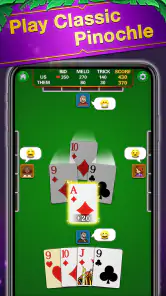
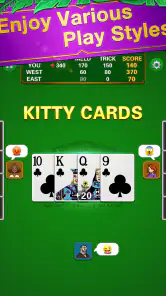
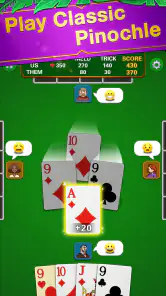
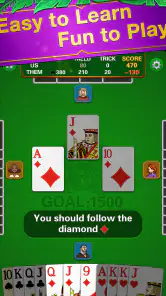
Analysis by Reviewed
Picking up a digital card game is easy; finding one that makes you want to deal another hand is harder. My time with Pinochle from Topy Games has been built around that simple test. It is a free card game for Android that lets me play online or offline, and its appeal comes from the compact cycle of choosing a move, seeing whether that choice pays off, collecting the result, and deciding whether I have enough time for one more hand.
That rhythm makes it a good fit for short breaks, quiet evenings, and players who enjoy thinking several turns ahead without committing to a large strategy game. It is not trying to replace every kind of card experience. If you want a huge collection of modes, elaborate presentation, or a social platform built around constant interaction, you may prefer a different option. If you want a recognizable trick-taking game that can work with or without an internet connection, this version deserves a closer look.
How the first hand becomes a real decision
The first useful thing to understand is that Pinochle is not simply about playing the highest card available. The opening phase asks me to read the situation, consider what I might be able to control later, and avoid spending valuable strength too early. That is where the game becomes more interesting than a quick luck-based card app. Each play has a consequence, even when the consequence is not immediately visible.
I find the best way to begin is to treat the first hand as information gathering. Rather than rushing to win every early trick, I look for clues about which suits may matter, which cards are likely to be protected, and how much flexibility my hand gives me. This approach is especially useful when playing against other people online, because an opponent's early choice can reveal more than the card itself. A cautious play may signal a plan, while an unexpectedly aggressive move can force me to reconsider my assumptions.
The offline option changes the mood considerably. I can start a game without making the session depend on a stable connection, which is useful during travel, in waiting rooms, or whenever I simply want a quiet match against the game's opposition. Offline play also works as a low-pressure practice space. I can test whether holding a strong card is wiser than using it immediately, then carry that lesson into a more competitive game.
One practical habit has helped me avoid careless losses: before playing a card, I quickly ask what I will still be able to do after the trick ends. That question is more valuable than focusing only on the current reward. A winning move can leave a weak follow-up, while a deliberately modest move can preserve control for a later exchange. Pinochle rewards that kind of short-term restraint, and the lesson transfers well to other trick-taking games.
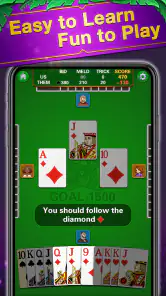
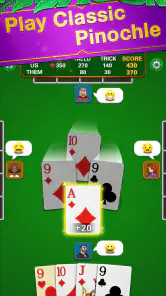
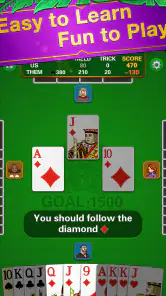
The game is also approachable because the basic action is clear. I select a card, commit to the play, and watch the trick resolve. There is no need to learn a complicated control scheme before I can participate. The challenge comes from understanding the cards and the timing, not from wrestling with the interface. For someone returning to Pinochle after a long break, that makes the first session less intimidating than a dense multiplayer card title.
The feedback rhythm keeps each trick meaningful
A good card game gives me feedback at several levels. The immediate feedback is the result of the trick: I can see whether my choice worked and whether I gained the position I wanted. The deeper feedback appears a few plays later, when an earlier decision either creates an opportunity or leaves me short of options. That delayed connection is what gives the game its satisfying mental texture.
In my experience, the most enjoyable moments are not always the obvious wins. Sometimes the better result is forcing an opponent to spend a useful card, even if I do not take the trick myself. Other times, I win a trick but realize that I have revealed too much about the strength of my hand. The game encourages me to judge a move by what it sets up, not only by the points or control it produces immediately.
This feedback rhythm also makes mistakes readable. When I lose because I played too quickly, the cause is usually understandable: I used a card that would have been more valuable later, misread the likely suit, or failed to account for what another player could still hold. That clarity matters. Losing feels less arbitrary when I can identify the decision that led there, and it gives the next hand a specific purpose.
Online play adds a different kind of feedback because human opponents are less predictable than a fixed computer routine. A person may abandon an obvious-looking line to protect a longer plan, or may make a surprising move simply because they saw something I missed. I enjoy that uncertainty, but it also means online games demand more patience. If I prefer a predictable pace or want to pause and think without pressure, offline play is the better choice.
There is a useful distinction between learning the rules and learning the tempo. A new player may understand which card can be played but still spend strong cards too early or fail to preserve a useful response. I recommend playing several relaxed offline hands while concentrating on one idea at a time: first protecting flexibility, then tracking played suits, and finally thinking about what the opponent is trying to make me do. That process is more effective than trying to memorize every possibility at once.
The game’s clear loop makes those lessons easy to repeat. I act, the table responds, and the result gives me a reason to adjust. Because the individual decisions are compact, I can experiment without feeling that one mistake has ruined a long campaign. That is one of the strongest reasons to return: every hand offers a small, understandable problem rather than an overwhelming wall of strategy.
Where the reward comes from
The reward in Pinochle is mainly strategic rather than decorative. I enjoy the satisfaction of turning a limited hand into a workable plan, especially when a choice that looked defensive eventually creates control. The game does not need a large progression system to make a successful hand feel worthwhile. The reward is the result itself, plus the knowledge that I read the table correctly.
That makes it appealing to players who like card games for their decisions instead of constant visual stimulation. A short session can still feel complete because the hand has a beginning, a middle, and a clear outcome. I do not need to wait for a long story sequence or manage a collection before I can enjoy the central activity. The cards are the content, and the changing relationships between them provide the variety.
There is also a social reward in online play. A well-timed move against a human opponent feels different from beating a routine computer response. I become more attentive to the table because another person may notice patterns I would ignore against an automated player. That tension can make a close hand memorable, although it also means the experience depends more on the quality and pace of the match than offline play does.
The free entry point is helpful for deciding whether this style suits me. I can try the core experience without paying first, while optional in-app purchases are listed at $1.99 per item. I would still approach those purchases carefully. They are not a reason to start playing, and anyone who wants a completely no-cost experience should pay attention to the purchase prompts and keep the focus on the basic card play.
For everyday use, the reward structure works particularly well in small gaps. Imagine having a few minutes before an appointment: an offline hand gives that pause a clear activity, and I can stop after the result rather than entering a large ongoing match. At home, I might instead choose online play when I want the uncertainty of a human opponent. The same game serves both situations because the basic reward is tied to making a better decision, not to the length of the session.
One less obvious benefit is that the game can act as a diagnostic tool for my own habits. I notice whether I chase immediate wins, overvalue a strong-looking card, or become too predictable after taking an early trick. That self-awareness is useful beyond this app. A card game that exposes those tendencies gives me something to work on, even when I am not playing competitively.
Why the next hand feels like a reset
Every finished hand creates a clean reset, but it does not erase what I learned. That balance is central to the game's appeal. The cards change, the available plan changes, and an earlier mistake does not permanently damage a long campaign. At the same time, the previous result stays in my mind, so the next hand begins with a small question: will I repeat the same error or respond differently?
I like this structure more than card games that surround each match with a heavy progression layer. Here, the reset puts attention back on the table. It also keeps losing manageable. A bad hand or poor decision can be frustrating, but I am not forced to carry it through a lengthy sequence of missions. I can review what happened, shuffle mentally, and try again.
The reset is especially valuable for practice. I can choose one improvement target for the next hand, such as keeping a likely winner in reserve or paying closer attention to which suits have already appeared. Because the game restarts quickly, I get immediate feedback on whether that adjustment helps. This creates a practical learning loop: identify a mistake, change one behavior, and see the result under a new deal.
There is a trade-off, though. Players who need a strong sense of long-term progression may find the repeated hand structure too self-contained. The satisfaction is in improving and winning individual games, not in following a large narrative or building an elaborate account. If your ideal card app is a collectible game with constant unlocks, this may feel spare. If you prefer a focused match that stands on its own, the reset is a strength.
The offline format makes restarting particularly convenient. I can use it for deliberate practice without worrying about whether I am ready for a human opponent. Once the decision-making feels more natural, online play becomes a useful test of whether my strategy works against someone who does not follow predictable patterns. I see these as complementary modes rather than separate experiences: offline play helps me refine habits, while online play challenges them.
The app is aimed at an Everyone 10+ audience, which fits its accessible card-game presentation. Younger players who already understand trick-taking ideas may be able to enjoy it, while complete beginners may need a little time to absorb the rules and scoring logic. I would not recommend judging the game after one rushed hand. The first session is mostly about understanding the rhythm; the strategic reward becomes clearer once I stop treating every trick as an isolated contest.
How it compares with familiar card-game alternatives
Compared with a simple solitaire app, Pinochle offers more deliberate opposition and more room for planning around another player's choices. Solitaire is often ideal when I want a solitary puzzle with a predictable structure. This game is better when I want the table to push back, whether that push comes from offline opposition or an online rival.
Compared with broad card-game collections, it is more focused. A collection can provide variety when I am not sure what I want to play, but that variety often means learning several rule sets and navigating more menus. Here, the benefit is concentration. I can spend my attention on improving at one traditional style rather than switching between unrelated games.
It also differs from collectible card games, where deck construction, card ownership, and long-term upgrades may matter as much as the match itself. Pinochle puts the emphasis on the hand I receive and the decisions I make with it. That is refreshing if I dislike the feeling that progress depends on building a stronger collection. On the other hand, players who love customizing decks may find the fixed-card format less expressive.
Against a dedicated physical-card group, the app is more convenient but less social in the ordinary sense. It removes the need to find a table, shuffle, and keep track of every card manually. Online play can provide human competition, while offline play offers availability on demand. Still, a phone screen cannot fully reproduce the conversation and shared atmosphere of sitting with friends, so I would choose the physical version when the social gathering is the main point.
One important trade-off is pace. An offline hand can feel controlled and private, while online play may be less comfortable if I want to think for a long time before every move. That is not a flaw unique to this title; it is part of playing against real people. I would choose the app for flexible access and repeatable practice, but I would choose a local group or a slower platform when discussion and extended analysis matter more than convenience.
Who should install it and who should skip it
I would recommend this game to someone who already enjoys trick-taking cards, wants a free way to practice, or needs an offline option for short sessions. It is also a good choice for a player who values decisions over spectacle. The combination of online and offline play gives it practical range, and the compact reset makes it easy to fit around a normal day.
I would be more cautious if you are completely new to Pinochle and want a highly guided tutorial before making any mistakes. The game becomes more rewarding when I actively think about card timing and future options, so a player looking for instant, almost automatic entertainment may find the learning curve less appealing. Likewise, anyone seeking a large progression system, extensive deck customization, or a story-driven card adventure should look elsewhere.
Before settling into online matches, I suggest using offline games to develop three habits: count what has already been played, protect flexibility instead of chasing every early trick, and review the reason behind each loss. Those habits make the transition to human opponents smoother. They also prevent the common mistake of blaming luck for a hand that was actually lost through one rushed decision.
Topy Games has kept the focus on the card table, and that focus is both the game's identity and its main limitation. The experience does not need much outside the hand itself, but players who expect a broad entertainment package may want more variety. For me, the narrow design works because it makes the action easy to understand: choose a card, receive immediate and delayed feedback, enjoy the reward of a well-read situation, then reset and test the lesson again.
The app was released on February 26, 2024, and the current version is 2.2, with support beginning at Android 7.0. Its average rating is 4.5 from around 1.5 thousand ratings, and it has passed 100 thousand installs, which suggests that the focused format has found an audience. Those figures do not replace personal experience, but they match my impression that this is an approachable, established choice for people specifically looking for a digital Pinochle table.
My final view is positive, with a clear condition: install it if the core card loop is what you want. I keep returning because a hand can challenge me without demanding a long commitment, and a loss usually gives me a concrete idea to test next time. The best reason to play is the reset: every new deal is a fresh chance to turn one lesson into a better decision. As a free card game from Topy Games, it is a sensible pick for focused offline practice and online matches, but not the right destination for players who need collection-building, dramatic presentation, or a wide menu of unrelated modes.
Pros
- Supports classic Pinochle rules for a familiar card-game experience.
- Helpful tutorials make it easier for new players to learn the basics.
- Quick matches work well for short gaming sessions.
- Offline play is useful when you have no internet connection.
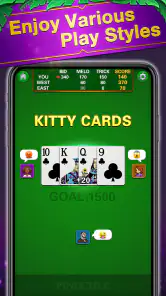
- Simple controls make bidding and card selection easy on mobile.
Cons
- Limited variation in game modes may reduce long-term replay value.
- Computer opponents can feel predictable after extended play.
- Some features may be restricted behind ads or in-app purchases.
- Small text or card details may be difficult to read on smaller screens.
- Online matchmaking may have limited activity depending on your region.
- Category
- Card
- Version
- 2.2