Nonocross
- 92.00
- 3.2
- Installs
- 100.00K
- Price
- Free
Screenshots
Analysis by Reviewed
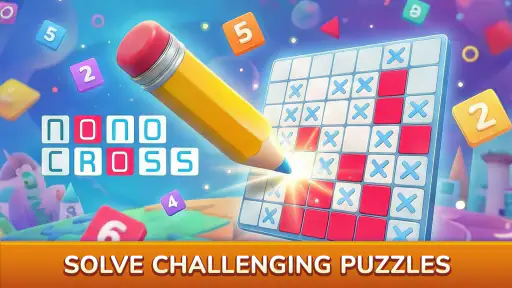
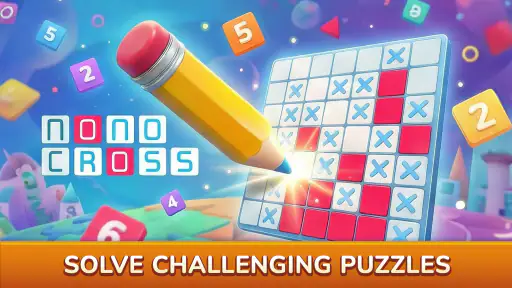
I found Nonocross to be a straightforward puzzle game built around Nonogram logic and pixel-art reveals. The basic idea is easy to understand: use the number clues around a grid to decide which squares should be filled, then watch an image take shape as your deductions become correct. That familiar format makes it approachable, but the real appeal is the quiet concentration it demands. I can play for a few minutes without preparing for a complicated session, yet a tougher puzzle can hold my attention much longer.
This is a free game from Gimica GmbH, listed for Everyone and available on devices running Android 7.0 or later. Its current version is 1.1.0. The store summary focuses on solving Nonogram puzzles and uncovering hidden pixel art, which is an accurate description of the central loop rather than an attempt to dress the game up as something else.
What to expect when you begin
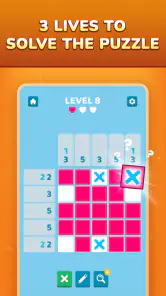
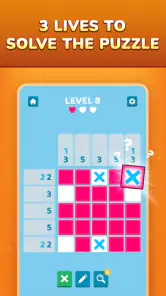
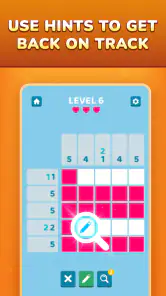
Anyone who has played a crossword, Sudoku, or picture-logic puzzle will recognize the general rhythm. Nonograms replace letters or numbers in cells with a visual grid and clue groups. A clue tells you how many consecutive filled squares belong in a row or column, while separate groups must have at least one empty square between them. The challenge is not speed; it is keeping track of what is certain, what is impossible, and what still needs more evidence.
That distinction matters during the first few puzzles. I initially wanted to fill squares based on a promising pattern, but Nonocross rewards restraint. A row with a single clue can sometimes be solved immediately, while a row with several possible placements may need information from crossing columns. The most satisfying moves are usually not guesses. They come from noticing that a square must be filled because every legal arrangement includes it, or that it must remain empty because filling it would break the clue sequence.
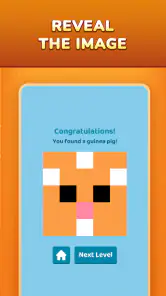
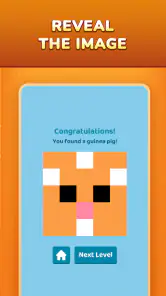
The pixel-art reward gives the logic a visible purpose. Instead of solving an abstract collection of cells, I can see a small image gradually become recognizable. That visual feedback helps maintain interest, especially when a puzzle reaches its slower middle stage and there are fewer obvious moves. It also gives beginners a gentle sense of progress: even a partly completed grid can hint at whether the emerging picture makes sense.
Still, this is not a game I would recommend to someone looking for fast action, elaborate controls, or a story-driven adventure. Its pleasure comes from careful deduction. If you enjoy calm concentration and the feeling of untangling a compact problem, the format fits well. If you prefer constant novelty or immediate rewards, the deliberate pace may feel too restrained.
Starting without overthinking the rules
My advice for a first-time player is to treat the opening puzzle as a lesson in certainty rather than a test of speed. Look first for clues that leave very few possible arrangements. A single group that nearly spans a line is often more useful than a complicated clue with many placements. Mark the squares you know are empty as carefully as the squares you know are filled; those gaps separate groups and can unlock the next deduction.
There is a practical reason to work this way. A filled square gives information in both directions, but an empty square can be just as valuable because it prevents a group from extending too far. I found that progress became more consistent when I stopped asking, “What picture might this be?” and instead asked, “Which placement is legally forced by the clues?” The hidden image should confirm my reasoning, not replace it.
The game is also suitable for short breaks because a puzzle does not require the kind of preparation associated with a larger strategy game. I can open it, inspect the current grid, make a few reliable deductions, and stop. That makes it a reasonable companion for a commute or a quiet wait, provided the player is comfortable with a puzzle that may not deliver a complete solution in one sitting.
From installation to the first meaningful success
After installing Nonocross, I would begin with the smallest-looking or least intimidating puzzle rather than trying to solve the most visually interesting one first. The goal of the opening session should be to understand how the clues interact with the grid. Read the row clues from left to right, then compare them with the column clues from top to bottom. You are looking for overlaps between possible placements, not trying to draw the final picture immediately.
A useful first move is to identify a line where the clue arrangement forces at least one cell. For example, if a single group is large enough that every possible placement covers the same central area, those shared cells are safe fills. If the clue is short and there is plenty of space, there may be no immediate fill; in that case, do not invent one. Move to a more constrained line and return after the crossing information changes.
Once a few cells are settled, use them to narrow the perpendicular clues. This is where the first real success usually happens. A row that looked ambiguous can become obvious after one column confirms an empty space or a filled square. I consider that first chain of deductions more important than simply completing a picture, because it teaches the transferable skill that makes later puzzles manageable.
New players often wonder whether they need to know pixel art or recognize the image in advance. They do not. The picture is a result of the logic, not a requirement for solving it. In fact, relying on a guessed image can lead to mistakes. A vague shape may suggest an attractive but incorrect pattern, while the numerical clues provide the dependable route.
Another question is whether the game is appropriate for children. Its Everyone content rating makes it broadly accessible, and the core activity is quiet visual reasoning rather than mature subject matter. I would still expect younger players to need help understanding the separation rule between clue groups. Once that idea is clear, the grid offers useful practice in patience and sequential thinking without requiring advanced vocabulary.
How I avoid turning a puzzle into a guessing game
The biggest improvement in my own play came from separating confirmed information from assumptions. I treat a filled cell as confirmed only when the clues support it, and I use empty marks to preserve the boundaries between groups. When I reach a point where two arrangements seem possible, I leave the uncertainty alone and search elsewhere. A later crossing clue often resolves it naturally.
This approach is slower for the first few minutes but faster overall. Guessing can produce a pleasing burst of progress, yet one wrong square may distort several lines and force a frustrating backtrack. On a compact puzzle, that mistake can affect a surprisingly large portion of the grid. The safer workflow is to solve the most constrained lines first, record every definite gap, and repeatedly scan for newly forced cells.
I also recommend checking the entire line after each important deduction. If a row contains a group that is already complete, mark the cells immediately beside it as empty when the clue structure requires separation. That small habit prevents accidental overfilling and often exposes a second group. It is a more reliable tactic than staring at the emerging picture and hoping the next shape becomes obvious.
For a realistic everyday session, imagine having ten quiet minutes before an appointment. I would open a puzzle, solve only the lines with clear overlaps, and stop once the grid had gained enough information to make the next session easy to resume. This is a better use of the game than forcing completion while distracted. Nonograms punish divided attention more than they punish a lack of speed.
Where first-time players commonly get confused
The most common misunderstanding is reading a clue number as the total number of filled cells anywhere in the line. It describes a consecutive group, and multiple numbers describe multiple groups in their listed order. Those groups need separation, so a line with two groups cannot place them directly against each other as one uninterrupted block. Keeping that rule visible in your mind prevents many early errors.
A second source of confusion is assuming that every empty square must be identified before any progress can continue. It is helpful to mark definite gaps, but you do not need to resolve the entire line at once. Often one filled cell from a crossing column is enough to restrict a group. Work with the information you have and allow the grid to provide the rest.
Players may also ask whether the hidden picture can be used as a correction tool. I would use it only as a broad progress check. If the image looks strange, that may indicate an error, but it does not tell you which cell is wrong. Returning to the clue logic is safer than editing squares to make the picture look more familiar. Pixel art can be suggestive, especially when incomplete, so it should remain secondary evidence.
Another practical issue is difficulty tolerance. A puzzle may feel easy at the start and then slow down when the obvious lines are exhausted. That is normal for this type of game, not necessarily a sign that you have missed a special move. When progress stops, scan for lines with the fewest possible placements, inspect completed groups for required gaps, and revisit columns after every new mark. If nothing is forced, pause rather than gamble.
The interface experience is best approached with the same care. On a small phone screen, dense grids can make precision more demanding than the logic itself. I would zoom my attention onto one line at a time and avoid rapid tapping. A deliberate rhythm reduces accidental marks and makes it easier to remember why a square was filled. This matters especially on a device used one-handed or while moving, where precision is naturally less comfortable.
There is also a difference between solving for relaxation and solving for completion. If I am tired, I choose the former: a few logical steps are enough. If I want a stronger mental workout, I continue through the point where the picture stops helping and rely entirely on the clues. Recognizing which mood I am in prevents the game from becoming a chore.
Three habits that make the puzzle loop more rewarding
- Start with forced overlaps: inspect long groups and tightly constrained lines before spending time on open-ended clues.
- Use empty cells as structure: gaps are not leftover space; they define where one clue group ends and another can begin.
- Keep the image in its proper role: enjoy the reveal, but let the numbers decide when the picture and your guess disagree.
These habits are more valuable than trying to memorize a particular solving trick. Nonocross works best when each mark has a reason behind it. The game becomes less about tapping a pattern and more about building a chain of small proofs across the grid.
How it compares with familiar puzzle alternatives
Compared with Sudoku, Nonocross feels more visual and more incremental. Sudoku asks you to place symbols while respecting relationships across rows, columns, and regions. Here, the reward is a picture, and the key tension comes from arranging consecutive groups with required gaps. I prefer Nonocross when I want a visible sense of construction; I prefer Sudoku when I want a denser number-placement challenge with less dependence on an emerging image.
Crossword puzzles offer language and clue interpretation, while this game removes vocabulary from the equation. That makes it a better choice for someone who wants a puzzle that can be understood through patterns and counts alone. On the other hand, crossword fans who enjoy wordplay, cultural references, or expressive clues may find the numerical structure less varied.
Compared with a simple matching game, Nonocross asks for more patience and gives less immediate feedback. Matching games are easier to play while distracted because a move can be evaluated instantly. Nonograms demand that I hold several conditions in mind and sometimes wait for a later intersection to resolve an earlier uncertainty. The trade-off is a more satisfying sense of earned progress when the grid finally opens up.
The free price lowers the barrier to trying it, which is useful for people who are unsure whether Nonograms suit them. The game has reached over one hundred thousand installs, and its average rating is around 3.2 from roughly four hundred ratings, with close to one hundred written reviews. I read that combination as a reason to try it personally rather than assume it will satisfy everyone. The format is appealing, but individual tolerance for interface friction, puzzle pacing, and repetition can vary considerably.
Someone looking for a broad puzzle collection may be better served by an app that combines several formats. Nonocross is more focused: its identity comes from one specific logic system and the pixel-art payoff. That focus is a strength if you want to improve at Nonograms, but it is a limitation if you need word puzzles, number puzzles, and arcade diversions in the same place.
Who should install it and who should skip it
I would recommend Nonocross to first-time Nonogram players who want a gentle entry into picture logic, as well as experienced solvers who enjoy completing pixel-art grids in short sessions. It is especially suitable for people who like calm games with a clear rule set and a reward that grows visibly from their own deductions. The Everyone rating also makes it a reasonable shared puzzle for family members who want to compare solving approaches.
I would be more cautious about recommending it to players who need constant stimulation, competitive rankings, or a strong narrative reason to continue. The verified store information identifies it as a puzzle game, and that is exactly how I experienced it: the grid is the event. There is no need to expect it to behave like a fast arcade title or a story-heavy mobile game.
It may also be the wrong choice if you dislike making tentative progress. Some Nonogram lines remain ambiguous until several crossings are solved, and that waiting period is part of the design of the puzzle format. If you find yourself wanting every move to produce an immediate reward, a simpler casual game may feel more comfortable.
Before installing, I would check that the device meets the Android 7.0 minimum and make sure the player actually enjoys logic puzzles rather than choosing it only because the pixel-art images look appealing. The artwork is a pleasant destination, but the journey is made of deductions, empty spaces, and occasional stretches where patience matters more than intuition.
My next-step advice after the first puzzle
After completing the first meaningful section, I would not immediately chase harder-looking grids. Instead, replay the solving process mentally: which clue gave you the first certain move, which empty mark separated groups, and which crossing finally resolved the difficult line? Understanding that chain makes the next puzzle less intimidating and helps you notice the same structures sooner.
For a productive routine, solve one or two constrained lines, scan their crossings, and then reassess the whole grid. Avoid staying locked on a single row just because it looks close to completion. Nonocross rewards switching between rows and columns; information gained in one direction frequently unlocks the other. If you are stuck, change orientation before changing your answer.
I would also keep expectations realistic about the game’s audience and scale. It is free, accessible on older Android versions, and focused on a compact puzzle concept rather than a large ecosystem. That makes it easy to sample, but it also means the right reason to keep it installed is that you enjoy the solving loop itself. The pixel-art reveal should enhance that enjoyment, not carry the entire experience.
My final view is positive but specific: Nonocross is worth trying if you want a focused Nonogram game that turns careful clue reading into a small visual reward. I like that the first success can come from a clear, teachable deduction rather than lucky tapping. Its main weakness is equally clear: players who want variety, speed, or a more forgiving style of play may outgrow the format quickly. For everyone else, the best way to judge it is to begin slowly, mark only what the clues justify, and let the hidden picture appear as a consequence of good reasoning.
Pros
- Relaxing nonogram puzzles suitable for short or extended play sessions.
- Clear grid design makes clues easy to follow on smaller phone screens.
- Large puzzle selection provides plenty of content for regular players.
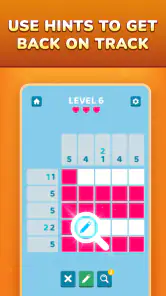
- Helpful hints can assist when a puzzle becomes difficult.
- Works well for players who enjoy logic games without time pressure.
Cons
- Some puzzles may feel repetitive after extended play.
- Hints or extra features may be limited by ads or in-app purchases.
- Larger grids can be challenging to complete accurately on a phone.
- Difficulty progression may not feel consistent across all puzzle packs.
- Offline availability may vary depending on the puzzle or app version.
- Category
- Puzzle
- Version
- 1.1.0