Just 2 Words Plus
- 916.00
- 4.6
- Installs
- 10.00K
- Price
- Free
Screenshots
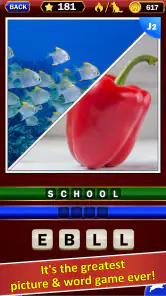
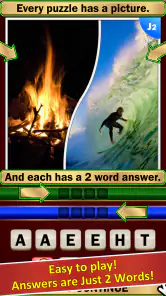
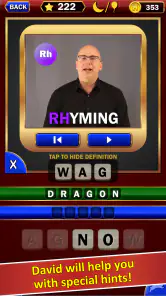
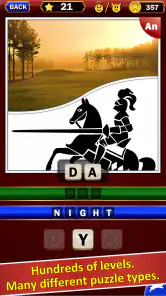
Analysis by Reviewed
I like word games that explain themselves in seconds, then give me a reason to try one more puzzle. Just 2 Words Plus takes that approach literally: each challenge asks me to solve a word puzzle with an answer made from only two words. That narrow rule makes the game easy to pick up, but it also creates enough room for misdirection, association, and those satisfying moments when two separate clues suddenly connect.
Developed by Just 2 Fun, this free word game is aimed at casual players rather than people looking for a long story, a competitive ladder, or a complicated collection of systems. I can open it when I have a few spare minutes, work through a puzzle at my own pace, and stop without feeling that I have abandoned a larger campaign. Its Everyone age rating also makes the tone approachable for families and younger players who enjoy language-based challenges.
There is a small but important distinction here. The game is not simply testing whether I know obscure vocabulary. Its appeal comes from interpreting clues, trying combinations, and deciding whether the most obvious answer is actually the intended one. That makes it a useful choice for people who enjoy lateral thinking, while anyone wanting a conventional crossword grid or a daily five-letter guessing routine may find the format less familiar.
How the two-word loop works in practice
The first action is quick, but the thinking is not always simple
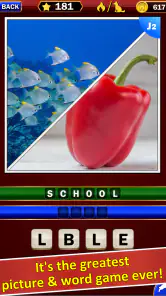
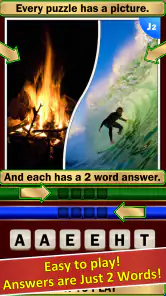
The opening move is straightforward: I read the puzzle, look for the relationship between its clues, and enter a two-word answer. The restriction gives every attempt a clear shape. I am not searching through a huge phrase or writing a sentence; I am trying to identify a compact pair that makes the clues work together.
That simplicity is one of the strongest design choices. A new player does not need a tutorial explaining a large set of buttons or resources. The central question is visible almost immediately: what two words belong here? Because the answer space is limited, I can concentrate on meaning instead of interface management.
In my experience, the best way to approach a difficult puzzle is to resist locking onto the first association. I read each clue separately, list a few possible meanings mentally, and then search for an overlap. A word may be used in an everyday sense, as part of a familiar expression, or in a way that only becomes clear when paired with the second word. This makes the game feel more like connecting ideas than recalling isolated definitions.
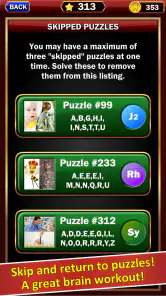
A practical everyday use case is a short break between tasks. I might start a puzzle while waiting for coffee, solve one quickly, and leave the phone alone if the next challenge needs more thought. The game suits that stop-and-start habit because the basic activity is self-contained. It does not demand that I prepare a board, remember a long chain of moves, or keep a separate notebook of progress.
The trade-off is that the compact answer rule can also make a puzzle feel opaque when my vocabulary or interpretation does not match the intended direction. If I prefer games that always provide a visible path from clue to answer, I may find this style occasionally abrupt. The challenge comes from ambiguity, and ambiguity is exciting when the connection clicks but frustrating when it does not.
Feedback gives each attempt a clear rhythm
The satisfying rhythm comes from making a guess, seeing whether the pair fits, and immediately deciding what to do next. A correct answer gives me the confirmation I need to continue. A wrong direction sends me back to the clues rather than burying me under a complicated penalty system. That keeps the focus on interpretation and makes each failed attempt useful.
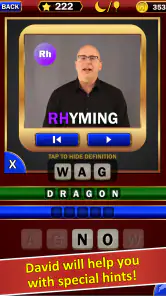
I find it helpful to treat an incorrect answer as information about my reading, not as a reason to throw random words at the puzzle. If one word seems certain, I hold it in place and reconsider the partner. If both words feel plausible but disconnected, I look for a phrase, category, or shared context that could unite them. This approach is slower than guessing, but it produces more genuine “aha” moments.
The feedback loop also prevents the game from becoming a passive vocabulary quiz. I am not just checking whether I recognize a word. I am testing a theory about how two ideas relate. That distinction gives the short format more depth than the store summary might suggest, especially for players who enjoy wordplay but do not necessarily want a formal crossword experience.
Still, the game’s appeal depends heavily on how comfortable I am with its clue style. Players who enjoy flexible meanings and indirect connections will probably settle into the rhythm quickly. Players who prefer strict definitions may want a more structured alternative, such as a traditional crossword or a word-search game where the target is visually constrained. Neither preference is wrong; they simply reward different kinds of attention.
Another useful habit is to say possible answers aloud, even quietly. Two words that look unrelated on the screen can sound like a familiar phrase when spoken. I also try reversing their order, because the natural pairing may not appear in the sequence I first imagine. These are small techniques, but they reduce the temptation to abandon a puzzle too early.
The reward is the connection, not a complicated economy
The main reward is the moment of recognition. After working through several possibilities, I find the pair that makes the clues fall into place, and the answer feels earned because I arrived there through interpretation rather than luck. That emotional payoff is the reason another session begins: I want to experience that clean resolution again.
For me, this is more important than collecting elaborate upgrades or managing a large inventory. The game’s pleasure is concentrated in the puzzle itself. It works well for someone who wants a mental reset that still feels active, especially after a day of routine tasks. Solving a compact language problem gives my attention something specific to do without requiring a long commitment.
The free entry point helps with that casual role. I can try the game without paying upfront, while optional in-app purchases range from $0.99 to $19.99 per item. That makes it sensible to sample the core experience first and decide later whether any purchase is worthwhile for my own habits. I would not recommend spending simply because a difficult puzzle creates impatience; the strongest reason to pay should be that the game has already become a regular part of my routine.
There is also a social use for the format. I can show a puzzle to a friend or family member and compare our first interpretations without needing to explain a complicated ruleset. One person may focus on a literal meaning while another notices an idiom or cultural association. That makes the two-word limit a conversation starter, not just a restriction.
On the other hand, players seeking a strong sense of progression may find the reward structure modest. The satisfaction is immediate and intellectual rather than tied to a large narrative payoff. If I want character development, collectible content, or a competitive ranking to keep me engaged, this game is probably not the right destination. Its reward is deliberately small-scale: understand the clue, solve the pair, and enjoy the next challenge.
Resetting after a puzzle keeps the sessions light
Once I finish a puzzle, the mental slate is clean enough to begin another. I do not need to carry a complicated strategy forward. The next challenge asks for a fresh interpretation, which is why the game works particularly well in short sessions. I can play one puzzle, pause, and return later without needing to reconstruct a battle plan or remember a chain of actions.
This reset is also what keeps a mistake from becoming too costly. A difficult clue may slow me down, but it does not define the whole experience. After solving it, I get another opportunity to approach language from a different angle. That change of subject helps the app avoid the fatigue that can come from staring at one large puzzle for too long.
I would use it differently depending on my energy level. When I am tired, I would attempt a few puzzles and stop as soon as the clues begin to feel like work. When I am alert, I might use a harder puzzle as a warm-up before reading or studying. The game is flexible in that respect: it can be a tiny distraction or a more deliberate exercise in association.
The reset is not perfect for everyone. Some players enjoy a persistent board where every move contributes to a larger objective. Here, the appeal is closer to a sequence of individual brainteasers. If I need a strong long-term goal to justify continuing, I may lose interest after the novelty of the answer format fades.
My advice is to avoid treating every puzzle as a test of intelligence. The clues may depend on familiarity with particular expressions or on seeing a connection from the intended angle. If I am stuck, I take a short break rather than forcing a string of guesses. Returning with a fresh perspective often works better than staring at the same two words until the game stops feeling enjoyable.
Who will get the most from this word game?
This is a good fit for casual word-game fans, people who enjoy riddles, and anyone who likes the satisfaction of making two ideas connect. It is also suitable for players who want a low-pressure activity that can fit around ordinary routines. The Everyone rating supports its broad accessibility, although individual enjoyment will still depend on vocabulary, language familiarity, and tolerance for indirect clues.
I would especially recommend it to someone who has tried crosswords but wants shorter, less grid-focused challenges. It may also appeal to fans of phrase puzzles who enjoy guessing the intended relationship rather than filling in letters one square at a time. The two-word rule gives the game a recognizable identity instead of making it feel like a generic word list.
I would be more cautious about recommending it to players who want a fully guided learning tool. The game can stimulate thinking, but I would not treat it as a structured language course. It is also not my first choice for someone who dislikes ambiguity, wants a fast arcade pace, or expects every session to unlock a visible new feature. A spelling game, crossword app, or competitive word title may serve those needs better.
Parents looking for something simple to share with a child should still play alongside them at first. The age rating is broad, but the real question is whether the child enjoys interpreting clues and discussing possible meanings. The game can encourage that conversation, yet it may be less rewarding for a young player who is still building vocabulary and finds unfamiliar word relationships discouraging.
Where it stands beside familiar alternatives
Compared with a crossword, this game removes the grid and the gradual accumulation of intersecting letters. That makes it easier to start and quicker to finish, but it also means I get fewer structural hints when stuck. A crossword gives me crossing answers as support; this format asks me to trust my interpretation of the clue relationship.
Compared with a word-search game, it is less about scanning and more about reasoning. There is no visual field doing part of the work for me. Compared with a daily guessing game built around a fixed word length, it offers a different kind of uncertainty: I am solving a connection between two words rather than narrowing down individual letters. That can feel more expressive, though also less mechanically predictable.
Those comparisons clarify the best reason to choose it. I would open this game when I want language to behave like a riddle, not when I want a timed score chase or a systematic spelling exercise. Its strength is the compact interpretive loop, and its weakness is that the same openness can make some puzzles feel less immediately fair than tightly defined alternatives.
Practical details before installing
The game is free to install and currently sits at version 2.70. It requires Android 6.0 or later, so it remains accessible on a range of older Android devices that cannot run newer software. That is useful for anyone keeping a secondary phone or avoiding an upgrade solely for a casual game.
Its average rating is 4.6 from around 2.4 thousand ratings, and the app has passed 10 thousand installs. Those figures suggest a small but clearly interested audience rather than a massive mainstream game community. I would read that as a reason to judge it by the quality of its core puzzle loop, not by expectations of a huge social ecosystem.
The developer is Just 2 Fun, and the current release keeps the product focused on its central word-game identity. Since optional purchases are present, I would check the purchase prompt carefully before confirming anything, particularly if a child is using the device. The sensible approach is to play enough free content to decide whether the clue style suits you before considering extras.
One final practical point is session length. This is not a game I would choose when I want a guaranteed five-minute result, because a clever puzzle can hold my attention longer than expected. At the same time, it does not punish me for stopping after a single answer. That balance makes it easy to fit into a commute, a waiting room, or a quiet moment before bed, provided I am comfortable with a challenge that may occasionally resist an immediate solution.
My verdict on the complete action-to-reset cycle
The loop is clean: I read a clue, propose two words, receive an immediate sense of whether the connection works, enjoy the answer when the idea clicks, and then reset for a fresh puzzle. Nothing in that sequence feels overloaded. The reason to begin again is not a forced reward track; it is the desire to solve another compact mystery.
That makes Just 2 Words Plus a worthwhile recommendation for players who like wordplay with room for interpretation. I appreciate that it can be played casually, discussed with another person, and approached with simple techniques such as testing alternate meanings or reversing the word order. Those details give the format more staying power than its tiny answer length might suggest.
My reservations are equally clear. The game will not satisfy everyone who wants a strong narrative, deep progression, competitive pressure, or perfectly literal clues. Some puzzles may ask me to make a mental jump that I find rewarding one day and irritating the next. The optional purchase range also means I would keep my spending deliberate rather than treating every obstacle as a prompt to buy something.
Overall, I see it as a focused, low-pressure word game with a memorable central rule. If your ideal mobile session is a sequence of small “I see it now” moments, this deserves a place on your phone. If you need a larger game world or a tightly structured vocabulary workout, choose a different category. For me, the best part is the reset: after solving one pair, I am not chasing a complicated system—I am simply curious about what the next two words will be.
Pros
- Simple rules make it easy to start playing immediately.
- Short rounds work well for quick sessions or casual play.
- Word challenges help exercise vocabulary and creative thinking.
- Suitable for playing alone or competing with friends.
- Clean interface keeps the focus on solving each puzzle.
Cons
- Some puzzles may feel subjective because multiple answers can fit.
- Difficulty can vary noticeably from one challenge to the next.
- Players wanting a large multiplayer community may find it limited.
- Repeated play may become predictable once familiar word patterns appear.
- Extra content or features may depend on in-app purchases.
- Category
- Word
- Version
- 2.70