Imposter : Word Party Game
- 45.00
- 4.6
- Installs
- 50.00K
- Price
- Free

Screenshots





Analysis by Reviewed
I like party games that can be explained before anyone loses interest, and Imposter: Word Party Game aims squarely at that moment. It is a free role-playing game from Codeva built around a simple social challenge: one person is out of the loop, while everyone else tries to identify that player without making the answer too obvious. The appeal is not deep character progression or a long campaign. It is the tension created by a roomful of people trying to sound convincing at the same time.
After spending time with it, I see it as a useful option for casual gatherings, family play, and those awkward few minutes when a group wants an activity but nobody wants to learn complicated rules. The game is rated for Everyone, which fits its approachable presentation. It has also built a 4.6 average from around 700 ratings and passed 50,000 installs, so it is clearly finding the audience a small offline party game needs.
How a normal round works in practice
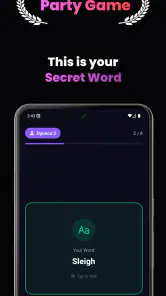
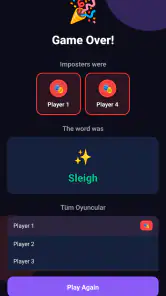
The basic workflow is refreshingly short. You gather the players, pass the device around, let each person check their role privately, and then begin discussing the shared word or idea. Most players receive the information they need, while the imposter must participate without knowing exactly what everyone else knows. The group then questions one another, compares answers, and votes on who seems suspicious.
That private-device handoff is the part that deserves more attention than it usually gets. I recommend choosing one fixed direction for passing the phone and asking every player to hold it close to the same angle. This sounds minor, but it prevents accidental glimpses and keeps the round fair. A quick “read, confirm, pass” habit also works better than letting people linger on the screen while the rest of the group watches.
The game is strongest when players treat clues as conversation rather than a race to reveal the answer. If everyone gives the most obvious description immediately, the imposter can often copy the pattern. More careful players offer clues that are meaningful to people who know the word but still leave room for interpretation. That creates the useful middle ground between silence and giving away the solution.
A realistic example would be a group waiting for food at a shared table. One person can start a round without preparing cards, paper, or a moderator. Each player checks the phone, answers a question or offers a clue, and listens for the person whose wording feels too broad or too carefully borrowed. When the vote arrives, the discussion itself becomes the entertainment, even if the group guesses incorrectly.
I would not approach this as a solo role-playing experience. The role-playing label describes the social act of pretending, bluffing, and reading other people, not a world to explore or a character to develop. If you want quests, equipment, story choices, or individual progression, this is the wrong kind of game. Its content comes from the people around the phone.
The best group size is the one that can hear everyone
In my experience, the game works better when every participant has enough time to speak and react. With too few people, the imposter has less room to hide and the deduction can feel abrupt. With a very large group, quieter players may disappear behind the most confident voices. The practical solution is not necessarily to exclude people; it is to keep turns orderly and invite short contributions from anyone who has not spoken.
This is also where the game differs from a typical online social deduction title. There is no need to coordinate a lobby or depend on strangers behaving well. You already know the people at the table, and the fun comes from noticing how a friend answers an ordinary question under unusual pressure. On the other hand, an online game may offer more variety, persistent progression, or a stronger sense of scale. Imposter is better when immediacy matters more than content volume.
Settings and preparation that make rounds smoother
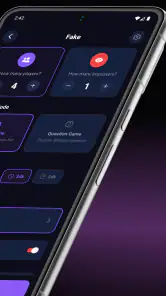
Before starting, I would spend a moment checking the available setup options rather than tapping straight into the first round. In a party game, a small configuration mistake can affect the whole mood. Confirm who is playing, make sure the device is ready to be shared, and choose a pace that gives everyone time to understand the prompt. The most experienced players often look for settings that reduce waiting and keep the group focused, but they should not make the opening round unnecessarily difficult.
Because the game is designed for offline party play, the phone itself becomes part of the table etiquette. Lowering distractions around the device matters as much as the in-game choices. I prefer placing it face down between rounds and picking it up only when the next private check begins. That prevents people from studying the screen when they should be debating and makes the handoff feel deliberate.
There is a useful trade-off between secrecy and speed. A quick pass keeps energy high, but rushing can cause someone to miss their role or accidentally reveal it through confusion. A slower first round is often worthwhile, especially with children or new players. Once everyone understands the rhythm, the group can shorten the handoff without sacrificing fairness.
The age rating of Everyone makes it a natural candidate for mixed-age gatherings, but the social rules still come from the adults or older players present. I would avoid mocking someone for a weak clue or treating a wrong vote as evidence that they are bad at the game. The app supplies the structure; the group decides whether that structure feels welcoming. For younger players, simple turn-taking and clear explanations make a bigger difference than any clever strategy.
Repeatable habits that improve the faster rounds
Experienced players can make the game feel much sharper by using repeatable habits instead of trying to invent a brilliant bluff every time. My first rule is to answer in a way that proves recognition without naming the central idea. A clue that is too broad sounds suspicious, while a clue that is too precise gives the imposter a free answer. The strongest contribution usually has a second possible interpretation.
My second rule is to watch changes in confidence, not just individual words. Someone who begins with a clear answer and then suddenly copies the group may be reacting to information they did not have at the start. Conversely, a nervous player may simply be uncomfortable speaking publicly. That is why I would never vote based on hesitation alone. Look for a pattern across the whole discussion.
A third useful habit is to remember the order of clues. If the first few answers establish a general direction, later speakers have more information to work with. Calling on people in a consistent order makes that effect easier to notice. It also prevents the loudest player from controlling the entire round. This is a small table rule, but it gives quieter participants a fairer chance to show whether their knowledge is genuine.
When I am the imposter, I try not to overcorrect. Asking for clarification can buy time, but asking too many questions advertises uncertainty. I would rather offer a clue that fits several possible interpretations and then build on the language other players use. The danger is becoming so cautious that the answer sounds empty. A believable bluff still needs a point of view.
When I am a regular player, I avoid announcing suspicion too early. The first accusation can shape the entire table, and everyone may start judging later answers through that lens. Listening through another turn often reveals whether the concern was real or merely a reaction to an unusual phrase. This makes the game more interesting and reduces the chance that one confident person decides the vote before the evidence develops.
Where the design is convenient, and where it creates friction
The free entry point is a genuine advantage. A group can try the game without committing money first, which is exactly what a casual party title needs. At the same time, in-app purchases range from $4.99 to $29.99 per item. That does not automatically make the game poor value, but it is something I would keep in mind before treating it as a completely cost-free experience. Families and hosts should review purchase controls on the device if children may be using it.
The current version is 1.9, and the game supports devices running Android 7.0 or later. That gives it a relatively broad reach for people using older Android phones, although the actual comfort of play still depends on screen size, battery, and how easily the device can be passed around. A small screen is workable, but it makes private reading and shared viewing less comfortable than on a larger phone.
The offline focus is both its identity and its main limitation. It is excellent when a group is physically together and wants something immediate. It is not a replacement for a multiplayer game that friends can join from different homes. If your regular group is separated by distance, a network-based alternative will serve you better. Here, the social connection comes from eye contact, timing, and the awkward pause after a suspicious answer.
Another limitation is replay quality. The rules are easy to revisit, but the freshness depends heavily on the words, prompts, and the players’ willingness to vary their clues. A group that always gives the same style of answer may solve the imposter quickly or fall into predictable arguments. I recommend changing who speaks first, rotating the person who manages the phone, and occasionally agreeing to shorter answers. Those habits create variety without pretending the game has a deeper progression system.
There is also a fairness issue that is specific to shared-device play: information can leak through reactions. A player may smile at a word, pause before handing over the phone, or look toward a particular person after reading the screen. Good groups learn to treat those reactions as part of the bluffing challenge, but beginners may find them frustrating. Keeping faces neutral and using the same handoff routine for every player makes the result feel less dependent on accidental tells.
Who should choose it over the usual alternatives?
I would recommend this game to someone who wants a lightweight offline party game that starts quickly and creates conversation without requiring a dedicated host. It is especially suitable for family visits, small social gatherings, travel breaks, and groups that enjoy reading personalities more than mastering complicated rules. The Everyone rating also makes it easier to consider for mixed-age play, provided the group keeps the tone respectful.
I would steer competitive players toward a more elaborate social deduction game if they need detailed roles, long-term unlocks, structured rounds, or online matchmaking. Those alternatives can provide more strategic depth and more content to study. Imposter is intentionally closer to a verbal table game: the app handles the private information, while the players supply the drama.
It is also not ideal for a group that dislikes speaking in front of others. Even a quiet version requires each person to contribute something and defend their interpretation. A card-based game with visible actions may be a better choice for people who prefer planning over conversation. Likewise, if the group is likely to argue personally about every vote, the app cannot solve that social problem. Its premise works only when suspicion remains playful.
One of the less obvious strengths is how little preparation it demands. A normal deck-based party game may require sorting cards, explaining what each card means, and finding somewhere to store the set afterward. Here, the phone can handle the private role distribution, leaving the group to concentrate on the discussion. That convenience is more valuable than it sounds when the activity is spontaneous rather than planned.
My verdict after learning its rhythm
Imposter: Word Party Game succeeds because it understands that a party game should get out of the way. The app provides the hidden-role setup, but the memorable moments come from a friend giving an answer that is technically reasonable, a player trying too hard to appear relaxed, or the table realizing that its first accusation was completely wrong.
I would install it for gatherings where people are already in the same room and want a quick activity with room for bluffing. I would not choose it for solo play, remote groups, or anyone expecting a full role-playing adventure. The free download makes trying it easy, while the optional purchase range means I would still pay attention during installation and keep spending controls sensible.
My strongest recommendation is to establish a consistent handoff routine, rotate the speaking order, and give clues that are specific enough to show knowledge but open enough to preserve doubt. Those three habits do more to improve the experience than rushing through rounds. Once the group learns that balance, the game becomes a compact test of observation and improvisation rather than a simple guessing exercise.
For its intended setting, Codeva’s game is a practical and enjoyable choice. It does not need to compete with large online deduction games on their terms. Its value is that it turns one shared phone and a few willing players into an immediate social challenge. If that is the kind of evening you are planning, this is a recommendation I can make comfortably.
Pros
- Easy to learn
- making it suitable for casual players and mixed-age groups.
- Short rounds keep the game lively and work well for quick sessions.
- Encourages creativity
- deduction
- and careful observation of other players.
- Supports social interaction and can be entertaining during gatherings.
- Different word prompts help keep each round feeling fresh.
Cons
- The experience depends heavily on having enough active players.
- Repeated prompts may reduce replay value over time.
- Unbalanced player skill levels can make some rounds feel predictable.
- Ads or in-app purchases may interrupt play
- depending on the version.
- Players who dislike bluffing or being eliminated may find it frustrating.

- Category
- Role Playing
- Version
- 1.9