Gitar Band Hero
- 21.00
- 3.6
- Installs
- 1.00M
- Price
- Free

Screenshots
Analysis by Reviewed
I approached Gitar Band Hero as a quick music game rather than a serious guitar-learning tool, and that distinction matters from the first tap. Its central appeal is simple: it turns guitar-band play into a casual, game-like activity that can be picked up without preparation. I found it most enjoyable when I wanted a short distraction, not when I was looking for structured lessons, realistic instrument practice, or a large social experience.
Developed by Bz Dev, this free Android game sits in the music category and is suitable for Everyone. It has passed the one-million-install mark, which suggests that its straightforward idea has reached a wide casual audience. The current release is version 13.0.0, and it runs on devices using Android 7.1 or later. Those details make it accessible to people using older phones, although the experience still depends on how comfortably the game responds on a particular device.
Why the guitar-band game format works
The most important capability here is not musical accuracy; it is the conversion of guitar-band fantasy into an immediately playable mobile activity. Instead of asking me to learn chords, tune strings, or understand music theory, the game gives me a lightweight way to feel involved in a performance. That makes the app approachable for someone who likes the idea of rhythm games but does not want a demanding setup.
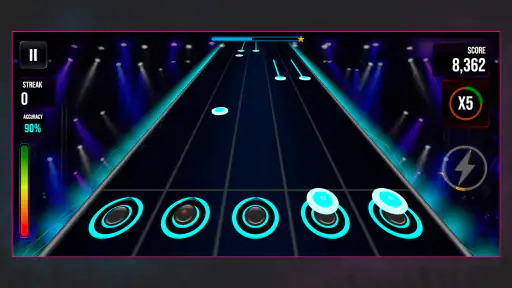
I think of it as a pocket version of the familiar guitar-game concept. The attraction comes from timing, attention, and the feeling of following a song-like flow. Even when the interaction is simplified, the format can create a small sense of momentum: I start casually, concentrate for a while, and then decide whether I want another attempt. That loop is more important here than any promise of becoming a better guitarist.
The key benefit is instant musical play, not authentic guitar training. If you keep that expectation in mind, the game makes more sense. Someone searching for finger exercises or a guided curriculum would be better served by a dedicated guitar-learning app. Someone who wants a quick band-themed diversion may find this much less intimidating than a full instrument simulator.
The store summary presents it as a free guitar band hero game, but my recommendation is based on how that idea fits into everyday use. It is a low-commitment option. You do not need to own a guitar, know how to read tabs, or reserve a long session. That is a real strength for younger players, music fans, and people who simply enjoy tapping along with a performance-style game.
What the central interaction changes
A guitar-focused music game gives the player a role that feels more active than simply listening. I am not treating it like a playlist or passive audio app; I am trying to keep up with the game’s musical action. That small responsibility changes the mood. A spare moment becomes a challenge, and a familiar rhythm-game structure gives the session a clear beginning and end.
At the same time, the simplified format removes much of what makes a real guitar difficult. There is no need to build calluses, coordinate complex chord shapes, or worry about whether an instrument is in tune. That is exactly why it is approachable, but it is also why progress inside the game should not be confused with progress on a physical guitar.
How I found the play experience in practice
My first sessions were easiest when I treated them as short bursts. I would open the game with no particular plan, try the guitar-band activity, and decide quickly whether I wanted to continue. This kind of design suits a phone better than a system that expects a quiet room and a long learning sequence. The game’s value is strongest when the barrier between opening it and playing is small.
For better results, I would begin with the phone held steadily rather than playing while walking or moving around. Timing-based interaction becomes less comfortable when the device shifts in the hand. I also found it useful to keep my attention on the active play area instead of trying to multitask. A short, focused attempt is more satisfying than repeatedly missing inputs while answering messages.
That may sound obvious, but it points to an important practical detail: the game is more sensitive to attention than its casual presentation suggests. A player can start it casually, yet the best moments still require a little concentration. If the screen is small or the device is older, holding the phone at a comfortable angle becomes even more important because crowded or hurried interaction can make the experience feel less precise.
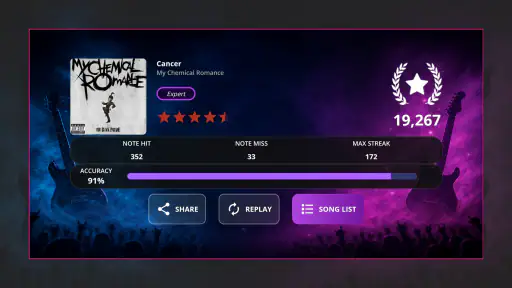
I would also recommend lowering expectations about what repetition accomplishes. Replaying a section can help me understand the timing pattern and improve my familiarity with the interaction, but it does not replace instrumental practice. The useful skill I develop is closer to visual timing and hand coordination. That makes repeated attempts worthwhile for score-chasing or personal improvement, but not as a substitute for learning guitar technique.
A practical routine for short sessions
My preferred routine is to play one attempt without worrying about performance, then use the next attempt to focus on a single issue. I might concentrate on reacting earlier, keeping my grip steady, or avoiding distractions. This is more effective than tapping repeatedly without noticing why a run went badly. The game works better when I give each attempt a small purpose.
Another helpful habit is to stop after a frustrating run instead of automatically buying another chance or continuing without focus. Because the game is free, it is easy to keep going, but free access does not mean every extra attempt is valuable. A brief pause often gives me a clearer sense of whether I am enjoying the challenge or merely repeating the same mistake.
The in-app purchase model is also worth keeping in mind. The game is free to start, while individual in-app items cost $0.99 each. I would treat those purchases as optional spending rather than part of the basic reason to install it. Before confirming anything, I would decide whether the item genuinely improves my session or simply encourages me to continue a run I would otherwise end.
The situation where it fits best
The strongest everyday scenario is a short break when I want something more engaging than scrolling but less demanding than a full game. Imagine waiting for an appointment or taking a quiet break at home. I can play a quick guitar-themed session, focus on the timing, and put the phone away without needing to remember a complicated story or manage a large collection of systems.
It can also work as a shared casual activity. A friend who does not play instruments can understand the basic appeal quickly, while someone who already enjoys music games may appreciate the familiar performance fantasy. I would not present it as a complete party game without testing every situation, but its simple premise makes it easier to show someone than a technical guitar simulator.
Parents may also find the Everyone rating reassuring for general audience suitability, although I would still pay attention to how a child interacts with optional purchases. The age classification describes the content category, not a guarantee that every child will enjoy the controls or understand spending prompts. For younger players, I would keep purchases protected and frame the game as entertainment rather than music education.
For a music fan who wants a mood boost, the guitar-band theme gives the session more personality than an abstract tapping exercise. The fantasy of joining a band is the hook. It does not need to reproduce a concert or a real instrument perfectly to provide that small emotional lift. In my experience, that is where the game feels most successful: it makes a few spare minutes feel like a tiny performance challenge.
When another type of app is the better choice
If your goal is to learn recognizable songs on a real guitar, I would choose a lesson app, tab resource, or structured practice course instead. Those alternatives can explain posture, chords, rhythm, and progression in ways this game is not designed to replace. A virtual guitar simulator may also be a better choice if you want to experiment with strings and chord shapes rather than follow a game-like timing task.
If you want a deeper rhythm-game experience with a large sense of progression, you may also find this title limited. Established console-style guitar games usually build their appeal around extensive song libraries, detailed difficulty systems, and more elaborate performance feedback. Gitar Band Hero is more appealing when convenience matters more than depth.
It is also not the right pick for someone who dislikes touch-screen timing. A physical controller can provide more tactile feedback, while a phone screen offers less separation between the input area and the rest of the device. If you regularly find mobile rhythm games imprecise or uncomfortable, the guitar theme alone may not overcome that limitation.
Tradeoffs that shaped my opinion
The rating sits at a 3.6 average from around ten thousand ratings, so I would describe the reception as mixed rather than universally enthusiastic. That feels consistent with the game’s position: the concept is easy to understand, but a simple idea can also leave experienced players wanting more refinement or depth.
The biggest tradeoff is accessibility versus authenticity. The easier it is to begin, the less it resembles the physical discipline of playing guitar. I see that as a fair design choice, but it should be stated clearly because the name and theme can create the wrong expectation. This is a music game with a guitar-band identity, not a portable instrument course.
Another tradeoff is convenience versus long-term commitment. A free game is easy to try, and the low entry barrier supports spontaneous sessions. However, casual access can make the experience feel disposable if you are searching for a rich progression system. I enjoyed it more when I accepted that a session could be brief and self-contained.
The optional purchase structure adds another decision point. At $0.99 per item, each purchase is small in isolation, but repeated spending can change the value calculation. My advice is to enjoy the free portion first and decide whether the core interaction itself is holding your attention. If it is not, an extra item is unlikely to transform the game into a different kind of experience.
Device age is another practical consideration. Android 7.1 support broadens compatibility, but older hardware can still affect touch response, loading, or general smoothness. I would close other demanding apps, keep the screen clean, and avoid judging the game after playing with the phone in an unstable position. Those simple steps may not solve every problem, but they make timing-based play fairer.
Small decisions that improve the experience
I would use headphones only if they make the timing easier for me and do not create a distraction. The point is not to make the session louder; it is to create a clearer connection between what I see and what I hear. In a noisy environment, sound can help maintain focus, while in a quiet room the phone speaker may be enough.
I would also avoid treating the average rating as a promise of quality for every player. A casual music-game audience and a guitarist looking for serious practice are judging different things. For the first group, quick access and a playful theme may carry a lot of weight. For the second, the lack of real technique may be a decisive weakness.
Finally, I would decide in advance whether I am playing for relaxation or improvement. Those are different goals. Relaxation means accepting imperfect runs and enjoying the band fantasy; improvement means studying my timing and making deliberate attempts. Mixing the two can make a light game feel more frustrating than it needs to be.
Who gets the most from this game
I would recommend it most to casual players who enjoy music-themed challenges, people curious about guitar games, and Android users who want a free title that can be tried without committing to a long campaign. Its Everyone rating also makes it a reasonable candidate for general household use, provided optional spending is handled sensibly.
It is especially suitable for someone who has always liked the idea of a guitar game but does not own an instrument. The app removes the cost and physical setup of a real guitar while preserving a small part of the performance fantasy. That does not make it a replacement for lessons, but it does make the first step less intimidating.
I would be more cautious recommending it to experienced musicians, competitive rhythm-game players, or anyone expecting a detailed catalog and sophisticated progression. Those users may quickly notice the gap between a compact mobile diversion and a full music-game platform. They might prefer a dedicated practice tool, a more advanced rhythm title, or a controller-based alternative.
The developer, Bz Dev, has kept the basic proposition clear enough that I never needed a long explanation before trying it. That clarity is valuable on mobile. Still, clarity alone cannot guarantee lasting interest, so I would approach the download as a low-risk experiment rather than a permanent replacement for other music apps.
After using it with those expectations, my view is positive but measured. Gitar Band Hero succeeds when I want a quick guitar-themed game that turns spare time into a focused musical challenge. It is free, broadly accessible on compatible Android devices, and easy to understand, but its simplicity limits how much it can offer dedicated players.
My final recommendation is to try it if you want casual band play, not guitar instruction. Give the core interaction a fair test before considering any $0.99 purchase, play in a stable position, and judge it by the quality of its short sessions rather than by the standards of a full console rhythm game. For the right player, Gitar Band Hero is a pleasant pocket diversion; for anyone seeking depth, realism, or structured learning, a different music app will be the wiser choice.
Pros
- Easy chord layouts help beginners start playing quickly.
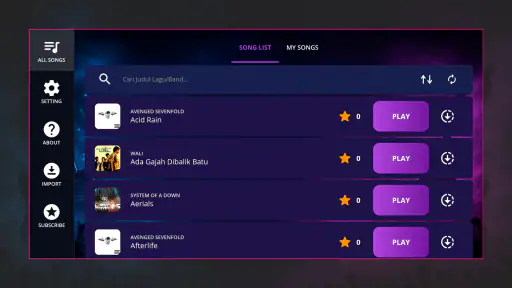
- Includes a broad selection of songs for different musical tastes.
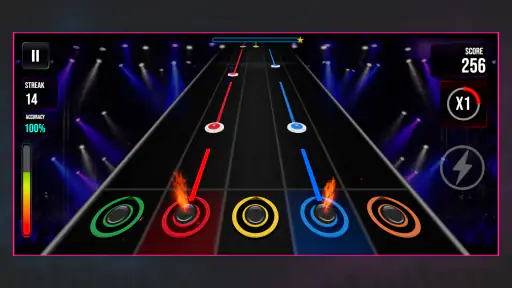
- Scrolling notes make practice sessions simple to follow.
- Works well for casual play and short practice sessions.
- Lightweight design should run smoothly on many Android devices.
Cons
- Song variety may feel limited without additional content.
- Some features can become repetitive after extended use.
- Timing feedback may not satisfy advanced players.
- Ads may interrupt the experience in the free version.
- Requires patience to improve accuracy on faster songs.

- Category
- Music
- Version
- 13.0.0