Cryptogram: Logic Puzzle Game
- 379.00
- 4.8
- Installs
- 100.00K
- Price
- Free
Screenshots


Analysis by Reviewed
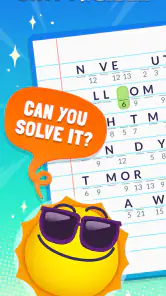
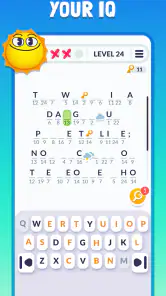
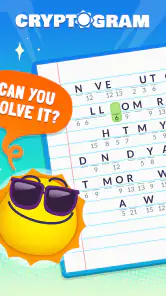
I enjoy word games most when they give me a small challenge I can pick up anywhere, but still reward careful thinking rather than random tapping. Cryptogram: Logic Puzzle Game fits that space well. It presents coded messages that I have to decode, turning familiar phrases into compact logic exercises. The basic idea is easy to understand, yet solving a difficult message can take enough attention to make it feel worthwhile.
Developed by Tripledot Studios Limited, this free word game is aimed at everyone and runs on Android devices using version 7.1 or later. It has already built a strong early audience, with a 4.8 average from around 6.9 thousand ratings and more than 100 thousand installs. Those figures suggest that the simple format is connecting with players, but they do not replace personal fit: this is much better for someone who likes language patterns than for a player looking for a story, action, or a large collection of game modes.
How I use Cryptogram from the first puzzle onward
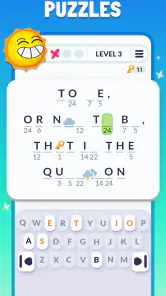
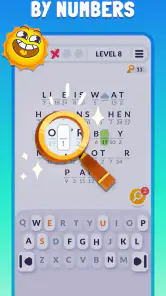
The most useful way to approach a cryptogram is to treat it as a process of elimination, not a guessing contest. Each symbol or substituted letter represents a normal letter, and the hidden sentence gradually becomes readable as I identify relationships between them. I start by scanning the whole message instead of attacking the first unknown word. Short words, repeated groups, and familiar endings often provide more information than a long word that looks interesting.
That opening scan is important because a cryptogram can make one stubborn word feel more important than it really is. I look for a repeated pattern first. If the same three-symbol sequence appears twice, I mentally mark it as a possible repeated word or word fragment. I also compare words with similar shapes. A four-letter group that appears with only one changed symbol may reveal a common letter substitution, even before I know what either word means.
Once I have a reasonable possibility, I test it across the entire message. This is where the game feels more like logic than vocabulary recall. A guess is useful only if it continues to make sense everywhere that symbol appears. If it creates several awkward fragments, I undo the assumption rather than forcing the sentence to fit. That habit saves time and prevents the familiar trap of building an entire solution on one attractive but incorrect letter.
The normal play rhythm works well for short breaks. I can begin a puzzle while waiting for an appointment, make progress in a few focused minutes, and return when I have a clearer idea. It is also suitable for a quieter evening when I want something more active than scrolling but less demanding than a full strategy game. The messages give the session a natural endpoint, which makes the experience feel more contained than an endless feed of quick puzzles.
One everyday use case has become especially practical for me. If I have a short break after lunch, I solve only the opening section of a message and leave the rest for later. When I return, the partial pattern is still visible in my memory, so I often notice a repeated word that I missed before. This makes the game work as a small mental reset without requiring a long uninterrupted session.
The clean concept also means the game is easy to explain to another person. Someone who has never played a cryptogram can understand the objective almost immediately. That accessibility is one reason the Everyone age rating feels appropriate. It can suit a casual family setting, although players will still differ sharply in patience and interest. A person who dislikes reading-based puzzles may find the experience slow, while a language enthusiast may appreciate exactly that deliberate pace.
Settings and habits that deserve attention
Before settling into a routine, I recommend checking the available settings rather than assuming the default arrangement is ideal. In a word puzzle, comfort has a direct effect on reasoning. Text size, sound behavior, notifications, and other available preferences can change how easy it is to concentrate, especially during repeated sessions. I do not treat settings as decoration; I use them to remove small distractions before they become reasons to quit.
Sound is worth considering first. If I am playing in a waiting room or during a quiet break, I prefer a setup that does not draw attention away from the message. At home, light feedback can make individual actions feel more responsive. The right choice depends on the environment, but the broader lesson is simple: a cryptogram rewards a calm screen and a calm mind, so I adjust the experience to match where I am playing.
I also pay attention to how I handle interruptions. If a puzzle is demanding, I avoid switching between several apps while holding a half-formed theory in my head. A quick note of the confirmed letters or a screenshot for personal reference can help me resume without starting over mentally. I would not use that as a substitute for solving, but it is useful when a real interruption arrives at the worst possible moment.
Players should also understand the difference between free access and optional spending. Cryptogram: Logic Puzzle Game is free to download and play, while its in-app purchases range from around one dollar to around one hundred dollars per item. That is a broad range, so I would review each purchase carefully rather than assuming every option has the same value. Anyone trying to keep a strict entertainment budget should disable impulsive buying or make a personal rule to play without spending.
The current version is 1.14.01, and the game was released on June 27, 2025. Those details matter when deciding whether an older Android device is suitable or when checking that the installed version matches the current store version. The minimum operating system is Android 7.1, which keeps the compatibility requirement relatively approachable for many devices, though performance and screen comfort can still vary between phones.
Patterns that make solving faster
The fastest improvement I have found is learning to separate certainty from possibility. I use a mental distinction between letters that are supported by several parts of the message and letters that merely make one word look familiar. Only the first group should guide the next move. This keeps the puzzle from turning into a chain of guesses that feels fast for a minute and then collapses.
Repeated words are the best starting point, but repeated endings are nearly as valuable. Common English endings can expose the final letters of several words at once, especially when the same symbol appears in the same position. I look at the shape of the word before trying to name it. A pattern such as a repeated middle symbol or a mirrored arrangement can narrow the possibilities without requiring me to know the quote immediately.
Short words deserve careful attention, but not blind confidence. A two-symbol word may suggest a common pronoun or conjunction, yet several options can look plausible at first. I test it against neighboring words and against every occurrence of both symbols. If the choice produces a useful letter in a longer repeated word, it becomes stronger. If it solves only one tiny fragment, I keep it provisional.
Another effective habit is to work from the most constrained area of the message. A long word with many unique symbols may offer very little information. By contrast, a repeated word, a near-match, or a cluster of familiar word shapes can produce several confirmed letters quickly. I therefore move around the message instead of reading strictly from left to right. The game rewards that flexible approach because the solution is distributed across the whole sentence.
I also try to read partial text aloud in my head. This sounds minor, but rhythm can reveal where a phrase is heading. A sequence of partly known words may suggest a natural grammatical structure, while an unnatural rhythm warns me that one earlier substitution is wrong. I do not let the apparent meaning override the code, but I use language sense as a second check after the letter relationships have done their work.
When I become stuck, I deliberately change the scale of the problem. Instead of staring at the entire sentence, I inspect one repeated symbol, then one word family, then the spaces between words. This prevents fatigue from disguising a simple clue. Another useful reset is to stop for a minute and return without trying to remember the exact guess I was defending. Fresh eyes often expose an assumption that felt invisible during the first attempt.
These techniques are more valuable than simply tapping quickly. The game does not become better because I rush through easy letters; it becomes better when each move reduces uncertainty. That is the main difference between a satisfying solve and a lucky completion. Experienced players can make their sessions faster without making them careless by building a repeatable order: scan, identify patterns, test globally, then commit.
Where the challenge becomes less forgiving
The same simplicity that makes the game approachable can also limit its appeal. The central activity is still decoding a hidden message, so players who want varied objectives may eventually feel that the format is narrow. Compared with crossword apps, it emphasizes substitution patterns more than clue solving. Compared with anagrams, it asks for less word construction and more structural deduction. Compared with a traditional word search, it is slower and more mentally deliberate.
That comparison helps clarify who should choose it. I would recommend it to someone who likes quotations, sentence patterns, and puzzles where one discovery can unlock several others. I would be less likely to recommend it to a player who wants competitive leaderboards, elaborate progression, or a visual world to explore. The store summary focuses on revealing a hidden message and training the brain with logic puzzles, and that accurately describes the central experience without suggesting a broader genre shift.
There is also a difference between being stuck productively and being stuck because the interface or puzzle design is not matching your expectations. If I have no confirmed letters after several minutes, I stop forcing a thematic guess and return to symbol frequency and repetition. If the message is readable but the substitutions still do not align, I revisit the earliest uncertain assumption. This method makes the difficulty feel fairer, even when the puzzle itself remains demanding.
Hints, if available in the version or mode I am using, should be treated as a last resort rather than the default way to progress. A useful personal rule is to spend several minutes proving that I have exhausted the visible patterns before accepting help. That preserves the logic element. Players who use assistance immediately may finish more quickly, but they lose the satisfying moment when a single confirmed letter unlocks the rest of the sentence.
There is a practical trade-off around purchases as well. Optional spending can make a puzzle routine more convenient, but the price range means the long-term cost deserves attention. I would begin with the free experience, decide whether the solving loop stays enjoyable after repeated sessions, and only then consider any optional item. This is especially important for families sharing a device, where an accidental purchase can change the value calculation.
Another limitation is that cryptograms depend heavily on reading comfort. Small screens, glare, or tired eyes can make a puzzle feel harder than its logic actually is. I get better results when I increase the distance from distractions, use a comfortable display setting, and avoid playing when I am too fatigued to compare symbols accurately. That is not a flaw unique to this game, but it matters more here than in a fast visual arcade title because every character carries information.
Who will enjoy it over time
For beginners, the best entry point is to solve without trying to identify the full message immediately. Focus on one repeated pattern and let the sentence emerge gradually. This approach reduces pressure and teaches the core relationship between symbols and letters. It also makes mistakes easier to diagnose because the player can see exactly where a theory stopped working.
For regular players, I suggest keeping a consistent solving order. I begin with repeated words, then short words, then matching word shapes, and finally the unusual fragments that remain. The order is not a rigid rule, but it prevents me from spending too much time on the most visually complicated part of the puzzle. Over time, the routine becomes almost automatic, leaving more attention for the genuinely ambiguous sections.
For experienced solvers, the challenge is less about learning another trick and more about controlling assumptions. I try to identify the point where a solution became certain and the point where I merely felt confident. That distinction is useful when reviewing a failed attempt. Usually the problem is not a lack of vocabulary; it is a letter assignment that was accepted before being tested against the whole message.
The game can also fit different social situations. I can solve alone for a quiet break, or show a friend the partially decoded sentence and ask what pattern they notice. That second option works because the rules are transparent and the visible progress gives another person an immediate starting point. Still, it is not a multiplayer party game in spirit; the enjoyment comes from shared observation rather than rapid competition.
People who need a completely offline, distraction-free tool should make their decision based on how the installed version behaves in their own routine. I would not assume that a free game is automatically free of interruptions or that every device presents it identically. My practical advice is to try several normal sessions before relying on it as a daily travel companion. If the interface remains comfortable and the purchase prompts do not bother you, it can become a dependable small puzzle habit.
The age rating of Everyone makes it broadly approachable, but age suitability and puzzle suitability are not the same thing. Younger players may enjoy the word patterns, while some messages may be easier for readers with a larger vocabulary. Adults who want to share it with children can turn the process into a language exercise by asking why a repeated pattern might represent a particular word. That adds conversation without changing the basic game.
My verdict after building a routine
Cryptogram: Logic Puzzle Game succeeds because it keeps its promise focused: decode a message by noticing relationships, testing ideas, and gradually turning symbols into language. I like that the main challenge comes from the puzzle itself rather than from complicated controls. The strongest sessions are quiet and methodical, with the satisfaction arriving when several previously disconnected clues suddenly fit together.
Its limitations are equally clear. It is not the right choice when I want a broad collection of word-game mechanics, a narrative campaign, or a high-energy competitive loop. The optional purchase range also means I would approach spending carefully, beginning with the free version and judging its lasting value through actual use. Players who need constant novelty may prefer a crossword collection or a larger puzzle suite.
For me, the deciding strength is how well it supports a repeatable habit. I can scan a message, mark patterns, test a theory across every occurrence, and stop at a natural point without needing a long setup. The best tip is to protect that process: keep guesses provisional, use repeated structures before obscure words, and change your focus when staring at one section stops producing information.
Tripledot Studios Limited has made a word game that is easy to begin but not empty once the novelty fades. With a 4.8 average and around 6.9 thousand ratings, it has attracted encouraging attention, while its 100 thousand-plus installs show that the format is finding players. I would recommend it to anyone who enjoys language-based logic and wants a compact challenge for ordinary breaks. I would skip it only if the idea of decoding sentences sounds more tiring than entertaining, because the game’s strength is also its boundary: it stays devoted to cryptograms rather than trying to be something else.
Pros
- Thousands of word puzzles provide plenty of content for regular play.
- Simple controls make it easy to start solving without a long tutorial.
- Progressive difficulty keeps beginner and experienced players engaged.
- Offline play is useful when you have limited or no internet access.
- Short puzzle sessions fit well into commutes
- breaks
- and casual play.
Cons
- Some puzzles may rely on cultural references unfamiliar to certain players.
- Hints can reduce the challenge and may be limited or tied to in-game rewards.
- Repeated quote styles can make the experience feel less varied over time.
- Mistakes and difficult clues may become frustrating without a clear learning system.
- Ads or optional purchases may interrupt the flow for players seeking uninterrupted play.
- Category
- Word
- Version
- 1.14.01