Cat Dash: Cute Cat Music Game
- 52.00
- 4.8
- Installs
- 500.00K
- Price
- Free

Screenshots







Analysis by Reviewed
I went into Cat Dash: Cute Cat Music Game expecting a lightweight arcade distraction, and that is exactly where it works best. It turns movement, bouncing, and music into a compact play loop that is easy to understand almost immediately. The appeal is not a complicated story or a deep collection of systems; it is the feeling of guiding a lively cat through a bright, beat-led challenge and trying to stay in control when the pace becomes less forgiving.
That focus gives the game a clear identity. It sits in the arcade category, but its personality comes from the meeting point between cute visual design and musical timing. The result feels more expressive than a plain obstacle game, while remaining simpler than a full rhythm title. I found it especially suitable for short sessions when I wanted something cheerful and reactive rather than a long campaign demanding sustained attention.
The game is free to start, with optional in-app purchases ranging from $0.99 to $99.99 per item. It is marked for Everyone, and the developer is AMANOTES PTE. LTD. On Android, it requires version 7.0 or later. The current release is 2.0.64, and the game has passed 500K installs, with a 4.8 average from around 1.2K ratings. Those figures suggest that its approachable presentation has found a receptive audience, although popularity alone does not make the controls right for every player.
Why the first few runs are so inviting
The opening impression is built around immediacy. I do not need to study a dense interface or learn a long list of commands before understanding the basic goal. The cat, the forward motion, the platforms, and the musical framing communicate the experience quickly. That matters in an arcade game because any delay between launching it and making the first meaningful move weakens the sense of fun.
What I like is how the cute theme softens the usual pressure of timing-based play. A missed jump or poorly judged bounce feels like a small setback rather than a dramatic failure. That makes the game approachable for younger players and for anyone who normally avoids demanding rhythm games. At the same time, the cheerful presentation should not be mistaken for a completely effortless experience. Once movement and timing begin to interact, attention becomes important.
It is also a good fit for the way people actually use mobile games. I can imagine opening it while waiting for an appointment, playing a few attempts during a short break, and closing it without feeling that I abandoned a complicated task. The compact structure makes each attempt feel self-contained. If you prefer games that let you make visible progress over long uninterrupted sessions, however, this may feel too focused on immediate play rather than extended exploration.
One practical tip is to treat the first attempts as calibration rather than performance tests. Instead of rushing to react to every visual movement, I pay attention to how the cat’s bounce lines up with the audio and how much time I have to prepare the next action. That approach is more useful than relying only on reflexes. It also reveals the central trade-off: the game looks relaxed, but its best moments come when I give the rhythm my full attention.
A visual world that speaks in simple shapes
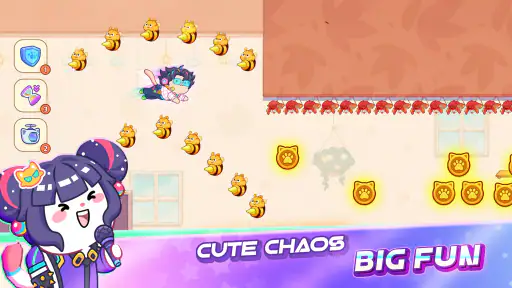
The art direction does a lot of work without needing a heavy narrative. The cat is the emotional anchor, while the bright setting and playful movement keep the screen readable. I never get the impression that decoration is competing with the path ahead. That clarity is valuable in a music platformer, where the player needs to notice both the character and the next timing opportunity.
The setting feels designed to support mood rather than explain a large fictional universe. There is a sense of playful motion and lightness, which matches the idea of a cat dashing through a musical challenge. Instead of asking me to absorb lore, the game establishes its tone through color, character animation, and the relationship between movement and sound. This is a sensible choice for an arcade title intended to be understood quickly.
The cat theme is more than a surface decoration because it changes how the action feels. A generic shape bouncing between platforms might communicate the same basic function, but a recognizable animal gives mistakes and successful passages more personality. I found myself reading the character’s movement as part of the performance, not merely as a marker showing where my input landed.
There is a useful design lesson here: visual charm works best when it reinforces play. The cute presentation encourages me to keep trying, but the screen still needs to guide my eyes toward the next decision. If you are looking for a game with detailed world-building, character dialogue, or a large setting to explore, this is not the right kind of experience. Its world is deliberately compact and expressive rather than expansive.
That compactness can also be an advantage on a phone. A busy visual style can make quick arcade decisions tiring, especially on a smaller display. Cat Dash keeps its identity recognizable without turning every moment into visual noise. I would still recommend playing with enough screen brightness to distinguish the path comfortably, particularly when the action speeds up or when the surrounding environment makes the display harder to read.
How music turns movement into a mood
The sound design is central rather than decorative. The musical framing gives the cat’s movement a pulse, so I am not simply watching platforms arrive; I am trying to understand when the next action belongs in the flow. This makes the game feel more cohesive than an arcade platformer with a soundtrack added afterward. The music helps explain why the movement has a particular pace.
I found that playing with audio enabled changes my approach. Without listening carefully, I tend to react late and treat every jump as an isolated visual problem. With the sound present, I start anticipating the next beat and keeping a steadier internal tempo. That is one of the game’s strongest ideas: the soundtrack can act as a second layer of guidance, even when my eyes are already busy following the character.
A useful everyday scenario is a short session with headphones during a quiet commute or while taking a break at home. The music makes those few minutes feel more absorbing than a silent tap game, but the experience does not require me to commit to a long story. I would avoid using it in situations where I need to remain fully alert to my surroundings, because rhythm-focused play naturally encourages concentration.
The audio also shapes the emotional balance. The cat theme and upbeat musical direction keep errors from feeling harsh, while the timing element provides enough tension to stop the game becoming passive. That balance is difficult to maintain. If the music were disconnected from the action, the game would lose much of its character; if the timing became too severe, the friendly tone would feel misleading. Here, the mood generally supports the mechanics.
My main reservation is that music-led play is not equally appealing to everyone. Players who prefer quiet puzzle games, story-driven adventures, or purely visual arcade challenges may find the sound more important than they want it to be. I would also choose a different type of mobile game if I needed something that could be played comfortably while muted. Cat Dash is at its most distinctive when its audio and movement are experienced together.
Where the mechanics fit, and where they may not
The mechanical appeal comes from the relationship between dashing, bouncing, and timing. Each element is easy to recognize on its own, but the game becomes more engaging when I have to coordinate them with the musical flow. That creates a clean learning curve: first I understand what the character does, then I learn when to do it, and finally I try to make my actions consistent enough to survive more demanding passages.
I appreciate that the game does not need a complicated control vocabulary to create pressure. A small number of meaningful actions can still produce mistakes when the timing window narrows or when I stop looking ahead. This is a good example of arcade design using restraint. The challenge comes from execution and anticipation, not from memorizing a large collection of commands.
For new players, I suggest watching one movement cycle before trying to optimize it. That small pause helps separate the visual rhythm from the impulse to tap immediately. Another useful habit is to focus on the next landing area rather than staring at the cat itself. The character is visually attractive, but the path ahead is where the important information appears. These are simple adjustments, yet they make the experience feel more controlled.
The trade-off is that an execution-focused game can become repetitive for players who need constant novelty. If your favorite arcade experiences offer extensive customization, complex progression, or a large number of distinct gameplay systems, this may seem narrow. Its strength is also its limitation: it concentrates on a musical platforming mood instead of trying to become an all-purpose mobile game.
The free entry point makes it easy to test that fit without paying first. Optional purchases are present, so I would advise deciding in advance whether you want to play casually without spending or whether additional purchases suit the way you use mobile games. The important point is not the existence of optional spending by itself, but whether the core loop already feels satisfying before you consider it. In my view, the game should be judged first on its movement and rhythm, not on the possibility of buying extras.
The Everyone age rating also matches the approachable presentation. I would recommend it to families seeking a colorful arcade title that can be understood quickly, although younger players may still need help developing the timing required for later attempts. For adults, the appeal is different: it is a small, cheerful reflex game that can provide a focused break without demanding a major time investment.
Compared with a traditional endless runner, Cat Dash feels more deliberate because the musical structure encourages anticipation instead of constant improvisation. Compared with a dedicated rhythm game, it gives more attention to character movement and platforming than to precise note input. That middle position is its clearest advantage. Players who want both a cute avatar and a beat-aware arcade loop may find it more inviting than either alternative.
On the other hand, someone who wants a runner that can be played almost automatically may prefer a simpler option. Likewise, a serious rhythm-game player looking for highly technical note patterns may find the platforming focus more important than the music itself. I would skip this one if my priority were deep competitive systems or a long-form adventure. I would choose it when I wanted the atmosphere of a rhythm game in a friendlier, more compact format.
The small details that make repeated attempts worthwhile
One non-obvious strength is how the game encourages me to convert failure into information. A missed sequence is not only a lost attempt; it shows whether I reacted too early, ignored the audio cue, or focused on the wrong part of the screen. That makes improvement feel practical. Instead of simply repeating the same action faster, I can change one part of my attention and see whether the run becomes smoother.
Another useful insight is that the visual theme can hide the importance of pacing. Because everything looks playful, I initially wanted to move aggressively. In practice, controlled timing is more reliable than frantic input. I get better results when I let the rhythm establish the tempo and use the cat’s movement as confirmation. This is especially helpful for players who are comfortable with reflex games but tend to overcorrect when the screen becomes busy.
A third trade-off appears in session length. The game is excellent for repeated short attempts, but that design may not satisfy someone looking for a single uninterrupted journey. I would use it as a reset between more demanding tasks, not as my only mobile game. Its value comes from how quickly it creates a complete mood: a bright character, a clear movement challenge, and music that gives the attempt a beginning and an end.
The latest version, 2.0.64, gives the game a current reference point for anyone checking compatibility before installing. I would still make sure the device meets the Android requirement and leave enough attention for the audio-led timing. The technical threshold is modest, but the experience itself depends more on comfortable controls, a readable screen, and sound that I can actually hear than on raw device power.
Those considerations answer the most important practical question: who should try it? I would point it toward players who enjoy cute characters, short arcade sessions, and music that influences the way they move. It also suits people who want a game that can be learned quickly but still rewards patience. I would steer away from it if I dislike repeated attempts, prefer silent play, or need a story and progression system to maintain interest.
My final view of the atmosphere
Cat Dash succeeds because its art, sound, setting, and pacing are pulling in the same direction. The cat gives the game warmth, the colorful world keeps the action approachable, and the music supplies a reason for the movement to feel rhythmic rather than random. None of those elements overwhelms the mechanics. Instead, they make a straightforward arcade loop feel more memorable.
I especially like that the game does not pretend to be broader than it is. It is not the choice I would make for a deep adventure, a silent time-killer, or a highly technical rhythm challenge. It is a focused music platformer with a friendly surface and enough timing pressure to keep repeated attempts meaningful. That honesty of design makes it easier to recommend to the right person.
My recommendation is simple: try it if you want a free, cheerful arcade game that turns bouncing and dashing into a small musical performance. Give the first attempts time, keep the audio on when possible, and watch the path rather than only the cat. The best part of Cat Dash is the moment when the visuals and beat stop feeling separate, and your movement begins to follow both at once.
For me, that coherent mood is what lifts it above a generic cute game. It may not offer enough variety for players seeking a long-term main game, and optional purchases mean some users will want to keep a close eye on spending. Even so, as a quick Android arcade experience from AMANOTES PTE. LTD., it delivers a clear personality and a satisfying reason to make one more attempt.
Pros
- Simple tap controls make it easy for beginners to start playing.
- Cute cat characters and colorful visuals create a charming atmosphere.
- Short levels are convenient for quick gaming sessions.
- Music-based gameplay gives each run a lively
- rhythmic feel.
- Unlockable content adds motivation to keep completing levels.
Cons
- Timing can feel unforgiving when song patterns become faster.
- Repeated attempts may become monotonous for some players.
- Ads may interrupt play or appear between completed stages.
- Limited gameplay variety can reduce long-term appeal.
- Some features may require in-app purchases or extra progression.

- Category
- Arcade
- Version
- 2.0.64