Brick Out - Shoot the ball
- 14.67K
- 4.5
- Installs
- 10.00M
- Price
- Free

Screenshots
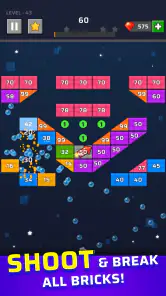
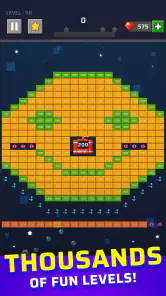

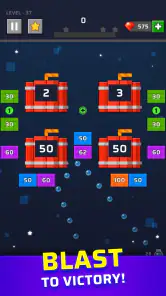

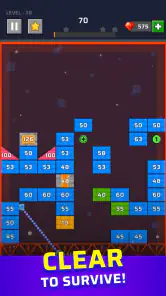
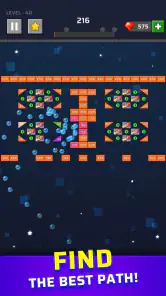
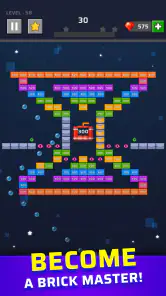
Analysis by Reviewed
I first approached Brick Out - Shoot the ball expecting a familiar brick-breaking game, but its appeal became clearer after a few short rounds. The basic action is immediate: aim a stream of balls, clear blocks, watch the impacts unfold, and prepare for the next arrangement. There is no long tutorial to work through before playing. That directness is exactly why it works well when I want a puzzle game I can understand within seconds.
At the same time, this is not a game I would recommend to everyone. Its pleasure comes from repeating a compact cycle rather than discovering a large world, following a story, or mastering a complicated set of controls. If you enjoy planning angles and improving one attempt at a time, it has an inviting rhythm. If you need constant novelty, deep character progression, or a competitive multiplayer layer, the simplicity may feel limiting.
How the brick-breaking loop feels in real play
The first shot is simple, but the angle matters
The opening move is easy to understand. I position the aim, release the shot, and let the balls travel through the arrangement of bricks. The satisfying part is not the initial tap itself; it is choosing a path that lets the balls bounce through several useful points before returning. A careless angle can leave difficult blocks untouched, while a thoughtful one can create a much more productive chain of hits.
That makes the game a puzzle rather than a purely reflex-based arcade title. I am not only asking where the first ball should go. I am considering how the rebound will affect the next contact, which blocks should be weakened first, and whether a narrow opening is worth targeting. The board gives me a small problem to solve, and the shot turns that plan into a visible sequence of consequences.
The controls are especially suitable for quick play because the central decision is clear. I do not have to remember a large collection of buttons or manage a character while aiming. That makes it comfortable during a short break, on public transport, or whenever I want something more engaging than scrolling but less demanding than a long strategy session.
One useful habit I developed was to stop aiming at the nearest obvious brick. The nearest target is not always the best target. I get better results when I look for an angle that keeps the balls active for longer and reaches blocks that would otherwise survive several turns. The game rewards that small pause before firing, even though the action afterward is fast and visually busy.
Every collision creates a readable feedback rhythm
The strongest part of the experience is the feedback after a shot. Balls strike bricks, numbers change, blocks disappear, and the board gradually reveals whether my original angle was sensible. The result is easy to follow without demanding constant concentration. I can watch the chain develop and quickly understand why a shot succeeded or failed.
This rhythm gives each turn a pleasant shape: aim, release, observe, assess. The observation stage is important because the game does not end the decision when I tap. The balls continue to produce information. A good shot shows me a useful route through the board; a weak shot exposes a problem I need to solve on the next attempt.
I also like that the feedback is immediate without turning every moment into a complicated spectacle. The game remains focused on the bricks and the trajectory. For me, that keeps the experience cleaner than many puzzle alternatives that surround a simple mechanic with layers of menus, characters, missions, and distractions.
There is a trade-off here. Because the central interaction is so focused, repeated rounds can begin to feel familiar. The impact of a successful chain is enjoyable, but it does not transform into a completely different type of challenge. The game depends on whether I find satisfaction in refining decisions inside the same framework.
Why a small reward can be enough
The reward is mainly the board changing in response to my plan. Clearing a cluster of bricks feels meaningful because it confirms that the angle worked. Even when I do not finish everything, weakening a difficult section can make the next turn more manageable. I enjoy that sense of gradual improvement more than a reward system that simply hands out unrelated bonuses.
For new players, this creates a gentle learning curve. Early success comes from understanding the basic path of the balls. Later improvement comes from noticing less obvious routes and thinking about the order in which blocks should be attacked. The game can therefore support both casual play and a more deliberate style, although it never becomes a full-scale logic game with many separate systems.
My practical advice is to value positioning over immediate destruction. A shot that removes one tempting brick may be less useful than a shot that opens a long rebound route. I also try not to rush the aim simply because the board looks busy. Taking a moment to inspect the whole layout often produces a better result than reacting to the first visible target.
That is one of the less obvious strengths of this title: it gives a small amount of strategic thinking to an action that initially looks automatic. The game does not need a long explanation to teach this. The board itself shows the difference between a short, wasteful path and a route that keeps producing contacts.
The reset is what makes another session tempting
After the balls finish moving, the board reaches a new state and the cycle begins again. That reset is central to the game’s appeal. A failed turn does not require a lengthy recovery period, and a successful one does not close the experience with a complicated conclusion. I can immediately look at the next problem and decide whether I want to try again.
This structure makes the game easy to fit around everyday interruptions. I can play one round while waiting for water to boil, stop when a message arrives, and return later without needing to remember a story or a multi-step objective. It is also useful when I want a short mental reset after work: the game asks me to focus on one concrete decision, then gives me a clear result.
The same design can become repetitive if I play for too long. There is a difference between a game being easy to return to and a game providing enough variety for an extended sitting. In my experience, Brick Out is stronger as a sequence of short sessions than as an all-evening commitment. Its reset invites another attempt, but it does not necessarily justify hours without a break.
I would also avoid treating every failed board as a reason to fire immediately again. The best use of the reset is to compare the previous angle with the new layout. If I simply repeat the same habit, I am likely to reproduce the same weakness. The reset is most rewarding when it encourages adjustment rather than mindless repetition.
Where it fits among puzzle and arcade alternatives
Compared with traditional brick-breaker games that use a paddle, this version puts more attention on planning the ball’s route before the action begins. A paddle-based game often tests timing and movement as the ball returns. Here, my main responsibility is the initial direction and the way that direction interacts with the arrangement of bricks.
That makes it a better choice for someone who likes compact spatial puzzles but does not want a demanding reflex test. On the other hand, players who enjoy controlling the paddle continuously may miss that hands-on tension. The game is less about rescuing a ball at the last second and more about creating a productive chain from the start.
It also differs from match-three puzzle games. There is no need to scan a grid for color combinations or plan a sequence of swaps. The visual question is instead about lines, rebounds, and access. If you like seeing a physical path play out after making one decision, this approach may feel more natural. If you prefer several possible moves visible at once, a match-three game may offer a richer sense of choice.
Against larger puzzle games with stories, collections, or elaborate progression, this one is refreshingly focused but less deep. I would choose it for a quick, repeatable challenge, not for a long-term world to explore. That distinction matters because its simplicity is both its main strength and its clearest limitation.
Who will enjoy it, and who should skip it
I think it suits casual players, fans of brick-breaking mechanics, and anyone who wants a puzzle game that can be understood immediately. It is also a reasonable option for families because its content rating is Everyone, and the controls do not require advanced gaming experience. The free entry point makes it easy to try without committing to a purchase.
The game is less suitable for players looking for a narrative campaign, character development, or a broad collection of unrelated puzzles. It may also disappoint people who need a strong sense of permanent progression. The pleasure here is in solving the current arrangement and making the next shot better, not in building a complex account of achievements or unlocking a large fictional setting.
Because the game is free, I would pay attention to the way optional purchases fit my own habits. In-app purchases range from $0.99 to $99.99 per item. I would not treat spending as necessary to understand the core loop, but anyone who is prone to impulse buying should set a personal limit before playing. A simple game can make repeated attempts feel harmless, so it is worth keeping the purchase side separate from the satisfaction of improving an angle.
Practical details before installing
Puzzle1Studio is the developer behind the game. It has reached over ten million installs and holds a 4.5 average from around one hundred thousand ratings, with roughly fifteen thousand written reviews. Those figures suggest that the straightforward format has found a substantial audience, although popularity alone does not change the fact that the experience is intentionally narrow.
The game is free to download, and the listed minimum operating system is Android 6.0. The current version is 2617.1.1. For someone using an older Android device, checking compatibility before installing is sensible, especially if the phone has limited storage or has not been updated for a long time.
Its release date was December 6, 2019, which helps explain why the concept feels established rather than experimental. I do not approach it expecting a new genre invention. I approach it as a polished take on a familiar activity, where the value comes from how quickly the game turns aiming and bouncing into a repeatable puzzle routine.
One everyday scenario captures the experience well. Imagine having ten minutes before an appointment. I can open the game, make a few shots, and stop after a natural board transition instead of abandoning a long mission halfway through. If I have more time, I can continue by treating each new arrangement as a fresh angle problem. That flexibility is more useful to me than a large feature list would be.
My verdict on the complete action-to-reset cycle
What keeps me returning is the clean connection between action and consequence. I aim, fire, watch the balls test my plan, enjoy the payoff when the route works, and then face a new arrangement. Nothing in that loop is difficult to understand, yet the angle decisions prevent it from becoming completely automatic right away.
The game works best when I play it in measured bursts. I enjoy looking for a route that reaches several bricks, learning from a poor rebound, and trying a different approach after the board resets. The experience loses some of its charm when I expect deep variety or play continuously for too long, because the same basic cycle remains at the center of everything.
My recommendation is simple: choose it for quick spatial decisions and satisfying brick-clearing feedback, not for a full-featured puzzle adventure. If that sounds like the kind of small challenge you want between larger activities, the free version is an easy place to start. If your ideal puzzle game needs a story, extensive progression, or constant mechanical surprises, I would look elsewhere.
For me, Brick Out succeeds because it respects the appeal of a focused idea. The first shot is accessible, the feedback is clear, the reward is visible on the board, and the reset makes another attempt feel natural. That is not an ambitious formula, but it is a dependable one, and when I want a brief game that gets to the point without demanding a large time investment, it does the job well.
Pros
- Simple controls make it easy to start playing immediately.
- Short levels are well suited to quick gaming sessions.
- Brick-breaking gameplay offers satisfying visual and sound feedback.
- Offline play makes it useful when no internet connection is available.
- Gradual difficulty provides a reasonable challenge for casual players.
Cons
- Gameplay can become repetitive after extended play sessions.
- Some levels may feel overly dependent on favorable ball angles.
- Ads may interrupt the experience
- especially between rounds.
- Limited variety can reduce long-term appeal for experienced players.
- Precision aiming may feel difficult on smaller phone screens.

- Category
- Puzzle
- Version
- 2617.1.1