WordWhizzle Connect
- 2.36K
- 4.6
- Installs
- 100.00K
- Price
- Free
Screenshots

Analysis by Reviewed
I approached WordWhizzle Connect expecting a light word game for short breaks, and that is exactly where it fits best. It is a free word title from Apprope AB, built around the simple pleasure of spotting connections between letters and words rather than managing a complicated story, character roster, or competitive system. After spending time with it, I found its appeal less about spectacle and more about the quiet satisfaction of seeing a puzzle come together.
The game is available for everyone, and its low entry barrier makes it easy to recommend to families, casual players, and anyone who enjoys language-based challenges. It has reached over one hundred thousand installs and holds a 4.6 average from around eight thousand ratings, which suggests that its straightforward format has found a receptive audience. Still, those numbers do not make it automatically right for every player. If you want a deep narrative, dramatic presentation, or a word game built around live competition, you may find it too restrained.
A calm first impression built around words
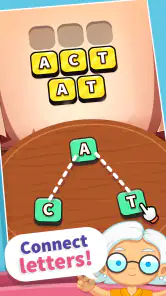
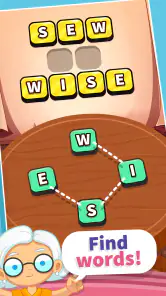
My first impression was that WordWhizzle Connect understands the value of getting out of the way. The central activity is word solving, so the interface does not need to compete with the puzzle for attention. That simplicity helps when I open the game for a few minutes while waiting somewhere or when I want a small mental reset after work.
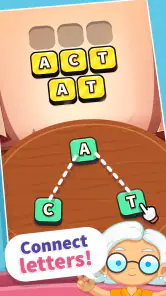
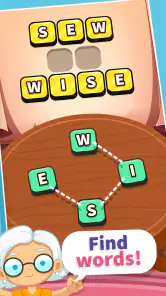
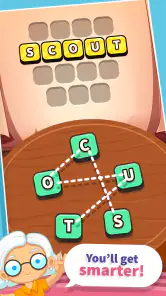
The presentation gives the puzzles room to breathe. Instead of asking me to learn several systems before I can enjoy the first challenge, it puts the focus on recognizing possible word relationships and making a choice. That makes the game approachable for players who are new to mobile word puzzles, while still leaving room for the familiar hesitation that makes this genre enjoyable: I can see several letters, but which connection is the intended one?
There is also a useful difference between a word game that feels like a test and one that feels like a pastime. WordWhizzle Connect generally leans toward the latter. I do not need to prepare for a long session, remember a complex rule set, or understand a fictional universe before playing. The result is a title that works well in small portions, although players who prefer a strong sense of progression may eventually want more variety than its focused format provides.
The game is free to download, with optional purchases ranging from $0.99 to $49.99 per item. That matters because casual puzzle players often want to try the core experience before deciding whether it deserves a place on their phone. I would start with the free experience and pay attention to how often I feel blocked or tempted to spend. For me, the best use of purchases in a word game is occasional help, not something that changes the basic rhythm of solving.
How the visual language supports the puzzle
The visual identity is best understood as functional rather than theatrical. The setting does not try to turn a vocabulary exercise into an adventure with elaborate characters or a dramatic plot. Instead, the screen acts as a clean stage for the letters and the connections between them. That choice is important: a crowded interface would make a language puzzle feel slower, while a restrained one keeps my attention on the shape of the solution.
I like this approach because word games depend heavily on visual scanning. I need to compare letters, test possible groupings, and notice when a familiar word is hiding in plain sight. A coherent layout reduces the mental cost of those actions. The art direction therefore supports the mechanics indirectly; it creates a calm surface where the real activity is thinking.
That calmness can also become a limitation. Players who use games mainly for visual discovery may find the presentation modest compared with a richly illustrated puzzle adventure. There is no reason to choose this title for animated spectacle. I would choose it for the tactile and mental pleasure of language, with the visual design serving that purpose rather than trying to replace it.
One practical tip is to avoid treating every puzzle as a race. When I rush, I tend to lock onto the first familiar word and ignore a better connection. A slower scan of the available letters is more effective, especially when the obvious answer feels almost right but does not complete the pattern. This is one of the small strengths of the format: the game rewards attention without requiring a long, uninterrupted session.
Sound, silence, and the pace of a short session
The mood of a word game is shaped as much by its rhythm as by its artwork. WordWhizzle Connect suits players who enjoy a measured pace. The activity naturally alternates between observation, trial, and the small release that comes when a solution works. That cycle feels more reflective than frantic, which makes it a good fit for a quiet break rather than an adrenaline-heavy gaming session.
I also think this kind of game works best when the sound does not dominate the act of thinking. A word puzzle needs a little mental space. If I am playing in a waiting room, on public transport, or during a short pause at home, I can focus on the puzzle without needing to follow spoken dialogue or a dramatic soundtrack. The overall mood is therefore easy to fit around daily life.
The pacing is especially suitable for people who like stopping and returning later. A short session can still feel complete because solving even a small group of words provides a clear endpoint. That is more convenient than games that pressure me to finish a timed round or maintain a long chain of consecutive play. On the other hand, anyone looking for rapid rounds, escalating urgency, or a constant stream of audiovisual rewards may experience the pace as too gentle.
My advice is to use the game deliberately as a reset rather than automatically opening it whenever you are bored. I get more from it when I give one puzzle my full attention, put the phone down, and return later. That habit turns the quiet rhythm into a benefit instead of letting the game blur into background scrolling.
Where the mechanics fit everyday play
The most convincing part of WordWhizzle Connect is the match between its word-focused mechanics and its casual structure. The rules are easy to approach, but the solving itself still asks me to notice patterns, consider alternatives, and use vocabulary flexibly. That combination is why the game can feel more satisfying than simply completing a basic spelling exercise.
A realistic example is a commute with a few spare minutes. I can open the game, work through a challenge while standing or sitting, and stop when I reach a natural break. I do not need to remember a story objective or coordinate with another player. The same quality works at home when I want something more active than reading but less demanding than a strategy game.
It can also suit families, provided everyone understands that word knowledge will vary. A younger player may enjoy the discovery of familiar vocabulary, while an adult may approach the same puzzle by testing word patterns more quickly. That difference can create a pleasant shared activity, but it can also make some challenges feel uneven. I would not present it as a formal educational tool; I see it more as a playful way to exercise attention and language habits.
One non-obvious advantage is that the game encourages a useful two-pass method. On the first pass, I look for the most obvious connections without forcing an answer. On the second, I revisit the unused letters and ask what kind of word would make the remaining set coherent. This is more reliable than repeatedly tapping random possibilities, and it makes the experience feel like deduction rather than guessing.
A second tip is to notice when frustration is coming from vocabulary rather than reasoning. If I understand the pattern but do not know a word, continuing to stare at the same arrangement rarely helps. I get better results by mentally changing the category I am considering, reading the letters in another order, or taking a short pause. The game is most enjoyable when a difficult puzzle challenges my thinking without making me feel that persistence alone is the answer.
A third trade-off concerns hints or paid assistance. Help can protect the flow of a session, especially when I am stuck on one stubborn connection, but using it too quickly removes the most rewarding part of the puzzle. I would save assistance for a genuine vocabulary wall rather than spending it on a moment of impatience. That approach keeps the free core experience meaningful and makes any optional purchase feel like a choice instead of a requirement.
How it compares with familiar word-game alternatives
Compared with a crossword, WordWhizzle Connect feels lighter and less dependent on clues that may require broad general knowledge. A crossword can offer richer thematic construction and a stronger sense of completing a full grid, while this game is easier to pick up for a brief session. If I want a quiet vocabulary workout without committing to a large puzzle, the connect-style format is more convenient.
Compared with a daily guessing game, it offers a different kind of satisfaction. Daily formats often create a ritual around one shared challenge, whereas WordWhizzle Connect is better suited to playing whenever I have time. That flexibility is useful, but it may lack the social conversation and anticipation that make daily games memorable.
Compared with a competitive multiplayer word title, this is the calmer option. I do not choose it when I want to test my speed against another person or feel pressure from a live opponent. I choose it when I want to think privately and control the pace. The trade-off is clear: less tension, but also less social energy.
It is also more focused than a broad collection of mini-games. That focus helps the experience feel coherent, yet players who need constant mechanical change may tire of it sooner. I would recommend it to someone who enjoys refining one type of mental activity, not to someone who downloads puzzle apps mainly for variety.
Who will enjoy it, and who should skip it
I would recommend WordWhizzle Connect to casual word-game fans, people who like pattern recognition, and players who want something that can be enjoyed in short, quiet sessions. It is also a sensible choice for households looking for an accessible language puzzle with an Everyone age rating. The free starting point makes trying it low-risk, and the current version is 1.6.6 with support for Android 7.0 or later.
I would be more cautious about recommending it to players who need a story, character development, elaborate scenery, or a strong competitive ladder. The same restraint that makes the game comfortable can make it feel limited if your idea of a good mobile game depends on constant novelty. I would also skip it if word puzzles are frustrating rather than relaxing for you, because the core loop does not hide what it is.
Another question many players have is whether it works for very young children. The Everyone rating makes it broadly accessible, but age suitability is not the same as equal difficulty. A child still needs enough reading ability and vocabulary to enjoy the challenges independently. For younger players, I would treat it as a shared activity rather than assume it will function as a self-guided learning app.
Players may also wonder whether the free version is enough. In my view, it is the right place to begin. Play normally, notice whether you enjoy the solving rhythm, and only then consider optional purchases. If you rarely feel stuck, spending money may add little. If you value uninterrupted progress and occasionally need help, a small purchase may be more reasonable than buying immediately out of curiosity.
The atmosphere verdict
WordWhizzle Connect succeeds because its mood and mechanics point in the same direction. The visual presentation keeps attention on the words, the pacing leaves room for thought, and the setting does not distract from the small pleasure of discovering a connection. It is not trying to be a dramatic game, and I respect that clarity.
My main reservation is that the same focused design can feel narrow over time. There is no need to invent a larger world around a word puzzle, but some players will want more variation, more social pressure, or a stronger long-term goal than this format naturally provides. That is not a flaw for everyone; it simply defines the audience clearly.
For me, the game works best as a dependable mental break: open it, examine the letters, solve what I can, and stop without feeling pulled into a long commitment. Apprope AB has kept the experience approachable, and the 4.6 average from thousands of ratings reflects why the formula appeals to many players. I would recommend trying the free version if you want a calm, accessible word challenge with a coherent atmosphere. I would look elsewhere only if you need richer storytelling, faster action, or a more competitive reason to keep playing.
Pros
- Quick word puzzles are ideal for short breaks or daily brain training.
- Simple swipe controls make the game easy to learn immediately.
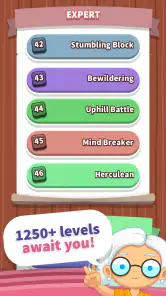
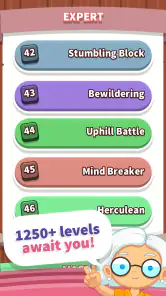
- Hundreds of levels provide plenty of content for casual players.
- The gradually increasing difficulty keeps early stages approachable.
- Offline play lets you solve puzzles without a constant internet connection.
Cons
- Some later puzzles may feel repetitive after extended play sessions.
- Hints can become limited
- potentially encouraging in-app purchases.
- Ads may interrupt gameplay
- especially between completed levels.
- A few word connections can feel subjective or difficult to predict.
- Players seeking competitive multiplayer features may find the experience limited.
- Category
- Word
- Version
- 1.6.6