Word Code - Cryptogram Puzzle
- 114.00
- 4.8
- Installs
- 10.00K
- Price
- Free
Screenshots
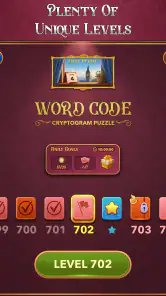
Analysis by Reviewed
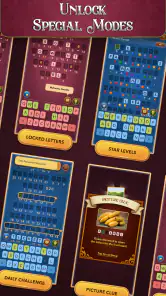
I approached Word Code - Cryptogram Puzzle as the kind of game I could open for a few quiet minutes and then return to when I wanted something more thoughtful than a quick tap. It is a free word game from SayGames Ltd that combines word guessing, logic puzzles, and cryptogram-style challenges. That combination matters because it is not simply a vocabulary test: I found myself switching between recognizing language patterns, checking the logic of a clue, and deciding whether a familiar phrase was being hidden behind a different presentation.
The main question is not whether it contains puzzles. Most word games do. The useful question is whether this particular mix suits the way you like to play. If you enjoy solving at your own pace and want a brain-training game that asks you to think rather than react, it has a clear appeal. If you prefer a large social ladder, rapid competitive rounds, or a traditional crossword layout, another type of word game may fit you better.
What I looked for before recommending it
My first decision criterion was variety within a simple idea. A cryptogram can become repetitive when every challenge uses the same mental process, so I paid attention to whether the experience encouraged more than one kind of thinking. The word-guessing and logic elements give the game a broader feel than a single-format puzzle app. I could approach a challenge through vocabulary, deduction, or pattern recognition instead of relying on one memorized technique.
The second criterion was accessibility. The game is rated Everyone, and it is available for devices running Android 8.0 or later. That makes it a practical choice for people using older compatible phones, families looking for a non-action game, or anyone who wants a puzzle that does not depend on fast reflexes. The age rating also makes the tone easier to recommend in shared settings, although younger players may still need help with unfamiliar phrases or more abstract clues.
I also considered how much commitment the game demands. Some puzzle apps are enjoyable only when I have a long uninterrupted session, while others work well during a short break. Word Code fits the second group more naturally. I can start with a single challenge without preparing for a long campaign, and the basic idea is understandable quickly. That makes it suitable for a commute, a waiting room, or the few minutes before bed when I want an activity that feels more rewarding than scrolling.
There is also a practical cost question. The game is free to download, but it includes in-app purchases ranging from $1.99 to $99.99 per item. I would not treat the free entry point as the whole decision. Anyone considering it should be comfortable with seeing purchase options and should decide in advance whether they want to spend anything. For me, the right approach is to begin without paying, learn how often I use it, and only then decide whether an optional purchase adds enough value.
How the puzzle mix changes the experience
The most useful way to play is to separate solving from guessing. When a clue feels obvious, I still try to identify why it works before entering an answer. Looking for repeated structures, likely word lengths, familiar expressions, and the relationship between connected clues reduces the temptation to throw random answers at the screen. This habit is especially helpful when a puzzle uses a phrase I recognize only partially.
More From Our News Desk

Weather by Xiaomi Review: Clear at a Glance, Less Clear Up Close

X Under Pressure: Can It Recover When Posting Goes Wrong?

Clash of Clans Is Won Between the Battles

Android Auto Makes the Case for Quieter Car Software

MobiOffice: Transforming Mobile Productivity with Seamless Integration

EA SPORTS FC™ Mobile Soccer: Redefining Mobile Sports Gaming
A small notebook or notes app can also improve the experience, particularly for players who enjoy working methodically. I use it to record possible letter relationships or alternative interpretations instead of repeatedly reopening the same clue in my head. That is not a required feature of the game; it is a practical workflow that makes the logic side more satisfying. It turns a frustrating pause into a process of elimination.
Another useful tactic is to stop treating every unknown word as a vocabulary problem. Sometimes the surrounding structure gives enough information to narrow the answer even when I do not know the phrase immediately. I found that solving the easiest part first often creates a path through the harder part. This is where the game feels different from a basic word scramble: the answer is not always unlocked by knowing more words, but by noticing how the available information fits together.
The strongest reason to try it is the change of mental gear between language recognition and deduction. That shift keeps the sessions from feeling completely automatic. I may begin by looking for a familiar expression, then move into a more deliberate comparison of possible answers. The result is a gentler form of mental exercise than a timed action game, but it still gives me a clear sense of progress when a difficult clue finally makes sense.
Where Word Code is particularly convincing
Its biggest advantage is focus. The game does not need a complicated setting or a large cast of characters to make a puzzle session worthwhile. The appeal comes from the act of decoding, and that makes it easy to recommend to someone who wants a direct word challenge without learning a large rule set first. I can explain the concept to a friend in a sentence, yet the puzzles can still require patience.
It also works well for players who like to think privately. Unlike a multiplayer word battle, there is no pressure to answer before another person does. I can pause over a clue, revisit my first interpretation, and take a break without feeling that I have let a team down. That makes it a good fit for uneven schedules and for people who enjoy solving as a quiet personal routine.
The game’s broad appeal is reflected in its current reception: it holds a 4.8 average from around 1.4 thousand ratings, with more than a hundred written reviews. I see that as encouraging rather than conclusive. A high average suggests that the central puzzle idea is connecting with its audience, while the relatively modest size of the audience means I would still judge it by my own preferred style of play. The current version is 1.2.4, so the experience is better understood as a focused puzzle title than as a huge, established word platform.
In everyday use, I would recommend it for a lunch break when I want to reset my attention. I can play one challenge, put the phone down, and return to work with my mind occupied by something structured rather than by an endless feed. It also suits a relaxed evening with a family member: one person can suggest possible words while the other checks whether the logic holds. That kind of shared solving is more natural here than in a game built around speed.
Where another word game may be the better choice
The same focus that makes Word Code appealing can limit it. Players who want daily competition, public scores, live opponents, or a strong social layer should look toward multiplayer word games instead. Those alternatives are better when the motivation comes from comparison and routine competition. I would not choose this game for someone whose main goal is to challenge friends in fast rounds.
It may also be the wrong fit for someone seeking a traditional crossword experience. A crossword gives a very specific satisfaction: crossing answers, building a grid, and using intersecting letters as a visible map. Word Code’s cryptogram and logic emphasis offers a different kind of structure. If you enjoy the physical layout of a crossword more than the act of decoding a hidden phrase, a dedicated crossword app will probably feel more natural.
Vocabulary learners should think about their goal before installing it. The game can encourage attention to words and phrases, but I would not treat it as a complete language course. It is designed around solving puzzles, not around lessons, pronunciation practice, spaced repetition, or a planned curriculum. For learning a new language systematically, a dedicated study app is the stronger option. For exercising familiar language skills in a playful way, this game makes more sense.
There is a similar trade-off for players who need constant novelty. A focused word puzzle can become less exciting if you prefer action, visual exploration, or a narrative that changes dramatically from one session to the next. I enjoyed its concentrated format, but I would not recommend it as a universal replacement for every kind of mobile entertainment. It is best viewed as a specialist tool for language-based thinking.
Friction points worth considering before you commit
The free price lowers the barrier to trying it, but the presence of purchases means I would pay attention to the way I use the game rather than assuming it will remain entirely cost-free for every player. The listed purchase range extends from $1.99 to $99.99 per item, which is a wide spread. I would set a device spending limit if a child might use the phone, and I would avoid buying anything simply because I was stuck on one puzzle.
That leads to an important personal rule: do not confuse speed with progress. When I cannot solve a clue, I first leave it, work through another part, and return with a fresh view. This costs nothing and often works better than immediately looking for assistance. It also preserves the central pleasure of cryptograms, which is discovering the answer rather than merely receiving it.
Another possible source of friction is the balance between accessibility and depth. A game that is easy to understand can sometimes feel too gentle for expert puzzle fans. Word Code has enough variety in its basic concept to keep a casual player engaged, but a dedicated solver who expects advanced cryptic construction, elaborate grids, or highly specialized wordplay may eventually want something more demanding. I would start here for approachability, then move to a specialist puzzle app if I wanted a deeper technical challenge.
The game is free and has passed the ten-thousand-install mark, which gives it a meaningful starting audience without making it feel like an enormous platform. That is relevant when choosing between a compact puzzle experience and a more established service with years of accumulated content or community features. I like the smaller, direct approach, but users who value a huge archive or a large player network may prefer the usual category leaders.
What switching from another puzzle app feels like
If you are coming from a word scramble, the transition should be fairly comfortable because you already understand the pleasure of forming answers from clues. The adjustment is that not every challenge rewards quick rearrangement. I had to slow down and consider meaning, patterns, and the possibility that a phrase was being represented indirectly. Players who normally tap through obvious combinations may need to accept a little more uncertainty.
Moving from a crossword is a different change. You lose the familiar grid-first way of thinking and gain a more phrase-centered process. I would not switch expecting the same rhythm. Instead, I would use Word Code when I wanted a looser, more flexible puzzle session, while keeping a crossword app for days when I wanted a visible network of intersecting answers.
Coming from a trivia game requires another adjustment. Trivia rewards stored facts, whereas these puzzles can often be approached through reasoning even when the subject is not something I know deeply. That makes the game more forgiving for general play, but it also means it may not satisfy someone who specifically wants to test knowledge of history, science, sports, or entertainment.
The cost of switching is low because the game is free to start and supports Android 8.0 or later. The real cost is attention: I need to learn its particular style of clues and decide whether I enjoy solving without the competitive systems found elsewhere. My advice is to give it several short sessions rather than judging it after one difficult puzzle. The first challenge may tell you whether the format is understandable, but repeated use reveals whether the reasoning loop suits you.
My recommendation for different kinds of players
I recommend it to casual puzzle fans, people who enjoy cryptograms, and anyone looking for a calm word game that can occupy a short break. It is especially suitable if you like reaching an answer through a mixture of recognition and deduction instead of relying only on speed. Families can also try it together, provided younger players are comfortable with the vocabulary and an adult manages purchase settings where necessary.
I would be more cautious about recommending it to competitive players, serious language students, and expert crossword enthusiasts. They may find a multiplayer platform, a structured learning tool, or a specialist crossword and cryptic puzzle app more aligned with their goals. That is not a weakness in itself; it simply defines the game’s place. Its value comes from being approachable and mentally engaging, not from trying to cover every branch of the word-game category.
For a first session, I suggest playing without spending money, solving the easiest-looking clues first, and keeping notes when a letter pattern seems important. Notice whether the satisfaction comes from the final answer or from the reasoning that leads there. If you enjoy the process, the game has enough of a distinct identity to earn a regular place on your phone. If you only enjoy it when answers are immediate, a faster word game may be less frustrating.
After using it as a compact brain-training game, my view is positive but specific. Word Code - Cryptogram Puzzle is a good choice when you want quiet, language-based problem solving without the pressure of live competition. It is not the best answer for every word-game preference, and its purchase options deserve sensible boundaries, but the blend of guessing, logic, and cryptogram thinking gives it a clear reason to exist.
SayGames Ltd has kept the concept straightforward enough for a broad audience while leaving room for players to develop their own solving habits. I would install it for short sessions, recommend it to a friend who likes word puzzles, and keep an alternative crossword or competitive word game available for different moods. As a free game with an Everyone rating and a focused format, it earns a trial; whether it becomes a favorite depends on how much you enjoy the slower satisfaction of decoding a phrase rather than racing to the next round.
Word Code - Cryptogram Puzzle Frequently Asked Questions
Is Word Code - Cryptogram Puzzle free to download, and does it offer purchases?
Word Code - Cryptogram Puzzle is free to download, so you can try its cryptogram puzzles without paying upfront. It also offers optional in-app purchases, with prices ranging from $1.99 to $99.99 per item. These purchases are separate from the initial download, so check the purchase options in the app and your device’s settings before playing, especially if someone else may use the device.
What devices and operating systems can run Word Code - Cryptogram Puzzle?
The game is available for Android and iOS, making it an option for players using either mobile platform. On Android, it requires version 8.0 or later. Before downloading, check that your device is running a compatible operating system and has enough available storage for the installation. Keeping your device’s software current can also help with app compatibility and performance.
Is Word Code - Cryptogram Puzzle appropriate for children?
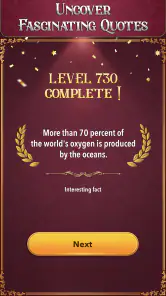
The game has an Everyone content rating, and its focus is on word puzzles and decoding quotations. That makes it suitable for a broad audience, including players who enjoy vocabulary and logic challenges. Parents may still want to review the game’s optional purchases and advertising arrangements with younger players, and use device-level purchase controls if they want to prevent accidental spending.
What is Word Code - Cryptogram Puzzle?
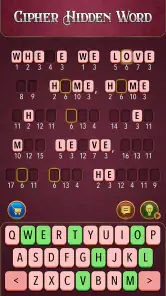
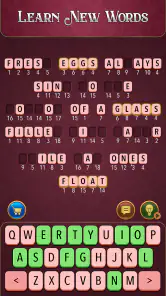
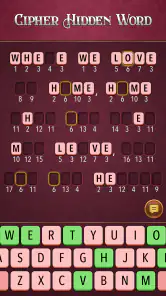
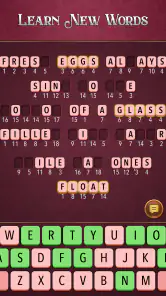
Word Code - Cryptogram Puzzle is a word game based on classic cryptograms. Each puzzle presents a coded quotation in which letters or symbols represent different characters, and your goal is to decode the message by recognizing patterns, testing guesses, and completing the phrase. It combines vocabulary, logic, and deduction, making it suitable for short sessions or longer puzzle-solving breaks.
How do you play Word Code - Cryptogram Puzzle?
To play, select a puzzle and examine the encrypted quotation displayed on the screen. Tap a letter or symbol, then enter the character you believe it represents. Correct guesses gradually reveal the hidden sentence, while incorrect choices may cost hints, lives, or other limited assistance depending on the game mode. Familiar words, repeated letters, punctuation, and quotation patterns are especially useful when solving difficult puzzles.
Pros
- Clever wordplay makes each puzzle feel rewarding to solve.
- Short levels fit well into quick breaks or daily play sessions.
- Helpful hints can prevent players from getting stuck for too long.
- Clean visuals keep the focus on letters and puzzle solving.
- Progression gradually introduces more challenging cryptograms.
Cons
- Some puzzles may rely on familiar phrases or vocabulary.
- Hint options can reduce the satisfaction of solving independently.
- Difficulty may feel uneven between certain levels.
- Repeated puzzle formats can become predictable over time.
- Ads or in-app purchases may interrupt the gameplay experience.
- Category
- Word
- Version
- 1.2.4