Rummy 500
- 12.63K
- 4.6
- Installs
- 1.00M
- Price
- Free

Screenshots







Analysis by Reviewed
I went into Rummy 500 expecting a familiar card game with a few modern touches, and that is exactly where its appeal lies. It keeps the recognizable rhythm of drawing, arranging, melding, and discarding, but gives each hand enough tension to make “one more game” feel natural. The first decision arrives quickly: take a card from the stock or risk picking up the discard pile, then decide whether your hand is ready to expose combinations or whether patience is more valuable.
That opening choice sets the tone for the whole experience. A good turn is not only about making a set or sequence; it is also about controlling what the next player might receive. I found myself watching the discard pile almost as closely as my own cards, especially when a tempting card could complete a run but might reveal too much about my plan. The game is free, rated for Everyone, and comes from North Sky Games, so it is easy to approach whether you already know Rummy 500 or are learning the rules from scratch.
What kept me playing was the compact loop: make a move, see its immediate effect, collect points or lose an opportunity, then begin rebuilding a hand from a new position. That loop is simple enough for a short break but layered enough to reward attention. It also explains why the game has reached over a million installs and maintains a 4.6 average from around forty-nine thousand ratings. Those figures do not guarantee that every player will enjoy it, but they match my impression that this is a polished, accessible take on a classic.
How the turn-to-turn loop feels in practice
The first action is more important than it looks
The most useful way to understand this game is to focus on the first action of every turn. Drawing from the stock is the safe, controlled option, while taking the discard pile can give you several useful cards at once but may force you to accept cards that do not fit your hand. That trade-off creates an immediate question: am I trying to complete something now, or am I gathering information and preserving flexibility?
When I play casually, I am often tempted by the visible card that appears to finish a sequence. That can be the right move, but it is not automatically the best one. Picking up a larger portion of the discard pile may expose a combination before I am ready to use it, and the extra cards can make the hand harder to manage. I learned to treat the discard pile as both a resource and a signal. If another player repeatedly ignores a certain suit or rank, that can influence what I safely throw away later.
This is one of the first places where the game feels more thoughtful than a purely luck-driven card app. Luck determines what appears, but the choice of what to accept, hold, reveal, and discard shapes the result. New players can simply make the most obvious legal move, while experienced card players can start tracking patterns without needing a complicated interface or a long tutorial.
Arranging cards turns uncertainty into a plan
Once cards begin accumulating, the hand becomes a small puzzle. I usually separate cards mentally into three groups: combinations that are nearly complete, cards that could support more than one possible combination, and cards that are probably safe to discard. The second group is especially valuable. A card that can join two different runs gives me room to adapt when the next draw changes the situation.
That flexibility matters because holding too many hopeful cards can be just as harmful as discarding too quickly. A hand full of isolated cards feels active, but it may not be progressing. I get better results when I choose a primary plan and keep only a small backup route. For example, I might pursue a sequence in one suit while retaining a pair that could become a set, rather than trying to build every possible combination simultaneously.
The interface supports this kind of thinking without turning the game into a spreadsheet. Cards are easy to read, and the basic actions are familiar enough that I can concentrate on the hand instead of searching for controls. That simplicity is a genuine strength for phone play. I can start a round while waiting for coffee, make a few decisions, and return to the game without having to remember a complicated control scheme.
Feedback arrives through the changing shape of the hand
The feedback rhythm is subtle but satisfying. A useful draw narrows the possibilities and makes the next discard feel purposeful. A poor draw forces a reset of the plan. Completing a meld gives a clear sense of progress, yet it can also make the remaining cards more awkward. The game constantly asks me to exchange short-term satisfaction for a better position later.
That rhythm is more engaging than a simple win-or-lose result at the end. I can often tell whether I am playing well before the hand finishes. If my cards are becoming more connected and my discards are not helping opponents, I feel in control. If I am collecting attractive cards without a coherent route, the problem is visible several turns before the score is settled.
There is also a useful psychological tension in deciding when to lay down combinations. Showing progress can reduce the cards in hand, but it may tell opponents what remains useful to me. Waiting can preserve uncertainty, though it risks being stuck with points if the hand ends unexpectedly. I would not call the game difficult to learn, but it does reward players who notice that every action has both a scoring effect and an information effect.
Rewards make progress feel immediate, not ornamental
The reward in a round is not just the final result. It is the feeling of converting a messy hand into a clean sequence or set, then watching the score reflect that decision. A well-timed meld feels particularly good when it removes several awkward cards at once. Even a losing hand can be instructive if I can identify the moment when I held too long or gave away a useful discard.
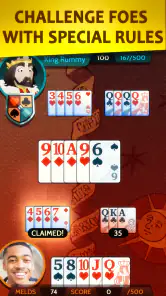
The game also includes online multiplayer and Boss Battles, which give the familiar rules different kinds of pressure. Multiplayer is the better fit when I want to test my reading of other people. A human opponent may make an unexpected discard or change pace in a way that prevents me from relying on a predictable pattern. Boss Battles, meanwhile, provide a more structured challenge for players who prefer a defined opponent and a sense of moving through encounters rather than simply repeating anonymous rounds.
I appreciate that these modes do not replace the basic card game. The central decisions remain understandable, so the extra formats feel like variations on the same skill rather than unrelated distractions. If you are new, I would begin with the straightforward experience and use the more demanding modes after the discard-pile decisions start to feel natural.
There is an important trade-off around the free-to-play structure. The game costs nothing to start, but in-app purchases range from $2.99 to $99.99 per item. I would approach those purchases carefully. The core enjoyment comes from reading hands and making decisions, so spending should be a personal convenience choice rather than something you assume is necessary to understand the game. Anyone who dislikes games with optional purchases should be aware of that model before settling in for regular play.
Why the next session begins
The reset after a hand is what makes the experience unusually repeatable. A bad round does not leave me with a long-term failure state; it gives me a fresh arrangement and another chance to make better choices. That reset is fast enough to keep momentum, but meaningful enough that I do not feel every hand is identical. The opening draw changes the problem, and the discard pile develops its own history.
A realistic use case is a short evening break after work. I can play one hand while waiting for dinner, stop after a frustrating result, or continue because the previous round revealed a mistake I want to correct. The game works well in that space because it does not demand a large time commitment before delivering a decision. At the same time, online multiplayer and Boss Battles give me reasons to stay longer when I have more time.
The reset also makes experimentation less intimidating. I can try holding a flexible card for an extra turn, take a risk on the discard pile, or change when I reveal a meld. If the idea fails, the next hand offers a clean test. That is a better learning structure than a game where one early error ruins a lengthy campaign.
Where the experience can lose momentum
The same repetition that makes the game comfortable may feel limited to players who want a broad collection of card games in one app. This is focused on Rummy 500 rather than serving as a large card-game hub. If you prefer solitaire variations, trick-taking games, or elaborate deck-building systems, you will probably find more variety elsewhere.
It is also not the best choice for someone who wants every match to be purely relaxed. Although the rules are approachable, the discard pile creates real pressure, and multiplayer can make each mistake feel more visible. Players who dislike planning around incomplete information may find the game more mentally demanding than the cheerful presentation suggests.
The free structure may be another point of friction for some people. The purchase range is broad, and players who prefer a single upfront payment may feel more comfortable with a premium card game that removes the question of optional spending. I would also avoid treating the high rating as evidence that the app suits everyone. Its strengths are specifically tied to short strategic rounds, repeated resets, and the tension of choosing what information to reveal.
Practical advice for getting better rounds
My first tip is to avoid judging a card only by whether it helps immediately. A card that connects to several possible combinations can be more valuable than one that completes a small meld but leaves the rest of the hand stranded. I try to preserve options early and become more decisive as the hand develops.
Second, watch the discard pile as a timeline rather than a shopping shelf. The newest card is obvious, but earlier discards can show what opponents rejected and what they may be collecting. Taking a large pile can be powerful, yet it can also make my plan easier to read. I use that option when the added cards clearly improve the hand, not simply because one visible card looks attractive.
Third, think about the penalty attached to cards that remain in hand. A player who is close to ending the round changes the value of every decision. At that point, I become less interested in a beautiful long-term combination and more interested in reducing risky leftovers. This is where many casual rounds turn: the best move is not always the one that promises the biggest score, but the one that limits the damage if the hand ends soon.
Finally, use the quick reset to test one adjustment at a time. If I change my drawing habits, discard timing, and melding strategy all at once, I cannot tell what helped. Trying one small change per hand makes the game more useful as a skill-building exercise and keeps losses from feeling arbitrary.
Who should play it, and who should skip it
I would recommend this card game to someone who already enjoys traditional Rummy but wants convenient play on a phone, especially if online multiplayer or Boss Battles sounds appealing. It is also a good introduction for a family member who knows basic card combinations but does not want a complicated collectible-card system. The Everyone rating makes it broadly approachable, and the controls are less intimidating than the strategic choices might initially seem.
I would be more cautious recommending it to players who need a strong narrative, constant visual novelty, or a large variety of unrelated modes. It is built around refining the same central loop, not replacing it every few minutes. I would also point competitive players toward a more specialized option if they need deep tournament tools, detailed statistical analysis, or a strictly purchase-free environment. This game is better at accessible, repeatable card play than at serving as a professional training platform.
Device support and long-term fit
The current version is 3.3.5, and it supports Android 7.0 or later. That makes it a practical option for people using older compatible Android devices rather than only the newest phones. I still suggest checking the available storage and system compatibility on the device before installing, particularly if you are keeping an older phone in service.
North Sky Games has kept the presentation centered on the cards, which is the right decision here. I do not need a crowded interface to enjoy the game, and the uncluttered structure helps when I am making a quick decision between drawing, taking the pile, melding, or discarding. The result is not flashy in the way a large action game is flashy, but it is readable and purposeful.
My verdict on the complete loop
After spending time with it, I see Rummy 500 as a strong choice for players who want a familiar card game with enough tactical friction to support repeated sessions. The action is immediate: draw or take the pile, arrange the hand, and discard with a purpose. The feedback is continuous because every turn changes both the cards and the information available. The reward is a cleaner hand, a better score, or the satisfaction of correctly reading an opponent.
The reset is equally important. A poor round does not make the next one feel pointless; it gives me a new puzzle and a clear chance to adjust. That is the reason another session begins. I am not chasing spectacle. I am trying to make one better decision than I made a few minutes earlier.
Its free entry, broad age rating, and large player base make it easy to try, while the optional purchases and focused format are worth considering before committing to it as a daily game. For me, the balance works: it is casual on the surface, but it rewards careful play underneath. If that combination sounds like your kind of card game, this is an easy recommendation. If you want variety, story, or a completely purchase-free premium experience, another option will likely fit better.
Pros
- Simple rules make it easy for beginners to start playing.
- Offline mode lets you play without an internet connection.
- Quick matches fit well into short breaks or commutes.
- Several difficulty levels provide a challenge for different players.
- Clear card layouts make melds and discards easy to follow.
Cons
- Some features may be limited unless you watch ads or make purchases.
- Random card deals can make matches feel luck-heavy at times.
- The interface may feel dated compared with newer card games.
- Limited social options may disappoint players seeking active communities.
- Longer matches can become repetitive without more game variations.

- Category
- Card
- Version
- 3.3.5