Redirect It! - Logic Puzzle
- 4.03K
- 4.8
- Installs
- 5.00M
- Price
- Free

Screenshots


Analysis by Reviewed
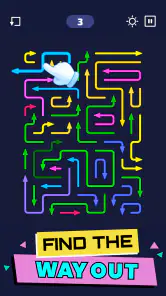
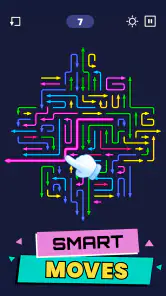
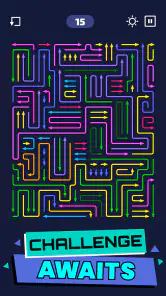
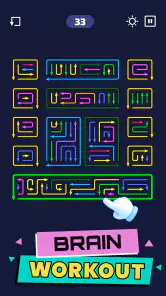
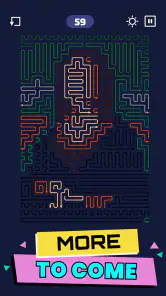
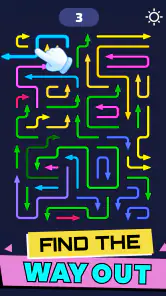
I spent time with Redirect It! - Logic Puzzle as the kind of game I would open when I wanted a short mental break rather than a long gaming session. Its central idea is easy to understand: you look at a maze filled with arrows and work out how to remove them all. The presentation is minimalist, but the decisions are not always as simple as the first screen suggests. A move that looks helpful can close off the route you need a moment later, so the game gradually turns a basic rule into a test of planning.
That simplicity is the main reason it is easy to recommend at first. I did not need a tutorial-heavy introduction or a story to understand what I was doing. I could pick it up while waiting for an appointment, play a few puzzles, and put it down without feeling that I had abandoned a complicated campaign. The more important question, though, is whether that first-week appeal survives once the novelty of redirecting arrows wears off. In my experience, the answer depends heavily on what you want from a puzzle game: quick repeatable challenges, or a broad collection of mechanics that keeps surprising you.
Why the first sessions work so well
The opening appeal comes from the clean relationship between the board and the objective. There is no need to remember a character build, collect equipment, or follow a plot between levels. I can concentrate on the arrangement in front of me. That makes the game particularly comfortable for casual players who enjoy logic puzzles but do not want a large commitment every time they open an app.
The best early puzzles create a useful rhythm. I first scan the maze, identify arrows that seem to control narrow routes, and then test a sequence in my head before committing. When I make a mistake, the problem is usually understandable: I treated one arrow as an isolated object instead of considering how it affected the rest of the maze. That clarity matters. A puzzle can be difficult without feeling unfair, and this game often gets that distinction right during the initial stretch.
I also like how the minimalist design keeps attention on the puzzle rather than on decoration. There are no visual distractions competing with the paths and directions. That makes it a good choice for a quick session on a smaller phone, especially when I want something readable at a glance. The trade-off is that players who need a strong visual identity, characters, or a sense of place may find the presentation too plain to sustain excitement by itself.
For an everyday example, I could imagine opening it during a commute, solving a couple of boards before reaching my stop, and returning later without having to reconstruct a complicated story. It also fits the five-minute gap before a meeting better than many traditional puzzle games that expect a longer uninterrupted session. The game’s strongest practical quality is this low entry cost: I can start thinking immediately.
The title is free to play, which makes trying it straightforward. It is rated for Everyone, so it is positioned as an accessible puzzle rather than an experience aimed at a narrow age group. SayGames Ltd is the developer, and the game has already attracted a 4.8 average from around 33 thousand ratings, with more than five million installs. Those figures suggest that the basic format has connected with a substantial audience, but they do not replace personal taste. A popular minimalist puzzle can still feel repetitive if its core action is not satisfying to you.
Learning the board instead of guessing
One of the first useful habits I developed was to stop treating every arrow as equally important. Some pieces appear to determine the order in which the rest can be cleared, while others are easier to handle once the board has opened up. I found better results by looking for bottlenecks and dependencies before touching anything. That approach is more rewarding than tapping rapidly and hoping the maze sorts itself out.
A practical tip is to trace possible routes from the most constrained areas outward. If an arrow seems to have only one meaningful relationship with the surrounding paths, I consider it a likely starting point. I also try to preserve flexible spaces until later. This is not a formal instruction that the game needs to announce; it is the kind of pattern recognition that makes repeated play more interesting. The puzzle becomes less about reaction and more about reading structure.
Another useful approach is to pause after each important change rather than planning the entire board in one glance. The layout can become easier to understand after a single correct move. That makes the game suitable for players who enjoy gradually refining a solution, not just those who can visualize a complete sequence immediately. It also reduces the temptation to restart too quickly after a mistake.
What remains after the novelty fades
After the first week, the question changes from “Can I understand this?” to “Do I still want to solve another one?” The answer is strongest when I use the game as a small daily brain exercise. Its short-puzzle format makes it easy to build a habit, and the act of examining routes can be more mentally engaging than passively scrolling through a feed. I appreciate that it asks for attention without demanding a large block of time.
That recurring value comes from the way familiar rules can produce different-looking arrangements. Even when the basic interaction remains the same, a new maze can make me reconsider my usual order of operations. I start noticing patterns: a tempting move that should be delayed, a central arrow that affects several paths, or an apparently open route that becomes useless after one change. These observations give the game more staying power than its one-line premise might suggest.
Still, the long-term value has a ceiling. This is a focused puzzle game, not a broad logic collection with several unrelated systems. If you need new mechanics, narrative rewards, or a constant stream of surprises, the same minimalist structure may eventually feel narrow. I would not choose it as my only puzzle app if I wanted variety. I would choose it as a dependable option for a particular mood: quiet concentration in small doses.
The game’s current version is 1.13.0, and it was released on October 17, 2025. Those details matter mainly because they place the experience in a relatively current release context when deciding whether to make it part of a regular rotation. I would still judge its durability by the quality of the puzzles I actually want to solve, not by the version number alone. A fresh installation is not automatically a lasting habit.
Who gets the most value from it
I think it suits people who like spatial reasoning, orderly problem solving, and games that respect short sessions. It is especially approachable for someone who finds large puzzle apps intimidating. A friend who wants “something to think about” without learning a complicated ruleset would probably enjoy it. The game also works for players who like improving their process, because solving more efficiently depends on seeing relationships rather than simply repeating taps.
It is less suitable for anyone who needs constant novelty. If your favorite puzzle games provide wordplay, numbers, physics, hidden objects, and elaborate progression in one package, this may feel too focused. Players who become frustrated by trial-and-error should also know that a clean board can still require several attempts before the correct order becomes clear. The minimal presentation does not make every puzzle effortless; it only makes the rules easy to see.
I would also be cautious about recommending it to someone who wants a completely uninterrupted free experience. The game is free to download, but it includes in-app purchases ranging from $0.99 to $99.99 per item. That does not automatically make the game poor value, and a player can decide whether optional spending fits their habits, but the purchase range is worth keeping in mind before turning a casual pastime into a daily routine.
Maintenance, friction, and the cost of keeping it installed
The maintenance burden is low in the everyday sense. I do not have to manage a complicated account, remember a large set of rules, or keep track of a long-term strategy between sessions. Opening the game and returning to the puzzle mindset is quick. For me, that is a real advantage over games that consume more attention through menus, upgrades, and constant notifications.
There is another kind of maintenance, however: maintaining personal interest. Because the game is built around one central puzzle language, I need to vary how I approach it to keep the experience fresh. I might play only when I have a calm few minutes, or use it as a deliberate alternative to checking social media. If I force myself to solve too many boards in one sitting, the arrows begin to feel like repeated chores instead of problems worth examining.
My best routine would be modest. I would keep it available for a short break, solve a small number of puzzles, and stop while the experience still feels satisfying. That prevents the minimalist design from becoming visually monotonous. It also makes each return feel intentional rather than automatic. The game benefits from restraint; it is easier to appreciate as a compact mental exercise than as an all-day pastime.
Device compatibility is broad enough for many older phones, since it requires Android 8.0 or later. That helps if you are looking for a lightweight puzzle option on a device that is not running the newest operating system. I would still pay attention to how comfortably the maze reads on your particular screen, because the game depends on distinguishing paths and arrows at a glance. The cleaner the display, the more pleasant the reasoning feels.
Where fatigue starts to appear
The main source of fatigue is repetition of the interaction. Redirecting arrows is satisfying when the board presents a fresh relationship to understand, but less satisfying when several puzzles seem to ask for the same mental gesture. The game can make a familiar rule feel new for a while; eventually, some players will want a larger change of pace than a different arrangement can provide.
I also noticed that minimalist design can amplify small frustrations. When there are no characters, story beats, or rich environments to provide variety, the puzzle itself carries nearly all the responsibility. A board that feels clever is rewarding. A board that feels like a sequence of forced corrections can make the whole session feel slower than it really is. That is why I prefer taking breaks rather than pushing through a tired run.
Another trade-off is accessibility of thought rather than accessibility of controls. The objective is easy to understand, but the best solution may not be immediately visible. That is good for players who enjoy analysis, yet it can be discouraging for someone looking for a relaxing game with almost no failure pressure. I would not describe every session as relaxing; some are calm, while others demand genuine concentration.
When I got stuck, the most effective response was not random experimentation. I returned to the board, identified which arrows had the fewest useful options, and considered what would happen if I removed a seemingly harmless piece first. This method turns frustration into information. It is also one of the game’s less obvious strengths: it encourages a transferable habit of looking for constraints before making a decision.
How it compares with other puzzle choices
Compared with a match-three game, this offers less instant stimulation and more deliberate planning. There is no equivalent rush from clearing a colorful cluster, but there is a stronger sense that the final solution came from understanding the board. If I want to relax through quick visual feedback, I would choose match-three. If I want a quiet problem that rewards patience, Redirect It! is the better fit.
Compared with word puzzles, it asks for spatial reasoning instead of vocabulary. That makes it useful when I am mentally tired of clues and definitions but still want to stay engaged. Compared with number-based puzzles, it avoids calculations and focuses on direction, order, and dependency. The choice is therefore less about which category is objectively better and more about what kind of thinking I want at that moment.
It also differs from large puzzle collections that constantly introduce new rule sets. Those alternatives offer broader variety and may hold attention longer for players who need surprise. This game is more consistent. Its advantage is that I can become familiar with its language and improve my reading of the maze; its disadvantage is that the same language may eventually feel limited. I would keep both types installed if I wanted a balanced puzzle rotation.
The free entry point makes it easy to test that distinction for yourself. I would play enough sessions to see whether I enjoy examining the board before making a move, rather than deciding after only the first few simple puzzles. I would also consider whether the available purchase options fit my spending boundaries. The right question is not simply whether it costs nothing to start, but whether the way you intend to use it feels comfortable over time.
My long-term verdict
Redirect It! - Logic Puzzle earns space as a focused, repeatable brain break, not as an endlessly varied puzzle universe. I like its direct rules, readable boards, and ability to fit naturally into small gaps in the day. The strongest moments come when I stop guessing, identify the maze’s dependencies, and find a clean order that was hidden in plain sight.
I would recommend it to a casual puzzle player who values clarity and short sessions, especially someone who wants a game that can become part of a modest daily routine. I would not recommend relying on it as your only source of puzzle variety if you need new mechanics or a strong sense of progression. In that case, a broader puzzle collection will probably remain interesting for longer.
Its lasting value depends on moderation. Played in short bursts, it can remain a pleasant way to train attention and fill an awkward pause. Played for too long, the minimalist format may expose its limited range. The in-app purchase range from $0.99 to $99.99 per item also means I would keep spending deliberate rather than treating every convenience as necessary.
For me, the game survives the first-week test because the central challenge is genuinely readable and satisfying. It passes the month-to-month test more conditionally: I would keep it installed, but rotate it with other puzzle styles so the arrow-based format does not become routine. That is still a positive result. Not every good mobile game needs to dominate my free time; sometimes the best one is the quiet option I can trust when I want a few minutes of focused thinking.
Pros
- Simple rules make it easy to start playing immediately.
- Short levels are ideal for quick gaming sessions.
- Increasing difficulty keeps the puzzles engaging over time.
- Minimalist visuals keep attention focused on solving.
- Works well for players who enjoy logical
- problem-solving challenges.
Cons
- Some puzzles may feel repetitive after extended play.
- Later levels can become frustrating without a clear hint system.
- Limited gameplay variety may reduce long-term appeal.
- Progress may feel slow for players seeking faster rewards.
- Small visual elements could be harder to follow on compact screens.

- Category
- Puzzle
- Version
- 1.13.0