Pocket Sort: Coin Merge Puzzle
- 2.69K
- 4.5
- Installs
- 10.00M
- Price
- Free

Screenshots

Analysis by Reviewed
The first thing I like about Pocket Sort: Coin Merge Puzzle is how little it asks of you: look at the coins, sort them by color, and work toward a tidier arrangement. It is a puzzle game from SayGames Ltd, built for short sessions rather than a sprawling story or a complicated rulebook. If you have a few minutes while waiting for coffee or riding the bus, it gives your attention a small, clear job. The appeal is easy to understand; the real question is whether that simple loop stays satisfying once the novelty wears off.
Before you install, it helps to know what kind of first impression to expect: this is not a game that needs a long tutorial or a special mood. You can come to it with no experience of sorting puzzles and still understand the broad aim quickly. The more useful question is whether you enjoy making small choices about a changing arrangement. If you do, the early play has an inviting rhythm; if you want surprise, story, or action, the same simplicity may feel slight.
What to expect from a coin-sorting puzzle
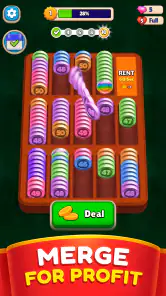
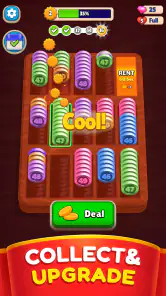
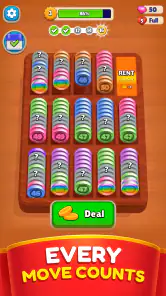
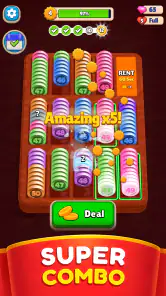
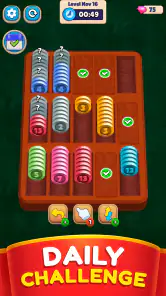
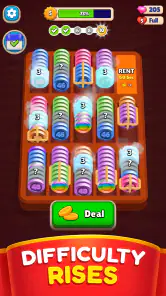
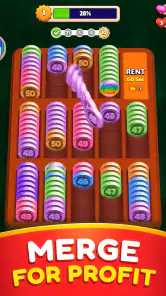
The central idea is visual organization. Coins of different colors need to be sorted and merged, so each move is about making the board more orderly while keeping future moves in mind. That makes this a gentler kind of puzzle than a word game or a strict logic challenge: you can see the problem, try a solution, and adjust your plan as the arrangement changes.
Articles Related to Pocket Sort: Coin Merge Puzzle
I would go in expecting a compact, repeatable activity, not a deep campaign. The satisfaction comes from turning a mixed-up layout into a cleaner one and spotting a useful sequence before acting. The color cues make the basic goal approachable, while the need to plan gives each choice a little weight. It is a good fit when you want something focused but not mentally exhausting.
The game is free to download and is rated Everyone, so its basic premise is easy to recommend across a broad range of ages. It has a 4.5 average from around 204,000 ratings, and it has passed 10 million installs. Those figures suggest that the simple format has found a sizable audience, though popularity alone cannot tell you whether its pace will suit you. I would judge it by whether arranging and merging pieces feels calming or repetitive to you.
One useful way to think about the game is as a small attention reset. It asks you to notice color, order, and the consequences of a move, without requiring you to remember a large set of rules. That makes it more engaging than passively scrolling, but less demanding than a puzzle that expects you to hold several clues in your head at once.
Getting started without overthinking it
On your first run, focus on understanding what counts as a productive move rather than trying to solve everything perfectly. Look across the full arrangement before acting. Identify which coins can be brought together and where you may need to leave room for later sorting. The best first result is not necessarily a flawless board; it is seeing how one sensible move creates a clearer next choice.
You May Like

How Microsoft OneDrive Became a Mobile Productivity Giant

How Google Translate Breaks Language Barriers Effortlessly

Why Google Sheets Is the Ultimate Mobile Productivity Tool

Unveiling the Dynamic World of My Talking Tom Friends

Free Fire MAX: Dominating the Battle Royale Arena

Free Fire: Winterlands – The Ultimate Winter Gaming Adventure
That approach also helps if you are new to merge-and-sort puzzles. Instead of moving the first matching color you notice, pause long enough to check whether another color is blocking a more useful grouping. A quick scan can prevent a move that looks tidy locally but makes the remaining layout harder to manage. This is the main habit I would recommend learning early: plan for the space your next move needs, not just the match immediately in front of you.
There is no need to treat the opening as a test of speed. A measured pace lets you learn the relationship between sorting and merging and makes the board easier to read. If you get stuck, take a moment to look for a different order of operations rather than repeating the same kind of move. Even without a complicated strategy, changing what you prioritize can reveal a route forward.
For a first meaningful success, aim to make one clean group and then use that improved layout to set up another. This gives you a practical sense of progress: a move has not only matched colors, it has made the next decision simpler. That small chain of cause and effect is where the puzzle starts to feel rewarding instead of like random shuffling.
When you first open it, resist the urge to judge your skill by how quickly you make progress. The opening is a chance to get comfortable reading the arrangement and seeing how your choices affect what remains. I find it more reassuring to treat the first clean group as a lesson in the puzzle’s rhythm, not as a scorecard. Once that clicks, the board becomes easier to approach with a plan.
When the board gets confusing
The most common source of confusion is mistaking a visible match for the best available move. Matching coins can feel productive, but sorting puzzles are also about preserving workable space and keeping different colors from becoming awkwardly placed. When a move seems obvious, check what it leaves behind. If it closes off useful room or strands another color, a less immediate move may be the better one.
Another point worth keeping in mind is that neatness and progress are not always the same thing. A board can look more orderly after a move while still leaving you with fewer good options. I find it helpful to judge a decision by what it enables next, not just by how satisfying the current arrangement looks. This is a modest but important shift: the game rewards thinking one step beyond the visible cleanup.
If you are playing while distracted, the colors can blur into a quick pattern of “move, match, repeat.” That is when mistakes become more likely, especially if you make several decisions without checking the whole layout. Short pauses between moves help. It is a small puzzle, so there is little benefit in rushing through it; treating each choice as a quick scan keeps the experience relaxing.
The trade-off is that a focused sorting loop can become repetitive for players who want each session to introduce a fresh mechanic, a narrative, or a dramatically different challenge. Pocket Sort is better approached as a reliable little brain break than as a game that constantly reinvents itself. If you need strong variety or long-term strategic depth, a larger puzzle game may hold your attention longer.
One practical response to a board that suddenly feels tangled is to stop making moves for a moment and describe the situation to yourself in simple terms: which colors are easiest to bring together, and which ones are in the way? This turns a vague feeling of being stuck into a smaller planning problem. It is especially helpful if you have returned after a pause and no longer remember what you intended to do. Re-reading the board is often more useful than trying to reconstruct every earlier decision.
A practical routine for short sessions
For an everyday use case, imagine opening the game during a short wait and wanting to do something more active than check the same apps again. Spend the first moments reading the board, choose a move that brings a useful group together, then reassess before continuing. That simple routine creates a satisfying stopping point even if you do not play for long: you have made a deliberate choice and seen the layout improve.
It also works well as a low-pressure transition between tasks. I would not use it when I need to keep my mind entirely free for conversation or urgent work, because even a simple puzzle benefits from attention. But during a break when I want a small focus exercise, its clear visual objective is easier to pick up than a game with a long setup or a detailed tutorial.
Compared with the usual alternatives in the puzzle category, this one leans on spatial sorting and color recognition rather than words, trivia, or elaborate logic grids. That makes it a better choice if you enjoy hands-on organization and immediate visual feedback. A crossword or a number puzzle is likely the stronger option if you want language practice, more formal deduction, or a problem that rewards extended concentration. The distinction is useful: Pocket Sort’s strength is accessibility, not maximal complexity.
One non-obvious tip is to make your first few choices as experiments. Notice which kinds of moves open up the board and which ones merely relocate the trouble. Once you recognize that difference, you can start planning rather than reacting. Another is to stop after a satisfying cleanup instead of pushing on automatically; the game’s short-session nature makes it easy to enjoy a small win without turning every spare minute into a lengthy session.
For a realistic routine, I would use it in a quiet waiting room or while a kettle is heating, rather than during a walk or a conversation that needs my full attention. A short pause is enough to look over the colors, make a considered move, and decide whether I want to continue. That makes the game easier to fit around the day without turning a small break into a commitment. It is also a good point to put the phone down: leave when the board feels satisfying, not just because another minute has passed.
What to know before spending more time
The game is free, but it includes in-app purchases ranging from $0.99 to $99.99 per item. If you prefer to avoid spending, it is sensible to treat purchases as optional and check carefully before confirming anything. The price range is broad enough that families or younger players may want to keep purchase settings in mind, even though the content rating is Everyone. That is a practical consideration, not a reason to assume that payment is required to enjoy the basic sorting idea.
The current version is 1.14.0, and the listed minimum operating system is 8.0. If you are checking whether it will run on an older device, that version requirement is the detail to compare with your phone or tablet before installing. The developer, SayGames Ltd, is identified with the game, and the experience is presented as a straightforward casual puzzle rather than a tool or social platform.
As you become more comfortable, the next step is to pay attention to the shape of the whole board before each move. Start by looking for a clear grouping, then consider which color or area will be hardest to deal with afterward. This gradual shift—from reacting to a match to preserving options—is what gives the puzzle more staying power for me. It provides a little room to improve without asking you to memorize a complicated system.
One sensible next step is to carry that wider scan into each new board instead of relying on a fixed sequence of moves. The useful choice depends on the arrangement in front of you, so a move that helped once may not be the right one next time. I like that this keeps the challenge grounded in observation: you are learning to notice consequences, not memorizing a walkthrough. If you are unsure, choose the move that leaves the clearest options to inspect afterward.
People often wonder whether this is suitable for a child or a family device. Its Everyone rating and immediately readable color-based objective make it approachable for a broad audience, and the basic interaction is easy to explain. I would still keep purchase settings in mind on a shared device, because the game offers paid items. For a parent deciding whether to introduce it, the more important fit question is whether the child enjoys calm sorting tasks rather than fast, highly varied play.
Who will enjoy it, and who may want something else
I would recommend Pocket Sort to people who like tidy visual puzzles, color-based tasks, and quick rounds with an obvious goal. It is particularly approachable if you are new to puzzle games, because the central action is easy to grasp and the board itself shows what needs attention. It can also suit someone who enjoys sorting in general but wants a more active version than arranging items in a list or clearing a desktop.
I would steer away from it if you need a strong story, a large collection of puzzle types, or a challenge that becomes substantially more demanding through complex rules. Its appeal depends on liking the core act of sorting and merging; if that loop does not click for you, a high audience score will not change the basic fit. Players who prefer wordplay, extended deduction, or competitive play should choose a puzzle built around those interests instead.
There is also a useful distinction between a game for a brief reset and one for a long stretch of focused play. This title suits the former: its visible layout gives you something concrete to work on without asking you to keep a story or a large set of clues in mind. If you are looking for a puzzle to settle into for an evening, a more varied game with different kinds of problems will probably offer better value for your attention. If you want a small task between errands, the narrow focus is part of its appeal.
My overall impression is that this is a welcoming, focused option for a few minutes of deliberate play. The best way to approach Pocket Sort: Coin Merge Puzzle is to slow down just enough to read the board, make one move that improves your next options, and enjoy the moment when the colors begin to fall into place. It does not need to be more complicated than that to work. If you want an easy-to-start sorting puzzle and are comfortable with a repeated core loop, it is worth trying; if you want constant novelty or a deep strategic climb, your time is probably better spent elsewhere.
Pocket Sort: Coin Merge Puzzle Frequently Asked Questions
What is Pocket Sort: Coin Merge Puzzle?
Pocket Sort: Coin Merge Puzzle is a casual puzzle game built around sorting and merging coins. You organize coins into the right groups, then combine matching values to make larger coins and progress through the puzzle. Its straightforward rules make it easy to pick up, while the sorting decisions provide a bit of planning as the board fills up. Exact features and available modes may vary by version.
How do you play Pocket Sort: Coin Merge Puzzle?
The central loop is to move or sort coins so that matching ones can be merged into a higher-value coin. Before making a move, look at the available spaces and consider how the change will affect later combinations; filling the board without a plan can make it harder to continue. The game is designed to be approachable, but steady progress still depends on keeping groups organized and making room for new coins.
Is Pocket Sort: Coin Merge Puzzle free to download?
The game may be offered as a free download, but that does not necessarily mean every part of it is free. Depending on the current store listing and version, it may include advertisements, optional in-app purchases, or other monetization features. Check the Google Play or Apple App Store page before installing for the latest price, purchase details, age rating, and any requirements that could affect your decision.
Can I play Pocket Sort: Coin Merge Puzzle offline?
Offline availability can depend on the version, platform, and how the developer has configured ads or online features. The core sorting and merging puzzles may be playable without a continuous connection, but features such as advertisements, rewards, cloud saves, or store-related functions could require internet access. If offline play matters to you, check the app’s store description and test it after installation while disconnected.
Is Pocket Sort: Coin Merge Puzzle suitable for children, and what should I check before downloading?
The simple coin-sorting concept may appeal to players who enjoy relaxed, casual puzzles, but suitability depends on the app’s current content, advertising, and purchase options. Parents should review the age rating, privacy information, and in-app purchase disclosures on the relevant store page, and consider using device-level purchase controls. Also check that the app supports your device and operating-system version before downloading.
Pros
- Simple merge-and-sort rules are easy to pick up.
- Short levels suit quick play sessions.
- Coin-merge mechanics add a clear puzzle objective.
- Sorting challenges can reward careful planning.
- Works well for players who enjoy casual brain teasers.
Cons
- Later puzzles may feel repetitive.
- Progress can depend on trial and error.
- Small items may be hard to distinguish on a phone screen.
- Ads or in-app purchases may interrupt the experience.
- The casual format may not satisfy players seeking deep strategy.

- Category
- Puzzle
- Version
- 1.14.0