Meowdoku: Brain Puzzle Games
- 13.05K
- 4.7
- Installs
- 10.00M
- Price
- Free

Screenshots

Analysis by Reviewed
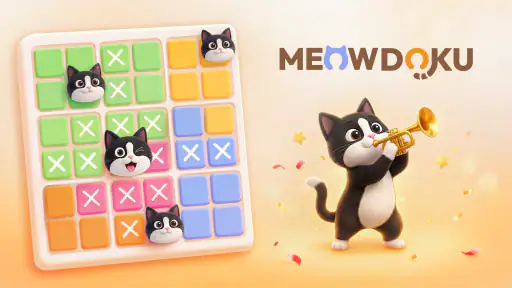
I’m drawn to puzzle games that make me slow down and reason rather than tap through a string of distractions. Meowdoku: Brain Puzzle Games has an appealing premise: it brings together the number-and-pattern logic of Sudoku and the area deduction of Minesweeper, with cats as the theme. The result is a distinctive kind of puzzle, but its appeal depends on whether that blend feels inviting or simply adds another layer to keep track of.
In my experience, the best way to approach it is as a quiet logic game, not as a fast reflex challenge. I would recommend it to someone who likes working through a board methodically and is comfortable holding a few possibilities in mind. The cat theme gives the puzzle its identity, while the underlying appeal is the satisfaction of narrowing down what can and cannot be true.
Reading the board and finding a rhythm
A familiar logic foundation with a different twist
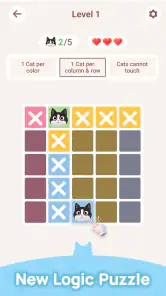
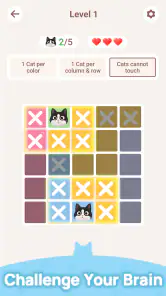
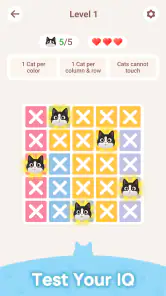
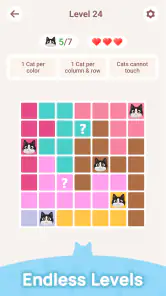
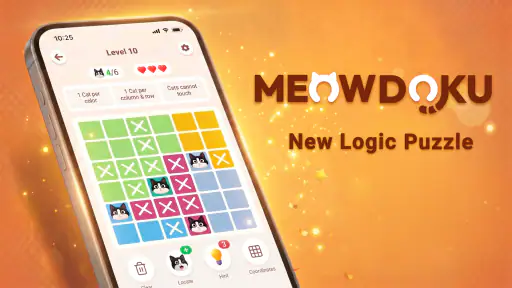
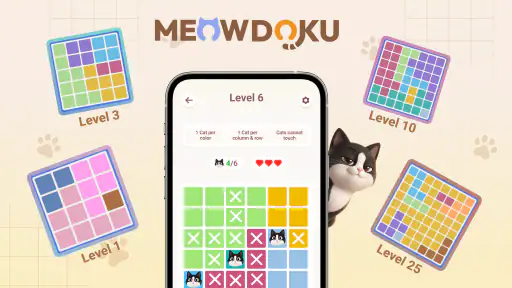
Sudoku and Minesweeper are useful points of comparison, but this game is not simply either one dressed up with cat artwork. Its central task is to work out the territories associated with the cats. That means the player needs to read the board as a set of connected clues rather than treating each square as an isolated answer. If you enjoy the moment when several small deductions combine into one clear move, that structure is likely to suit you.
There is a modest learning curve in switching between the two styles of reasoning. Sudoku tends to encourage checking rows, columns, and possible number placements; Minesweeper asks you to interpret local clues and infer which spaces are safe. Here, I would give myself time to understand how the cat-territory idea changes the way clues relate to one another. Rushing into a guess can make a board feel confusing, while stepping back to check the surrounding pattern often makes the next deduction easier to see.
That distinction also makes the game a better fit for players who like deduction than for people looking for a casual match-three-style pastime. It asks for attention, even when a puzzle is short enough to pick up in a spare moment. I find that a useful trade-off: the game gives me something to think about, but it is not the kind of entertainment I would choose when I want action or constant audiovisual feedback.
Visual clarity matters more than speed
Because the challenge depends on comparing clues across a board, legibility is central to the experience. I recommend playing somewhere you can comfortably see the puzzle and taking a moment to orient yourself before making a move. On a small screen, fine details and nearby clues may take more effort to scan, especially if you are used to playing on a larger display. The puzzle’s logic can still be appealing, but visual effort can become part of the challenge rather than a neutral background.
A practical habit is to look at one region at a time and then widen your view to check whether that deduction fits the rest of the board. This reduces the mental load of trying to track every clue at once. It is also a good way to catch an assumption that seemed obvious locally but conflicts with another part of the puzzle. I would avoid treating a quick glance as enough; the game rewards deliberate comparison more than speed-reading the screen.
The game is made by Oakever Games and sits in the puzzle category. It has a 4.7 average from around 420,000 ratings, and has passed 10 million installs. Those figures suggest that the format has found a substantial audience, though they do not tell me whether an individual player will find the board comfortable to read or the logic enjoyable. That comes down to personal preference and the conditions in which you play.
Playing comfortably across different situations
Touch input and the cost of a mistaken move
This is a game where the main physical demand is careful interaction with the puzzle rather than quick movement. That makes it potentially easier to approach than an action game that depends on rapid taps, but it does not remove motor considerations altogether. If a player has difficulty aiming at small on-screen targets or making precise repeated touches, a logic board can still be frustrating. I would suggest trying a puzzle at a relaxed pace and noticing whether selecting spaces feels comfortable before settling into a longer session.
For players who experience hand fatigue, one useful adjustment is to pause between deductions rather than trying to finish a board in one uninterrupted stretch. That is not a special feature; it is simply a way to make a thinking game less physically demanding. It also helps avoid the common mistake of tapping before fully checking the clue. When a puzzle depends on accurate choices, slower play can be both more comfortable and more reliable.
Sensory preferences matter, too. A puzzle game can be a good alternative when someone wants a focused activity instead of a visually frantic one, but I would not assume that any particular sound, animation, contrast option, or display setting is available. If sound or motion is uncomfortable, check the game’s controls on your device and use the settings you can access. The most dependable way to judge the experience is to try a board in the environment where you expect to play, not to rely on the genre alone.
Short breaks, commutes, and shared spaces
Meowdoku can suit a quiet break between tasks because its central activity is reasoning through a board rather than reacting to a changing stream of events. A realistic use case is a few minutes of play while waiting for an appointment: I can focus on one section, stop when I need to, and return with a fresh look at the clues. That kind of session works best if I am comfortable leaving a puzzle unfinished and do not feel compelled to solve it immediately.
For a commute, the main question is not just whether the game is engaging but whether the screen is easy to use in that setting. Bumps, glare, limited space, and one-handed play can all make a deduction puzzle harder to manage. I would save a difficult board for a stable seat and decent lighting rather than forcing it in a crowded or moving environment. In a shared space, its quiet, thought-led style may be less disruptive than a game built around rapid action, but concentration can still be difficult when people are talking around you.
It is also suitable for a player who wants to practise patience and structured thinking without needing another person to participate. The trade-off is that this is a solitary puzzle experience: if you want conversation, competition, or a social activity to fill a break, a multiplayer game or a paper puzzle shared with someone else may be a better choice.
Where it differs from familiar alternatives
Compared with standard Sudoku, the cat-territory concept gives the board a different visual and logical identity. Someone who has exhausted their appetite for number grids may appreciate having to interpret clues in a new way. On the other hand, players who specifically enjoy Sudoku’s clean, number-first structure may prefer a conventional Sudoku app, where the rules are familiar and the focus stays on placing digits.
Against Minesweeper, this game’s appeal is less about a quick sequence of risky reveals and more about connecting the territory idea to the puzzle’s logic. If you like Minesweeper because of its tension and uncertainty, the different framing may feel less immediate. If what you enjoy is deduction, however, the combination offers a refreshing change from simply counting adjacent clues. It occupies a narrower niche than either classic game, and that specificity is a strength for the right player rather than a universal improvement.
Practical details before you settle in
The game is free to download, is rated Everyone, and supports Android 7.0 and later. Its current version is 1.18.0. In-app purchases range from $3.99 to $69.99 per item, so I would check the purchase details in the app before spending and decide whether the free experience is enough for the way you play. The existence of purchases does not mean you need to buy something to enjoy a logic puzzle, but it is sensible to be aware of them, especially if a child will be using the device.
For families, the Everyone age rating makes the game broadly approachable, and its puzzle format can be a calmer option than more intense games. I would still consider the individual player’s needs: a child who enjoys careful reasoning may find the territory rules intriguing, while someone who wants immediate rewards or simple instructions may lose interest. Adults who like brain teasers are likely to get more from the process of testing deductions than from the cat theme alone.
Who will enjoy it, and what may get in the way
Good fit for patient puzzlers, less so for everyone
I would recommend it to Sudoku fans curious about a fresh rule set, Minesweeper players who enjoy inference, and anyone who prefers a measured challenge over reflex-based play. It can also work well as a personal screen-time activity when you want to concentrate on a single problem. The best results come from treating each board as a sequence of deductions and being willing to reconsider a conclusion when the wider pattern does not support it.
I would skip it if you strongly dislike grid-based reasoning, find clue-dense screens tiring, or mainly want a game you can play without sustained attention. A word game may be a better option if you prefer language-based clues; a standard Sudoku app may be better if you want familiar rules and a predictable visual system; and a casual arcade game may suit you more when you have only a few seconds and no desire to focus.
One limitation is that the very combination that makes the game distinctive can also make its logic less immediately readable than either inspiration on its own. Players may need time to understand how the territory framing changes their usual habits. Another is that screen comfort is personal: small details, touch accuracy, and the play environment can influence enjoyment even when the puzzle itself is well suited to the player. I would not choose it solely because it is described as a brain game; I would choose it because I genuinely enjoy this particular kind of deduction.
A thoughtful option with a specific kind of accessibility
My inclusive verdict is positive but measured. Meowdoku’s turn-by-turn logic makes it more approachable than a game that demands fast reactions, and its familiar Sudoku and Minesweeper touchstones can help explain the general appeal. At the same time, careful visual scanning and precise interaction still matter, so it will not be equally comfortable for every ability or setting. I see its strongest accessibility advantage in the pace of the thinking: players can take time to reason rather than compete against a timer or an opponent.
The clearest reason to try it is the unusual blend of familiar logic and cat territories, not a promise that it will suit every player. Oakever Games has built a puzzle for people who enjoy pausing, checking a pattern, and earning a solution through their own deductions. If that sounds satisfying, I think it is worth trying at a comfortable pace. If you need large, effortless-to-scan visuals, a very low-effort pastime, or an energetic social game, another option will probably serve you better.
Overall, I find it a distinctive choice in a crowded puzzle field, with a thoughtful pace and a learning curve that asks for patience. Its 4.7 average is encouraging, but my recommendation is more specific: try it if you enjoy Sudoku-style analysis and Minesweeper-style inference, and judge the screen and touch experience for yourself. For that audience, Meowdoku: Brain Puzzle Games offers a worthwhile change of pace; for everyone else, its particular mix may be more work than fun.
Meowdoku: Brain Puzzle Games Frequently Asked Questions
What is Meowdoku: Brain Puzzle Games?
Meowdoku is a casual puzzle game that combines Sudoku-style number placement with a cat-themed presentation. Players fill a grid while following rules that prevent repeated numbers in the relevant rows, columns, or sections. Its cute visuals make the experience feel lighthearted, while the logic challenges can still require careful thought. Exact modes and features may vary by version, so check the store listing before downloading.
How do you play Meowdoku?
The basic goal is to complete a puzzle grid by placing the available numbers in the correct empty cells without breaking the game’s placement rules. Tap a cell and choose a number, then use the clues already on the board to narrow down the possibilities. If you are new to Sudoku, start with easier puzzles and take your time; difficulty options and any hints depend on the version you install.
Is Meowdoku suitable for beginners and children?
The straightforward tap-based controls and approachable cat theme can make Meowdoku accessible to casual players, including people learning number puzzles for the first time. Sudoku-style logic nevertheless takes patience, and younger children may need help understanding the rules. Check the app-store age rating and description for the current version, and consider whether advertisements, optional purchases, or other online features are appropriate for the player.
Can I play Meowdoku offline, and does it contain ads or in-app purchases?
Offline availability, advertising, and optional purchases can differ by platform, region, and app version. Do not assume that every puzzle or feature works without an internet connection: review the store listing and test the game’s behavior before relying on it offline. The listing should also disclose whether the app includes ads or purchases. Check those details before downloading, especially if you want uninterrupted play or are setting it up for a child.
Where can I download Meowdoku, and what should I check first?
Download Meowdoku: Brain Puzzle Games from the official Google Play Store or Apple App Store when it is available for your device. Before installing, confirm the developer name, supported operating-system version, recent update information, age rating, and user reviews. Also review the privacy details and requested permissions, since these can change over time. Avoid unofficial download sites, which may provide outdated or modified versions.
Pros
- Quick rounds make it easy to fit a puzzle into a short break.
- Simple controls are easy to learn
- even for casual puzzle players.
- Grid-based challenges offer a fresh twist on familiar block puzzles.
- No reflexes or fast reactions are needed to play.
- A good option for exercising spatial reasoning and planning.
Cons
- Some puzzles may feel repetitive after extended play.
- Later challenges can become frustrating without careful planning.
- The small grid may be difficult to read on compact screens.
- Hints or other aids may reduce the satisfaction of solving puzzles unaided.
- Players looking for a story or varied game modes may find it limited.
- Category
- Puzzle
- Version
- 1.18.0