Hexiwords
- 39.00
- 4.8
- Installs
- 10.00K
- Price
- Free
Screenshots

Analysis by Reviewed
Hexiwords is the kind of word game I can open for a short break without needing to learn a complicated ruleset first. The basic idea is easy to understand: connect letters and search for words hidden across a hexagonal layout. What makes it worth a closer look is the way that simple goal turns into a small exercise in pattern recognition, vocabulary, and patience. I found it more thoughtful than a basic anagram app, but less demanding than a traditional crossword that expects broad general knowledge.
Created by Second Gear Games, it is aimed at players who enjoy discovering words rather than racing through timed challenges. The game is free to download, with optional in-app purchases ranging from $1.99 to $19.99 per item. That distinction matters: you can try the core experience without paying, while the optional spending gives the game a different value proposition for people who play regularly. It is also rated for Everyone, making it a reasonable choice for shared family use, although younger players may still find some word choices more difficult than others.
How the hexagonal word layout changes the usual word-game routine
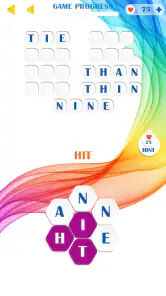
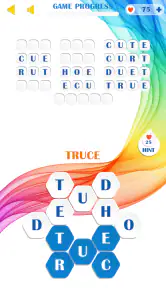
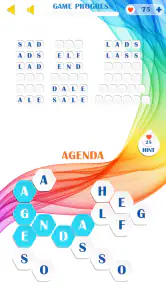
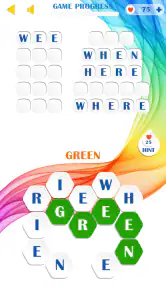
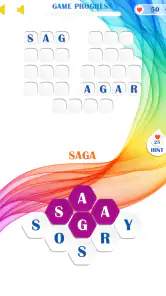
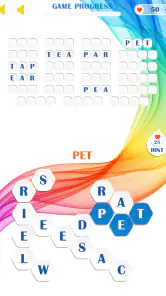
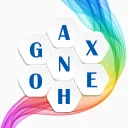
Most word games teach you to scan in straight lines, shuffle a set of letters, or fill a grid from clues. Hexiwords takes a different visual approach. The hexagonal arrangement encourages me to look for connected paths instead of treating each letter as an isolated tile. That small change affects how I think: I start by spotting familiar endings and beginnings, then trace possible routes through neighboring letters.
The result is approachable but not completely automatic. A word may be visible once I stop searching from left to right and begin checking the surrounding connections. This is the first useful tip I would give a new player: do not stare at the board as if it were a standard crossword. Rotate your attention around clusters, look for common combinations, and revisit letters that seemed unhelpful after finding one new word.
The store summary presents the game as a matter of connecting letters to uncover hidden words, and that description is accurate without explaining why the format can be satisfying. The enjoyment comes from the gradual change in the board. Each successful word reduces the visual noise and makes the remaining possibilities easier to judge. I like that sense of progress because it rewards careful observation rather than only a large vocabulary.
A good fit for short sessions
I would use this game while waiting for an appointment, during a commute when I am not driving, or at the end of the day when I want something quieter than an action game. A typical session can begin with obvious words and then slow down as the remaining letters become less cooperative. That natural rhythm makes it easy to stop after a puzzle instead of feeling forced to continue through a long campaign.
It also works well as a low-pressure mental warm-up. I can play a few rounds before studying, writing, or doing another task that requires concentration. The important point is that the game gives my attention a clear target without demanding the emotional energy of competition. Players who prefer calm, self-directed challenges will probably appreciate that quality more than people looking for leaderboards or fast reactions.
What I learned from the board design
The hexagonal structure creates a trade-off. It makes the game visually distinctive and gives word discovery a spatial element, but it can also make the first few puzzles feel less immediately readable than a conventional word grid. I sometimes found myself spending time understanding the shape of the board before thinking about the vocabulary. That is not a serious flaw, but it means the opening experience is better for players willing to adjust their habits.
My preferred method is to divide the board mentally into small zones. I search one group of connected letters, then move to another rather than jumping randomly across the entire shape. This reduces the chance of repeatedly checking the same attractive-looking path. When I get stuck, I reverse the process: instead of hunting for a whole word, I look for short fragments and ask which nearby letters could extend them.
Another practical approach is to avoid spending too long on a single suspected answer. If a path looks promising but does not produce a word, I leave it and search elsewhere. Returning later often works because finding a different word changes the way I see the surrounding letters. That is a useful strength of the design: progress often comes from a change in perspective rather than from forcing one stubborn solution.
Value, limitations, and the decision to keep playing
What the free entry point offers
The free price makes Hexiwords easy to test without treating the first download as a commitment. For me, that is especially important with word games because personal vocabulary and preferred puzzle style make a large difference. Some players will enjoy the search immediately; others may find the hidden-word format too open-ended. Being able to start free lowers that risk.
The game has reached over ten thousand installs and holds a 4.8 average from hundreds of ratings, which suggests that its central idea has connected with a sizeable group of players. I would not treat those figures as a guarantee that everyone will enjoy it, but they do make the game look established enough to try rather than like an untested experiment. The number of written reviews is smaller than the overall rating count, so I see the score as a useful signal of general satisfaction rather than a detailed explanation of every player’s experience.
There is also practical value in the modest technical requirement. The current version is 1.0.2 and supports devices running Android 5.0 or later. That gives the game a broad compatibility range for Android users with older phones or tablets. I would still check the device’s available store page before installing, but the stated minimum makes it more accessible than games built only for recent hardware.
Where optional purchases change the calculation
Optional purchases sit between $1.99 and $19.99 per item. I would approach that range carefully rather than assuming every player needs to spend money. A casual player who only wants occasional word puzzles may find the free access sufficient. A frequent player should decide whether the extra value justifies the cost based on how often the game becomes part of their routine, not simply because a purchase is available.
This is also where the game’s value cannot be judged in the same way for everyone. Free access is a strong advantage for trying the format, but paid value depends on what the individual purchase adds during actual play. I would not buy anything on the first session. I would first confirm that I enjoy the hexagonal search, that the puzzle flow holds my attention, and that I expect to return often. That approach keeps the decision grounded in use rather than impulse.
For families, the free starting point is convenient because different people can test the game before anyone decides whether it deserves spending. For a dedicated word-game fan, the higher end of the purchase range deserves more scrutiny: the game must become a regular source of satisfying puzzles to feel worthwhile. Since the price is not a subscription, the decision is easier to frame as a one-time value question for each available item, but I would still avoid treating the largest option as automatically better.
Friction that may make another word game preferable
Hexiwords is not the best choice for every kind of word-game player. If you want clue-based solving, a daily ritual built around one famous puzzle, or a competitive format where speed is central, a crossword, anagram race, or another specialized alternative may suit you better. This game’s appeal is the connected visual search, so players who dislike exploring possibilities without a written clue may experience the board as vague rather than relaxing.
The same openness that makes discovery enjoyable can create moments of uncertainty. When I cannot see the remaining word, I have to decide whether the problem is my vocabulary, my route through the letters, or my failure to notice a familiar pattern. That ambiguity is part of the challenge, but it can also be frustrating when I want a clear explanation for why I am stuck.
Players who need accessibility options, detailed progress tools, or extensive customization should inspect the current version carefully before committing time or money. I would not choose this game specifically for advanced tracking or a deep social layer. I choose it for the board itself. That narrow focus is a virtue when it matches your taste and a limitation when you want a broader package.
Who will get the most from it
I think Hexiwords is especially suitable for adults and older children who enjoy vocabulary puzzles but do not always want definitions, trivia, or a timer. It can also work for a parent and child solving together, with the adult helping identify possible words while the child learns to follow the connected paths. The Everyone rating supports that general family-friendly positioning, although the challenge level may vary depending on reading ability and vocabulary.
It is a good match for someone who likes to play in small portions. The game does not need to replace a full evening of entertainment; its value can come from being available for five or ten minutes whenever the mind needs a focused diversion. I also see it fitting people who enjoy visual puzzles and word searches but want something with a little more structure than a blank letter jumble.
It is less suitable for players who measure enjoyment through constant novelty, multiplayer competition, or dramatic presentation. If your ideal game has rapid rounds, animated rewards, or a strong narrative, this quiet format may feel too restrained. I would also suggest skipping it if you become irritated by words that are difficult to spot without a clue. The game asks for patience, and no purchase can change whether that basic style suits you.
My practical way to evaluate it before spending
I would begin with several free sessions played at different times rather than judging the game from one unusually easy or difficult puzzle. During those sessions, I would pay attention to three things: whether the board makes me curious, whether getting stuck feels motivating or annoying, and whether I naturally want to return later. Those answers reveal more about value than the rating alone.
I would also test the game with a simple routine. Start by scanning for short, familiar words, then search around the letters that remain isolated. After that, revisit the areas where a discovered word opened a new visual pattern. This workflow helps distinguish a genuine design challenge from random guessing and makes the game more rewarding for me.
If I were considering an in-app purchase, I would wait until the game had earned a regular place in my week. The free entry point is enough to establish whether the core loop works for me. Once that is clear, the lower-priced item is the sensible place to begin, while the higher-priced option should be reserved for someone who already knows they will play frequently and has considered the purchase’s specific benefit.
My verdict on the free-to-paid balance
Hexiwords succeeds because it gives a familiar word-search goal a distinct spatial identity. I enjoy the moment when a board that looked crowded suddenly reveals several connected possibilities. The game is calm, easy to start, and compatible with older Android devices, while its free availability makes experimentation straightforward.
Its limitations are equally clear. The hexagonal layout takes a little adjustment, the open-ended search can feel unclear when I am stuck, and the optional purchase range means regular players should make a deliberate value decision. Those are not reasons to dismiss it; they are reasons to know what kind of experience you are choosing.
Second Gear Games released this word title on July 5, 2022, and the current version remains a focused experience rather than an overloaded one. I would recommend trying it free to anyone who likes quiet vocabulary challenges, visual pattern hunting, and short sessions. I would skip the purchase unless the game has already proved that it belongs in your routine. My overall recommendation is simple: try the free experience first, then pay only if the hexagonal search keeps pulling you back.
Pros
- Simple hexagonal layout makes word-building easy to understand.
- Quick rounds are ideal for short play sessions.
- Word challenges help strengthen spelling and vocabulary skills.
- Clean visuals keep the focus on solving each puzzle.
- Suitable for players who enjoy relaxed
- brain-training gameplay.
Cons
- Some puzzles may feel repetitive after extended play.
- Difficulty can vary noticeably between consecutive challenges.
- Players seeking action or multiplayer features may find it too quiet.
- Limited vocabulary knowledge can make later levels frustrating.
- Progress may depend heavily on recognizing uncommon word combinations.
- Category
- Word
- Version
- 1.0.2