Food Hunt: Pixel Puzzle
- 677.00
- 4.5
- Installs
- 1.00M
- Price
- Free
Screenshots
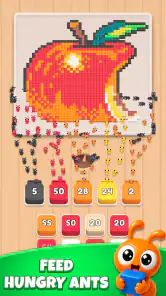
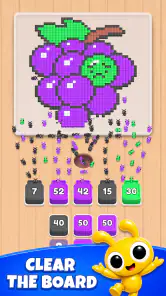
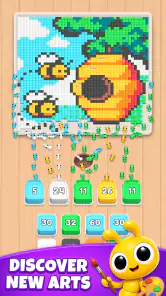
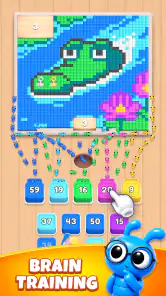
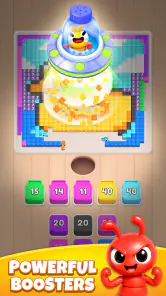
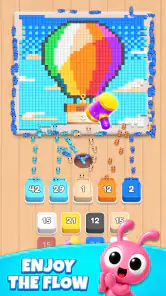
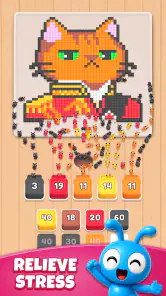
Analysis by Reviewed
Food Hunt: Pixel Puzzle is an unusual fit for a quick puzzle break: instead of shifting gems or fitting shapes, I’m asked to think about how ants can consume a picture one color at a time. That premise gives the game a clear visual identity, but it also makes the central question more specific than “Do I like puzzles?” I’d ask whether I enjoy carefully reading a board and making progress in small, deliberate steps. If that sounds satisfying, this is a game worth trying; if I want a story, fast action, or a constant stream of new mechanics, I’d look elsewhere.
A puzzle break that fits into an ordinary day
I can see Food Hunt: Pixel Puzzle working well in a short wait: I might open it while a kettle boils or while I’m waiting for someone to arrive, take on one board, and put my phone away once I’ve reached a natural stopping point. The point is not to turn every spare minute into a session. Its appeal is having a small visual problem ready when I want something more engaging than scrolling but less involved than a long game.
It is a better fit for someone who enjoys looking closely than for someone who wants to play with the sound off and tap through on autopilot. A practical way to test that fit is to play a board slowly at first, noticing which changes actually help. If I find the process satisfying even without rushing, the game’s central rhythm is probably for me. If I mainly want to clear things quickly, the measured pace may feel like friction rather than relaxation.
Articles Related to Food Hunt: Pixel Puzzle
How it differs from familiar puzzle routines
In the mobile puzzle category, match-three games often reward quick combinations, while block puzzles ask me to plan around empty space. Food Hunt’s focus on clearing a picture by color offers a different kind of attention: I’m considering the image as a board whose state changes in deliberate steps. That makes it a useful alternative when I’m tired of chasing cascades or arranging pieces, but it is not a replacement for those games if I specifically want their brisk feedback or spatial planning.
A non-obvious trade-off is that a readable picture can make the task feel inviting while also making it easier to lose track of the puzzle logic. I’d try narrowing my attention to the color I’m working through instead of scanning the whole image at once. This gives me a manageable question to answer and can help distinguish a move that advances the task from one that merely changes what I’m looking at.
Small goals give each puzzle its shape
The most appealing part of the concept is its simple, readable objective. The store summary captures the basic idea, but the useful point for a player is how that idea frames a puzzle: colors matter, and the order in which the board is dealt with is part of the thinking. Rather than chasing a complicated narrative goal, I can focus on understanding what the current picture asks me to do.
That makes the opening experience approachable in principle. Color is an easy visual cue to grasp, and the ant-and-food theme gives the activity a playful frame without needing a lengthy explanation. I’d recommend approaching each board as a small problem to inspect before acting, rather than tapping quickly and hoping the picture sorts itself out. In a one-color-at-a-time puzzle, noticing the state of the board is part of the challenge, not a pause before the “real” game.
You May Like

How Microsoft OneDrive Became a Mobile Productivity Giant

How Google Translate Breaks Language Barriers Effortlessly
Why Google Sheets Is the Ultimate Mobile Productivity Tool
Unveiling the Dynamic World of My Talking Tom Friends

Free Fire MAX: Dominating the Battle Royale Arena
Free Fire: Winterlands – The Ultimate Winter Gaming Adventure
This style suits brief pockets of time. I can imagine opening it while waiting for an appointment or taking a quiet break, concentrating on a single puzzle rather than committing to a long session. It is also a gentler option for someone who enjoys visual logic but finds competitive timers or dense rule sets tiring. The trade-off is that a calm, focused goal can feel repetitive if I’m looking for a puzzle game that constantly changes its central idea.
Food Hunt is listed as a free puzzle game from EVERFUN, with a 4.5 average from around 114,000 ratings and more than a million installs. Those figures suggest a sizeable audience, but they don’t tell me whether its particular rhythm will suit me. I’d treat them as context, not a substitute for trying the core loop: the appeal depends on whether gradual, color-based progress feels engaging rather than slow.
What to look for as you make progress
In a picture-based puzzle, progress is easiest to appreciate when I pay attention to what has changed, not only to whether I have finished. A useful habit is to pause after a move and check how the remaining colors and shapes now relate to one another. That small reset helps me avoid treating every action as interchangeable. It also turns a potentially fiddly board into a sequence of decisions I can understand.
This is one of the game’s more interesting trade-offs. The visual theme makes the task inviting, but a picture can also draw my eye away from the logic of the board. If I get stuck, I’d stop looking at the artwork as a whole and focus on the color I’m currently trying to clear. Then I’d scan the surrounding area and consider whether my next move creates a cleaner path or simply changes the image without helping. That method is useful even when the puzzle itself is not difficult: it keeps the play intentional.
I wouldn’t judge a session only by how quickly I finish. For this kind of puzzle, a satisfying signal is being able to explain why a move helped. If I’m making progress but can’t tell what my decisions are doing, I may be tapping rather than solving. If each step makes the remaining task easier to read, the game is giving me the kind of feedback that can keep a compact puzzle engaging.
That makes it a reasonable choice for players who like visual order and steady completion. It is less suited to someone who needs a strong sense of narrative advancement or a collection of elaborate systems to stay interested. Food Hunt’s premise invites attention to the board itself, so its satisfaction is likely to come from solving the immediate problem rather than from a broader story about the ants.
Challenge depends on how patiently you read the board
The difficulty I’d expect from this concept is less about reflexes and more about interpretation. When a puzzle is organized around colors, a rushed player can overlook relationships that become obvious after a moment’s inspection. My practical advice is to take a breath before committing to a move, especially when the remaining picture looks cluttered. A short pause can be more useful than repeating the same approach with faster taps.
That said, this is not automatically a perfect low-stress game. A visual puzzle can become frustrating when I stop seeing a clear next step, and a simple premise does not guarantee that every board feels effortless. If I find myself staring at the same area without learning anything, I’d take a break and return with fresh eyes rather than forcing a long session. This is a better match for patient experimentation than for someone who wants every puzzle to resolve immediately.
Compared with familiar match-three games, the appeal here is not the familiar rush of making combinations and watching a cascade. Compared with block-placement puzzles, the central pleasure is not fitting shapes into open space. Food Hunt’s color-by-color idea gives it a different visual problem to consider. That distinction is useful when choosing: players who enjoy studying an image and making measured progress may prefer it, while players who want a more kinetic board or a sharper tactical tempo may be happier with those alternatives.
The game is rated Everyone, so it is presented for a broad audience. I can see the gentle visual premise being approachable for younger players, though a child who expects action or character-driven play may lose interest. For adults, it works best as a small mental reset rather than a substitute for a deep strategy game. A parent choosing it for a shared break could use the color changes as a prompt to talk through possible moves, but the enjoyment still depends on whether the child likes puzzles that ask for patience.
Free to start, with a reason to keep expectations grounded
Food Hunt is free to download and includes in-app purchases, with listed item prices ranging from $0.99 to $99.99. That range is worth knowing before handing the device to a child or making the game part of a casual routine. I’d start without spending and decide whether the puzzle loop itself holds my attention. A purchase should make sense only if I understand what I’m buying and genuinely want it; the presence of optional purchases is not a reason to assume they are necessary to enjoy the basic idea.
For a low-commitment trial, the free starting point is helpful. I can test whether I like the color-focused approach before considering anything beyond it. The important distinction is between enjoying the puzzle and feeling pushed to spend in order to continue. If the game stops feeling like a pleasant break and starts feeling like an obligation, I’d step away instead of treating continued play as something I owe the app.
The version currently listed is 0.41, and the game was released on May 13, 2026. It requires Android 10 or later. Those practical details matter if I’m installing on an older phone or deciding whether to recommend it to someone whose device is several generations back. I’d check the operating-system requirement before downloading, rather than discovering the mismatch after looking forward to trying it.
How well its pacing can hold attention
The strongest retention hook here is the natural appeal of finishing a visual task: I can see the picture changing as I work through its colors. That gives a session a clear endpoint and makes it easy to fit around ordinary routines. I’d use it when I want one contained challenge, not when I’m trying to fill a whole evening with a game that keeps introducing new modes or a layered progression system.
There is also a limit to that kind of momentum. If several puzzles feel too similar, the same clean objective that makes the game easy to understand can make it feel predictable. I would not recommend it to a player who needs frequent surprises, a competitive ladder, or a complex unlock path to stay motivated. Its hook is focused rather than expansive, and that is either a strength or a weakness depending on what I want from a mobile game.
To keep the experience pleasant, I’d set a simple stopping point before starting: one puzzle, or a short break, rather than an open-ended session. That approach suits the game’s small-goal structure and helps prevent a relaxing activity from becoming mindless repetition. It is especially useful when I’m playing between tasks, because I can enjoy a clear finish without letting the game consume the time I meant to spend elsewhere.
Who should skip it? Anyone who dislikes color-led visual puzzles, gets impatient when a board needs inspection, or wants story and action to carry a game should probably choose a different genre. It may also disappoint players who judge a puzzle game mainly by how many distinct mechanics it layers together. Food Hunt’s premise is deliberately narrow; its success depends on making that narrow idea satisfying enough to revisit.
My verdict on its progression
I’d recommend Food Hunt: Pixel Puzzle to someone who wants a friendly, visually guided challenge and enjoys seeing a board change through careful decisions. The early goal is easy to understand, the color-focused progress gives each puzzle a visible sense of movement, and the format can fit naturally into short breaks. Its best quality is that it asks me to pay attention without demanding a fast reaction.
I would keep my expectations modest about how far that single idea can stretch. The game is not the right pick if I want elaborate progression, a strong story, or a constantly changing set of puzzle rules. Its calm pacing can also become repetitive for players who need a new kind of challenge every few minutes. In my view, the right way to try it is to download the free game, give the core puzzle style a fair chance, and stop if the color-by-color rhythm feels more like repetition than discovery.
For a casual player, that is a clear and useful proposition: a small puzzle with a playful ant theme, a broad age rating, and a visual objective that rewards patience. The 4.5 average and sizable player base make it a familiar choice in the mobile puzzle space, but the deciding factor is still personal taste. If I want a quiet board to study and a simple task to complete, I’d give it a go. If I want speed, story, or a deep progression journey, I’d pick another game.
Food Hunt: Pixel Puzzle Frequently Asked Questions
What is Food Hunt: Pixel Puzzle?
Food Hunt: Pixel Puzzle is a casual puzzle game built around arranging or matching pixel-style food pieces to complete challenges. Its simple visual theme makes it easy to understand at a glance, while the puzzle objectives encourage careful planning rather than fast reactions. Exact mechanics and available modes can vary by version, so check the game’s store listing and screenshots to confirm what is included in the release available on your device.
Is Food Hunt: Pixel Puzzle free to download, and does it include ads or in-app purchases?
The game may be offered as a free download, but pricing and monetization can differ between the Android and iOS versions and may change over time. Some mobile puzzle games include advertising, optional purchases, or both; do not assume that every feature is available without payment. Before downloading, review the current store listing for price, in-app purchase details, and information about ads so there are no surprises.
Can I play Food Hunt: Pixel Puzzle offline?
Whether Food Hunt: Pixel Puzzle works without an internet connection may depend on its current version and how its levels or optional features are delivered. Core puzzle play may be available offline in some releases, while advertisements, cloud saves, updates, or online events generally require a connection. If offline access matters to you, check the app’s listing and test the game with connectivity disabled before relying on it while travelling.
Is Food Hunt: Pixel Puzzle suitable for children?
The colorful pixel-food presentation and puzzle-focused format may appeal to younger players, but suitability depends on the game’s content, difficulty, advertisements, and purchase options. Check the age rating on the relevant app store and review its privacy information before installing it for a child. If the game includes ads or in-app purchases, parental controls can help manage exposure and prevent unintended spending.
Which devices support Food Hunt: Pixel Puzzle, and what should I check before downloading?
Compatibility depends on the specific Android or iOS release, your device model, and the operating-system version installed. Check the game’s store page for its minimum requirements, download size, supported devices, and any permissions it requests. Keeping enough free storage and installing the latest system updates can help avoid setup problems. Availability may also differ by region, so confirm that the title appears in your local app store.
Pros
- Pixel-art visuals give the puzzle boards a distinctive
- nostalgic look.
- Short levels make it easy to play in quick sessions.
- The food theme keeps the presentation cheerful and approachable.
- Simple matching rules are easy for new players to understand.
- Level-based progression provides clear goals as you play.
Cons
- The core puzzle format may feel repetitive over longer sessions.
- Later stages can require more careful planning than the early levels.
- Pixel graphics may not appeal to players who prefer detailed visuals.
- Progress depends on completing levels
- which can feel slow at times.
- The game offers limited variety for players seeking a broader puzzle mix.
- Category
- Puzzle
- Version
- 0.41