Euchre Classic Card Game
- 3.06K
- 4.1
- Installs
- 500.00K
- Price
- Free

Screenshots
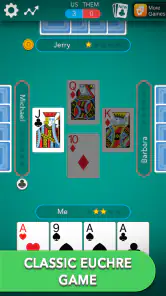
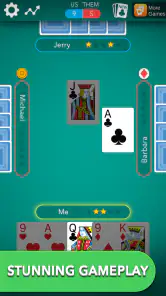
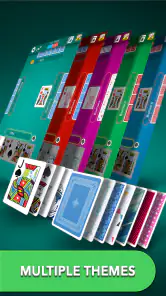
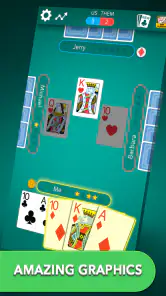

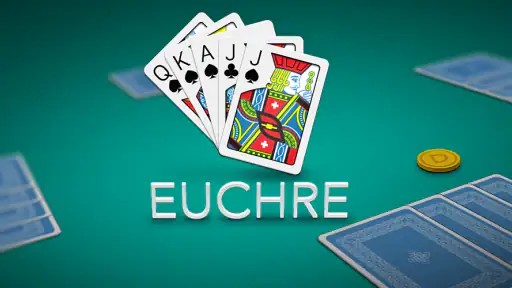
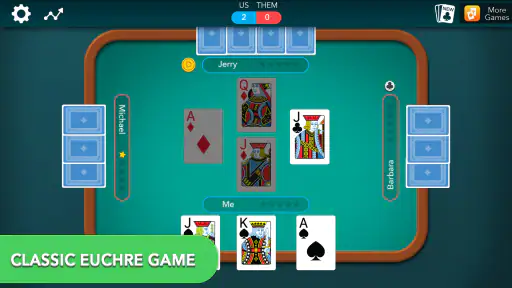
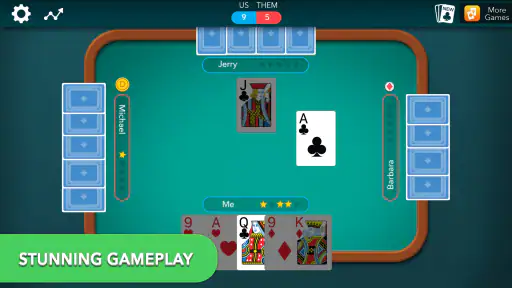
Analysis by Reviewed
I came to Euchre Classic Card Game expecting a straightforward digital version of a traditional trick-taking game, and that is exactly where its appeal lies. It does not ask me to learn a sprawling collection of cards, build a deck, or manage a long campaign. I choose a hand, decide how aggressively to bid, play each trick, and quickly find myself thinking about the next deal. That compact rhythm makes it easy to open for a few minutes, while the decisions are sharp enough to keep a familiar card game from feeling empty.
This is a free card game from FIOGONIA LIMITED, available for Everyone and designed for Android devices running version 7.0 or later. It has built a solid audience, with over 500 thousand installs and a 4.1 average from around 8.5 thousand ratings. Those figures suggest a game that is easy to approach rather than a niche simulator aimed only at serious Euchre players. After spending time with it, I would describe it as a convenient practice table and a casual way to play, with enough tactical pressure to reward attention.
How a hand turns into another hand
The first action is simple, but the decision is not
The most important thing about a Euchre round is that the first meaningful choice arrives early. I am not merely matching cards by color and waiting for the game to finish. I have to judge whether the proposed trump suit gives my hand enough strength, whether my partner is likely to help, and whether taking control is worth the risk. That makes the opening of a deal feel active immediately.
The rules are approachable if I already know trick-taking games, but a newcomer still has a few ideas to absorb. Trump changes the value of the cards, the right bower becomes especially important, and the left bower belongs to the trump suit rather than its printed suit. Those details are where many casual players make their first mistakes. I found it useful to slow down and think in terms of the current trump suit instead of trusting the symbols printed on the cards.
That small mental adjustment is one of the better reasons to use a digital version. The app lets me concentrate on the decision instead of physically sorting cards or checking every rule with another player. It is also a forgiving way to learn the order of play because the table presents the available action at the moment it matters. I still need to understand why a move is good, but the interface reduces the handling work that can distract from the game itself.
My practical advice is to avoid treating every strong card as an automatic reason to call trump. A hand with one excellent card and little support can be more fragile than it first appears. I look at how many tricks I can realistically take, not just whether I hold the highest card. That habit makes the game more interesting and prevents the opening decision from becoming a repetitive “choose the strongest-looking option” routine.
Feedback arrives one trick at a time
Once play begins, the feedback rhythm is clear: I choose a card, see whether it wins the trick, watch the score situation change, and immediately reconsider the remaining cards. A successful play feels good because it confirms a prediction. A failed play is useful because it exposes a gap in my reading of the hand. The short distance between action and result keeps the game understandable even when I make a poor decision.
The strongest part of this rhythm is how quickly it teaches restraint. It is tempting to spend a powerful trump card simply to secure an early trick, but doing so can leave me without control when the hand reaches its important moment. I began paying more attention to what had already been played, especially the cards that could no longer threaten my remaining winners. That turns each trick into information rather than just a point.
There is also a subtle difference between playing to win a trick and playing to protect a contract. If I have called trump, the goal is not always to collect every possible trick. Sometimes the sensible move is to preserve one key card, allow a minor loss, and keep the hand on track. This is the kind of judgment that makes the app more than a passive card animation. It gives me a reason to review my own choices after the deal ends.
For a beginner, the feedback can feel less explanatory than a dedicated tutorial would be. The game is better at showing the consequence of a play than at teaching the full strategic vocabulary of Euchre. I would not recommend jumping in while expecting every rule and tactic to be explained in depth. A new player will get more from it by playing several low-pressure hands, noticing which cards win, and then applying one lesson at a time.
One useful approach is to mentally track the trump cards that have appeared. I do not need to remember every ordinary card. Knowing whether the strongest trump cards are still hidden often tells me more than remembering a complete discard history. This is a practical skill that carries from one hand to the next and gives the game a satisfying layer of concentration without turning a short session into homework.
The reward is control, not decoration
The immediate reward in this game is the feeling of having read the hand correctly. Winning a trick after holding back a stronger card, choosing a sensible trump suit, or recovering from an awkward deal gives each round a small payoff. I like that the pleasure comes mainly from decisions rather than from collecting elaborate extras. The core satisfaction is still recognizably the satisfaction of Euchre.
That also means the game may not satisfy someone looking for a large progression system. Players who prefer card games with extensive deck construction, character upgrades, story chapters, or a constant stream of unlockable content may find this experience restrained. Its reward is repeated improvement: I see a situation, make a choice, learn from the result, and try to handle a similar hand better next time.
The offline option is particularly valuable here. I can use the game when I want a quiet card session without arranging a table or depending on a live opponent. That makes it suitable for a commute, a waiting room, or a short break at home. The important trade-off is that offline play is best understood as a self-contained practice or casual match experience, not a replacement for the social energy of sitting across from people I know.
Online play changes the emotional texture. A human opponent can make an unexpected choice, and that uncertainty makes a familiar hand feel less predictable. If I enjoy reading another person’s habits, online play is the more engaging option. If I mainly want to rehearse bidding or relax without pressure, offline play is the better fit. Being able to choose between those moods is one of the app’s practical strengths.
I would also keep the free price in perspective. The game costs nothing to start, but it includes in-app purchases ranging from $4.99 to $29.99 per item. That does not automatically make the free experience unsuitable, yet it is worth remembering before treating the app as a completely purchase-free pastime. I would begin without buying anything and first decide whether the basic deal-and-play loop is enjoyable enough to justify spending more.
Why the reset makes another session tempting
After a hand ends, the reset is almost as important as the result. A win can make me want to continue because I feel I have found a good rhythm. A loss can be just as motivating because the next deal offers a clean chance to correct the mistake. The short structure prevents one unlucky hand from dominating the entire experience, although it also means I need to accept that a single round may not reflect my actual skill.
This is where the app works well as a break-time game. I can finish a round, put the phone down, and return later without losing the basic appeal of the activity. Alternatively, I can continue because the next hand asks a different question. The reset is not merely a loading point; it clears the tactical situation while leaving me with a small lesson from the previous deal.
A realistic example is a quiet evening when I have only fifteen minutes. I can play a hand or two without committing to a long multiplayer match. If I notice that I am rushing the trump decision, I can make the next round about patience rather than trying to win at all costs. That kind of personal goal gives a short session direction. It also prevents the game from becoming a mindless sequence of taps.
There is a downside to the same compactness. People who want a long-form competitive ladder, a persistent identity, or a rich social community may find the reset too abrupt. The app is strongest when the hand itself is the main event. It is less convincing if I need a broader ecosystem around each match. In that situation, a dedicated multiplayer platform or a physical game with regular friends would offer more atmosphere and continuity.
How it compares with other ways to play Euchre
Compared with a physical deck, this app is faster to set up and more convenient when I am alone. There is no shuffling, dealing, scorekeeping, or disagreement about whose turn it is. That makes it a good companion for learning the flow of the game or filling a small gap in the day. The physical alternative still wins when four people are together, because conversation, table presence, and shared reactions are part of what makes card games memorable.
Compared with a generic solitaire app, the decisions here are more social and more dependent on partnership. I am not simply optimizing a visible layout. I need to consider the contract, the likely strength of the other side, and the information revealed by each played card. Someone who wants a solitary puzzle with no bidding or partner dynamics may prefer solitaire. Someone who enjoys compact competition should find Euchre more involving.
Compared with a larger online card-game platform, this title feels more focused. It does not need a complicated collection of modes to make a hand worthwhile. That focus is useful for players who already want Euchre and do not want to navigate unrelated games. The trade-off is variety: a broad platform may provide more formats, more social tools, and a deeper sense of ongoing competition. I would choose this app for direct access to the game, not for a huge card-game hub.
Small habits that improve the experience
My first recommendation is to treat the opening call as a probability decision, not a test of bravery. Before choosing, I ask which tricks are certain, which are conditional, and which depend on my partner. That simple three-part check makes weak hands easier to recognize and helps prevent a flashy card from distorting my judgment.
Second, I try to notice what the opposing players do when they cannot follow suit. A discard can reveal that a suit is becoming dangerous, while a delayed trump play may suggest that a stronger card is still waiting. I do not need perfect memory. I only need enough awareness to avoid replaying the same assumption on every trick.
Third, I use offline rounds as focused practice rather than endlessly repeating random hands. One session can be about identifying the right trump. Another can focus on preserving control until late in the deal. This turns the reset into a learning tool. It is a more effective use of the app than measuring success only by the final score.
Finally, I would avoid playing while distracted if I am trying to improve. Euchre is short, but the small decisions arrive quickly. If I am watching television or answering messages, I may still complete a hand, yet I will miss the information that makes the next hand more interesting. For casual relaxation that may be fine; for meaningful practice, a few undisturbed minutes work better.
Who should install it, and who should skip it
I recommend this game to someone who already enjoys Euchre, wants an accessible way to play without a physical group, or likes card games built around quick tactical choices. It is also a reasonable starting point for a newcomer who is willing to learn through repeated hands rather than expecting a long tutorial. The combination of free access, offline play, and a compact round structure makes it easy to test without much commitment.
I would be more cautious about recommending it to players who dislike bidding, partnership uncertainty, or repeated short matches. It is not a deck-building game, a story-driven adventure, or a card battler with a large collection of systems. If your ideal app is about unlocking cards, customizing a character, or working through a campaign, this focused format may feel too narrow.
Device compatibility is also straightforward: the current version is 1.6.1 and it supports Android 7.0 or newer. That makes it approachable for many older Android phones, provided the operating system meets that requirement. I would still keep expectations realistic about the experience: this is a classic card table translated to a screen, not a visually elaborate production designed to compete with major action games.
My verdict on the complete loop
The loop works because every stage has a clear purpose. I take the first action by judging the hand and deciding how much responsibility to accept. I receive immediate feedback as each trick tests that judgment. The reward is a successful read, a well-timed card, or a better understanding of why a plan failed. Then the hand resets, giving me a fresh puzzle and a reason to try again.
That loop is not flashy, but it is dependable. The app’s best quality is that it respects the structure of Euchre instead of burying it under unnecessary systems. Its limitations are equally clear: the experience may feel too focused for players seeking a broad card-game platform, and the included purchases mean “free” should not be confused with an entirely purchase-free ecosystem.
After using it, I would keep Euchre Classic Card Game installed as a practical option for short offline sessions and casual online play. I would not present it as the definitive choice for every Euchre fan, especially someone whose priority is a lively group table or a deep competitive community. But if you want the essential decisions of Euchre in a convenient Android game, I think it earns a place on the shortlist. The reason to return is simple: one hand ends, one lesson remains, and the next deal gives you a chance to use it.
Pros
- Clear rules and tutorials help beginners learn Euchre quickly.
- Smooth offline play is useful when traveling or without internet access.
- Customizable difficulty provides a challenge for different skill levels.
- Quick rounds make it easy to enjoy a game during short breaks.
- Simple card-focused design keeps attention on the gameplay.
Cons
- Limited variety may feel repetitive after extended play sessions.
- Computer opponents can make predictable moves at lower difficulties.
- Some features may require patience to understand at first.
- The game may not appeal to players unfamiliar with trick-taking cards.
- Ads can interrupt the experience in the free version.

- Category
- Card
- Version
- 1.6.1