Cryptogram · Cryptoquote Game
- 3.71K
- 4.5
- Installs
- 500.00K
- Price
- Free
Screenshots
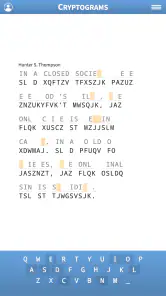
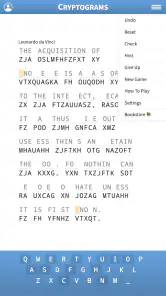
Analysis by Reviewed
I like word games that give me something to think about without demanding a long session, and Cryptogram · Cryptoquote Game fits that space well. It is a free word puzzle game from Razzle Puzzles built around decoding quotations: each letter in the puzzle stands for another letter, and my job is to uncover the substitution until the sentence makes sense. The idea is simple, but a difficult quotation can keep me occupied far longer than I expect.
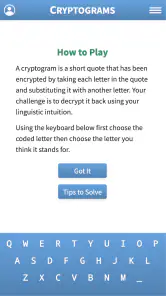
What makes it approachable is that the first goal is clear. I am not learning a complicated board, managing resources, or memorizing a large rulebook. I read the displayed text, look for patterns, test a possible letter, and gradually turn an apparently meaningless line into readable language. That makes it a comfortable choice for a first-time player who wants a calm mental challenge rather than a fast arcade game.
What the first session feels like
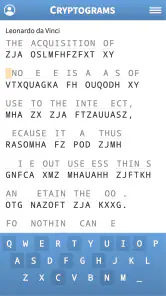
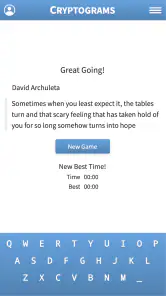
After installing it, I can get into the core activity quickly. The game presents a cryptogram, and the useful information is already in front of me: repeated symbols, short words, word lengths, punctuation, and the overall shape of the quotation. I do not need to understand a separate story or complete a tutorial campaign before the puzzle becomes meaningful. My first satisfying moment usually comes when one correct guess unlocks several connected letters and the sentence suddenly starts to reveal itself.
The game is listed for Everyone, which matches its basic concept. The challenge comes from language and deduction, not from complicated controls or mature themes. It also runs on Android devices using version 6.0 or later, so it remains relevant for people using older compatible phones rather than only the newest hardware. The current version is 1.90.
Razzle Puzzles has kept the presentation focused on the puzzle itself. That is good when I want a short break during a commute, while waiting for an appointment, or before going to sleep. I can concentrate on one quotation without the visual noise that often surrounds more elaborate mobile games. At the same time, anyone expecting animated characters, a narrative, or a large collection of game modes may find the experience intentionally narrow.
Starting without feeling lost
My advice to a new player is not to begin by trying to solve every letter at once. I first scan the quotation for a one-letter word, repeated short words, and familiar endings. A single-letter word is especially useful because English gives me only a small set of realistic possibilities. Once I have a reasonable candidate, I check whether that letter produces sensible fragments elsewhere instead of committing emotionally to the first guess.
This is the first important trade-off: the game is easy to understand but not always easy to solve. The rules can be grasped almost immediately, while the vocabulary, quotation style, and letter relationships determine how long the puzzle takes. A player who prefers instant rewards may find the slower deduction frustrating. I enjoy it more when I treat each puzzle as a process of narrowing possibilities rather than as a test I must finish quickly.
The most useful early habit is to work from certainty toward probability. If a repeated pattern appears in several words, I compare those words before entering a guess. For example, a three-letter pattern that appears twice may represent a common word, but I should wait for another clue if several alternatives fit. This prevents one bad assumption from spreading through the whole quotation and forcing me to undo a chain of guesses later.
The first meaningful success
The first real breakthrough usually happens when I identify a common word pattern rather than a famous quotation. Repeated letters can reveal whether a word has a double letter, while the position of a symbol can show whether it is likely to be a vowel or consonant. I enter the most convincing substitution, then use the new information in every other word. When several fragments become readable together, the puzzle stops looking like a wall of symbols and starts behaving like a connected language problem.
That moment is why I would recommend this game to people who enjoy crosswords, anagrams, or logic puzzles but want a different kind of challenge. Crosswords give me clues and a grid; anagrams focus on rearranging known letters; this game asks me to infer a hidden alphabet. It feels closer to solving a small code than filling in a conventional word list. Someone who enjoys recognizing patterns may find that distinction especially rewarding.
A practical approach is to keep the quotation visible as a sentence, not as a collection of isolated words. Grammar provides clues. If a partially solved phrase looks like a verb followed by a likely noun, that relationship can guide the next guess. Punctuation also matters: a comma, apostrophe, or question mark can tell me how the sentence is structured. I do not need specialist cryptography knowledge; ordinary reading instincts are often more valuable than technical terminology.
When I get stuck, I take a short break instead of entering random substitutions. Returning after a few minutes often makes a familiar word pattern stand out. This is one of the game’s quiet strengths: it works well in interrupted sessions. A puzzle does not require the same continuous attention as a timed action game, so I can put it down and come back when I have more patience.
Where new players commonly hesitate
The biggest source of confusion is assuming that a symbol always has the same visual identity as the letter it represents. It does not; the point of the puzzle is to discover the substitution. I have to separate what I can see from what I think the sentence means. A word that looks obvious may still be wrong if its proposed letters create impossible combinations elsewhere.
Another common mistake is treating a plausible quotation fragment as proof. Familiar phrases can tempt me to force the remaining letters to match my memory. That approach may work occasionally, but it can also create contradictions. I get better results by using the quotation’s visible patterns first and treating recognition as confirmation rather than as the starting point.
It is also worth remembering that a difficult puzzle can feel harder because of the wording, not because I have misunderstood the rules. Unusual vocabulary, names, or a sentence with an unexpected structure can slow down even an experienced player. If every guess seems to fail, I review the earliest assumption I made. The problem is often one incorrect letter that has been reused across several words.
For that reason, I would not recommend guessing rapidly just to make the screen look more complete. Careful elimination is more effective. I look for substitutions that preserve the same relationship wherever the symbol appears. If a candidate letter makes one word look attractive but turns two other words into nonsense, I discard it. The game rewards consistency more than speed.
How I make short sessions worthwhile
For a quick daily-style routine, I choose one puzzle and give myself enough time to understand its structure before trying to finish it. I identify repeated patterns, mark the words that look most familiar, and solve the parts that offer the strongest evidence. Even when I do not reach the final quotation, I usually leave with a clearer idea of what remains. That makes the session feel productive instead of incomplete.
For a longer session, I change my focus from individual words to the rhythm of the sentence. I read the partially decoded line aloud in my head and consider what kind of phrase would naturally follow. This is not a shortcut that guarantees an answer, but it helps when the letter evidence has narrowed the possibilities. The combination of visual pattern recognition and ordinary language sense is more powerful than either method alone.
One less obvious benefit is that the game encourages me to notice how much information is hidden in small grammatical details. Articles, contractions, repeated endings, and word positions all become useful clues. I would not describe it as a formal language-learning tool, because its main purpose is solving puzzles, but it can make me more attentive to sentence construction. That makes it a better fit for curious readers than for players who only want a quick matching mechanic.
There is also a useful mental boundary between solving and searching for a quote I recognize. If I already know the quotation, the task can become a memory exercise. If I do not, the solution feels more like deduction. I enjoy both situations, but they offer different kinds of satisfaction. Players who want pure logic may prefer unfamiliar lines, while people who enjoy word recognition may appreciate the moment a well-known phrase emerges.
How it compares with familiar word games
Compared with a crossword, this game gives me fewer direct clues but more internal repetition. A crossword can let me jump between unrelated entries when one clue is difficult. A cryptogram is more interconnected: one substitution may affect many words, so progress can accelerate once I find a reliable foothold. That connection is exciting, but it also means a mistaken guess can make the whole puzzle feel blocked.
Compared with an anagram game, the challenge is less about generating vocabulary and more about testing relationships. I am not given a pile of letters to rearrange into a word. Instead, I infer a consistent mapping across an entire quotation. This makes it a stronger choice for players who like deduction and a weaker choice for anyone who prefers rapid rounds with obvious completion points.
Compared with a standard word-search game, the experience is slower and more interpretive. Word searches reward scanning and visual speed, while this title asks me to read, hypothesize, and revise. I would choose it when I want my attention engaged for several minutes, not when I want something I can finish almost automatically while multitasking.
The free price makes it easy to try without turning the decision into a purchase commitment. Its audience is also substantial, with over 500 thousand installs, an average rating of 4.5 from around 12 thousand ratings, and around 3.7 thousand written reviews. Those figures suggest that the straightforward format has found a dependable audience, although they do not change the basic truth that enjoyment depends heavily on whether I like quotation-based deduction.
Limitations I noticed before recommending it
The focused design can become repetitive if I play for a long stretch every day. The central action remains decoding quotations, so there is less variety than in a word game that alternates between anagrams, clues, timed rounds, and themed boards. I see that as a deliberate design choice rather than a flaw, but it matters when deciding what to install.
The difficulty can also feel uneven from one quotation to another. A familiar sentence with common words may open quickly, while a less predictable line can leave me searching for a starting point. Players who want a perfectly smooth progression may prefer a game with a more visible level structure. Here, the satisfaction comes from solving the specific puzzle in front of me, even when the path is not equally clear each time.
It is not my first choice when I have only a few seconds, because reading the quotation and forming a useful hypothesis takes some attention. It is also not ideal for someone who dislikes seeing a puzzle remain unfinished. In that situation, a short word-matching game may feel more comfortable. I would skip this one if my main goal were competition, rapid scoring, or a rich visual adventure.
On the other hand, I would choose it for a quiet break, a waiting room, or a low-pressure evening activity. It does not ask me to remember a complicated control scheme, and the core challenge remains understandable even after a long gap between sessions. That makes it particularly suitable for adults who enjoy language puzzles and for families looking for an Everyone-rated game that can be approached at different skill levels.
The best next step after the first puzzle
Once I solve my first quotation, I do not immediately try to become faster. I review which clue helped most: the one-letter word, a repeated ending, punctuation, or a phrase I recognized. On the next puzzle, I deliberately start with a different type of evidence. This turns each round into practice for a specific solving skill instead of a series of lucky guesses.
I also recommend keeping a mental note of contradictions. If a proposed substitution makes a common word impossible somewhere else, that is useful information rather than wasted effort. I remove the weak assumption and return to the strongest visible pattern. This habit is especially valuable when a puzzle appears nearly solved but one awkward word refuses to fit.
For a friend trying it for the first time, I would explain the goal in one sentence: find a letter substitution that works everywhere, not just in one attractive word. Then I would suggest solving the most constrained parts first and allowing the sentence to guide later guesses. That is enough to produce a meaningful first success without making the game feel like homework.
My recommendation is simple: choose Cryptogram · Cryptoquote Game if you want a free, thoughtful word challenge built around decoding quotations. It is easy to start, satisfying when the hidden sentence emerges, and flexible enough for short breaks. I would look elsewhere for varied modes, competitive pressure, or a more energetic presentation, but for calm pattern solving, this remains a focused and approachable option from Razzle Puzzles.
Released on August 14, 2014, it has had time to establish a clear identity rather than chasing every trend in mobile gaming. I appreciate that restraint. The experience is not trying to be everything at once; it gives me a quotation, a code, and the pleasure of making sense of it. If that particular loop sounds appealing, the free download is an easy experiment, and the first solved phrase will tell you quickly whether this style of word puzzle suits you.
In my experience, the right expectation makes all the difference. I do not open it looking for instant entertainment or a collection of unrelated mini-games. I open it when I want to read closely, test a theory, and enjoy the gradual shift from confusion to clarity. For that purpose, Cryptogram · Cryptoquote Game delivers a small but genuinely engaging puzzle experience.
Pros
- Thousands of quote puzzles provide plenty of content for regular play.
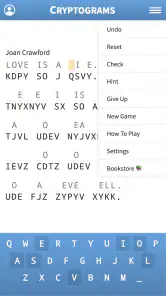
- Simple controls make it easy to enter letters and correct mistakes.
- Helpful hints can assist when a puzzle becomes especially difficult.
- Short rounds work well for quick sessions during breaks or commutes.
- Solving famous quotes can improve vocabulary and pattern-recognition skills.
Cons
- Some puzzles may feel repetitive if you play for long periods.
- Hints can reduce the challenge and may require in-game resources.
- The game may become frustrating when several letters have similar patterns.
- Progress can feel slow for players who prefer fast-paced gameplay.
- Ad interruptions may affect the flow of puzzle-solving sessions.
- Category
- Word
- Version
- 1.90