Crime Mysteries: Find objects
- 2.70K
- 4.5
- Installs
- 1.00M
- Price
- Free

Screenshots







Analysis by Reviewed
I spent time with Crime Mysteries: Find objects expecting a light hidden-object game, but its identity is a little broader than that. It combines clue hunting, clue analysis, match-three puzzles, and case solving in an adventure package from G5 Entertainment. That combination gives each session a useful sense of direction: I am not simply searching a busy picture for entertainment, because the objects I find are tied to an investigation and the next step in a mystery.
The game is free to start and is rated for Everyone 10+, which makes it an approachable choice for players who enjoy detective stories without wanting a frightening or especially demanding experience. It has attracted more than a million installs and holds a 4.5 average from roughly 26 thousand ratings, so there is clearly a sizeable audience for this particular blend of investigation and puzzle play. My own impression is that its strongest appeal comes from the way it turns familiar hidden-object tasks into small pieces of a larger case.
How the first cases establish a clear routine
The opening experience is built around a simple loop that is easy to understand. I look through a scene, identify useful objects, examine clues, and then use match-three puzzles as part of the investigation. That structure gives the early game a practical goal beyond “finish the level.” Each completed activity feels like progress toward understanding what happened, even when the individual action is simply spotting an item or clearing a board.
That clarity matters because hidden-object games can sometimes feel like disconnected picture searches. Here, the detective framing gives the search a reason. I found it easier to stay focused when I treated every scene as evidence rather than as a visual quiz. The game works best when I slowed down enough to inspect the image instead of tapping randomly, then approached the match-three section as another step in the same case rather than as a completely separate mini-game.
The early goals are also friendly to short sessions. I could make progress without needing a long uninterrupted sitting, which suits playing during a commute, a break, or while waiting for an appointment. At the same time, the case structure gives me a reason to return later. I was not merely trying to beat a score; I wanted to see what the next discovery would reveal.
One useful habit is to read the objective before searching. It is tempting to scan the entire scene immediately, but the wording of the task can influence what deserves attention. I found that concentrating on the requested objects first made the search feel less chaotic. This is a small adjustment, but it helps preserve the detective feeling and reduces the urge to tap every suspicious-looking detail.
Why the combination of search and match-three works
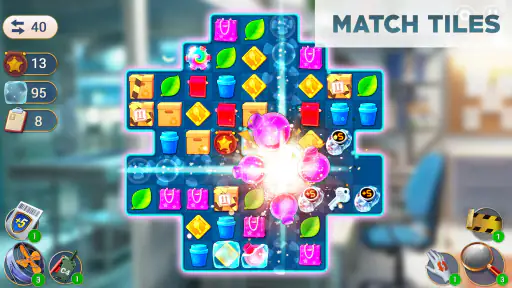
The two main activities create a modest change of pace. Searching asks me to observe shapes, colors, and context, while match-three play asks me to recognize patterns and plan moves. If the game consisted only of one activity, the rhythm would become more predictable. Switching between them keeps the investigation from becoming visually monotonous, even though both parts are straightforward to learn.
I also liked that the match-three sections do not undermine the detective theme completely. They function as a puzzle interruption within the case rather than replacing the investigation altogether. The transition is not for players looking for a deep standalone match-three game, but it gives the wider adventure a more active rhythm. For me, the best sessions came from treating the search as the observation phase and the board as the problem-solving phase.
There is a trade-off here. Anyone who wants a pure hidden-object experience may find the match-three portions unnecessary, while players who mainly want match-three action may consider the scene searches slower than expected. The game is aimed at people who are comfortable moving between both styles. That hybrid design is its defining strength, but it is also the first reason a specialist alternative might suit someone better.
Progress signals that keep the investigation moving
The game communicates progress through the cases themselves. Finding and analyzing clues gives the player a sense that the investigation is advancing, while completing puzzles helps maintain momentum between discoveries. I appreciated this because the game does not rely on one single type of reward to make progress feel meaningful. The narrative purpose of the clues and the immediate satisfaction of completing a puzzle support each other.
In practical terms, the strongest progress signal is the change from uncertainty to a clearer picture of the case. A scene begins as a crowded collection of details, but after I locate the relevant objects, it becomes part of a chain of evidence. That shift is more satisfying than simply receiving a completion message. It encourages careful searching and makes the visual clutter feel intentional rather than random.
The pacing also benefits from having both small and larger goals. A single object can be found quickly, a match-three board can provide a compact challenge, and a case gives those actions a wider purpose. This layered structure is useful for different moods. When I only had a few minutes, I could focus on the immediate task. When I had more time, I could follow the investigation further and enjoy the continuity between scenes.
Players wondering whether the game is suitable for casual play should know that its casual nature does not mean the investigation is entirely passive. The basic controls are accessible, but attention still matters. Searching efficiently is easier when I compare the requested object with the scene’s lighting and perspective instead of assuming every item will appear at a convenient size. The game rewards patience more than frantic tapping.
Small decisions that improve each session
I found three practical approaches especially helpful. First, I scan the edges of a scene before settling on the center, because decorative objects near borders are easy to overlook. Second, I avoid spending my attention on items that merely resemble the target; I wait for the shape and context to match. Third, I treat the match-three board as a planning exercise rather than making the first obvious move. These habits do not change the rules, but they make the experience less wasteful and more deliberate.
Another useful approach is to stop after a frustrating search instead of repeatedly tapping the same area. A short pause often makes an overlooked object stand out when I return to the image. This matters because visual fatigue is one of the more genuine weaknesses of the format. The game can be relaxing, but long searches through detailed scenes may become tiring, particularly on a smaller phone screen.
The game is also a reasonable fit for players who like a gentle sense of completion. I never felt that I needed to master complicated controls to understand what to do next. The challenge comes from observation, matching, and maintaining attention. That makes it more welcoming than an adventure game built around complex action or difficult navigation, but it also means players seeking a highly demanding mystery may find the interaction too restrained.
How the challenge develops and where friction appears
The difficulty is most effective when it asks me to look more carefully rather than simply move faster. Hidden-object scenes naturally become harder when similar shapes, busy backgrounds, and less obvious placements compete for attention. The match-three sections add a different kind of pressure, asking me to notice combinations and choose moves with some thought. Together, these challenges create variety without turning the game into a reflex test.
That said, the difficulty curve is not equally satisfying for every player. If I am in the mood for a relaxed search, a demanding scene can feel like a sudden interruption to the story. If I am looking for a serious puzzle challenge, the basic structure may feel too forgiving. The game sits between those extremes. Its challenge is enough to keep me engaged, but it is not designed as a specialist logic game or a hard-core detective simulation.
Screen size makes a noticeable difference to comfort. On a larger display, details are easier to separate and the search feels more like examining evidence. On a small phone, crowded scenes can require more concentration, and repeated zooming or close inspection would be welcome in any hidden-object experience. I would recommend playing with the screen brightness and viewing angle adjusted before assuming a scene is unfair; visual conditions have a real effect on how difficult the search feels.
The age rating of Everyone 10+ is a useful guide to the tone. The crime theme gives the game a sense of mystery, but the overall experience is much closer to accessible puzzle adventure than to graphic or intense crime drama. I would consider it appropriate for older children and adults who enjoy investigation themes, while parents should still decide whether the subject matter suits a particular child.
Free access and the pressure to continue
The free entry point makes it easy to try the central loop before deciding whether it deserves regular play. That is important here because the blend of clue hunting and match-three puzzles will not appeal equally to everyone. I would rather test the rhythm myself than choose based only on the detective label. The game can be enjoyed casually, but its long-term appeal depends on whether the case structure keeps the player interested after the novelty of the first searches fades.
There are in-app purchases ranging from $0.99 to $99.99 per item. That range is worth considering before becoming invested, especially for players who prefer games with a single upfront price or no purchase prompts. I did not view spending as essential to understanding the basic concept, but the presence of optional purchases can affect how comfortable the pacing feels. Players who dislike any form of monetization pressure may be happier with a paid adventure or a puzzle game designed around one purchase.
My advice is to decide in advance how you want to play. If I treat the game as a free series of short investigations, the experience feels more relaxed. If I start measuring every pause against the desire to advance immediately, the free-to-play structure becomes more noticeable. Setting that expectation early helps prevent the game from turning a pleasant break into a frustrating attempt to push through every case at once.
This is also where the game’s retention design becomes clear. The cases provide the long-term reason to return, while the short searches and boards provide immediate tasks. That is a sensible structure for mobile play, but it can encourage “just one more” sessions. I found it useful to finish at a natural stopping point rather than continuing automatically, particularly when I noticed that my accuracy was dropping from fatigue.
Who will enjoy it and who should choose something else
I would recommend this game to someone who likes hidden-object scenes but wants more context than a sequence of unrelated pictures. It is especially suitable for players who enjoy switching between visual observation and match-three puzzles, and for anyone who prefers adventure games that can be played in compact sessions. The detective presentation gives ordinary searches a stronger purpose, while the puzzle breaks keep the routine from feeling completely repetitive.
It is less suitable for a player who wants a fully interactive mystery with branching decisions, complex interrogation, or free exploration. The experience is structured around finding clues, analyzing them, and solving cases through puzzle activities. That is a focused design, not a weakness by itself, but it sets clear expectations. A story-heavy adventure would be a better choice for someone who wants to influence the investigation through dialogue and major decisions.
Likewise, a dedicated match-three fan may prefer a game where board strategy is the central attraction. Here, matching is one part of a wider investigation, so it supports the pacing rather than dominating it. On the other hand, someone who finds hidden-object games too slow may appreciate the board sections but still spend more time searching than they would like.
A realistic everyday use case is an evening when I have ten or fifteen minutes and want something more engaging than a passive video. I can open the game, work through a search, analyze the clue-related results, and stop before the session becomes a commitment. It also works well as a quiet travel companion because the goals are easy to resume. I would avoid starting a demanding case when I am distracted, though; the visual searching loses much of its appeal if I am constantly interrupted.
Device expectations and version details
The game supports Android devices running at least Android 5.0, which covers a broad range of phones and tablets. The current version is 1.30.3400, and that is the version I would look for when checking whether my device is ready to run the latest available build. Compatibility alone does not guarantee the same level of comfort on every screen, so I would favor a display where small objects are easy to distinguish.
Because this is a visual search game, screen clarity matters more than raw speed for my enjoyment. A phone with a cramped display can make the scenes feel harder for the wrong reason, while a tablet-sized screen makes careful inspection more comfortable. I also prefer playing when I can give the image my full attention, since the game’s best moments come from noticing a clue that initially blends into the surroundings.
The developer, G5 Entertainment, has chosen a format that is familiar enough to learn quickly but distinctive enough to stand apart from a basic object-finding app. The adventure category is a good fit because the search and matching activities are connected by cases rather than presented as isolated exercises. That connection is what gives the game its staying power for me.
My verdict on the progression and overall value
Crime Mysteries: Find objects succeeds when its goals remain connected: search carefully, examine what you uncover, solve the puzzle in front of you, and use that progress to continue the case. The early objectives are clear, the progress signals are easy to understand, and the changing demands of observation and matching give the pacing enough variety for casual play. I especially value the way a crowded scene becomes meaningful once I know which details matter.
Its limitations are equally clear. The hidden-object format can become tiring on a small screen, the match-three sections will not satisfy players seeking deep board strategy, and the free-to-play structure may bother anyone who prefers a fixed-price experience. The investigation is focused rather than open-ended, so players looking for branching detective role-play should look elsewhere.
For me, the progression is strong enough to support regular short sessions because each activity contributes to a case instead of feeling completely disposable. I would recommend trying it if you enjoy accessible adventure games, visual searches, and puzzle breaks in equal measure. I would skip it if I wanted either a pure match-three game or a complex crime story with extensive player choice.
As a free adventure game, it offers a convincing reason to test the first cases and decide whether the rhythm suits you. The best way to approach it is patiently: inspect scenes rather than tapping blindly, plan match-three moves, and treat the case as a sequence of small discoveries. With those expectations, it becomes an easy game to pick up and a surprisingly pleasant way to spend a short, focused break.
Pros
- Engaging hidden-object scenes with varied crime-themed settings.
- Clues and evidence help create a satisfying investigative atmosphere.
- Short cases make it convenient for quick gaming sessions.
- Simple controls are easy for both casual and experienced players.
- Regular challenges can add variety beyond the main investigation.
Cons
- Some scenes may feel repetitive after extended play.
- Hints and extra resources may be limited without in-app purchases.
- Small objects can be difficult to spot on smaller phone screens.
- Difficulty can increase sharply in later investigations.
- Progress may depend on energy or waiting timers between cases.

- Category
- Adventure
- Version
- 1.30.3400