Colorwood Sort Puzzle Game
- 3.76K
- 4.5
- Installs
- 10.00M
- Price
- Free

Screenshots



Analysis by Reviewed
I judge a sorting puzzle by what happens in the small loop: make a move, see whether it opens a path, feel the payoff when a color comes together, then decide whether to try again. Colorwood Sort Puzzle makes that loop easy to understand from the start. I tap a log, choose a place for it, and work toward grouping matching colors. The idea is approachable, but the limited room means an apparently harmless move can leave fewer useful options later.
What a First Move Teaches You
The first few moves are a useful test of whether this kind of puzzle suits you. There is no complicated control scheme to learn: I tap a log, choose a spot, and watch how the arrangement changes. The real learning is in noticing that a legal move is not always a helpful one. A color may be movable now, but shifting it can occupy the exact space needed to sort something else later.
I recommend treating the opening of a board as reconnaissance rather than a race to clear the most obvious match. Before committing, I scan for open spaces and ask which colors are blocking progress. That small pause makes the taps feel intentional and can prevent an early move from narrowing the board too quickly. It also gives new players a practical way to learn the puzzle’s logic without needing a tutorial-heavy approach.
The Concept
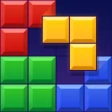
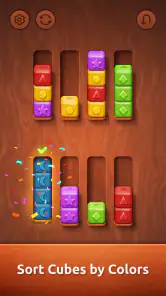
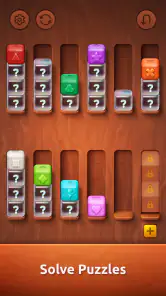
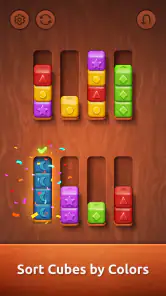
At the heart of Colorwood Sort Puzzle is a simple yet addictive concept. The game presents you with a series of wooden logs, each painted with different colors. Your task is to sort these logs so that logs of the same color end up together. Sounds easy, right? Well, not quite. The challenge lies in the limited space and the rules that restrict certain moves, making each decision crucial.
Gameplay and Mechanics
The gameplay starts off fairly straightforward, allowing you to get the hang of the sorting mechanics. You tap on a log to pick it up and then tap on another spot to place it. As you progress, the levels become increasingly complex, introducing more colors and fewer free spaces to maneuver. This is where your strategic skills truly get tested.
The controls are intuitive, which is a big plus. I found myself quickly getting into the groove, experimenting with different strategies to overcome the more challenging levels. There’s a satisfying sense of accomplishment when you finally crack a tough level after several attempts.
Planning Before the Board Closes In
My most useful habit is to pause before moving a color that is only partly visible in the arrangement. I look for which spaces are genuinely available, then ask whether the move I’m considering will give me somewhere to temporarily place the next color. That quick check helps avoid turning a tidy-looking board into a crowded one. If I do reach a dead end, restarting with a different order of moves is more productive than repeating the same taps and hoping for a different result.
More From Our News Desk

Clash of Clans Is Won Between the Battles

Android Auto Makes the Case for Quieter Car Software

MobiOffice: Transforming Mobile Productivity with Seamless Integration

EA SPORTS FC™ Mobile Soccer: Redefining Mobile Sports Gaming

How Microsoft OneDrive Became a Mobile Productivity Giant

How Google Translate Breaks Language Barriers Effortlessly
This makes the game better suited to short bursts of attention than to frantic play. I can make a move, study the new layout, and continue when I have a plan. A realistic use is a quiet few minutes while waiting for a ride: I can focus on one board, stop when I need to, and return to the same kind of deliberate sorting rather than needing fast reactions. It is less suitable when I want a puzzle that rewards speed or a story that carries me from one stage to another.
When to Pause, and When to Reset
A reset is most useful when I can explain why my current arrangement has stalled. If I have used the available room in a way that blocks the colors I need, starting over with a different sequence gives me a clean comparison: I can test whether the problem was my first choice or a later move. By contrast, restarting just because a board looks messy can throw away a position that still has workable options. I try to identify the bottleneck first, then decide.
This is also why the game works well as a small break rather than a background activity. If I am interrupted, I can leave the puzzle and come back when I can give the layout a little attention. I would not use it while walking or in a situation where I need to react quickly; the challenge is in reading the board, not in tapping fast. For a brief wait at a café or a pause between errands, that measured pace is a strength.
Visuals and Sound
Visually, the game is quite pleasing. The developers have opted for a minimalist design, which works well here. The wooden textures and vibrant colors of the logs are easy on the eyes, and the interface is uncluttered, allowing you to focus on the puzzle itself. The sound effects are subtle, providing just enough feedback without becoming intrusive.
That clear presentation matters for more than looks: sorting depends on reading the colors quickly, and the logs keep the board’s central task easy to follow. I still have to pay attention as the arrangement gets busier, so this isn’t a game I’d choose if I wanted to play while dividing my attention between several things. The feedback is pleasing when a move helps, but the real reward is recognizing that a sequence has opened up space for a better next move.
How the Feedback Builds Momentum
The most satisfying feedback is not a flashy effect; it is seeing a useful space appear after a deliberate choice. A move can make the board look less orderly for a moment, yet create room to work with a color that was previously trapped. I find that the puzzle rewards reading consequences rather than chasing the neatest-looking arrangement at every step. That difference gives the sorting a little more thought than its simple premise suggests.
There is a natural rhythm to a successful attempt: inspect, move, check the new layout, and decide whether the plan still holds. When a move helps, I can see why it helped; when it does not, the board gives me a reason to reconsider. The drawback is that a run can feel repetitive if I keep making similar mistakes or if I want a new kind of challenge after each level. The pleasure comes from refining a method, not from surprise or a changing story.
Where It Fits Among Sorting Puzzles
Compared with familiar color-sorting puzzles built around containers or tubes, this one gives the task a wooden-log presentation and a more tactile tap-and-place feel. The underlying pleasure is still the same: make room, separate colors, and gradually bring order to a mixed layout. If you enjoy that core logic but want a radically different kind of challenge, a word puzzle or a spatial puzzle may offer more variety. Here, the appeal is repeating one clear problem-solving rhythm and improving your decisions from board to board.
That focus is also the main trade-off. Players who like planning and retrying a layout can find satisfaction in it; players who need a new mechanic, character, or changing objective to stay engaged may find the repeated sorting less compelling. I would choose it for a calm mental reset, not as a substitute for a varied puzzle collection.
What the Wooden Presentation Changes
The wooden-log look gives the familiar sorting task a distinct visual identity, but it does not turn the game into a different genre. If you have played tube-based color sorters, you will recognize the broad appeal of freeing space and bringing colors together. The useful comparison is not that one format is universally better: it is whether you prefer this board’s log presentation and tap-and-place interaction, or another puzzle’s particular rules and layout.
For me, the biggest trade-off against a broader puzzle game is consistency. Colorwood Sort keeps attention on one central skill, so it is easy to understand what I am trying to improve. That also means it offers less variety from moment to moment than a collection that switches between wordplay, patterns, and spatial problems. I would pick it when I want to settle into one kind of reasoning, and choose a mixed puzzle app when I want the activity itself to keep changing.
Visuals and Sound
Visually, the game is quite pleasing. The developers have opted for a minimalist design, which works well here. The wooden textures and vibrant colors of the logs are easy on the eyes, and the interface is uncluttered, allowing you to focus on the puzzle itself. The sound effects are subtle, providing just enough feedback without becoming intrusive.
Who Should Give It a Try
Burny Games is the developer behind this free puzzle game, which is rated for Everyone. It has a 4.5 average from around 219,000 ratings and over 10 million installs, so it has clearly found a broad audience. The current version is 4.1.18847, and the game runs on Android 5.1 or later. Optional in-app purchases range from $0.99 to $99.99 per item, so I’d treat it as a free download rather than assume every part of the experience is cost-free.
I’d recommend it to someone who likes a clean, self-contained logic task and doesn’t mind retrying when a plan gets stuck. It can fit a commute or a small break because the action is simple to resume, though I wouldn’t play it while walking or doing anything that needs close attention. If I wanted a larger variety of puzzle types, or a game with a strong narrative and changing goals, I’d pick something else. The original release was Jan 29, 2024, but what matters more to me is whether this particular sorting loop suits the way I like to spend a few spare minutes.
Making a Short Session Count
For a short session, I would choose one board and give it a clear goal: find the bottleneck, open a useful space, or test a different move order after a reset. That keeps a few spare minutes purposeful without turning the puzzle into a chore. It also helps me notice whether I am genuinely improving my decisions or simply tapping through the same approach again.
One practical habit is to pause after a move that changes the available space, rather than immediately making the next obvious tap. The board may have changed what is safe to move, so a quick scan can prevent an automatic follow-up from undoing the advantage. This is a small discipline, but it suits the game’s central challenge: managing room while keeping colors accessible.
Why You'll Love It
If you love games that make you think and strategize, this one’s for you. It’s not just about sorting logs; it’s about planning your moves ahead, much like a game of chess. Plus, the sense of progression keeps you coming back for more. Each level you conquer feels like a small victory, and that’s addictive in its own right.
There are no time limits or penalties for taking your time, which I appreciate. It lets you play at your own pace, making it a perfect game for a relaxing break or a thoughtful challenge during your commute.
Who May Want a Different Puzzle
I would skip it if I mainly want fast action, a plot to follow, or frequent changes in the type of problem I am solving. Its appeal depends on enjoying the process of sorting and the small decisions that shape a board. Someone who gets bored when a game repeats its core mechanic may be happier with a puzzle collection or a title built around different objectives.
It is also not my first choice when I am tired enough that I cannot comfortably track which moves preserve room for later. The controls are simple, but the planning still asks for attention. If I only have a few seconds or need to keep my eyes on something else, I would rather wait until I can focus than turn a thoughtful puzzle into distracted tapping.
The Loop Verdict
In a nutshell, Colorwood Sort Puzzle is a delightful mix of simplicity and challenge. It’s a game that’s easy to pick up but hard to put down. So, if you’re looking for a new puzzle to dive into, this might just be your next favorite. Happy sorting!
Colorwood Sort Puzzle Game Frequently Asked Questions
Is Colorwood Sort Puzzle Game suitable for quick play sessions?
Colorwood Sort Puzzle Game centers on sorting blocks by color, so its basic premise is easy to understand before you begin. That makes it a puzzle option to consider when you want a focused activity rather than a game built around a complex story. The challenge is in arranging the colors, and you can decide whether that kind of sorting puzzle suits the length and style of play you prefer.
What kind of puzzle gameplay can I expect from Colorwood Sort Puzzle Game?
The game’s central activity is matching and sorting colored blocks, with a woody visual theme reflected in its store summary. It is intended for players who enjoy working through a color-based puzzle and thinking about how to organize pieces. If you like clear objectives and puzzles built around arranging items into matching groups, its premise should give you a useful idea of what to expect.
Is Colorwood Sort Puzzle Game free to download, and what should I know about optional spending?
Colorwood Sort Puzzle Game is free to download, so you can try its puzzle gameplay without paying upfront. It also offers optional in-app purchases, with listed item prices ranging from $0.99 to $99.99. These purchases are not required to enjoy the game’s core sorting challenge, but it is worth checking purchase settings if children will be playing.
What is Colorwood Sort Puzzle Game, and who developed it?
Colorwood Sort Puzzle Game is a puzzle game from Burny Games. Its store short description calls it Colorwood Sort, and the game’s premise is reflected in the summary: enjoy a woody color-sorting puzzle, match blocks by color, and solve and sort. Players looking for a straightforward color-matching challenge may find that description helpful when deciding whether the game suits their interests.
What is the main objective of Colorwood Sort Puzzle Game?
Colorwood Sort Puzzle Game is a brain-teasing and addictive puzzle game where players must sort colored wooden blocks into matching groups. The primary objective is to arrange the blocks by color in as few moves as possible. This game challenges your problem-solving skills and offers various levels of difficulty to keep players entertained and engaged.
Pros
- Engaging and relaxing gameplay
- Simple and intuitive controls
- Visually pleasing graphics
- Challenging levels increase difficulty gradually
- Free to play with optional in-app purchases
Cons
- Contains ads that can be disruptive
- Limited hints available for tough levels
- Requires internet for some features
- In-app purchases can be expensive
- Some levels may feel repetitive

- Category
- Puzzle
- Version
- 4.1.18847