Bunnsies - Happy Pet World
- 148.00
- 4.0
- Installs
- 10.00M
- Price
- Free

Screenshots
Analysis by Reviewed
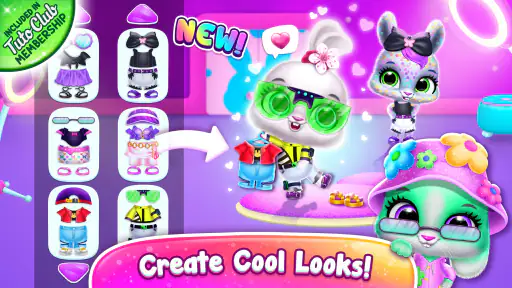
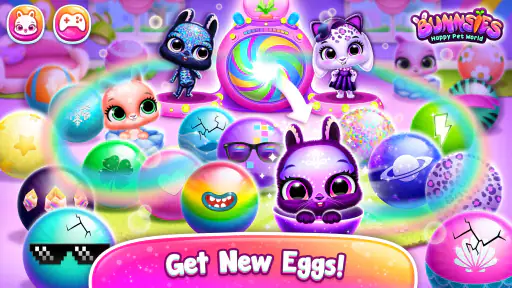
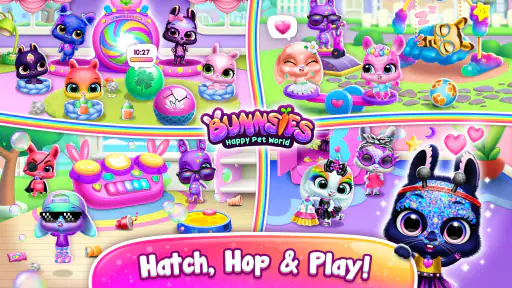
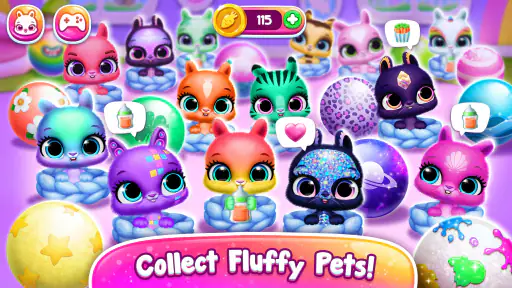
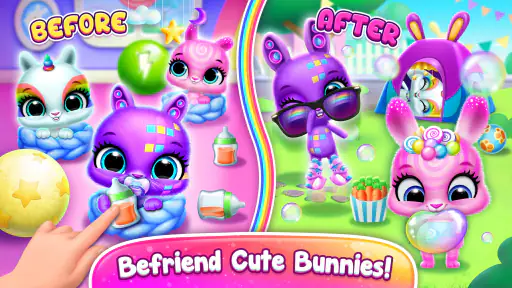
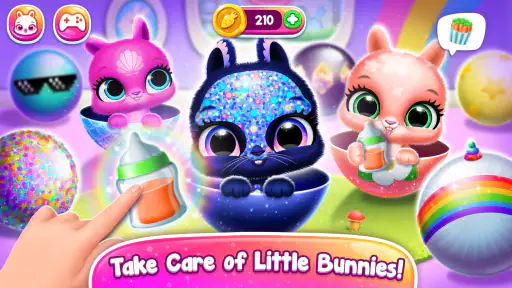
I like pet games most when they give me a small routine rather than turning every minute into a race for rewards. Bunnsies - Happy Pet World takes that approach with a simple idea: hatch and collect adorable bunnies, look after them, and spend time with them through pet-focused mini-games. It is an educational game from TutoTOONS, but its learning value comes mainly through gentle care, observation, and repeated choices instead of lessons that feel like schoolwork.
After spending time with it, I see the main appeal clearly. This is a relaxed digital-pet experience for children who enjoy cute animals and short activities. It is free to start, rated for Everyone, and available for devices running Android 7.0 or later. The game has reached over ten million installs, while its average score sits at 4.0 from around 6,900 ratings. Those figures suggest a broad audience, but they do not make it the right choice for every family. The important question is whether a child wants a calm bunny world or a more demanding game with deeper progression.
Why caring for bunnies is the real heart of the game
The strongest capability here is not simply collecting characters. It is the way collection is connected to care. A new bunny is not just another item to unlock and forget; the game encourages the player to spend time looking after it and then use that relationship as a reason to return to the world. That makes the experience feel more personal than a basic matching game or an endless runner with animal artwork.
In practice, this kind of design gives children a manageable loop. They meet or hatch a bunny, interact with it, complete a playful activity, and then come back to see what else they can do. The loop is easy to understand without requiring advanced reading or complicated controls. For younger players, that matters because the fun begins quickly instead of being hidden behind a long tutorial.
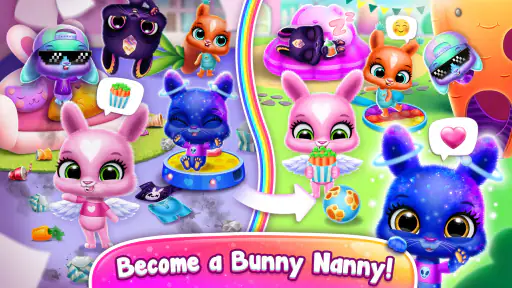
I also think the bunny theme does useful emotional work. Cute animals make the consequences of neglect or attention feel understandable without needing a complicated story. A child can grasp that a virtual pet benefits from care, even when the activity is presented through bright visuals and simple play. That is why I would place this closer to a gentle responsibility game than to a traditional educational title built around quizzes.
The educational category should therefore be understood in a broad, practical sense. The game can support habits such as taking turns, following a sequence, noticing what a pet needs, and staying focused on a small task. It will not replace a reading, mathematics, or language-learning app. Parents looking for direct academic instruction should choose a dedicated learning tool instead. Parents wanting a friendly way to introduce routines may find this format more approachable.
What the care loop feels like during ordinary play
When I play a pet game like this, the difference between a pleasant routine and a chore is how quickly I can understand the next useful action. Bunnsies keeps its central idea visible: the bunnies are the reason to explore, play, and return. That clarity is valuable for a child who may lose interest if several unrelated systems compete for attention.
A useful way to approach it is to let the child choose one bunny and spend a short session with that character rather than trying to collect everything immediately. This turns the game into a small shared activity. An adult can ask which bunny the child likes, what it needs, and which game was most enjoyable. Those questions add real-world conversation without making the play session feel like a test.
The design also works well for children who prefer predictable activities. They can repeat familiar interactions and gradually become comfortable with the controls. That repetition is not a weakness by itself; for younger players, repeating a known routine can build confidence. The limitation appears when a child wants constant novelty or a strong competitive challenge. In that case, the care loop may start to feel too gentle.
How the mini-games change the experience
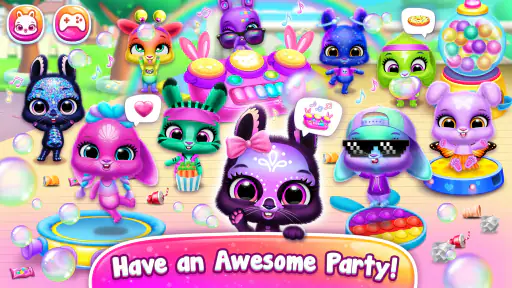
The pet activities are important because they stop the game from becoming a static collection screen. A bunny is more appealing when it leads to something the player can do. The mini-games give short bursts of action inside the slower care structure, which helps the experience suit different moods. A child can focus on the animals when they want something calm, then switch to a playful activity when they need more movement.
My advice is not to judge the whole game by the first few minutes of any one activity. The value comes from the combination: collecting gives a reason to continue, care gives the collection meaning, and mini-games provide variety. If a child dislikes one activity, the wider pet routine may still keep the game enjoyable. On the other hand, someone who wants a large selection of sophisticated mini-games may find these activities less satisfying than a dedicated arcade title.
This is one of the less obvious trade-offs. The game uses mini-games to support the bunny world, not the other way around. That makes the experience coherent, but it also means the activities may feel secondary to players who want deep mechanics. I consider that a sensible choice for the intended audience, though parents should set expectations accordingly.
A realistic way to use it at home
Imagine a child finishing homework or waiting during a quiet family break. Instead of handing over a game with a complicated mission structure, a parent can let the child spend a brief session caring for a favorite bunny and playing one or two activities. The child has a clear beginning and end: choose a pet, interact with it, play, and stop when the interest fades. That makes it easier to use as a short leisure activity rather than an open-ended demand for attention.
I would make the first session collaborative. Let the child handle the device, but ask them to explain what they are doing. This reveals whether the controls are intuitive and whether the game is holding their attention for the right reasons. It also helps an adult notice whether the child is repeatedly pressing through screens without understanding the purpose of each action.
For siblings, the game can become a conversation starter, although it is not necessarily a substitute for a fully designed multiplayer experience. Each child may prefer different bunnies or activities, and taking turns with one device can become part of the routine. I would avoid presenting collection as a competition between children. The more useful benefit is sharing choices and comparing what each player enjoys.
Another practical tip is to treat in-app purchases as an adult decision from the beginning. The game is free, but optional purchases range from $1.49 to $159.99 per item. That is a very wide range, so I would review the purchase settings before giving the device to a child and make it clear that virtual items are not automatic rewards. The free entry point is convenient, but families should not assume that every possible addition will remain free.
Where it fits beside other children’s games
Compared with a puzzle app, Bunnsies is less focused on one measurable skill and more focused on motivation through a character relationship. Compared with a virtual-pet simulator, its educational positioning makes the care routine feel more suitable for guided play with younger children. Compared with an action game, it is slower, softer, and less dependent on fast reactions.
That comparison explains both its strength and its boundary. If a child needs practice with letters, numbers, spelling, or problem-solving, a specialist app will usually offer clearer progress. If the child wants to nurture an animal, enjoy colorful interactions, and move between short pet games, this title is a better match. I would not install it expecting a complete curriculum. I would install it as a friendly bridge between screen entertainment and simple care-based routines.
The game’s Everyone rating supports that broad family positioning, but an age label cannot tell an adult whether the tone suits one particular child. Some children will enjoy the softness immediately; others may find the pace too slow. Watching the first session is more useful than relying on the rating alone.
The friction parents should understand
The biggest limitation is the possibility of repetition. A care-and-collect game depends on the player enjoying the same basic rhythm over time. That is excellent for routine, but less effective for children who need a constant stream of new challenges. If the initial cuteness wears off, the collection goal may not be enough to bring them back.
There is also a difference between collecting and meaningful progression. Gathering more bunnies can feel rewarding, but it does not automatically create deeper learning. Parents who want visible academic improvement should use this game alongside, not instead of, activities designed for that purpose. I would describe its educational benefit as indirect and habit-based.
In-app purchases are another point of friction. A free download lowers the barrier to trying the game, yet the presence of paid items means the adult should remain involved in the setup. I would not hand the device over with unrestricted purchasing enabled. Even when a child understands that an item costs money, the bright reward structure can make an optional purchase feel more urgent than it really is.
Device compatibility is reasonably broad because the game supports Android 7.0 and later, but families should still check how it feels on their particular phone or tablet. A larger screen may make pet interactions more comfortable for small hands, while an older device could affect the general smoothness of play. I would test it before making it a regular part of a child’s routine.
Who will get the most from it
The best audience is a young player who already likes animals and responds well to gentle repetition. Children who enjoy choosing favorites, caring for characters, and trying short activities are likely to understand the appeal quickly. It can also suit parents who want a game that creates opportunities for conversation about routines and responsibility without presenting itself as a formal lesson.
It is less suitable for a child who wants competitive rankings, complex strategy, long adventures, or precise academic practice. Older players may appreciate the artwork but move through the central loop quickly. Likewise, families looking for a completely purchase-free experience should think carefully before installing a free-to-start game with optional items.
I would also recommend it for supervised shared play rather than assuming it will teach independently. A parent can turn a short session into a useful moment by encouraging the child to describe choices, wait for turns, and stop when the activity is finished. Those small habits are where the game offers more than its cute presentation.
My final take on this bunny-focused experience
Bunnsies - Happy Pet World succeeds when it stays close to its central promise: giving children a cheerful world of bunnies to hatch, collect, care for, and enjoy through simple pet activities. The care capability is the reason to try it, and the mini-games work best as support for that relationship rather than as standalone entertainment.
My honest recommendation is conditional but positive. I would suggest it to families seeking a calm, animal-themed game for short sessions, especially when an adult is willing to guide the first play and manage purchases. I would skip it for children demanding deep challenge or for parents seeking direct school-skill instruction. Its current version, 1.6.206, comes from TutoTOONS and the game is free to begin, so trying the basic experience is straightforward.
For me, the most valuable part is the way a child can turn a digital pet into a small daily routine: choose a bunny, pay attention, play together, and then put the device away. That makes the game more useful as a gentle shared habit than as an all-purpose learning solution. If that is the kind of screen time you want, this is a thoughtful option; if you need measurable lessons or demanding gameplay, another category will serve you better.
Pros
- Cute
- colorful visuals appeal to children and casual players.
- Caring for pets creates a relaxing
- low-pressure gameplay loop.
- Simple controls make it easy for younger players to understand.
- Many bunnies offer variety and encourage collecting.
- Short activities suit quick play sessions on mobile devices.
Cons
- Progress may feel repetitive after completing the same care routines.
- Some content may be locked behind in-app purchases.
- Frequent rewards can make gameplay feel overly focused on collecting.
- Young players may need supervision around purchases and advertisements.
- The game may require considerable storage and battery over time.

- Category
- Educational
- Version
- 1.6.206