Bridge Constructor Portal
- 1.95K
- 4.7
- Installs
- 500.00K
- Price
- $1.99

Screenshots

Analysis by Reviewed
I approached Bridge Constructor Portal as a puzzle game first and a franchise crossover second. Its appeal is not just the familiar Aperture Science setting: it asks you to make practical structural decisions while accounting for Portal-style mechanics. I found that mix more interesting than simply building the strongest-looking bridge, because a solution has to work with the room’s layout as well as the vehicle’s route. The game costs $1.99, with optional in-app purchases priced at $0.99 per item, so it is worth deciding whether you want a focused paid puzzle experience before you start.
What the purchase gets you
The upfront price makes this a straightforward choice for anyone who prefers paying for a game rather than beginning with a free download. The optional purchases are a separate consideration: they cost $0.99 per item, but their contents are not described here, so I would read each item’s own details before spending more. I would not treat those purchases as necessary to enjoy the central puzzle premise, and I would avoid assuming they unlock a particular advantage or type of content without checking first.
That distinction matters if you are choosing a game for a child or sharing a device. The age rating is Everyone 10+, and the purchase model includes both a paid game and optional items. I’d check the purchase settings on the device if accidental spending is a concern, then decide whether the initial price alone fits your budget. That is a more useful way to judge the cost than comparing it with a free game whose monetization may work differently.
Welcome to Aperture Science
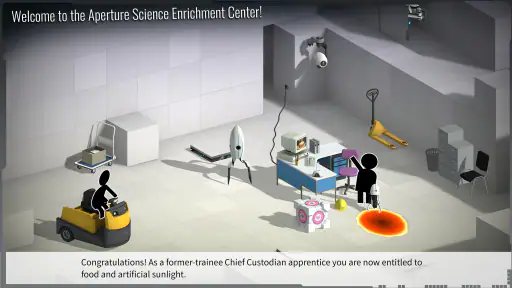
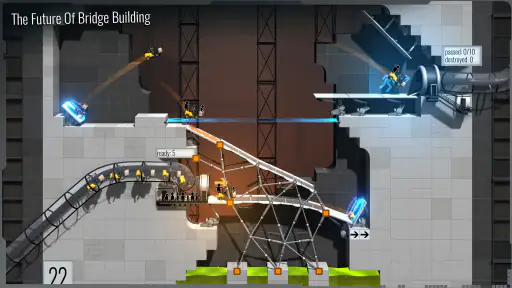
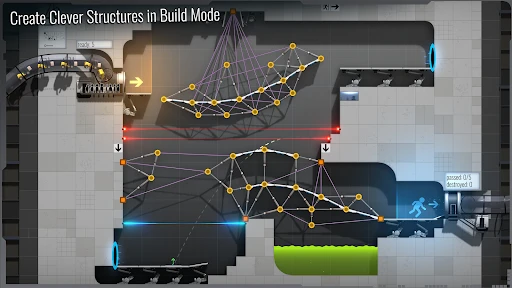
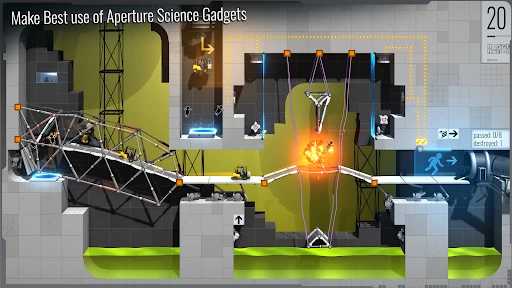
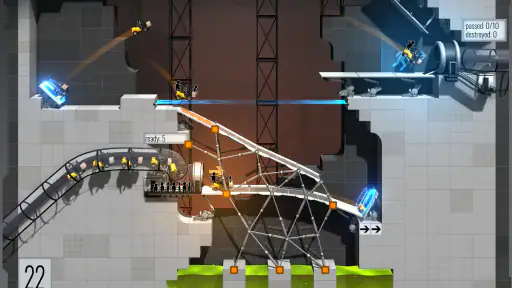
Right from the start, the game immerses you into the familiar yet bizarre world of Aperture Science. The aesthetics, sound effects, and even the sarcastic remarks from the AI are spot on. If you’ve played Portal before, you’ll feel right at home. The objective? Simple, yet complex—construct bridges to help your convoy of cute little vehicles reach the exit without crashing and burning. But it’s not just any bridge-building game. Oh no, you’ll be dealing with portals, propulsion gel, repulsion gel, and all sorts of mind-bending mechanics that make you feel like a genius when you finally solve a level.
Building Bridges and Breaking Minds
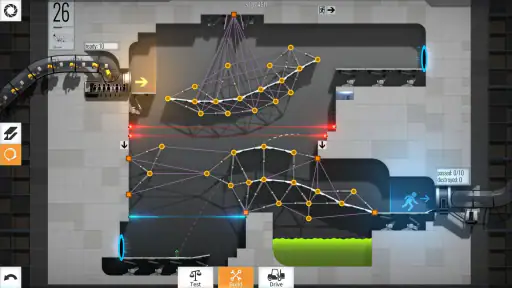
Each level starts off seemingly straightforward. You have a starting point, an end point, and a variety of tools to get your convoy across. However, as you progress, the game introduces more elements that require you to think outside the box—or rather, outside the bridge. You’ll find yourself scratching your head, trying to figure out how to use those pesky portals to your advantage. It’s like playing chess, but with bridges and deadly falls. The difficulty ramps up perfectly, keeping you engaged without being frustrating. And the satisfaction of watching your convoy succeed? Absolutely priceless.
The most useful habit I found is to read the room before placing anything. A portal or a patch of gel can change what looks like a simple gap into a question about direction, momentum, and where the vehicle will land. Instead of treating every level as “build a stronger bridge,” I’d first trace the convoy’s path from entry to exit and note where it must change height or direction. That quick mental map can prevent a lot of needless rebuilding.
There is also a real trade-off between a sturdy-looking structure and a good route. Extra supports may solve a weak crossing, but they cannot fix a vehicle arriving at an awkward angle or carrying the wrong momentum. When a run fails, I’d pay attention to the moment of failure rather than judge the whole design at once. If the vehicle reaches a section safely and then goes wrong after a portal or gel interaction, the problem is probably in that transition, not necessarily in the bridge behind it.
More From Our News Desk

Clash of Clans Is Won Between the Battles

Android Auto Makes the Case for Quieter Car Software

MobiOffice: Transforming Mobile Productivity with Seamless Integration

EA SPORTS FC™ Mobile Soccer: Redefining Mobile Sports Gaming

How Microsoft OneDrive Became a Mobile Productivity Giant

How Google Translate Breaks Language Barriers Effortlessly
How I’d Tackle a Stubborn Level
When a design fails, I’d resist the temptation to rebuild the entire route immediately. It is more useful to identify where the convoy loses support or momentum, then change one connection at a time. That turns a confusing failure into a small test: does the weak point need a different brace, or is the route itself sending the vehicle into trouble? This deliberate approach is especially helpful when portals and gels make a simple-looking crossing behave in an unexpected way.
I’d also treat a first successful crossing as a starting point rather than proof that the design is reliable. Watching the whole convoy matters: a structure that appears to work for one vehicle may not hold up as the rest follows. The trade-off is that careful testing takes patience, but it is more satisfying than randomly adding supports and hoping the physics work out.
For a practical play session, I’d give a difficult level a few focused attempts, changing only one part of the construction each time. If I have started adding braces without a clear reason, that is my cue to pause rather than keep tinkering. A short break can be genuinely useful here: on returning, I can look at the route as a whole and catch a bad transition that was hidden by concentrating on one weak-looking joint. The game rewards diagnosis more than frantic clicking.
One question people often have about physics puzzles is whether they need to find a single exact arrangement. I would approach each room as a problem to solve with the tools and route it presents, not as a decorating exercise. The satisfying part is seeing the convoy make it through, and the path to that result may involve testing and revision. If you dislike that kind of experimentation, the same process that makes a breakthrough feel earned may instead feel like friction.
For Puzzle Fans, Not Every Player
This is a good fit if you enjoy working through a compact engineering problem and don’t mind revising an idea after it fails. It also suits Portal fans who want the setting and dry AI humor wrapped around a different kind of puzzle. On an ordinary short break, I could see playing one level, pausing when a design needs thought, and returning later with a fresh view of the layout.
If you mainly want a relaxed, decoration-focused building game, or prefer puzzles with one clear answer and little trial and error, this may not be your best pick. Compared with conventional bridge-building games, the Portal mechanics make route planning less predictable; compared with a traditional Portal puzzle, the emphasis here is on constructing a path for vehicles rather than directly navigating a character. That hybrid is the game’s defining strength, but it also means neither style is presented in its most straightforward form.
For example, I’d choose it for a quiet evening when I want to concentrate on a handful of spatial problems and enjoy the odd failure along the way. It is less suitable for a commute or waiting-room session if I only have a moment and want immediate, low-effort entertainment; a puzzle that needs careful inspection can be hard to enjoy when I’m repeatedly interrupted. It also is not my pick when I want an open-ended building toy, because the pleasure here comes from solving a designed challenge, not from making structures for their own sake.
Compared with a pure logic puzzler, this asks me to think about physical construction as well as the intended route. Compared with a freeform bridge-building game, it adds Portal-themed mechanics that make the environment part of the puzzle. That combination makes it more distinctive, but also more demanding: someone who wants straightforward bridge stress-testing may prefer a conventional builder, while someone who wants to navigate portals directly may be happier with a Portal adventure. I’d pick this when the overlap itself sounds appealing.
Purchase, Progress, and Fairness
Headup developed this puzzle game, which was released on December 20, 2017, and its current version is 7.0. It has an average rating of 4.7 from around 19,000 ratings, with about 2,000 written reviews and over 500,000 installs. Those figures suggest it has found an audience, though they cannot tell you whether its particular mix of construction and Portal mechanics will suit your taste. Its Everyone 10+ age rating is useful context for families considering it.
The purchase is the main spending detail I’d weigh: the game is $1.99, and optional in-app purchases are listed at $0.99 per item. I would not assume those purchases affect puzzle difficulty or provide a competitive advantage; this is a solo puzzle experience, not a contest against other players. The available purchase details establish that optional items exist, but don’t explain what each item contains, so I’d check the item descriptions before buying anything extra. The game does not need a leaderboard to make its central challenge meaningful: the useful measure is whether your own design gets the convoy through.
Progress is built around solving levels, so I’d expect the pressure to come from a stubborn layout rather than a race against other people. If you get stuck, taking a break can be more productive than making increasingly complicated edits; returning with a clear eye often makes the missing support or route choice easier to spot. The main limitation is that this thoughtful pace will not appeal to someone looking for constant action or a casual game that asks for little concentration.
On fairness, the experience is best judged as a personal puzzle challenge rather than a competition. There is no reason to buy an optional item to keep up with other players, because the appeal is in working out your own construction. I would still check what an optional purchase offers before paying for it, especially if I am trying to keep the total cost predictable. That keeps the decision grounded in what is actually clear: a paid game, with optional low-cost items, and puzzles whose satisfaction comes from solving the room.
Humor and Challenges
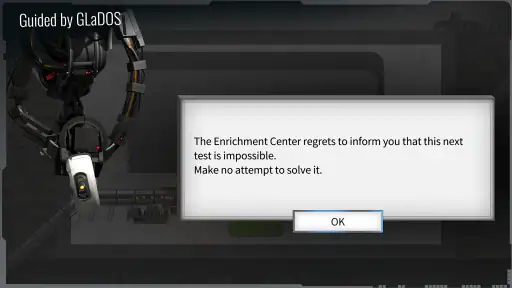
One of the standouts of Bridge Constructor Portal is its humor. The game doesn’t take itself too seriously, and that’s a good thing. The hilarious comments from the AI, reminiscent of Portal’s GLaDOS, keep the mood light even when you’re stuck on a particularly tricky level. Plus, the physics-based gameplay mechanics can lead to some pretty funny outcomes, especially when things don’t go according to plan. It’s a perfect blend of brain-teasing puzzles and laugh-out-loud moments.
The humor is a welcome counterweight to repeated attempts, but it is not a substitute for enjoying the construction itself. If the dry commentary and Portal atmosphere are what draw you in, they add personality to the puzzles; if you are indifferent to that world, the core appeal still has to come from experimenting with routes and structures. I would not buy it expecting a full Portal-style story experience, since the central activity described by the game is the bridge-and-convoy puzzle format.
My Trust Verdict
For families, puzzle fans, and people deciding whether this is worth the price, my recommendation is fairly specific: try it if you like spatial reasoning, patient trial and error, and Portal’s offbeat tone. The cost is clear, and the existence of optional purchases is worth keeping in mind, but I would not infer that spending beyond the initial price is required. Check the item descriptions first if an extra purchase is on the table, and consider whether a focused construction puzzle is what you actually want rather than a sandbox or a direct Portal adventure.
If you’re a fan of either franchise, or simply someone who enjoys a good puzzle game, then Bridge Constructor Portal is a must-try. It’s a refreshing take on the bridge-building genre, with enough twists and turns to keep even the most seasoned puzzle solvers on their toes. So grab your hard hat and your best thinking cap, because you’re about to embark on an unforgettable journey through the world of Aperture Science. And remember, in the words of GLaDOS, “The cake is a lie,” but the fun you’ll have with this game is very real. I’d choose it when I want a distinctive, hands-on logic challenge; if I were after a pure Portal-style adventure or an unhurried construction sandbox, I’d pick a game built specifically for that instead.
Bridge Constructor Portal Frequently Asked Questions
How much space should I make available before installing Bridge Constructor Portal?
It is sensible to check the available storage on your device before downloading Bridge Constructor Portal, as with any game. Installation needs room on your phone or tablet, and keeping some free space can also help with routine updates. The game’s puzzles are designed around building and testing structures, so having it installed and ready lets you get straight into experimenting.
Can I play Bridge Constructor Portal if I have never played a Portal game?
Yes. Bridge Constructor Portal is a puzzle game in its own right, and its central challenge is building structures that let vehicles cross gaps safely. Familiarity with Portal may make its setting and references more recognizable, but the basic appeal comes from experimenting with designs and solving each construction problem. It can be approached as a bridge-building puzzle even if the series is new to you.
Is Bridge Constructor Portal a good fit if I enjoy physics-based puzzles?
Yes, Bridge Constructor Portal is a puzzle game built around designing structures and seeing how they behave when vehicles travel across them. It suits players who enjoy experimenting, spotting weak points, and adjusting a solution until it works. The Portal-themed tools add variety to the engineering challenges, so it offers more than straightforward bridge building.
What is Bridge Constructor Portal and what makes it unique?
Bridge Constructor Portal is a unique puzzle game that combines the engineering challenges of building bridges with the quirky, science-based humor of the Portal series. Players must construct bridges and other structures to get vehicles safely across gaps, all while using Portal technology like portals, propulsion gel, and more. Its unique blend of physics-based gameplay and Portal's signature humor makes it a standout in the puzzle genre.
Is Bridge Constructor Portal suitable for all ages?
Bridge Constructor Portal is generally suitable for players of all ages, but it is best enjoyed by those who appreciate puzzle-solving and engineering challenges. It is rated Everyone 10+, and some complex problem-solving scenarios might be challenging for younger children. It can be a good choice for older kids and adults who enjoy developing their critical thinking skills through play.
Pros
- Creative puzzle-solving experience
- Integrates Portal's iconic elements
- Challenging physics-based gameplay
- Variety of levels and increasing difficulty
- Humorous narrative and voice acting
Cons
- Steep learning curve for beginners
- Some levels may feel repetitive
- In-app purchases can be annoying
- Graphics might seem dated to some users
- Occasional bugs affecting gameplay

- Category
- Puzzle
- Version
- 7.0