Bible Games: Trivia & Verse
- 126.00
- 4.8
- Installs
- 10.00K
- Price
- Free

Screenshots




Analysis by Reviewed
I found Bible Games: Trivia & Verse most interesting as a small, low-pressure word game for people who want Bible-themed questions and daily reflection in the same place. It is free to start, aimed at Everyone, and developed by Floral Game. Rather than treating it like a deep study tool, I approached it as something to open for a few minutes during a quiet break, after a reading session, or when I wanted a simple quiz with a faith-based focus.
The first thing I noticed is that the game’s appeal depends less on fast competition and more on how comfortably you can read, think, and move through each question. That makes its presentation important. A quiz can be technically simple but still tiring if the text is crowded, the controls are awkward, or the pace feels demanding. In my experience, this game works best when I treat it as a relaxed routine instead of a test of speed.
How the game feels to read and navigate
A straightforward format for short sessions
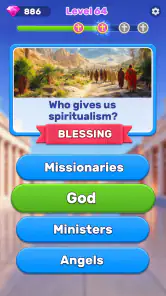
The combination of trivia and a daily verse gives the game a clear rhythm. I can approach it as a question-based word game when I want interaction, then use the verse element as a quieter pause. That separation is useful because it prevents the experience from feeling like one long quiz session. Someone who enjoys Bible trivia may spend more time answering questions, while another player may mainly value the daily devotional moment.
The interface is easiest to handle when I give each screen my full attention. This is not the kind of app I would recommend opening while walking, cooking, or switching between several tasks. Questions require reading and recall, and a missed tap can interrupt the flow even when the underlying activity is simple. For readers who prefer calm, single-purpose screens, that restrained pace can be a benefit.
I also think the word-game category sets a useful expectation. This is not a large role-playing game with a complicated map, inventory, or character system. There is no need to learn a long chain of controls before getting started. That makes it more approachable for a family member who rarely plays games, a reader who wants a brief mental exercise, or someone returning to Bible knowledge after a long break.
Readability matters more than visual excitement
For this type of game, readable question text is more valuable than decorative effects. I found myself judging each screen by whether I could absorb the wording quickly and distinguish the possible answers without mental clutter. If you have difficulty with small text, strong visual contrast, or dense layouts, I would recommend checking the first few questions at your normal screen brightness before committing to regular use.
The daily verse also changes the reading demand. Trivia usually asks for an answer, while a verse invites slower attention. That means the app serves two different reading modes: quick recognition and reflective reading. I prefer using the quiz when I have enough concentration to compare answers, then returning to the verse when I want something less competitive.
A useful personal workflow is to avoid treating every question as a score challenge. I read the full question first, pause before looking at the answers, and only then choose. This reduces the temptation to tap the first familiar phrase. It also makes the game more useful for learning, because I notice which parts of my Bible knowledge are solid and which ones depend on vague memory.
Who can follow the navigation comfortably?
People who are comfortable with ordinary mobile quiz screens should find the basic path easy to understand. The game’s concept is immediately recognizable: read, choose, continue, and return for the verse. That simplicity is a genuine strength for older relatives or younger players who might be discouraged by a more elaborate Bible app.
However, simple does not automatically mean universally comfortable. A player with low vision may need to enlarge the device’s system text or use a larger display. Someone with attention difficulties may prefer answering only a few questions at a time rather than trying to complete a long sitting. If you need a fully customizable learning environment, a dedicated Bible study app with more reading controls may suit you better.
I would also avoid assuming that every user will interpret a wrong answer in the same way. For a confident player, it is a harmless prompt to try again. For a beginner, repeated mistakes can feel discouraging. The most inclusive approach is to use the questions as prompts for curiosity, not as a judgment of religious knowledge.
Motor and sensory considerations
From a motor perspective, a quiz format is usually less demanding than an action game. There is no reason to expect rapid swipes, precise dragging, or continuous movement from the player. That makes it a reasonable choice for someone who prefers tap-based interaction and short sessions. I still recommend holding the phone securely and answering one question at a time, especially if accidental touches are a concern.
The main physical challenge is repetition. Even simple taps can become tiring for users with hand pain, tremors, or limited reach if a session continues for too long. I found that the game makes more sense in small portions: answer a few questions, reflect on the verse, and put the phone down. That routine also protects the experience from becoming monotonous.
Sensory comfort is a separate issue. A player sensitive to bright screens, sudden changes, or busy visual presentation may prefer a dimmer display and a quieter environment. I would not use it as background entertainment while listening to music or watching television, because the questions need visual concentration. Its strongest sensory profile is the simplest one: a phone, a readable screen, and a calm moment.
For users who rely on screen readers, magnification, switch access, voice control, or other assistive tools, the practical question is whether the individual controls are exposed clearly enough for the device’s accessibility features to identify them. I would test that directly during the free portion rather than assuming compatibility. The game’s modest interaction model may help, but a small number of controls does not guarantee that every assistive setup will feel smooth.
Using it in everyday situations
A realistic use case is a short evening routine. I might open the game after dinner, answer a handful of trivia questions, and read the daily verse without turning the activity into a formal study session. That works particularly well when I want something more intentional than scrolling but less demanding than a long lesson.
It can also fit into a waiting period, such as a quiet appointment lobby or a commute when I am not the person driving. The important condition is that I have enough light and concentration to read properly. Because the experience depends on remembering details, it is not ideal when I am distracted, rushed, or dealing with glare on the screen.
For families, the game could provide a starting point for conversation. A parent, grandparent, or youth leader might use a question as a prompt and discuss why an answer is correct instead of simply moving on. I would not present the game as a replacement for a Bible lesson, though. Its value is in creating an accessible opening for discussion, not in supplying the full context that a teacher or study guide can provide.
It may also suit a person who wants a daily faith habit but struggles with long reading plans. A single verse feels more manageable than a large chapter, and the quiz adds an active element for days when passive reading is difficult. On the other hand, readers who need extensive commentary, cross-references, translation choices, or structured study will likely outgrow it quickly and should choose a more specialized resource.
How it compares with familiar alternatives
Compared with a general trivia game, this title offers a much narrower subject but a clearer purpose. A mainstream quiz app may provide broader topics, stronger competition, or more varied question formats. Bible Games: Trivia & Verse is better for someone who wants the subject matter itself to support personal reflection rather than simply maximize variety.
Compared with a conventional Bible app, it is more interactive but less suited to serious reference work. A Bible reader is the better option when I want to compare passages, search for a phrase, follow a reading plan, or study a chapter in context. This game makes more sense when I want a lightweight combination of recall and a daily verse.
It also differs from a word puzzle game that focuses on spelling, anagrams, or vocabulary. Here, the challenge is knowledge and recognition within a biblical theme, not building words from letters. That distinction matters if you are looking for language practice or a purely linguistic brain teaser. The game’s category may be described as word-based, but its real appeal is faith-focused trivia.
Practical details before installing
The game is free, which makes it easy to try without committing money at the beginning. It includes optional in-app purchases ranging from $1.99 to $99.99 per item, so I would keep purchase controls in mind if children use the device or if you prefer a completely cost-free experience. The free entry point is useful, but anyone sensitive to spending prompts should review the purchase flow carefully.
It is rated for Everyone, which fits the gentle, general-audience concept. That rating does not mean every family will want to use it in exactly the same way; parents may still prefer to look at the questions and decide whether the religious presentation matches their household. I see it as most appropriate for players who already understand that the quiz is built around Bible content.
The app requires Android 8.0 or later. On a compatible phone, the current version is 1.0.27. The game was released on May 15, 2026, and has reached over 10 thousand installs, with a 4.8 average from around 2.4 thousand ratings. Those figures suggest that it has found an interested audience, although popularity alone does not tell me whether its reading experience will suit a particular user.
Where the experience still creates barriers
The biggest barrier is not complexity but dependence on visual reading. If the question text, answer choices, or verse are difficult to see, the central activity becomes difficult as well. Device-level magnification may help, but it can also make navigation less convenient if the screen no longer shows the full question and the answers together.
Another limitation is the possibility of uneven comfort across age groups. A younger player may want faster feedback and more game-like energy, while an older player may need more time to read and remember. The same pace cannot serve everyone equally. I would introduce it to a group by allowing players to answer individually rather than turning every question into a race.
There is also a learning barrier for people who are new to Bible terminology. A question can be perfectly readable and still feel inaccessible if the names, places, or events are unfamiliar. Beginners may benefit from playing alongside someone who can explain the context. Without that support, a sequence of wrong answers could feel like a lack of ability when it is really a lack of background knowledge.
Finally, this is not the right choice for users who need a comprehensive accessibility-first study tool, a large-print reading environment, or a robust reference library. I would choose a dedicated Bible reader for detailed study and a general word game for broader puzzle variety. This title occupies the middle ground: a focused, casual quiz with a devotional element.
My inclusive verdict
I recommend Bible Games: Trivia & Verse to people who want a calm, faith-centered activity that can fit into a few spare minutes. Its strongest quality is the pairing of active recall with a daily verse. That combination gives the app a more meaningful routine than a standard quiz, while keeping the interaction approachable for people who do not normally play mobile games.
My advice is to use it deliberately. Adjust the phone for comfortable reading, play in a quiet setting, take breaks if tapping becomes tiring, and treat incorrect answers as invitations to learn rather than failures. Families and study groups can get more from it by discussing the questions instead of focusing only on progress.
The best reason to try it is its low-pressure bridge between Bible trivia and daily reflection. It is not a substitute for a full study app, and it may not meet the needs of players who require extensive control over text, input, or learning pace. For the right reader, though, Floral Game has created a focused free game that feels easy to revisit and flexible enough for both personal use and gentle conversation.
After spending time with it, I would suggest starting with short sessions and deciding whether the question layout works for your eyes, hands, and attention. If it does, the game can become a pleasant part of a daily routine. If it does not, a dedicated Bible reader or a more adjustable quiz platform will be the kinder choice.
Pros
- Short trivia rounds make it easy to play during quick breaks.
- Verse challenges can help reinforce Bible knowledge through repetition.
- Simple controls are accessible for younger and older players.
- Progress tracking provides motivation to return and improve.
- Suitable for solo play without requiring an internet connection at all times.
Cons
- Some questions may feel too easy for experienced Bible readers.
- Repeated questions can reduce variety after extended play sessions.
- Ads may interrupt gameplay unless an optional removal purchase is available.
- Answer wording may occasionally depend on a particular Bible translation.
- Limited customization may make the experience feel basic over time.

- Category
- Word
- Version
- 1.0.27