Bible Trivia Quiz Game
- 478.00
- 4.8
- Installs
- 100.00K
- Price
- Free
Screenshots



Analysis by Reviewed
I approached Bible Trivia Quiz Game as a quick way to test my knowledge rather than as a replacement for reading the Bible itself. That distinction matters. The game’s focus is simple: it turns familiarity with biblical people, stories, events, and teachings into short trivia challenges. I found that appealing because it gives me something structured to do during a spare moment, while still leaving room for learning when I get an answer wrong.
It is a free trivia game from Floral Game, rated for Everyone, and it has attracted a 4.8 average from around 11 thousand ratings. That combination suggests a strong reception among the people who have tried it, although a high score alone cannot tell me whether it will suit every player. The real question is whether I want a relaxed Bible quiz for casual practice, family use, church activities, or personal revision—or whether I need a deeper study tool with explanations, references, and a more complete learning system.
How the quiz feels in everyday use
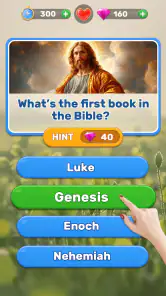
My favorite way to use this kind of game is in small sessions. I might open it while waiting for an appointment, take a few questions during a break, and close it without feeling that I have started a large commitment. That short-session design is a natural fit for trivia. It also makes the game easier to share with someone else: one person can answer first, another can challenge the response, and the discussion can continue after the question disappears.
The game’s main strength is its clear subject. Many trivia apps jump between unrelated categories, but this one keeps attention on Bible knowledge. That narrow focus makes it more useful for someone preparing for a youth-group activity, reviewing familiar stories before a study session, or looking for a gentle way to encourage children and relatives to discuss Scripture. It is also less intimidating than opening a large reference app when I only want a few questions.
At the same time, I would not treat every quiz answer as the final word on a complicated biblical topic. Trivia works by reducing a subject to a question and an answer. That is useful for recall, but it can flatten differences in translation, interpretation, chronology, or context. When a question touches a detail I do not recognize, my best habit is to use it as a prompt for further reading rather than assuming the quiz has provided a complete explanation.
Speed expectations for short sessions
For a game built around questions, the most important performance expectation is responsiveness between one prompt and the next. I found the format most comfortable when I could concentrate on the question instead of waiting through a complicated setup. Its modest purpose works in its favor: it does not present itself as a large action game with demanding graphics or elaborate worlds. That makes it a sensible choice for quick mental exercise on an ordinary phone.
Still, speed is not only about how quickly a screen appears. A good trivia session also depends on whether the wording is easy to scan, whether answer choices are comfortably separated, and whether moving forward feels natural. I pay attention to those details because trivia loses its rhythm when I have to fight the interface. The best experience comes when I can read, decide, learn from the result, and continue without unnecessary friction.
My practical advice is to begin with a short session rather than planning a long study block. That lets me see how the question flow suits me and whether the difficulty feels appropriate. If I am using it with a child or a group, I would also read each question aloud instead of rushing through it. The game becomes more social that way, and the conversation around an answer can be more valuable than simply collecting correct responses.
Because the game is free to start, it is easy to try without making a commitment. There are in-app purchases ranging from $0.99 to $49.99 per item, so I would keep that in mind if I were handing the phone to a child or allowing repeated play. The free entry is convenient, but I would still review purchase controls on the device before turning it into a family activity.
What happens during heavier use
A few questions are one thing; repeated sessions over a longer period are another. When I use a trivia game heavily, I look for signs that the experience becomes tiring: repetitive prompts, a narrow difficulty range, or a sense that I am memorizing patterns instead of improving my understanding. Those are more meaningful concerns here than visual intensity. A Bible quiz can remain enjoyable for a long time, but its lasting value depends on the breadth and quality of its question pool.
This is where I see an important trade-off. A focused quiz is easier to understand than a broad educational platform, but it may not offer the same depth as a dedicated Bible study app, printed study guide, or group-led lesson. If I already know the common stories very well, I may want questions that test context and connections rather than simple recognition. If I am new to the subject, familiar questions may be exactly what I need to build confidence.
One useful workflow is to separate play from review. I can answer a set of questions without immediately searching every detail, then note the items that surprised me and look them up afterward in a trusted Bible or study resource. This prevents the game from becoming a guessing contest and turns mistakes into a personal reading list. It is a small change, but it gives the quiz more educational value than repeatedly tapping until I remember an answer.
For group use, I would avoid making the fastest player the automatic winner. A better approach is to ask each person to explain why an answer seems right, then check the relevant passage when there is disagreement. That works especially well with teenagers or mixed-age groups, because it values reasoning and discussion instead of rewarding only quick recall. The app provides the prompt; the people using it provide the deeper learning.
Reliability and recovering from interruptions
Reliability matters even in a small game. I want a session to feel dependable when I open it, answer a question, and return later. I also think about ordinary interruptions: a phone call, a notification, a locked screen, or switching briefly to another app. A trivia game is most useful when it fits around real life, so recovery from an interruption should not turn a short break into a frustrating restart.
I cannot judge reliability by the rating alone, but the game’s audience size gives me some confidence that it is not an obscure experiment with no users. It has passed the hundred-thousand-install mark, and the current release is version 4.0.1. Those details do not guarantee perfect behavior on every phone, yet they indicate an established app rather than something with no visible history of use.
My cautious approach is to keep a session short when I am testing the game on a new device. I would answer a few questions, leave and reopen it, and see whether the experience remains comfortable before relying on it for a planned group activity. That is not a criticism of this particular title; it is simply sensible practice for any app I expect children, students, or several family members to use.
If a session is interrupted, I would avoid assuming that every unfinished moment is preserved exactly as I left it. Trivia progress can be easy to reconstruct, but a long run may feel less satisfying if an interruption breaks the flow. For that reason, I prefer using it as a flexible activity rather than as a high-stakes competition where one unexpected pause decides the result.
Device constraints and who should install it
The listed minimum operating-system requirement is 10, which is important for anyone using an older phone or tablet. Before installing, I would check the device’s system version rather than assuming that every Android device can run it. The requirement is not unusually demanding for a current device, but it can matter in households that keep older phones for children, guests, or offline activities.
I would also consider screen size and the person using the device. A phone is convenient for solo play, while a tablet may be more comfortable when several people are reading the same question. For younger players, an adult can help with reading and discuss unfamiliar names. The Everyone content rating makes the game approachable for a broad audience, but age suitability does not remove the need for supervision around purchases or screen time.
The game is a particularly good match for people who already enjoy quizzes and want a clearly defined subject. It can work for a church group looking for an informal warm-up, a family wanting a conversation starter, or an individual who wants to discover which parts of biblical history they remember poorly. It is less suitable for someone seeking a complete devotional routine, a searchable commentary, language-study tools, or carefully structured lessons with extensive explanations.
I would also skip it if my main goal were competitive general trivia. A broad quiz app would give me more variety across science, history, entertainment, and geography. Likewise, someone preparing for a serious examination may be better served by a study resource that cites passages, tracks topics, and explains why an answer is correct. This game can support those goals, but it should not be expected to replace them.
How it compares with usual alternatives
Compared with reading a Bible directly, the game is faster and more interactive, but much less complete. Reading gives me context, sequence, language, and the ability to follow an idea across chapters. The quiz gives me retrieval practice. I see them as complementary: the game can reveal what I remember, while reading can show me what I misunderstood or never noticed.
Compared with a Bible study app, this title is likely to feel lighter and easier to enter. A study app usually asks me to search, choose a plan, read commentary, or follow a longer lesson. That is better when I have dedicated time and want depth. The trivia format wins when I have five minutes and need a clear activity immediately, but it loses when I want a detailed answer to a difficult question.
Compared with a printed quiz book, the digital game is more convenient to carry and easier to use spontaneously. A book can be better for a classroom or group that wants to write notes, compare answers on one page, or avoid screen distractions. The choice depends on the setting. I would use the app for quick practice and a book or study guide when the session needs discussion, annotation, and a visible shared record.
Compared with general-purpose quiz games, its specialization is both its advantage and its limitation. I do not have to sort through unrelated categories, and the questions stay relevant to my chosen interest. On the other hand, I should not expect the constant novelty that comes from switching between many subjects. The right choice depends on whether I want focused Bible recall or a broader entertainment experience.
Small habits that make the game more useful
My first tip is to treat wrong answers as categories, not just failures. If I repeatedly miss questions about places, family relationships, or the order of events, I can identify a specific area for later reading. That turns a casual score into a simple diagnostic tool. I do not need a formal notebook; even a short note on my phone can help me notice patterns across several sessions.
My second tip is to avoid playing while distracted by conversation or notifications. Trivia looks easy, but rushed reading can make me choose an answer before I have understood the wording. A quiet few minutes produces a more honest picture of what I know. When playing with others, I would give everyone time to answer privately before discussing the result, because confident guesses can influence the whole group.
My third tip is to use the game as a bridge into a passage, not as a substitute for one. When a question raises curiosity, I can pause and read the relevant account in context. This is especially useful for details that sound familiar but may belong to a different person or event. The quiz supplies a memorable question; the reading supplies the surrounding meaning.
A fourth practical point concerns spending. Since optional items can cost as much as $49.99, I would decide in advance whether I am comfortable with purchases and use the device’s purchase restrictions where appropriate. That is particularly important when the game is installed on a shared family device. A free download is helpful, but “free” does not mean every optional item is free.
My performance verdict
On balance, I see Bible Trivia Quiz Game as a focused, approachable way to exercise Bible recall in short bursts. Its strongest performance case is not demanding entertainment; it is convenience. I can open a subject-specific trivia experience, answer a few questions, and use the results to guide a later conversation or reading session. The Everyone rating and free entry make it easy to consider for families and groups, while the current version and substantial install base make it feel like an established choice.
The limits are just as clear. Trivia cannot provide the context of a full Bible reading, the depth of a commentary, or the structured progression of a serious study course. Heavy users may eventually want more variety or more explanation, and anyone with an older device should check the minimum system requirement first. I would also remain mindful of optional purchases rather than handing the device over without restrictions.
My recommendation is straightforward: install it if you want a friendly Bible-themed quiz for spare moments, family discussion, or light revision. I would recommend pairing it with a trusted Bible or study resource whenever an answer leads to a serious question. Its best role is a doorway into deeper learning, not a replacement for it. For that purpose, Floral Game’s trivia title is an enjoyable and practical option, especially when I want something focused, accessible, and easy to fit into an ordinary day.
Pros
- Covers both Old and New Testament topics
- Short rounds make it easy to play during spare moments
- Helpful for testing memory after reading Bible passages
- Simple interface is suitable for casual players
- Can encourage family or group Bible discussions
Cons
- Some questions may depend on a specific Bible translation
- Difficulty can feel uneven between consecutive questions
- Limited appeal for players seeking broader quiz categories
- Repeated questions may reduce long-term replay value
- Ads may interrupt the flow in the free version
- Category
- Trivia
- Version
- 4.0.1