Beach Bliss: Merge Puzzle
- 296.00
- 4.2
- Installs
- 50.00K
- Price
- Free

Screenshots
Analysis by Reviewed
I spent time with Beach Bliss: Merge Puzzle, a free puzzle game from Kite Games AS that combines relaxing merges with a beach makeover theme. Its basic idea is easy to understand: combine matching objects, use the results to move a visual renovation forward, and enjoy a calmer pace than the usual timer-heavy puzzle games. The appeal is immediate, but the real question is whether the merge loop stays satisfying after the first few sessions.
My overall impression is positive, with an important qualification. This is best approached as a casual game for short breaks, not as a deep strategy title or a demanding brain-training challenge. The beach setting gives the familiar merge formula a pleasant sense of purpose, while the makeover progression provides a reason to keep playing beyond simply clearing a board. I found it most enjoyable when I treated each session as a small piece of relaxation rather than a race toward the next reward.
How the current version feels to play
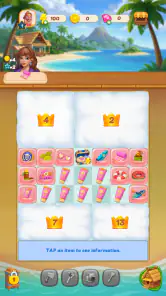
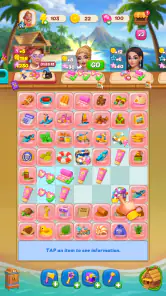
The current release is version 1.0.3, and it presents itself as a polished early experience rather than a sprawling puzzle platform. The central interaction is straightforward enough for almost anyone to pick up, which fits its Everyone age rating. You do not need a long tutorial explanation to understand the first decisions: identify useful combinations, manage the available space, and decide which merge is worth making now instead of immediately combining everything in sight.
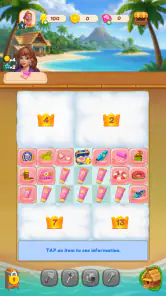
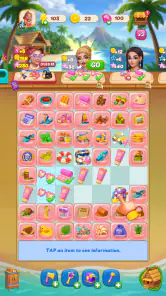
That last choice is where the game has more substance than its peaceful presentation initially suggests. A merge can solve an immediate problem while creating a less useful object for the next move. I quickly learned that empty spaces are valuable, especially when the board begins to fill with pieces that are waiting for their matching partners. Playing too quickly can leave a tidy-looking board with no practical room to continue.
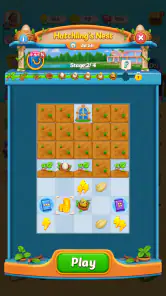
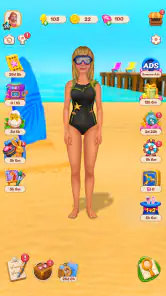
The makeover layer gives those small decisions a visible payoff. Instead of solving abstract levels with no connection between them, progress is tied to improving a beach environment. I liked that relationship because it makes a successful chain feel meaningful without turning the game into a complicated management simulator. The visual goal helps answer the common casual-game question, “Why am I doing this next merge?”
Its audience is easy to identify. If you enjoy gentle puzzle games, decorative progression, and a play pattern that works in brief sessions, this should feel welcoming. It is also a reasonable choice for someone who finds match-three games too frantic but still wants simple decisions and a steady sense of completion. The 4.2 average from around 3.1 thousand ratings suggests that the general concept is connecting with players, while the more modest scale of over 50 thousand installs makes it feel like a smaller title rather than an established giant in the genre.
The merge loop rewards patience more than speed
My most useful habit was to pause before making an obvious combination. When several pieces can be merged, I first look for the move that opens the most room, not necessarily the one that creates the highest-level object. That distinction matters in a board-based merge game. A larger item may look like progress, but freeing two spaces can be more valuable if it allows several future pieces to enter play.
I also found it helpful to keep likely pairs near one another when possible. Scattering pieces across the board makes later combinations harder to spot and encourages unnecessary rearranging. A compact arrangement gives me a clearer view of what is available and reduces the chance of using a useful item simply because it is blocking something else.
This is one of the less obvious strengths of the design: the game can be relaxing without being completely mindless. The decisions are small, but they reward planning. Players who only tap the first available merge may run into avoidable congestion, while players who leave every move untouched in search of a perfect sequence can make the experience feel slower than it needs to be. The best rhythm sits between those extremes.
Why the beach theme helps, and where it may not be enough
The beach makeover framing gives the game a warmer identity than a plain collection of numbered merge boards. It also makes progress easier to read emotionally. A new decorative improvement feels like a change to a place, not merely another item added to a counter. For me, that made the game particularly suitable for winding down in the evening or filling a few minutes while waiting for an appointment.
However, players who need a strong narrative, complex characters, or a large variety of puzzle rules may find the presentation too gentle. The makeover goal is motivating, but it does not replace the depth of a dedicated strategy game. Likewise, someone who prefers fast competitive rounds may find the slower, more decorative structure lacking urgency.
That trade-off is intentional, and I would not call it a flaw by itself. The important point is to choose it for the right reason. This is a game for a calm loop with visible improvement, not for leaderboard pressure or elaborate tactical systems. If your ideal puzzle session involves intense time limits and constantly changing mechanics, a more traditional arcade puzzle title will probably suit you better.
What the release tells us about its direction
The release date is Jul 2, 2026, so the game is still at an early point in its life. Version 1.0.3 indicates that Kite Games AS has already moved beyond the first numbered release, which is a useful sign for anyone considering starting now. I would read that as evidence of early refinement rather than proof of a fully mature content roadmap. The current experience should be judged on what is playable today, while future expansion remains something to watch rather than something to assume.
For an existing player, a small version number can be reassuring because it suggests that the developer is addressing the initial shape of the product. It also means that the game may still be finding its balance between relaxing progression and the pressure to keep returning. I would not install it expecting a huge catalogue of systems immediately. I would install it because the core loop already has a clear identity and because the current version is easy to understand.
The most important evolution to monitor is not simply the addition of more beach decorations. New content will matter most if it gives experienced players fresh decisions instead of only extending the same sequence. Additional goals, more varied board situations, or new ways to make a merge meaningful could deepen the experience. On the other hand, adding too many layers would risk weakening the clean, approachable quality that makes the game attractive in the first place.
What this means for people starting now
New players can begin without feeling that they have missed years of accumulated content. The simple entry point is one of the strongest reasons to try it. I would recommend playing through the opening sessions without spending anything, learning how quickly the board fills and which objects are worth keeping nearby. That gives you a better sense of whether the makeover loop itself is enough to hold your interest.
The game is free to download and includes in-app purchases ranging from $0.99 to $99.99 per item. That range makes it especially important to decide your own boundary before buying. I personally would treat purchases as optional convenience rather than part of the basic test. If the unhurried merging and visual restoration are enjoyable on their own, the game has already demonstrated its value for you. If the core loop feels repetitive without assistance, spending more is unlikely to solve the underlying mismatch.
This is also where families should be sensible despite the Everyone rating. The age classification describes the content suitability, but a parent may still want to discuss purchases on a shared device. The game’s accessible presentation can make it easy for a younger player to continue tapping, so device-level purchase controls are worth using if children have access to the phone or tablet.
A realistic everyday session
Imagine having ten minutes before leaving for work. You open the game, make a few careful combinations, and use the resulting progress toward a beach improvement. You do not need to remember a complicated storyline or prepare for a competitive match. If the board becomes crowded, you can stop after reaching a natural point instead of forcing a long session. That makes it more practical than games that punish you for stepping away halfway through a round.
Another good use is a quiet break after a busy day. I found the visual makeover goal more satisfying in that setting than when I was looking for intense stimulation. The game gives my attention something small to organize, but it does not demand the same concentration as a difficult logic puzzle. The trade-off is that a short session may not deliver a dramatic payoff every time; sometimes the reward is simply a cleaner board and a little progress toward the next change.
For travel, the game’s suitability depends on your expectations and the conditions in which you play. It is appealing as a compact casual distraction, but I would not choose it as my only entertainment for a long journey. Its strength is repeatable, low-pressure play, and that can become familiar if used continuously for hours. Pairing it with another type of game or activity would make more sense than expecting it to carry an entire day.
Where the experience still has limits
The biggest limitation is the potential for repetition. Merge games naturally rely on a repeating action, and the beach makeover layer can only compensate for that if the goals continue to feel worthwhile. I enjoyed the early sense of arranging, combining, and improving, but players who quickly recognize the pattern may want more variation than the current early release provides.
There is also a difference between relaxing friction and irritating friction. A full board can create a satisfying planning challenge when I understand how to recover from it. It becomes less enjoyable when progress feels dependent on waiting, repeated attempts, or paid help. Because the game includes optional purchases with a broad price range, I would pay attention to how often the design invites spending during longer play sessions. The free starting experience is the right place to judge that balance for yourself.
Compared with a standard match-three game, Beach Bliss: Merge Puzzle feels less focused on quick pattern recognition and more focused on space management and gradual construction. Compared with a pure decoration game, it asks you to make more active decisions before you can improve the setting. That middle ground is its clearest identity. It will not replace either alternative for specialists, but it may suit players who want a bridge between the two.
Another consideration is device compatibility. The minimum operating system is Android 7.1, which keeps the entry requirement relatively accessible for older Android devices. Still, compatibility on paper does not guarantee the same comfort on every screen or hardware configuration. I would give the game enough storage and notification attention to play comfortably, but I would avoid assuming that every older phone will feel equally smooth simply because it meets the minimum system requirement.
Who should try it, and who should skip it
I would recommend it to players who like peaceful visual themes, incremental goals, and puzzles that reward thinking one or two moves ahead. It is especially suitable for people who want a game they can open during small gaps in the day without learning a complex ruleset. The Everyone rating also makes it a broadly approachable option, provided purchases are managed appropriately on shared devices.
I would skip it if you want a demanding logic workout, a substantial story, or a highly competitive experience. I would also be cautious if repetitive merge actions quickly lose their charm for you. The makeover setting may soften that repetition, but it cannot completely change the fundamental structure. In that case, a level-based logic puzzler with more varied rules would be a better use of your time.
Players who dislike in-app purchase systems should make their decision early. The game is free, but the available purchase range means the commercial layer is part of the experience you are evaluating. You do not need to buy anything to understand the basic appeal, and I would not recommend spending simply to test whether the game becomes more interesting. First decide whether the free loop is satisfying; only then consider whether optional convenience has a place in your play style.
My recommendation after playing
Beach Bliss: Merge Puzzle succeeds because it knows the mood it wants to create. The beach makeover theme gives ordinary combinations a gentle purpose, while the compact merge decisions keep the player involved. I appreciated the need to protect board space, preserve useful pairs, and resist making every obvious move immediately. Those details give the game more practical strategy than its soft presentation might suggest.
At the same time, I would keep expectations measured. The current version 1.0.3 is a promising early package, not a reason to assume endless variety. Its long-term appeal will depend on how well future development adds meaningful decisions without turning a calm game into a cluttered one. For now, the strongest case is simple: it is an approachable free puzzle game for short, relaxing sessions, with enough planning to keep the merges from feeling entirely automatic.
If you are looking for a friendly alternative to frantic match-three play, I think it is worth trying. Start without purchasing, use the first sessions to learn how much you enjoy managing space, and notice whether the beach improvements genuinely motivate you. The right way to play it is as a small daily ritual, not as a race to exhaust its content. With that expectation, Kite Games AS has created a pleasant option for casual puzzle fans, and its early release stage leaves room for the experience to become more substantial over time.
Pros
- Relaxing beach theme with soothing visuals and casual gameplay.
- Merge mechanics are easy to learn for players of all ages.
- Short levels fit well into quick gaming sessions.
- Progression provides a satisfying sense of discovery and collection.
- Playable without demanding fast reflexes or complex controls.
Cons
- Energy or move limits may interrupt longer play sessions.
- Some upgrades can require repeated merging and patience.
- Later puzzles may feel repetitive for experienced players.
- Optional purchases may speed up progress or provide extra resources.
- Requires careful planning when the board becomes crowded.

- Category
- Puzzle
- Version
- 1.0.3