Ball Sort Game - Color Puzzle
- 2.56K
- 4.9
- Installs
- 1.00M
- Price
- Free
Screenshots
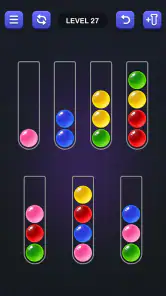
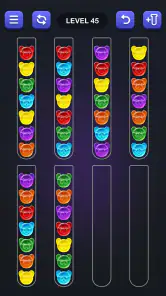
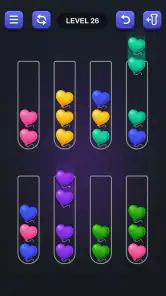
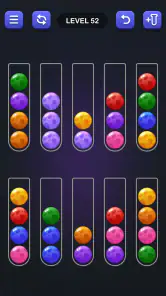
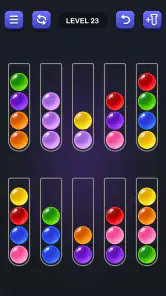
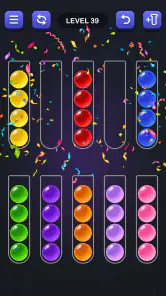
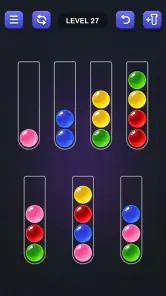
Analysis by Reviewed
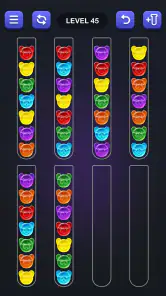
I tried Ball Sort Game - Color Puzzle as the kind of game I can open without preparing myself for a long session. It is a free puzzle game from Words Mobile where the task is to arrange colored balls into matching tubes. That sounds simple, and the first levels are easy to understand, but the appeal comes from planning several moves ahead rather than moving pieces randomly.
My first impression was that it is designed for short, quiet breaks. There is no complicated story to follow and no character system competing for attention. You look at the tubes, identify which colors are blocking one another, and decide whether a move creates space or makes the board harder. For anyone who enjoys tidy visual puzzles, that direct approach is immediately comfortable.
The game belongs to the puzzle category and carries an Everyone content rating, so it is approachable for a broad audience. It was released on March 27, 2024, and the current version is 5.3. It runs on Android 5.0 or later, which makes it accessible on many older devices as well as newer phones.
How I decided whether it was worth keeping
When I judge a sorting puzzle, I look beyond whether the rules are easy. I want to know whether the board encourages real thinking, whether a mistake feels recoverable, and whether the game remains pleasant after the novelty of the first few rounds disappears. I also consider how well it fits into everyday use: a two-minute wait, a longer commute, or a relaxed evening when I do not want a demanding game.
This game scores well on immediate clarity. The colored balls and tubes make the objective visible, so I did not need a tutorial full of instructions. The important decision is not simply where a ball can go, but whether that move preserves enough empty space for the colors underneath it. That small distinction gives the puzzle more depth than the cheerful appearance first suggests.
I also paid attention to the rhythm of failure. In this type of puzzle, one careless move can leave a color buried under the wrong stack. The best experience comes when the player can pause, review the board, and undo a poor decision instead of feeling forced to restart immediately. That makes the game suitable for relaxed problem-solving rather than reflex play.
Another useful criterion is visual load. Some puzzle games use timers, animated effects, crowded menus, or several currencies. Here, the central activity remains the arrangement of the balls. That makes it easier for me to concentrate, especially when I am playing with sound off or checking the screen briefly in a public place.
The basic loop is simple, but the order matters
Each puzzle asks me to move balls between tubes while respecting the color-sorting goal. A tube can act as a temporary parking place, but using it carelessly can remove the only space available for a later sequence. I quickly learned to inspect the top ball of every stack before making a move, then trace which color would become available next.
A practical habit is to avoid completing one color too early if doing so leaves the remaining tubes crowded. Finishing a tube feels satisfying, but the more important question is whether the move opens access to a buried ball. I found that treating empty space as a resource leads to better results than chasing the first obvious match.
Another small tactic is to create a temporary color pair only when it helps expose the next useful ball. A matching pair can look like progress, yet it may also occupy a tube that is needed for a different color. I recommend thinking in terms of future access: which move gives me more choices on the following turn?
That is one of the game’s less obvious strengths. The colorful presentation suggests a very casual experience, but the satisfying moments come from recognizing a sequence before it is visible to someone who is only matching the nearest available colors.
Why the game works well in ordinary daily moments
I can imagine using it while waiting for an appointment, during a short break between tasks, or at the end of the day when I want something interactive but not emotionally intense. A level does not require learning a fictional world or remembering a long chain of objectives. I can return after a pause and understand the board immediately.
It is also a reasonable choice for people who like visual organization. Sorting colors into clean groups has a calming quality, and the repeated structure makes the game easy to settle into. I would recommend it to someone who enjoys number puzzles, tile matching, or arranging objects but wants fewer rules to memorize.
For families, the Everyone rating makes the concept broadly approachable. Still, I would not describe it as a guaranteed shared game for every child and adult. The challenge is mostly quiet planning, not cooperative interaction, so it works better as an individual activity than as a game built around conversation or competition.
The game is also a good fit for players who prefer playing without a strong time-pressure element. If you enjoy examining a board before acting, you can engage with the puzzle at your own pace. If you need rapid action, changing objectives, or a constant stream of surprises, the deliberate sorting loop may feel too restrained.
Where it stands out among sorting puzzles
The clearest advantage is how little friction sits between opening the game and solving a board. I did not have to learn a complicated control scheme. The central visual language is consistent: colors show the relationships, tubes show the available space, and each move has an understandable consequence.
Compared with match-three games, this is more thoughtful and less dependent on quick pattern recognition. There is no need to search for a flashy chain while the board changes around me. I can stop and calculate. That makes it a better choice when I want a puzzle that rewards patience rather than speed.
Compared with word puzzles, it asks for less language ability. A player does not need to know vocabulary or interpret clues, which makes the experience more immediately accessible across languages. The trade-off is that it offers less variety in the type of reasoning involved; the challenge stays focused on space, order, and color grouping.
Compared with traditional logic puzzles on paper, the digital format makes moving pieces more convenient. I can test a plan directly instead of erasing and redrawing a diagram. However, paper puzzles may offer more variety for someone who wants deduction, arithmetic, or written clues rather than spatial sorting.
The game’s strong reception also suggests that the format has connected with a large audience: it has a 4.9 average from around 73 thousand ratings, with more than a million installs. I see those figures as evidence of broad appeal, not proof that every player will enjoy the same pace. A popular casual puzzle can still be the wrong match for someone seeking a deeper campaign or competitive structure.
The limits I noticed before recommending it
The central mechanic is focused, and that is both its identity and its main limitation. If sorting colored balls is already familiar to you, the experience may begin to feel repetitive sooner than a puzzle game with several distinct modes. I would not choose it as my only game if I wanted narrative progression, character development, or a changing set of genres.
There is also a narrow emotional range. The game is relaxing and orderly, but it is not especially dramatic. Players who enjoy the tension of a countdown, the satisfaction of defeating an opponent, or the discovery of a large world will probably find more excitement elsewhere.
Difficulty can be personal in this format. A board that seems obvious to one player may require careful planning for another, especially when several colors are layered in the same tubes. I prefer to treat a stuck position as a signal to reconsider the order of moves rather than as a test of speed. That mindset makes the game more enjoyable, but players who dislike restarting or retracing decisions may become frustrated.
The free price is a clear advantage for trying it without a financial commitment. At the same time, free casual games are not always the best choice for someone who wants a completely uninterrupted, highly curated puzzle experience. Before settling in for a long session, I would check how the current presentation fits my tolerance for interruptions and menus. That is a general practical step with any free mobile game, and it matters more when the appeal depends on calm concentration.
When another category is the better choice
I would steer you toward a word game if you enjoy building vocabulary, solving clues, or feeling that every round teaches you something linguistic. Ball sorting does not provide that kind of mental exercise. It is better for spatial planning than for language practice.
A match-three game may suit you more if you want quick decisions, visual effects, and changing boards that reward fast reactions. This game asks me to slow down and preserve options, so it can feel passive to someone who wants constant movement.
For players seeking a serious logic challenge, a sudoku app or a deduction game may offer more variety and a stronger sense of formal problem-solving. Those alternatives can be preferable when you want numerical constraints, unique solutions, or puzzles that demand written notes. This game wins when the goal is a lighter, more visual form of reasoning.
Likewise, a competitive puzzle title is a better fit if your motivation comes from rankings, head-to-head matches, or measurable performance against other players. I would not install this one expecting that social pressure. Its value is in the private act of organizing a board and finding a workable sequence.
What switching to it feels like
If you are moving from a busy mobile game, the adjustment is easy in terms of controls but noticeable in terms of pace. You will spend less time reacting and more time looking. I found that the best way to switch is to play a few boards without trying to rush, because the pleasure comes from seeing how one move changes the available structure.
If you are moving from paper puzzles, the convenience is immediate. The phone handles the pieces, so you can experiment without cluttering a desk. The trade-off is that the digital board gives you fewer opportunities to annotate your reasoning. I would choose this game for spontaneous sessions and a paper puzzle for longer, more deliberate study.
If you already play other color-sorting games, the cost of switching is mainly whether this particular presentation keeps your attention. The rules are familiar enough that you can begin quickly, but familiarity can also make the first impression less surprising. I would give it a short trial and judge whether the board layouts encourage you to plan rather than simply repeat a memorized routine.
One useful way to make the switch worthwhile is to use the game as a reset between demanding tasks. Instead of opening it while distracted by several notifications, I would play one board with a clear stopping point. That turns the sorting process into a small concentration exercise rather than another source of scattered attention.
Small strategies that improve the experience
My strongest practical tip is to count empty spaces before moving anything. An apparently helpful stack can become a trap if it consumes the only spare tube. I first identify which tube can safely serve as a buffer, then decide whether the next move exposes a new color or merely rearranges the same blockage.
I also recommend looking for colors that are almost accessible rather than colors that are already visible. If the top ball of a tube can be moved to reveal a useful second ball, that move may be more valuable than completing a matching pair elsewhere. This forward-looking approach reduces the number of times I have to undo a decision.
When I reach a difficult arrangement, I mentally separate the board into two questions: which color should eventually be completed, and which temporary moves are needed to reach it? That prevents me from confusing short-term tidying with actual progress. It is a simple distinction, but it makes complicated stacks easier to read.
Finally, I do not treat a failed sequence as wasted time. The failed attempt shows which tube became unavailable and which color was buried too deeply. Remembering that information makes the next attempt more deliberate. This is especially useful for players who normally dislike trial and error, because the game becomes a process of refining an order rather than guessing repeatedly.
Who should install it
I recommend it to anyone who wants a free, accessible puzzle for short sessions and prefers calm spatial reasoning over speed. It is especially suitable if you like arranging objects, spotting dependencies, and solving problems with a limited amount of visual information.
I would also suggest it to people using older Android phones, since the minimum operating system is Android 5.0. The broad compatibility and Everyone rating make it an easy title to consider for a mixed household, although the experience remains primarily single-player and quiet.
I would skip it if you need a story, regular social interaction, competitive rankings, or a wide rotation of mechanics. I would also skip it if color sorting itself does not appeal to you, because the game’s focused design leaves little room to hide from that central activity. A different puzzle category will offer better value for your time in those cases.
Words Mobile has kept the concept direct, and that directness is why the game is easy to recommend selectively. It does not need a long explanation, but it does reward players who notice how temporary space controls the entire board. The best audience is not necessarily expert puzzlers; it is people who enjoy a small, orderly challenge that can be picked up and put down.
My final recommendation
After spending time with it, I see Ball Sort Game - Color Puzzle as a dependable casual puzzle rather than an all-purpose mobile game. Its strongest qualities are immediate readability, low learning effort, and a planning loop that becomes more interesting when I stop chasing obvious matches and start protecting empty space.
The free price makes trying it straightforward, and the combination of an Everyone rating, broad Android support, and a large installed audience gives it a practical edge for casual users. Its 2.6 thousand reviews also show that many players have taken the time to respond to it, while the current 5.3 version indicates an actively available form of the game to consider.
My recommendation is clear: install it if you want a quiet color-based puzzle for waiting rooms, short breaks, or relaxed evenings, and if you enjoy planning without a timer pushing you forward. Choose a word, match-three, sudoku, or competitive puzzle instead if you need richer variety, language-based challenges, or social pressure. For the right player, the real strength is not the act of matching colors, but learning to manage space before the board runs out of options.
Pros
- Simple one-finger controls make it easy to play anywhere.
- Short levels are ideal for quick breaks or casual sessions.
- Colorful visuals are clear and easy to follow.
- Gradually increasing difficulty keeps the puzzles engaging.
- No fast reflexes are needed; careful planning is rewarded.
Cons
- Some levels can feel repetitive after extended play.
- Later puzzles may require trial and error to solve.
- The color-focused design may challenge players with color blindness.
- Limited gameplay variety beyond sorting colored balls.
- Ads may interrupt the experience between completed levels.

- Category
- Puzzle
- Version
- 5.3