Ace Pool Elite
- 798.00
- 4.5
- Installs
- 1.00M
- Price
- Free

Screenshots




Analysis by Reviewed
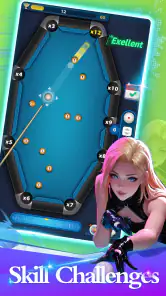
I approached Ace Pool Elite as a focused puzzle game built around one simple promise: every shot should reward careful precision. That focus matters because mobile pool games often try to be everything at once, adding tournaments, collections, social systems, or flashy distractions around the table. Here, the appeal is more direct. You line up a shot, judge the angle, control the strength, and live with the result. When the aim feels right, the satisfaction comes from your own decision rather than from a complicated progression system.
The game is free, belongs to the puzzle category, and comes from execl marocco. Its store summary, “Precision in Every Strike!”, describes the central experience better than a long feature list would. I found it easiest to enjoy in short sessions, especially when I wanted something that demanded attention without requiring a large time commitment. It is available for devices running Android 7.0 or later, and its current version is 1.0.1.2.
Why precision is the real feature
The most important capability here is not simply putting balls into pockets. It is the ability to turn a familiar pool table into a small problem-solving exercise. Before touching the cue, I have to read the available angles, decide which ball is worth attempting, and consider where the cue ball may finish. That last part is easy to ignore when playing casually, but it often separates a controlled turn from a lucky one.
This makes the game feel closer to a visual puzzle than to a fast arcade title. A shot can look obvious until I notice that the cue ball will drift into an awkward position afterward. Taking an extra moment to plan changes the result. The game’s strongest quality is therefore its invitation to slow down. It gives me a reason to study the table instead of treating every turn as a quick tap.
The useful skill is not merely aiming at a pocket; it is planning the complete path of the turn. That distinction gives the experience more depth than its straightforward presentation might suggest. Players who enjoy spatial reasoning, angles, and controlled experimentation will probably get more from it than people looking for constant action.
Reading the table before taking the shot
I recommend making a habit of checking three things in order. First, I identify the most realistic target rather than automatically choosing the nearest ball. Second, I look at the contact point and the likely direction of the cue ball after impact. Third, I consider whether a successful shot leaves a useful next opportunity. This routine sounds basic, but it prevents the common mistake of celebrating one pocketed ball while creating a much harder position immediately afterward.
That approach also makes misses more useful. If the cue ball travels differently from what I expected, I can adjust the next attempt instead of blaming the game. A failed shot becomes feedback about angle, force, or positioning. In a short mobile session, that sense of gradual correction is more satisfying than simply restarting until luck produces a good result.
How the controls feel during ordinary play
The practical experience depends on making small adjustments rather than swinging wildly. I found that broad movements are tempting when a shot looks difficult, but they usually make the decision less precise. A better workflow is to establish the intended line, make a modest correction, and then apply only the strength needed for the distance. This is especially important when the target pocket is close but the cue ball has room to travel afterward.
New players should resist the urge to rush because the table encourages overconfidence. A nearly straight shot can still go wrong when the force is excessive, while a delicate attempt can fail if the player focuses only on the pocket and ignores the cue ball. The game is at its best when I treat each turn as a sequence of choices rather than one gesture.
There is also a useful mental trick for playing on a phone: I separate aiming from power selection. I first decide where the cue should send the object ball, then I think about how far the cue ball needs to move. Combining both decisions too quickly makes the shot feel vague. Separating them gives me a repeatable process, which is valuable when the screen is small or my finger partly covers the table.
A realistic everyday session
Imagine having a few minutes before an appointment or during a quiet break. A large competitive game may be inconvenient because it asks for a long match or several menus before the action begins. This title fits that moment better. I can open it, focus on a handful of carefully chosen shots, and stop after a satisfying attempt without needing to commit to a lengthy play session.
For that use, the puzzle identity is important. I do not need to be in the mood for a full sports simulation. I only need enough concentration to solve the table in front of me. On a stressful day, that narrow task can be calming because it replaces background noise with one clear question: what is the safest and most effective shot available now?
It also works for players who like practicing patience. Someone who normally taps quickly through casual games may discover that the best results come from waiting, checking the line again, and accepting that a defensive or conservative choice can be smarter than an ambitious one. That is a small but meaningful change in how the game is approached.
Where the experience stands against other pool games
Compared with a traditional pool simulator, Ace Pool Elite feels more approachable because its main attraction is the individual shot rather than the broader sporting presentation. A simulator may be preferable if you want a detailed recreation of real-world rules, a structured league atmosphere, or a strong sense of competitive identity. This game is a better match when you want the table to function as a compact logic challenge.
It also differs from quick arcade pool games. Arcade alternatives often reward speed, dramatic effects, or aggressive attempts. Here, the precision angle makes patience more valuable. That does not mean every shot becomes deeply strategic, but it does mean careless play is less rewarding. I would choose this title when I want to think through a turn; I would choose a faster alternative when I want immediate spectacle or a more energetic rhythm.
Against general puzzle games, the pool setting gives the decisions a physical feeling. Instead of moving abstract pieces, I judge direction, distance, and rebound-like consequences through a familiar table. Players who enjoy spatial puzzles but do not usually play sports games may find that combination appealing. The trade-off is that anyone who dislikes pool mechanics may find the central challenge repetitive, because the same basic skill remains at the heart of the experience.
Small habits that improve the experience
My first practical tip is to stop treating the hardest-looking shot as automatically the best shot. A safer pocket can preserve control and make the next decision easier. This is particularly useful for beginners, who often chase an impressive angle before understanding how much the cue ball’s final position matters.
My second tip is to use misses diagnostically. If the object ball reaches the pocket but the cue ball ends badly, the aiming decision may have been correct while the power decision was not. If the object ball misses completely, the line deserves another look before changing the force. Separating those errors helps me improve faster than simply trying a different gesture each time.
My third tip is to play in short, deliberate blocks instead of continuing after concentration has faded. Precision games become frustrating when I keep attempting difficult shots while distracted. A brief pause often helps more than repeated retries because I return with a clearer view of the table. This makes the game a better fit for mindful breaks than for passive background play.
A fourth useful habit is to plan one step ahead without overplanning the entire table. Looking too far ahead can make a simple shot feel intimidating, while ignoring the next position causes avoidable problems. I usually aim to identify the immediate target and one likely follow-up. That balance keeps the puzzle manageable while still rewarding foresight.
What may frustrate experienced players
The same focused design that makes the game accessible can limit its appeal for players seeking a complete pool ecosystem. If your priority is a deep competitive structure, extensive customization, or a broad collection of modes, a larger pool title may offer more variety. Ace Pool Elite is easier to understand when viewed as a precision-centered puzzle experience rather than a full replacement for every kind of digital billiards game.
Its free entry is convenient, but free games can also encourage players to judge the experience by how much long-term variety they expect. I would not install this specifically for endless novelty. I would install it for the repeatable pleasure of solving shots more cleanly. That distinction is important: the game’s value comes from refining the same central skill, not from constantly changing the rules.
There is also a learning curve in judging force. Players who want immediate, effortless success may find the early attempts less satisfying because the table rewards attention. The game is not necessarily difficult in a punishing way, but it asks for a more measured style than many casual titles. If you prefer games where every action produces instant progress, this may feel slower than expected.
Who should install it
I think the strongest audience is made up of players who enjoy compact challenges and want a pool game that emphasizes decision-making. It suits someone who likes testing angles, correcting mistakes, and seeing a clean plan work. It is also a sensible choice for casual players who want a free title for short breaks without learning a large set of systems first.
It may appeal to people who normally choose puzzle games but want something more tactile. The table provides a clear visual goal, while the shot itself creates enough uncertainty to make each attempt feel active. Players who enjoy practicing a skill can return to it repeatedly and notice that better results come from better preparation rather than random tapping.
I would be more cautious about recommending it to someone who mainly wants online competition, a realistic sports presentation, or a large progression framework. Those players may be happier with a more feature-heavy billiards game. I would also suggest skipping it if you dislike repeating a core mechanic, because precision is not a side activity here; it is the reason to play.
Availability and overall value
The game is free, which lowers the barrier to trying it. It carries a Mature 17+ content rating, so families should check that classification before handing it to younger players. The title has passed the stage of being an obscure experiment: it has more than a million installs, an average rating of 4.5 from roughly twelve thousand ratings, and 798 written reviews. Those figures suggest that the straightforward pool-puzzle idea has found a substantial audience, while the rating indicates that many players respond positively to its core feel.
Still, popularity does not remove the need to match the game with the right expectations. I would judge it by the quality of its shot-by-shot decisions, not by expecting the breadth of a major sports package. The current release, version 1.0.1.2, is a sensible starting point for anyone using a compatible device, but the more important question is whether you enjoy careful aiming enough to make repetition feel rewarding.
After spending time with it, I see Ace Pool Elite as a focused recommendation rather than an all-purpose pool app. Its best quality is the way it turns each turn into a compact exercise in geometry, restraint, and planning. The most enjoyable moments come when I choose a realistic line, control the force, and leave the cue ball in a useful position instead of relying on luck.
If you want a free puzzle game where patience directly improves your shots, this is worth trying. I would recommend it to a friend who likes pool but does not need a huge competitive package, and to puzzle fans who enjoy physical-looking challenges. I would point elsewhere for players demanding extensive modes or constant variety. For the right audience, though, the narrow focus is a strength: it keeps the attention on the one thing that matters most, making a precise decision and watching it succeed.
Pros
- Realistic physics make positioning and shot selection feel rewarding.
- Multiple game modes provide variety beyond standard pool matches.
- Smooth touch controls make aiming and applying spin intuitive.
- Progression gives regular players goals to work toward.
- Matches are suitable for quick sessions or longer play periods.
Cons
- Some advanced features may be locked behind in-app purchases.
- Online competition can feel intimidating for casual beginners.
- Progression may become repetitive after extended play.
- A stable internet connection may be needed for some features.
- Ads can interrupt the experience for users on the free version.
- Category
- Puzzle
- Version
- 1.0.1.2