8 Ball Kick
- 2.63K
- 4.5
- Installs
- 10.00M
- Price
- Free

Screenshots
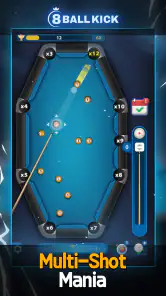
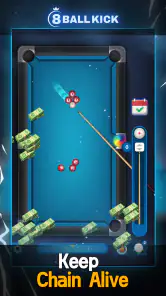
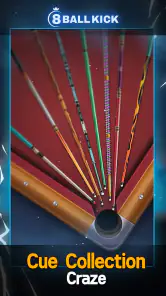
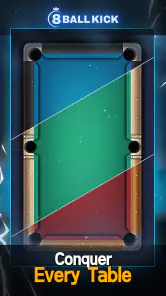
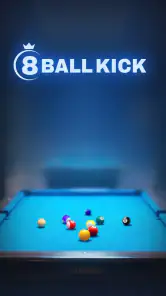
Analysis by Reviewed
8 Ball Kick is a free puzzle game built around a simple promise: make each shot count. I found it most enjoyable when I treated every turn as a small problem rather than rushing to hit the nearest ball. That focus gives the game an easy-to-understand starting point, while the pool-table setting adds enough tension to make a short session feel more involved than a basic tap-and-match puzzle.
My overall view is positive but specific. This is a good fit if you like compact challenges, careful aiming, and the satisfaction of solving a shot through trial, adjustment, and timing. It is less suitable if you want a deep pool simulation, a long story, or a large collection of clearly explained modes. The appeal here is the repeated decision of what to do with one shot, not a broad collection of systems.
Why the one-shot idea works
The strongest part of 8 Ball Kick is the way its pool theme gives ordinary puzzle decisions a physical feeling. A move is not just a colored tile disappearing or a piece sliding into place. You have to think about direction, contact, and what the result may leave behind. Even when the basic objective feels familiar, the table makes mistakes more visible: a poor choice can create a difficult next position instead of simply ending a turn without consequence.
I recommend beginning slowly, especially during the first few sessions. Rather than aiming immediately at the most obvious target, I look at the whole table and ask which ball or route will leave the cleanest follow-up. This small change in approach makes the game feel more thoughtful. It also helps prevent the common mistake of using a powerful-looking shot that solves the immediate problem but creates a worse one afterward.
The game’s store summary, “One Shot, Infinite Thrills!”, captures the intended rhythm without telling the whole story. The thrill does not come from complicated controls. It comes from the pressure attached to a limited opportunity. When a shot appears straightforward, I still pause to consider whether the angle is safe and whether the next position will remain manageable.
That makes it useful as a short break. I can imagine playing while waiting for an appointment, taking a few turns after work, or using it as a quick mental reset between longer tasks. It does not require the commitment of a full strategy game, yet it can hold attention better than a completely passive time-filler because each move asks for a decision.
Learning the table instead of chasing quick wins
One practical technique is to divide each turn into three checks. First, identify the immediate target. Second, inspect the likely path and surrounding obstacles. Third, decide whether the resulting position helps the next shot. This routine sounds obvious, but it changes the game from reactive tapping into a repeatable puzzle-solving process.
I also found value in deliberately taking a safer shot when two options appear available. The more dramatic route may look satisfying, but a controlled move can preserve flexibility. In a game based on one-shot decisions, keeping the next opportunity workable is often more valuable than trying to finish everything at once.
Another useful habit is to treat failed attempts as information rather than wasted time. If a shot misses or produces an awkward arrangement, I pay attention to what caused the problem: an overly ambitious angle, poor positioning, or a failure to account for the surrounding balls. That makes the next attempt more deliberate. The puzzle structure rewards observation, not just speed.
These details are where the game earns its place among puzzle games. A conventional match-style title may offer more colorful effects and a faster reward cycle, while a full pool simulator may provide more realistic control and competition. 8 Ball Kick sits between those approaches. It uses the recognizable language of pool but keeps the emphasis on solving compact situations.
What stands out in everyday play
The best everyday scenario is a player who has only a few minutes but still wants something that engages attention. I would use it during a short commute break or while waiting for someone, playing a handful of attempts and stopping without feeling that I had abandoned a long campaign. That flexibility is one of its clearest strengths.
It can also work for people who enjoy visual problem solving but do not normally choose traditional puzzle formats. The pool setting provides an immediate mental picture: targets, angles, space, and consequences. Someone who finds abstract grids dull may find this more approachable because the goal is represented on a table rather than hidden behind symbols.
At the same time, the game’s simplicity may limit its appeal for experienced pool players. If your priority is realistic cue control, competitive matches, detailed rules, or a strong sense of sporting authenticity, a dedicated billiards game will probably be a better choice. This title is primarily about puzzle decisions. The pool theme supports that design rather than replacing it with a complete simulation.
The mature age classification is worth noticing before installation. That recommendation matters for families choosing games for younger players, even though the basic concept may look harmless at first glance. Adults should check the age suitability on the device and store account they plan to use rather than assuming that a pool-themed puzzle is automatically appropriate for children.
Where the experience can lose momentum
My main reservation is that the central idea can become repetitive if you are looking for constant novelty. A one-shot puzzle loop is appealing because it is clear and focused, but that same focus can feel narrow during a long session. I would not approach this as a game meant to occupy an entire evening every day. It works better in bursts, with breaks between sessions.
There is also a natural trade-off between accessibility and depth. A simple shot-based structure is easy to understand, but players who want extensive progression or a wide range of specialized challenges may eventually want more variety. That is not a flaw in the basic concept; it is a reason to match the game with the right expectations.
I would also avoid judging it by the standards of a competitive online billiards title. The satisfaction here comes from solving the situation in front of you, not necessarily from proving that you can outplay another person. If social competition is the feature that keeps you engaged, another category of pool game may serve you better.
The developer is listed as execl marocco, and the current version is 1.0.2.4. For me, that makes it sensible to keep expectations centered on the present core experience rather than assuming it will replace a much larger, established pool package. I would install it for the focused puzzle loop and evaluate it on that basis.
Who should try it first
I would recommend 8 Ball Kick to players who enjoy making careful choices under a small amount of pressure. It is especially well suited to people who like games that are easy to start but reward a more thoughtful second attempt. You do not need to be an expert at billiards to understand the attraction, because the important skill is reading the situation and planning the consequence.
It is also a reasonable choice for someone who wants a free game that can be sampled without a financial commitment. The price is free, so the practical barrier to trying it is low. That does not mean every player will enjoy it indefinitely, but it makes the game easy to test during a short session and keep installed if the shot-by-shot format fits your habits.
The audience response suggests broad interest: it carries a 4.5 average from around 223 thousand ratings, with more than 10 million installs. I read that as evidence that the core idea connects with many players, not as a guarantee that it will suit everyone. Ratings can show that a game has found an audience, while personal preference still decides whether its pace and depth feel satisfying.
In practical terms, I would choose it over a traditional match-three game when I want more spatial reasoning, and over a full billiards simulator when I want a quicker, less technical session. I would skip it in favor of those alternatives if I wanted elaborate progression, realistic sports mechanics, or a stronger multiplayer focus.
Device fit and installation expectations
The game supports Android 7.0 and later, which makes it accessible to many older Android devices as well as newer phones. I would still consider the age classification and the way the game fits your personal screen-time habits before installing. A game that is easy to open can also become an easy default whenever you have a spare minute.
Because the game is free, I would approach the first launch as a trial rather than making a long-term commitment immediately. Play enough to see whether the aiming decisions remain interesting after the initial novelty fades. The most useful test is not whether you enjoy the first shot, but whether you want to rethink the third or fourth one after a mistake.
Players who prefer playing with a physical controller or a large screen may also want to consider how comfortable they are with the device they use. A puzzle built around precise visual decisions benefits from a display and touch response that feel comfortable. If aiming feels cramped or tiring on your phone, that is a practical limitation of the experience for you, even if the underlying design remains appealing.
My final recommendation
8 Ball Kick succeeds when it stays focused on the question that gives the game its identity: what is the smartest way to use this shot? I like that the pool setting turns a small puzzle into something concrete, and I appreciate that short sessions can still feel purposeful. The game does not need a complicated explanation to become engaging; its strongest moments come from noticing a better route after initially seeing only the obvious one.
Its limits are equally clear. The focused loop may not provide enough variety for players who need a large progression system, and pool fans seeking detailed simulation should look elsewhere. I would also keep sessions moderate if repetition begins to replace curiosity. The game is at its best when I am solving a fresh situation, not forcing myself to continue after the decision-making has started to feel routine.
For the right player, the recommendation is straightforward: try it if you want a free, approachable puzzle with a billiards-inspired structure and enough consequence to make each move matter. The best reason to play is not the promise of endless action, but the satisfaction of turning one difficult position into a clean solution. That focused appeal makes it a worthwhile download for casual puzzle fans, while its narrow design gives more demanding players a clear reason to choose a different game.
With an age rating of Mature 17+, a current version of 1.0.2.4, and a large existing audience, it is easy to see why the game attracts attention. My verdict is that it is a strong short-session puzzle choice, provided you want thoughtful shots rather than a complete billiards world. I would keep it available for quick mental breaks, play patiently, and judge it by the quality of its decisions—not by features it was never designed to provide.
Pros
- Simple controls make it easy for beginners to start playing.
- Quick matches are convenient for short gaming sessions.
- Pool-inspired gameplay feels familiar to most players.
- Works well as a casual game for passing time.
- Progression can encourage repeated play and practice.
Cons
- Physics may feel inconsistent during some shots.
- Limited variety can make the gameplay repetitive over time.
- Ads may interrupt the experience between matches.
- Advanced players may find the challenge too shallow.
- Some features may require in-app purchases or extra time.

- Category
- Puzzle
- Version
- 1.0.2.4