7 Little Words and More
- 44.37K
- 4.7
- Installs
- 1.00M
- Price
- Free

Screenshots
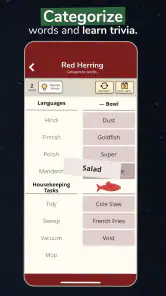
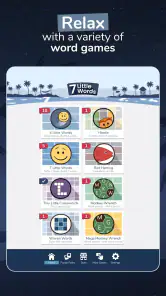
Analysis by Reviewed
I like word games that fit into the small gaps of a normal day, but I also want them to feel purposeful rather than like a random pile of anagrams. 7 Little Words takes a clean, clue-driven approach: each puzzle asks me to connect short definitions with groups of letters and assemble the answers from the pieces available. It is a game for quiet concentration, not frantic tapping, and that makes it easy to return to when I have a few spare minutes.
Blue Ox Family Games, Inc. has kept this title available as a free word game for a long time, and its strong reception is easy to understand. It has a 4.7 average from around 140,000 ratings, with more than a million installs. Those figures do not make it automatically perfect, but they do match my experience: the basic idea is simple to learn, while the clues can remain surprisingly stubborn once the obvious answers disappear.
How the first puzzles create a useful goal
The early appeal comes from having a clear target. I am not wandering through a large map or managing several resources; I am trying to solve the puzzle in front of me. That narrow focus helps the game feel approachable. A new player can understand the task quickly, yet solving the first few sets still gives a small sense of achievement because every answer has to fit both its clue and its letter fragments.
The best part of this design is that it rewards more than vocabulary recall. I have to think about word length, possible beginnings and endings, and whether a familiar-looking fragment belongs to a less obvious answer. A clue may suggest one word immediately, but the available pieces force me to test that assumption. This makes the opening goal more interesting than simply matching a definition to a word.
That structure also makes the game suitable for different kinds of sessions. I can solve one puzzle while waiting for an appointment, or stay longer when I am in the mood to work through several clues. The game does not require the commitment of a full crossword or a long story chapter. At the same time, it is not so disposable that I forget the puzzle as soon as I close it.
For someone who wants a word game for children or family use, the Everyone age rating is reassuring. Still, the rating should not be confused with universal ease. The interface and subject matter are accessible, but some clues can demand mature vocabulary or broad general knowledge. I would happily let a younger player try it, while expecting that shared play may be more enjoyable than leaving them to solve every puzzle alone.
What makes the opening loop work
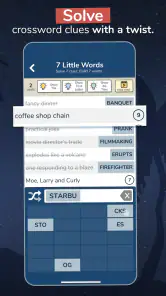
The central loop has a pleasant rhythm. I read a clue, scan the available letter groups, form a guess, and then use the remaining pieces to reassess the board. A correct answer reduces uncertainty, because the unused fragments become easier to interpret. An incorrect assumption can be useful too: once I remove it mentally, another clue often becomes clearer.
One practical tip is to avoid attacking the hardest clue first. I usually look for the answer with the most distinctive fragment or the clearest definition, then use that solved word to narrow the possibilities elsewhere. This is more effective than repeatedly staring at the same vague clue, especially when several answers could share similar endings.
Another useful habit is to treat the board as a connected problem rather than seven separate questions. If one answer seems too long or too short, I do not force it just because the clue feels right. I check whether its pieces are needed by a more convincing answer. That small change in approach is where the game becomes more satisfying: progress comes from managing uncertainty, not just knowing obscure words.
Progress signals, challenge, and the pace of returning
Word games need some way to make progress feel visible. Here, the strongest signal is the puzzle itself becoming complete. Each solved entry reduces the clutter, and the final answer provides a natural finish line. I do not need a complicated reward structure to understand that I am moving forward; the board shows it directly through the words I have uncovered.
That simplicity is both a strength and a limitation. Players who enjoy language puzzles for their own sake will probably appreciate the focus. Players who expect elaborate unlock trees, collectible items, character upgrades, or a story campaign may find the progression comparatively light. The game’s motivation comes mainly from solving and returning to more puzzles, rather than from a separate layer of customization.
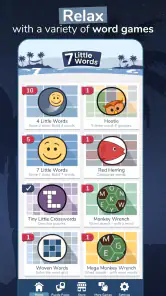
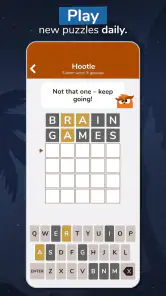
The store presents it as a variety of daily word games, and that daily framing matters to the pacing. A regular puzzle gives me a reason to check in without demanding a long session. It can become part of a morning routine, a short evening wind-down, or a shared challenge with someone who enjoys comparing approaches. The daily cadence feels healthier than an endless feed because it encourages a deliberate pause instead of constant consumption.
In an everyday scenario, I might open it during a train ride with only a few minutes available. I can start by solving the most obvious clue, leave the difficult one for later, and return when the rest of the board has supplied more context. If I get interrupted, the puzzle still feels like a coherent task rather than a timed event I have failed to complete. That makes it especially comfortable for fragmented schedules.
Where the difficulty becomes meaningful
The difficulty curve is less about fast reflexes and more about how quickly the clues stop yielding their first interpretation. Early answers can establish confidence, but later ones may require me to reconsider familiar words, notice a less common meaning, or use the letter groups in an unexpected combination. The game is at its best when it stretches my thinking without turning every puzzle into a vocabulary test.
My approach changes as the board gets tougher. I first solve clues with precise definitions, then identify fragments that look unusually distinctive, and finally revisit the answers I rejected too quickly. I also find it useful to say possible answers aloud. Hearing the word can expose an awkward fit that looks acceptable on screen, or reveal that the clue is pointing toward a different grammatical form.
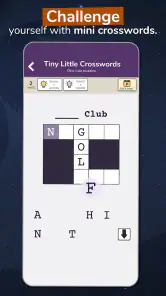
There is a trade-off here. If you prefer conventional crossword clues with a broad grid and many crossing letters, this format may feel restrictive. A crossword lets one answer provide several letters for another; this game instead asks me to reason through grouped pieces and clue relationships. I prefer it when I want a compact puzzle, but I would choose a traditional crossword when I want a larger, more interconnected solving experience.
It is also not the best choice for someone seeking a competitive word game built around speed or head-to-head pressure. The appeal is contemplation and completion. Players who want timed races, large multiplayer matches, or a constant stream of rapid guesses should look elsewhere. The slower pace is intentional, but it will feel passive if your favorite part of word gaming is urgency.
Hints and the cost of impatience
When I am stuck, the temptation is to reach for help immediately. I try not to do that. A better workflow is to mark the clue mentally as uncertain, solve two or three easier entries, and then return with a less crowded board. This preserves the satisfaction of discovery and often works because the remaining fragments become more informative.
Hints can still have a legitimate role. If I have spent too long circling the same possibility, a small nudge can keep the session moving instead of turning relaxation into irritation. The important trade-off is that assistance changes the feeling of progress: solving a clue independently teaches me something about the puzzle’s construction, while receiving help mainly restores momentum.
Because the game is free to download and offers in-app purchases ranging from $0.99 to $39.99 per item, I would decide in advance how I want to handle optional spending. Someone who enjoys solving without assistance may never feel pressure to buy anything. Someone who uses help frequently should pay attention to how quickly small purchases can add up. The free entry point is appealing, but the most satisfying experience for me comes from treating hints as an occasional last resort rather than part of every puzzle.
How the retention design feels in practice
The daily structure provides gentle retention pressure: I know there is a fresh reason to return, but the game does not need to dominate my attention. That balance is one of its strongest qualities. It supports a habit without making the habit feel like an obligation, provided I am comfortable walking away from a difficult clue.
There is still a possible downside. A daily routine can make a missed session feel more important than it really is, especially for players who enjoy maintaining uninterrupted streaks. I would not recommend turning the game into a test of discipline. The puzzles are more enjoyable when the goal is to exercise curiosity and language skills, not to punish yourself for being busy.
The pacing also depends on your tolerance for repetition. The core interaction remains focused on clues and letter groups. That consistency is why the game is easy to pick up, but it also means the experience does not transform dramatically from one session to the next. If you need new mechanics, visual surprises, or a strong narrative to maintain interest, the long-term appeal may fade sooner.
On the other hand, consistency is exactly what makes it useful as a low-pressure mental break. I can understand the rules without relearning a system, and I can stop after a completed puzzle without feeling that I have left a complicated objective unfinished. For me, that makes the game more dependable than many larger word titles that offer more content but require more attention.
Who should play it, and who should skip it
I would recommend it to anyone who enjoys vocabulary, clue solving, and short sessions with a definite endpoint. It is particularly good for players who like thinking gradually rather than racing a clock. It can also work well as a shared activity: one person may spot the definition while another notices how the fragments can be combined.
I would be more cautious if you dislike uncertainty in clues. Some players want every question to have an immediate, mechanically obvious answer. Here, part of the challenge is accepting that a plausible answer may still be wrong because the available pieces do not support it. That can be rewarding, but it can also feel frustrating when you are tired or simply want a quick win.
I would also skip it if your main reason for downloading a word game is social competition, rapid scoring, or extensive avatar progression. This is a focused puzzle experience from Blue Ox Family Games, Inc., not a broad platform built around several unrelated play styles. Its restraint is a virtue for the right audience and a limitation for everyone else.
Practical details before downloading
The game is free, carries an Everyone rating, and currently lists version 8.15.2 with a minimum operating-system requirement of 10. I would check that your device meets that requirement before trying to install it, particularly if you use an older phone or tablet. The title has been available since Aug 9, 2011, so it is an established option rather than a brand-new experiment.
I would also think about the kind of device on which I plan to play. A larger screen can make it easier to inspect the letter groups and read clues comfortably, while a phone is better for quick sessions away from home. The game’s compact format suits both situations, but the smaller display may make prolonged solving less comfortable for anyone who prefers generous text.
One of the less obvious strengths is how well it supports delayed insight. I can close a puzzle while stuck, return later, and often see a clue differently after my attention has reset. That is a useful contrast with games that reward constant engagement. The best strategy is sometimes to stop deliberately, not to push until every answer feels impossible.
My progression verdict
After spending time with it, I see the progression as a steady chain of small victories rather than a dramatic ladder of unlocks. The goals are clear, the solved entries visibly reduce the problem, and the daily rhythm gives returning players a natural reason to continue. The challenge grows through interpretation and deduction, while the pacing remains friendly to short, interrupted sessions.
The real reward is the moment a stubborn clue becomes obvious because the rest of the board finally makes sense. That feeling is more important here than flashy progression systems, and it explains why the game can remain appealing even when its presentation is straightforward.
My final recommendation is positive, with a clear qualification. If you want a calm, clue-based word game that respects your time and gives each session a satisfying finish, this is an excellent free starting point. If you need competitive urgency, deep unlock mechanics, or constant novelty, a crossword app with broader grids or a multiplayer word game may suit you better. I keep coming back because the design knows what it wants to be: a compact daily language challenge, with enough resistance to make solving feel earned.
For me, that focus is the reason to try 7 Little Words. It does not need to overwhelm the player with systems to create momentum. One clue leads to another, a handful of fragments gradually become meaningful words, and a short break can turn into a genuinely satisfying exercise in attention.
Pros
- Short daily puzzles are easy to fit into a busy schedule.
- Clues encourage vocabulary building without feeling like a lesson.
- Multiple puzzle packs provide plenty of variety.
- Simple interface makes the game accessible for most players.
- Hints can help you progress when a clue feels especially difficult.
Cons
- Some puzzle packs may require an additional purchase.
- A few clues can feel vague without strong word knowledge.
- Limited lives or hints may slow progress for impatient players.
- The difficulty can vary noticeably between individual puzzles.
- Frequent players may eventually find the format repetitive.

- Category
- Word
- Version
- 8.15.2