СASHFLOW
- 191.00
- 3.7
- Installs
- 100.00K
- Price
- $1.99

Screenshots


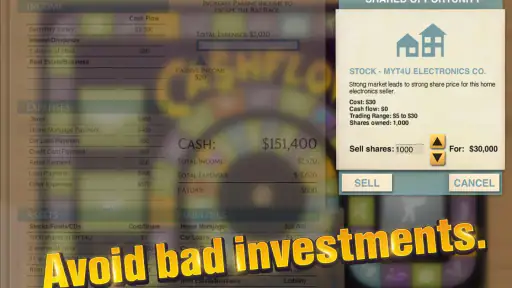




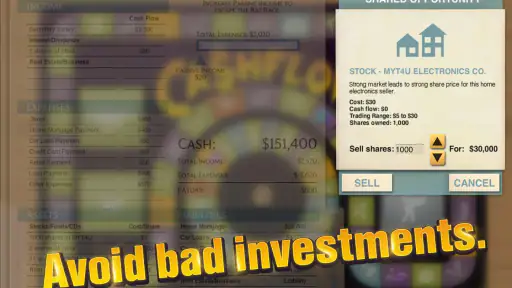
Analysis by Reviewed
When I want to think through money choices without turning the evening into a finance lecture, I’m drawn to games that make decisions feel tangible. СASHFLOW is an educational game built around that idea: it places financial choices inside a game, so the appeal is not only learning terms but considering what a choice might lead to. I would treat it as a low-pressure way to start talking about money, not as a substitute for advice about real investments.
That distinction matters. A simulated decision can help me notice how I think about spending, risk, and opportunity, but it cannot tell me what I personally should buy or sell. I find the game most useful when I pause to explain why I made a choice, rather than simply trying to finish quickly or win.
What a decision-focused game can teach
The useful capability here is not simply that money appears as a theme; it is that the game gives financial choices a consequence within a playable setting. That changes the way I approach the subject. Instead of only reading that spending, investing, and risk involve trade-offs, I have to choose between options and consider what I expect each one to do. The game can make an abstract topic easier to discuss, especially for someone who has never felt comfortable starting with finance books or technical explanations.
I would still keep the lesson modest. A game can help me practise asking better questions—what might this cost, what do I hope to gain, and what am I taking a chance on? It cannot reproduce every detail of a person’s finances or settle whether a real-world opportunity is suitable. The best learning comes from noticing my reasoning, not treating an in-game result as a reliable forecast.
Getting Started with СASHFLOW
The first thing you’ll notice when you open СASHFLOW is its user-friendly interface. It's designed to get you hooked right away, with vibrant colors and engaging graphics that make the financial world seem less daunting. The setup is straightforward, allowing you to jump right into the action without any complicated tutorials. Just create your profile, and you’re ready to start your financial journey!
The app is developed by Torn Screen Entertainment, Inc. and costs $1.99, so I’d think of it as a paid game to try when I’m genuinely curious about learning through play. It’s rated for Everyone, and the current version is 2.0.27, with Android 6.0 as the minimum requirement. Its 3.7 average from around 3,000 ratings and over 100,000 installs suggest that it has found an audience, though popularity alone would not decide whether its style suits me.
Gameplay and Features
Now, onto the gameplay. СASHFLOW is essentially a financial strategy game where your goal is to escape the rat race and achieve financial freedom. Sounds exciting, right? The game simulates real-world financial scenarios, teaching you how to manage budgets, invest wisely, and grow your wealth. It’s like Monopoly but on steroids, with a real-world twist.
More From Our News Desk

Clash of Clans Is Won Between the Battles

Android Auto Makes the Case for Quieter Car Software

MobiOffice: Transforming Mobile Productivity with Seamless Integration

EA SPORTS FC™ Mobile Soccer: Redefining Mobile Sports Gaming

How Microsoft OneDrive Became a Mobile Productivity Giant

How Google Translate Breaks Language Barriers Effortlessly
One of the most impressive features of СASHFLOW is its educational content. The app doesn’t just throw you into the deep end; it provides helpful tips and explanations for every decision you make. Whether you’re buying stocks, investing in real estate, or managing your expenses, the app offers guidance to help you understand the implications of your choices.
That decision-and-explanation loop is the part I’d focus on. Rather than treating each prompt as a quiz with one obvious answer, I’d ask myself what I expect to happen next and what I might be giving up by choosing it. A useful habit is to make a quick prediction before reading the explanation, then compare it with the game’s feedback. That turns a move into a small lesson about assumptions, not just a step toward a score.
For example, a short session after work can be more revealing than a long, distracted one. If I’m weighing a simulated purchase, I can stop for a moment and ask whether I’m considering the cost, the possible return, or only the exciting upside. That reflection is practical even when the game’s situation is simplified: it helps me notice which parts of a money decision I tend to overlook.
Making a session useful without turning it into homework
I’d approach a session with one small question in mind rather than trying to absorb every financial idea at once. For instance, I might pay attention to how often I favour a tempting possibility over a more cautious choice, then see whether the game’s explanation changes my view. This keeps the activity manageable and gives me something concrete to discuss afterward, without pretending that a single play session makes me an expert.
Another practical habit is to separate the decision from the result. If a choice works out in the game, I would still ask whether my reasoning was sound or whether I simply got a favourable outcome. If it goes poorly, I would look at what I overlooked instead of assuming that every similar real-life choice is automatically bad. That distinction helps avoid learning the wrong lesson from a simplified scenario.
For a family or a pair of friends, I’d let each person explain a choice before comparing outcomes. Someone who prefers caution may have a sensible reason for declining an opportunity, while another player may be comfortable taking a chance. The conversation is valuable precisely because there is room to compare priorities; copying whoever seems to be winning would make the exercise much less thoughtful.
Why You’ll Love It
If you’re someone who finds traditional financial education a bit dry, СASHFLOW is a breath of fresh air. The game format makes learning about money engaging and enjoyable. Plus, the competitive aspect of trying to beat your own high score or compete with friends adds an extra layer of excitement.
СASHFLOW also includes a social element, allowing you to connect with friends and compare financial strategies. It’s a great way to learn from others and share your own tips and tricks. The community aspect makes it feel like you’re not alone on your financial journey.
Playing with a friend could make the comparison more useful if you explain your reasoning instead of focusing only on who does better. Two people can choose differently because they value caution and opportunity differently; discussing that gap is often more instructive than copying the apparent winner. If I’m playing alone, I can get a similar benefit by noting one decision I would change next time and why.
Compared with a personal-finance tracker, this is a more playful way to explore choices, but it is not the better tool for recording actual spending or planning household bills. Compared with a book or lesson, the game gives decisions a more active feel, while a structured course may be better when I want a careful explanation of real financial concepts. I’d use it as a conversation starter and practice space, not as a comprehensive investing course.
A realistic place for it in an ordinary week
Imagine I have a quiet half-hour after dinner and want to bring up saving or investing with a teenager, a partner, or a friend without making the conversation feel like a lecture. A few decisions in the game can give us a shared example to react to: one person can explain why an option feels worthwhile, while another can point out the risk they notice. The value is not that we leave with a personal financial plan; it is that we have a more specific conversation than “we should be better with money.”
It can also suit someone who is curious about money but hesitant to begin with real accounts, market news, or complicated terminology. The simulated setting gives that person a way to engage with choices while keeping the stakes conversational. I’d still be careful not to present it to a child or a new learner as a complete guide to investing: an approachable game is a starting point, and important real-world questions need more context.
When I play alone, I’d keep a brief note of one assumption I made and one question I still have. That makes it easier to take the useful curiosity from the game into a book, a class, or a discussion with someone knowledgeable. It also gives me a reason to return with a specific purpose instead of opening the game and hoping that repeated play will automatically teach me more.
Where the Game’s Limits Matter
The game format is also a limitation. Real finances involve personal circumstances, uncertainty, and consequences that a simulation cannot fully reproduce. I would not use a successful run as proof that I’m ready to invest real money, and I would check important financial decisions against reliable, situation-specific guidance. The educational framing is useful, but the learning still depends on questioning what the game presents.
It may also be the wrong choice if I want a fast arcade game, a practical budgeting app, or detailed instruction before making real-world investment decisions. Players who dislike strategy or prefer direct lessons may get more from a finance book, a course, or a straightforward money-management tool. The $1.99 price makes sense to me only if I’m willing to engage with the decisions rather than treat it as a one-off novelty.
There is a difference between finding the interface approachable and finding every part of the experience easy to learn. Someone who expects a quick, hands-off game may not enjoy stopping to think through choices, while a player who wants detailed instruction may find game explanations too limited for their needs. I’d go in expecting an interactive introduction to financial decision-making, not a replacement for a carefully structured lesson.
The game is also not the right answer to an urgent practical problem. If I need to track this month’s bills, compare real investment products, or decide what to do with money I cannot afford to lose, I would use tools and guidance built for those specific tasks. Its strongest role is giving me a safe topic to think about and talk through; the more personal the decision becomes, the less I would rely on a game for direction.
Who gets the most from the experience
I’d recommend it most to curious beginners who prefer learning by making choices, and to friends or families who enjoy discussing why they disagree. It can be a comfortable entry point for someone who finds financial vocabulary intimidating, provided they are willing to pause and reflect rather than treat the game as a shortcut to expertise. The educational angle is most rewarding for players who are interested in the reasoning behind a move, not just the outcome.
People who already manage investments confidently may still find the strategic play entertaining, but they should not expect advanced, personalised analysis. On the other hand, someone who wants a concise guide to a specific topic may be better served by a book or course, and anyone looking for a simple expense log should choose a budgeting tool. Those differences are worth considering before paying: the central appeal is practising choices inside a game, not managing real money or delivering a complete curriculum.
Final Thoughts
Overall, СASHFLOW is a fantastic tool for anyone looking to improve their financial literacy while having a good time. It’s perfect for both beginners who want to learn the basics and seasoned investors looking to refine their strategies. The app turns the serious topic of money management into a fun and interactive experience, which is no small feat!
I’d especially recommend it to curious beginners, families or friends who enjoy talking through choices, and anyone who learns better by making decisions than by reading a long explanation. More experienced investors may still enjoy the strategic angle, but should not mistake a game for advanced or personalized financial training. Released on December 20, 2018, it has continued to reach players; the key question for me is whether its interactive approach matches how I like to learn.
If you’re ready to take control of your financial future and have some fun along the way, give СASHFLOW a try. It might just be the game-changer you need to start making smarter financial decisions. Trust me, your future self will thank you!
СASHFLOW Frequently Asked Questions
What should I know about the cost and age rating before downloading СASHFLOW?
СASHFLOW is an educational game called CASHFLOW - The Investing Game, developed by Torn Screen Entertainment, Inc. It costs $1.99 and has an Everyone content rating, making it suitable for a broad audience. It is designed around learning through a game format, so consider whether that style is a good fit for what you want before purchasing.
Which devices can run СASHFLOW?
СASHFLOW requires Android 6.0 or later and is available as version 2.0.27. Before downloading, check your device’s operating system to make sure it meets that minimum requirement. The game has more than 100,000 installs and an average rating of 3.7 from around 3,000 ratings, offering a helpful snapshot of its reach and player feedback.
What is СASHFLOW and how does it work?
СASHFLOW is a financial management app designed to help users track their income and expenses effectively. It allows users to input their daily transactions, categorize them, and visualize their spending habits through comprehensive reports and charts. The app aims to provide insights into your financial health, enabling better budgeting and saving strategies.
Is СASHFLOW available on both Android and iOS platforms?
Yes, СASHFLOW is available for download on both Android and iOS devices. You can find the app in the Google Play Store for Android devices and the Apple App Store for iOS devices. Ensure that your device meets the minimum operating system requirements for a smooth experience.
Does СASHFLOW require a subscription or is it free to use?
СASHFLOW offers both free and premium versions. The free version includes basic features such as transaction tracking and budgeting tools. The premium version, available through a subscription, offers advanced features such as multi-currency support, detailed financial reports, and personalized financial advice. Users can choose the version that best fits their needs.
Pros
- User-friendly interface makes navigation easy.
- Offers a comprehensive financial overview.
- Customizable categories for expense tracking.
- Multi-device synchronization available.
- Includes educational resources for financial literacy.
Cons
- Limited features in free version.
- Occasional syncing issues reported.
- Lacks integration with some banks.
- No option for manual transaction entry.
- Customer support can be slow to respond.

- Category
- Educational
- Version
- 2.0.27