Words with Foxy
- 160.00
- 4.4
- Installs
- 50.00K
- Price
- Free
Screenshots
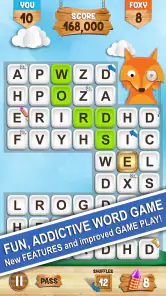
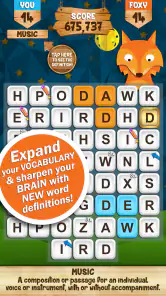
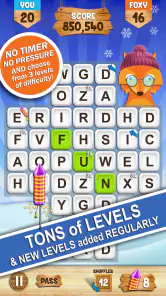
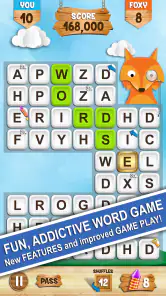
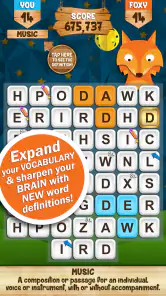
Analysis by Reviewed
I found Words with Foxy most interesting as a compact word game with a clear personal challenge: you play against Foxy and use the result to judge your own word-game ability. That idea is simple, but it gives each round a little more purpose than an endless pile of unrelated puzzles. I could open it when I wanted a short mental break, yet I also felt encouraged to return and see whether I could make better choices the next time.
Developed by DonkeySoft Inc., this free game belongs to the word category and is suitable for Everyone. It has been around since June 2017, and its current version is 2.2.82. The game has reached more than fifty thousand installs and holds a 4.4 average from roughly five hundred ratings, which suggests that its focused format has found a modest but interested audience.
How the game feels to use in different situations
Readability and navigation without unnecessary clutter
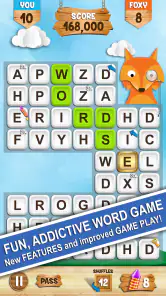
The strongest part of the experience is how quickly the central idea becomes understandable. You are not asked to learn a complicated fictional world or manage a long list of systems before playing. The Foxy comparison gives the session a recognizable target, while the word-game format keeps the attention on vocabulary, spelling, and decision-making.
That directness matters for people who prefer interfaces that do not bury the main activity. If you are opening the game during a short break, you can get to the mental task without first sorting through a large collection of modes. I also think it is a useful quality for younger players and for anyone who feels overwhelmed by games packed with menus, currencies, badges, and constant notifications.
At the same time, a simple structure does not automatically solve every readability issue. Word games depend heavily on being able to distinguish letters quickly, especially when several possible answers compete for attention. Players with reduced vision, dyslexia, or difficulty processing dense letter patterns should try a few rounds rather than assuming that a clean-looking word game will be comfortable for them.
I would approach the navigation in the same practical way. Play in portrait or landscape according to whichever gives you the most stable view, keep the screen free of glare, and increase the device’s text size or display scaling if that makes other interface elements easier to read. System-level adjustments can help, but they cannot change the fundamental fact that the game asks you to inspect and manipulate words.
A useful habit is to slow down before committing to an answer. The competitive framing can make me rush because I want to keep up with Foxy, but speed is not always the best measure of word skill. Taking a moment to scan the available letters can reduce mistakes caused by visual crowding. This is one of the less obvious strengths of the game: it can be played as a quick reflex test, but it also works better as a deliberate vocabulary exercise.
Motor and sensory considerations
Words with Foxy is a better fit for players who are comfortable tapping and reading on a touchscreen than for anyone looking for an audio-led or hands-free game. The core activity is inherently visual and language-based. That makes it appealing to people who enjoy quiet concentration, but it also creates a barrier for players who cannot comfortably distinguish small letter controls or repeatedly tap precise areas.
For players with limited dexterity, the important question is not only whether a round is intellectually manageable, but whether the physical interaction feels forgiving. Word games can become tiring when a missed tap changes an answer or when the player has to make many small movements in succession. I recommend holding the device in a supported position and using a stylus only if that normally improves your accuracy; otherwise, the extra tool may slow you down.
Players with tremors or reduced fine-motor control may prefer playing when they are not standing on public transport or walking between tasks. A stable surface gives the hand more control and makes the game less frustrating. This is a realistic distinction: the same session that feels comfortable at a kitchen table may feel awkward during a crowded commute.
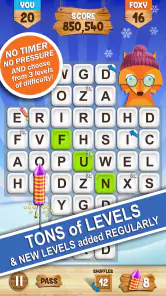
Sensory comfort also depends on the player. Some people enjoy the pressure of competing with a named opponent, while others find any comparison stressful. If the Foxy framing makes you focus too much on losing, treat each round as a personal vocabulary drill instead of a judgment. That small mental change makes the game more approachable without pretending that the competitive element is irrelevant.
I would also avoid playing in a noisy environment if you need strong concentration. Even when a word game does not demand constant sound, surrounding conversation and announcements can break the mental search for a word. Conversely, the game can suit quiet waiting rooms, a calm evening at home, or a short pause between study tasks because it does not require the kind of continuous attention demanded by an action game.
Situational access: where it fits best
The free price makes it easy to test without making a financial commitment. There are in-app purchases ranging from $1.49 to $11.99 per item, so I would treat the free starting point as a chance to decide whether the basic experience suits you before spending anything. The most sensible approach is to play several short sessions and ask whether the challenge remains enjoyable after the novelty of meeting Foxy wears off.
For families, the Everyone age rating makes the game a natural candidate for shared casual play, but age suitability and reading ability are not the same thing. A child may understand the competitive idea while still finding the vocabulary demanding. I would let a younger player experiment without turning the score into a test, especially if the goal is to build confidence with words rather than create pressure around performance.
It can also work for adults who want a small alternative to scrolling. I used to think a word game had to offer a large puzzle library or a daily streak to justify returning to it. This one has a different appeal: the opponent gives the session a defined point of comparison. That is useful when I have only a few minutes and want an activity with a beginning, a challenge, and a clear reason to pay attention.
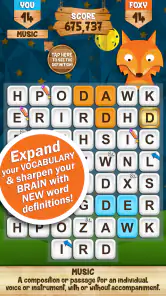
Students and language learners may find value in the pause between recognizing a possible word and deciding whether it is the best move. I would not use it as a complete language course, because a game built around performance does not necessarily explain every unfamiliar term. Instead, I would keep a note of words that slow me down and look them up later. That turns a short play session into a more useful vocabulary routine.
It is less suitable for a group that wants lively social interaction in the same room. The central relationship is between the player and Foxy, not a table full of friends debating answers together. If your ideal word game involves conversation, shared clues, or cooperative solving, a traditional party word game will probably be a better match.
What the Foxy comparison adds to ordinary word puzzles
Many word games rely on a timer, a streak, or a personal best. Words with Foxy uses an opponent as the reference point, and that changes how I read the result. Instead of asking only whether I completed a puzzle, I start asking why my performance differed from Foxy’s. Did I overlook a simple word because I chased a more ambitious option? Did I hesitate too long? Did I recognize the letters but fail to organize them efficiently?
That makes the game more useful for self-assessment than a completely open-ended word search. The comparison gives me a reason to examine my habits. A practical method is to play one round normally, then replay with a single focus: accuracy first, speed second. Even without turning the session into formal training, this helps separate vocabulary gaps from rushed decisions.
The trade-off is that the opponent can make the experience feel narrower than a broad puzzle collection. If you want a constant stream of new formats, themed boards, or elaborate progression, this may seem restrained. Its appeal depends on enjoying the specific challenge of measuring yourself against Foxy rather than needing a large variety of activities.
I also would not confuse the comparison with a complete assessment of language ability. A result reflects how you handled this particular game and its word choices, not your overall intelligence or communication skill. That distinction is important for children and for players who are learning English. The game is best used as an encouraging challenge, not as a label.
Remaining barriers and everyday friction
The biggest limitation is that accessibility here is closely tied to the basic demands of the genre. A player needs to read letters, recognize word patterns, and interact with the screen. Anyone who relies on a screen reader, has severe visual difficulty, or cannot comfortably perform touch input may find that ordinary device settings are not enough. I would not recommend assuming that a word game is accessible simply because its rules are easy to explain.
Language confidence can be another barrier. A player may understand the controls but still feel excluded by unfamiliar vocabulary, regional spelling expectations, or the pressure of making a quick choice. This is especially relevant for people using the game as an English-learning aid. I would start with short sessions, accept that some rounds will expose gaps, and keep a dictionary nearby if learning is the goal.
The free-to-start model also deserves a little attention. The presence of optional purchases is not automatically a problem, but it means families should decide in advance whether spending is allowed. For a child, I would make that rule clear before handing over the device. For myself, I would play long enough to know whether the core challenge is satisfying before considering any item.
Another practical issue is context. A fast word challenge may sound ideal for a commute, yet a moving vehicle, glare, or one-handed use can make letter selection less comfortable. The game is more accessible when the physical environment supports concentration. A quiet seat, a stable grip, and enough time to read are small changes, but they have a noticeable effect on enjoyment.
Players who need extensive customization should also set modest expectations. The game’s appeal comes from its focused design, not from presenting a large toolkit for changing every part of the experience. If you need adjustable text, high-contrast presentation, alternative input, or detailed audio support as a requirement rather than a preference, test it on your own device before committing to regular use.
Who should try it, and who should choose something else?
I would recommend it to someone who likes word games but wants a clear opponent instead of an endless personal score. It is especially suitable for short sessions, quiet concentration, and informal self-testing. The Everyone rating and free entry point make it easy to introduce to a family member, although the actual vocabulary demand may still suit older or more confident readers better.
I would also suggest it to players who enjoy analyzing their own habits. The most rewarding way to play is not simply to chase a win, but to notice where you lose time and which kinds of words cause hesitation. That turns Foxy into a useful benchmark. You can play after a break, compare how focused you feel, and use the difference as a reminder that performance depends on attention as well as knowledge.
I would skip it if you want a rich narrative, fast action, cooperative multiplayer, or a large collection of unrelated word modes. I would also choose a different option if you need robust accessibility controls that are central to your experience. A conventional paper word puzzle may be better for someone who prefers larger print and no touch precision, while a social word game may suit players who learn best through discussion.
Device compatibility is relatively broad, with support beginning at Android 7.0. That makes it worth considering for someone using an older Android phone who wants a lightweight word challenge rather than a demanding modern game. Still, compatibility alone does not tell me whether the screen, touch response, or display quality will feel comfortable, so I would judge the experience on the actual device being used.
My inclusive verdict after spending time with it
Words with Foxy succeeds because it gives a familiar word-game activity a specific purpose: find out how you perform against Foxy, then decide what that result says about your approach. I like that it can be played casually without requiring a long commitment, yet it offers enough competitive tension to make a short round feel meaningful.
Its inclusive value is strongest for readers who are comfortable with visual word puzzles and touchscreen interaction. The clear concept, Everyone rating, free starting point, and modest device requirement make it approachable in practical terms. It can fit a family tablet, an older Android phone, a study break, or a quiet moment when I want something more active than scrolling.
But approachability has limits. The game still depends on reading, visual discrimination, and accurate touch input, and the opponent-based framing will not suit every temperament. Players with specific accessibility needs should test the real interaction on their device, while language learners should see it as a practice companion rather than a structured teaching tool.
My final recommendation is therefore fairly specific: try it if you want a focused word challenge with a built-in comparison, especially for short solo sessions. Keep your expectations realistic about customization and accessibility, and do not treat the score as a verdict on your intelligence. Used as a friendly benchmark rather than a high-pressure test, it is a pleasant, focused game from DonkeySoft Inc. that earns its place on the phone of anyone who enjoys seeing whether the next round can be a little sharper.
Pros
- Simple word puzzles are easy to learn and suitable for short play sessions.
- The fox-themed presentation gives the game a friendly
- distinctive personality.
- Progressive challenges can help improve vocabulary and spelling skills.
- Offline play may make it convenient for travel or areas with limited internet.
- Relaxed gameplay is suitable for players who prefer non-competitive experiences.
Cons
- Some puzzles may feel repetitive after extended play sessions.
- Difficulty can vary noticeably between levels and may frustrate some players.
- Hints or extra gameplay options may depend on limited in-game resources.
- The small-screen interface can make longer words harder to arrange comfortably.
- Players seeking multiplayer competition may find the solo format limiting.

- Category
- Word
- Version
- 2.2.82