Words: Associations Word Game
- 552.00
- 4.5
- Installs
- 100.00K
- Price
- Free
Screenshots
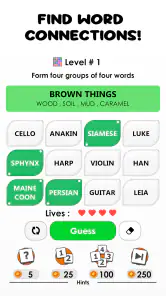
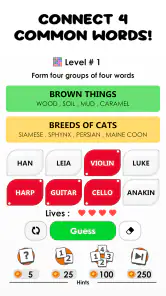
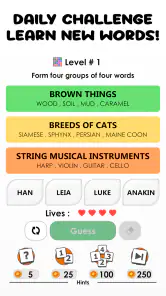
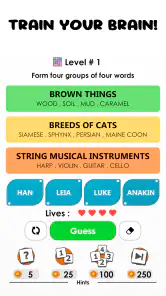
Analysis by Reviewed
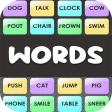
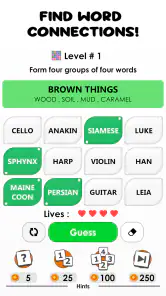
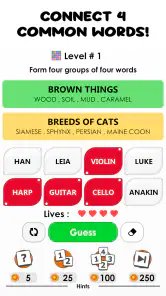
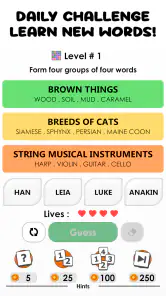
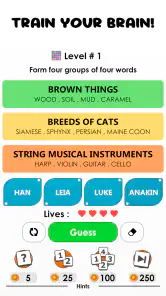
I spent time with Words: Associations Word Game as a compact word puzzle built around finding links between apparently unrelated terms. The basic challenge is easy to understand: identify four words that share a connection, then use that relationship to complete the puzzle. What makes it interesting is that the answer is rarely just about vocabulary. It also tests how quickly I can change perspective when my first interpretation turns out to be wrong.
This is a free word game from MEGARAMA, aimed at everyone and available on devices running Android 6.0 or later. Its audience is already fairly broad: the game shows an average rating of 4.5 from around 2.3 thousand ratings, and it has passed 100 thousand installs. Those figures suggest that it has found a comfortable place among casual puzzle players, but they do not remove the need to consider how it actually feels during repeated play.
How the game feels during ordinary play
The strongest part of the experience is the short mental loop. I look at the available words, group the ones that seem related, test that idea, and then reassess the leftovers. That creates a satisfying rhythm without requiring a long tutorial or a complicated ruleset. Someone who enjoys word association games, crossword clues, or daily brain teasers should understand the appeal almost immediately.
The daily format is especially useful for people who want a small routine rather than a large game session. I can approach a puzzle while waiting for a bus, during a coffee break, or at the end of the day without committing to a lengthy level. The limited scope also makes it easier to stop after one successful solve instead of falling into an endless sequence of increasingly similar rounds.
Although the store summary emphasizes unlimited daily word puzzles, the real value comes from the changing interpretation of familiar words. A term may look like it belongs with another because of spelling, meaning, or a common phrase, while the intended group may depend on a different association. That uncertainty gives the game more depth than a simple vocabulary quiz.
Why the puzzles can be deceptively difficult
I found that the hardest moments were not necessarily caused by obscure words. More often, the problem was an attractive wrong grouping. Once I became convinced that three words belonged together, I started forcing the fourth into the same pattern. The better approach was to treat every early answer as provisional and ask what category would explain all four words with the fewest exceptions.
That makes the game suitable for players who enjoy reasoning more than rapid tapping. It rewards patience, but it can also frustrate anyone who wants every answer to be immediately obvious. If you prefer word games where a clue points directly to one solution, this association-based design may feel vague rather than clever.
One practical technique helped me avoid wasting time: I looked first for the most specific relationship, not the broadest one. Words can share a general theme with many others, but a narrower connection usually gives the puzzle its intended structure. I also held back from committing when a group depended only on a loose synonym. That small change made the solving process feel more deliberate and reduced the number of guesses.
Speed, pauses, and the shape of a short session
Words: Associations Word Game is best understood as a quick-thinking game rather than a high-speed action title. The important sense of speed comes from how quickly I can recognize a pattern, not from rapid animations or reflex controls. That is good news for players who want a calm puzzle that still keeps the mind active.
On a normal session, the game feels naturally suited to brief bursts. I can solve one puzzle when I have a few spare minutes, then return later without needing to remember a complicated story or map. The daily structure gives the experience a clear stopping point, which is more disciplined than many casual games that keep presenting another level indefinitely.
Heavy use changes the question. If I play several puzzles in succession, the mental demand becomes more noticeable than the device demand. Repeatedly searching for hidden connections can be tiring, especially after I have already spent time defending a wrong category. In that situation, taking a short break is more useful than tapping faster. The game’s main resource cost is attention.
That distinction matters for commuters and students. It is a good companion when I want something engaging but quiet, and it does not depend on sound or a large amount of concentration from the first second. However, it is less suitable when I am distracted, sharing attention with a conversation, or trying to finish something else. A puzzle that looks simple can still require enough focus to make interruptions annoying.
Stability and recovering from an interrupted session
For a word puzzle with a small, focused scope, reliability is more important than spectacle. I do not need elaborate graphics or complex systems here; I need the puzzle state to behave predictably and the interaction to stay clear. In my experience, the simple format makes it easy to return to the central task instead of navigating through layers of menus.
Recovery is also straightforward in concept. If I put the game down after getting stuck, I can return with a fresh view rather than carrying the same assumption forward. That is an underrated advantage of association puzzles: forgetting the false link I was protecting often solves more than another minute of staring at the same words.
Still, the game’s simplicity means that any interruption around the puzzle can feel more prominent. There are not many other activities to absorb a delay or distract from a stalled solve. Players who expect a highly polished, feature-rich word platform may find the experience intentionally narrow. I see that as a reasonable trade-off, but it is worth recognizing before installing it.
The current version is 3.2.1, which gives the game a clear, established form rather than the feeling of a brand-new experiment. I would still keep expectations realistic: a version number does not tell me that every device will behave identically, and performance can vary across older phones. What it does suggest is that the app has moved beyond its earliest release stage.
Older phones, storage, and everyday device demands
The minimum operating-system requirement is Android 6.0, so the game is accessible to people using older Android hardware. That is helpful for a puzzle title because it does not force casual players to own a recent flagship phone. The design also appears naturally compatible with modest device use: the core activity is reading words, making selections, and checking relationships rather than rendering a large animated world.
I would not choose this game because I need a tool that proves exceptionally light on battery or memory. Those details are not part of the experience I can responsibly promise. Instead, I would describe it as a sensible candidate for ordinary casual play, particularly when the phone is already used for reading, messaging, and other light tasks. The game’s appeal comes from its mental challenge, not from demanding hardware.
That also makes it a practical option for a secondary phone or an older family device. The Everyone content rating keeps the audience broad, and the rules are simple enough for a parent and child to understand together. The only caution is that younger players may know fewer cultural references or word relationships, so difficulty can depend on language experience rather than age alone.
Players should also remember that free does not always mean completely separate from spending. The game is free to install, with in-app purchases ranging from $2.99 to $24.99 per item. I would approach those purchases carefully and decide in advance whether I want the basic puzzle experience only or am comfortable paying for optional additions. For a casual word game, setting that boundary early prevents a small daily habit from becoming an unplanned expense.
Who will enjoy it, and who should skip it
I would recommend this game to people who like making connections between words, spotting categories, and testing their assumptions. It is particularly well suited to someone who wants a quiet daily challenge that can be played alone, without a story to follow or a complicated control scheme to learn. It also works well for friends or family members who enjoy comparing interpretations after solving the same puzzle.
It is less convincing for players who need constant novelty, competitive action, or a strong progression system. Someone looking for timed battles, character upgrades, or a large collection of modes will probably find the focused format too restrained. It may also disappoint players who dislike ambiguity. The satisfaction comes from discovering the intended connection, but the same quality can feel unfair when several groupings seem equally plausible.
Compared with a crossword, the game asks for less clue-by-clue recall and more flexible grouping. Compared with a traditional word search, it is less about scanning a fixed grid and more about interpreting meaning. Compared with a spelling game, it tests relationships rather than accuracy at entering individual words. Those differences make it a useful alternative when I want language play without repeating the same familiar puzzle structure.
There is a trade-off in that comparison. Crosswords often provide crossing letters that gradually confirm an answer, while this game gives me fewer such safety rails. That can make a correct insight feel more rewarding, but it also means I have to manage uncertainty on my own. I would choose this title over a crossword when I want a quick association challenge, but not when I want a long, methodical solve supported by many clues.
Small strategies that improve the experience
My first useful habit was to separate certainty from possibility. I mentally marked groups as strong, weak, or merely tempting. That prevented one clever-looking connection from controlling the entire puzzle. When a group had only two convincing words and two stretched matches, I left it open and searched for a cleaner relationship elsewhere.
A second technique was to read every word in multiple roles. A word may function as a noun in one group, part of a phrase in another, or a reference to something familiar outside its most obvious meaning. I did not need specialist knowledge for every puzzle, but I did need to stop treating the first definition that came to mind as the only available one.
The third insight is about stopping at the right time. If I had been staring at the same four words without changing my theory, continuing usually made me more stubborn rather than more accurate. Closing the game and returning later worked as a genuine reset. This is one reason the daily format fits the design: the puzzle can remain a small mental exercise instead of turning into an exhausting contest.
For group play, I would avoid showing another person my proposed categories too early. Explaining a wrong theory can anchor both players to it. A better routine is to let each person identify one possible connection independently, then compare the strongest groups. That turns the game into a conversation about language and interpretation, not just a race to tap the answer first.
My performance verdict
Words: Associations Word Game succeeds because it keeps its central idea clear. I can open it, understand what I am meant to do, and begin testing word relationships without a long setup. Its perceived speed is comfortable, its sessions are naturally short, and its hardware expectations are approachable thanks to support for Android 6.0 and later.
The main limitation is not a lack of complexity but the kind of complexity it chooses. The game can be mentally demanding while remaining visually and mechanically simple. If I want a relaxing puzzle with just enough resistance to keep me thinking, that balance works. If I want visible progression, competitive pressure, or a broad set of activities, I would look elsewhere.
MEGARAMA has made a focused word game rather than an all-purpose entertainment package. That focus is its strength during a spare moment and its weakness during a long gaming session. The free entry point makes it easy to try, while the optional purchases mean I would pay attention to my own spending habits rather than treating every extra as necessary.
My recommendation is straightforward: install it if you enjoy discovering hidden links and do not mind sitting with an uncertain answer for a while. Start with the daily puzzle, classify your guesses by confidence, and take a break when the same theory stops producing progress. The best reason to play is the quality of the mental reset, not the promise of endless stimulation. For short, thoughtful word sessions on a wide range of Android devices, it is a solid choice; for action, deep progression, or guaranteed clarity, another type of game will suit you better.
Pros
- Simple word-association gameplay that is easy to learn
- Short levels make it convenient for quick play sessions
- Helps exercise vocabulary and lateral-thinking skills
- Clean interface keeps the focus on solving each puzzle
- Suitable for casual players across a wide age range
Cons
- Some clues may feel subjective or have multiple possible answers
- Difficulty can fluctuate noticeably between consecutive levels
- Repeated word patterns may reduce the challenge over time
- Hints or extra attempts may be limited during tougher puzzles
- Offline availability may vary depending on the version or device
- Category
- Word
- Version
- 3.2.1