Word Wanderer - win real cash
- 299.00
- 4.8
- Installs
- 50.00K
- Price
- Free

Screenshots



Analysis by Reviewed
I approached Word Wanderer as a casual word game first and as a cash-out game second, and that order matters. Its central appeal is easy to understand: swipe through letters, build words, collect diamonds, and work toward a PayPal withdrawal. The word-play is familiar enough to start quickly, while the reward layer gives ordinary short sessions a more concrete goal. My overall impression is that it works best as a light vocabulary distraction with an extra incentive, not as a dependable way to make money.
The game comes from hindustanfood and sits in the word category. It is free to install, rated for Everyone, and currently listed as version 1.4 for devices running Android 9 or newer. That makes it approachable for a broad audience, especially people who want something simple for spare moments rather than a demanding puzzle experience.
What playing it feels like in everyday use
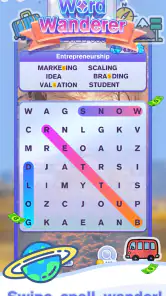
The basic interaction is deliberately uncomplicated. You look at the available letters, swipe across a possible word, and receive progress in the game’s reward system when the answer is accepted. I found that simplicity useful during short breaks because there is very little setup between opening the game and making the first move. It feels closer to a quick mental snack than to a long-form word campaign.
A realistic use case is a commute, a waiting room, or the few minutes before bed when I want something more active than scrolling but do not want to learn a complicated ruleset. A short session can be stopped without the sense that I have abandoned a large strategy. That low commitment is one of the strongest reasons to try it.
The swipe format also changes the rhythm compared with typing-based word games. Swiping encourages quick visual scanning, so I tend to look for common prefixes, endings, and short connecting words before attempting anything ambitious. That habit makes the game feel more fluid on a phone screen, although it can also make the experience repetitive if you prefer puzzles with a changing board or deeper planning.
The reward idea gives each accepted word a second purpose. Instead of solving only for a score, I am also watching the diamond balance and thinking about whether continued play moves me meaningfully closer to a withdrawal. That extra layer can make a familiar word mechanic feel more purposeful, but it also raises expectations that the game itself needs to manage carefully.
Why the word mechanic has staying power
The strongest part of the design is its accessibility. You do not need specialist vocabulary to begin enjoying it. Common words are the natural entry point, and the swipe gesture is immediately understandable. For families, casual players, and people returning to word games after a long break, that is a genuine advantage.
I also like that the game can support two different moods. Sometimes I play quickly, accepting obvious words without overthinking them. At other times I slow down and search for less visible combinations. That choice gives the same basic screen a little flexibility, even though it does not turn the game into a full crossword or an advanced anagram challenge.
One useful personal technique is to avoid spending too long hunting for a single difficult word. I first clear the easy combinations, then reassess the remaining letters. This keeps the session moving and reduces the frustration that comes from staring at one arrangement while overlooking a simple answer. It is a small change, but it makes the reward loop feel less tiring.
Another practical tip is to treat the diamond balance as a progress marker rather than an hourly wage. That mindset prevents the cash-out promise from dominating every move. If I play only while expecting a predictable financial return, the ordinary pace of a casual word game can feel disappointing. If I treat the rewards as a bonus attached to a pastime, the experience is easier to enjoy on its own terms.
The cash-out promise needs a realistic reading
The PayPal angle is the feature most likely to attract a first download, but it is also the part that deserves the most caution. “Earn” language can sound more substantial than the underlying activity really is. A free word game may provide diamonds and a route toward cashing out, yet that does not make it equivalent to paid work or a reliable side income.
Before investing serious time, I would inspect the in-game withdrawal area carefully. The important practical questions are how many diamonds are needed, whether the available PayPal option is clearly explained, and what steps appear before a request can be made. Those details affect the real value of the reward loop far more than the headline promise.
I would also keep expectations modest because the game’s main activity remains casual word solving. Even when the reward system is motivating, the sensible reason to play is that you enjoy the puzzles. Anyone downloading specifically to generate dependable cash should probably choose a different kind of activity altogether.
The trade-off is straightforward: the reward system can make repetitive play feel more directed, but it can also make every limitation more noticeable. In a conventional word game, a slow session is simply a slow session. Here, I may start wondering whether the time spent is worth the number of diamonds earned. That tension is built into the concept and cannot be solved by the swipe mechanic alone.
Where the experience may become repetitive
The game’s simplicity is both its strength and its main weakness. Players who like quick, familiar word rounds may appreciate the low barrier to entry. Players who expect layered levels, rich themes, strategic boards, or a strong sense of long-term progression may find the routine narrow.
I would not choose it as my main word game if I wanted the variety of a traditional crossword collection, the competitive pressure of a head-to-head word battle, or the vocabulary depth of a serious training app. Those alternatives usually give the player a clearer reason to improve beyond collecting rewards. This title is more relaxed and more immediately accessible, but that also means it may not satisfy someone looking for demanding mental development.
Swipe recognition can be another source of friction. On a small display, a hurried gesture may not feel as precise as intended, particularly when letters sit close together or when I am trying to trace a word quickly. Slowing down helps, but it takes away some of the instant rhythm that makes the format attractive in the first place.
There is also a motivational issue after the novelty wears off. The first sessions benefit from discovering the reward cycle, while later sessions depend more heavily on whether the word play itself remains enjoyable. If diamonds are the only reason to continue, the game may lose its pull once progress feels slow. That is why I see the reward layer as reinforcement, not a substitute for interesting puzzles.
Who should give it a try
I think Word Wanderer is a reasonable choice for casual players who enjoy forming words with one hand and want a simple reason to return. It suits people who prefer short, low-pressure sessions and do not want to commit to a campaign, a timer-heavy competition, or a complicated puzzle interface.
It may also appeal to someone who likes the idea of turning spare minutes into small in-game rewards, provided that person is comfortable treating the cash-out feature as an uncertain bonus rather than a financial plan. The Everyone age rating makes the presentation broadly approachable, although younger players should still have an adult explain that in-game rewards are not the same as guaranteed earnings.
For a daily routine, I would use it selectively. A few rounds during an idle moment make sense; leaving it open for long grinding sessions does not seem like the best use of time unless the word game itself is genuinely holding my attention. The most balanced workflow is to play when I already want a word puzzle, then regard any accumulated diamonds as an extra outcome.
I would skip it if my priority is reliable income, advanced vocabulary study, or a richly varied puzzle collection. I would also look elsewhere if I dislike reward systems that encourage repeated sessions. A standard word game with no cash-out framing may be more relaxing because it lets me focus entirely on solving rather than evaluating the value of each round.
What the current reception suggests
The game has an average rating of 4.8 from around 2.8 thousand ratings, with close to 300 written reviews, and it has passed 50 thousand installs. Those figures show that the concept is attracting a meaningful audience and that many players respond positively to the combination of word play and rewards. They are useful signs of interest, but they do not remove the need to judge the experience personally.
Reception can be especially sensitive in a game built around cash-out expectations. One player may value the entertainment and rate it highly, while another may focus almost entirely on the pace of rewards. I would therefore read comments with a specific question in mind: are people praising the puzzle experience, the reward process, or both? That distinction helps set a more accurate expectation before spending much time with it.
The current version is 1.4, which suggests the app is still in a relatively early stage of its development. I would keep an eye on how future updates affect the balance between word variety, interface smoothness, and reward clarity. For this type of game, small changes to progression can make a noticeable difference to whether casual play remains satisfying.
My verdict after weighing the trade-offs
My recommendation is conditional: try it for the word game, not for promised income. The swipe controls are easy to understand, the sessions fit naturally into spare moments, and the diamond system gives familiar word solving a distinct hook. Those qualities make it more interesting than a bare-bones word exercise for players who enjoy visible progress.
At the same time, the reward premise should not overshadow the actual entertainment value. The experience can become repetitive, the cash-out goal may encourage unrealistic expectations, and it does not replace a deeper crossword, competitive word game, or structured vocabulary tool. Its best audience is someone who wants a free, accessible word pastime and is happy if the reward system adds motivation.
For me, the deciding test is simple: would I still enjoy swiping words if the diamond balance were moving slowly? If the answer is yes, the game has a fair chance of becoming a pleasant occasional habit. If the answer is no, the usual alternatives in the word category are likely to provide a more satisfying experience without the extra pressure of chasing a payout.
Overall, hindustanfood has built a straightforward casual game with a clear hook and a broad entry point. I would recommend trying it in short sessions, checking the withdrawal details before committing time, and keeping the financial expectations firmly grounded. Used that way, it is an entertaining word distraction with an interesting reward layer rather than a substitute for dependable earnings.
Pros
- Simple word puzzles are easy to learn and suitable for short sessions.
- Cash prizes can add extra motivation for competitive players.
- The game offers a more engaging alternative to ordinary vocabulary practice.
- Quick rounds make it convenient to play during breaks or while traveling.
- Improving word recognition may help expand vocabulary over time.
Cons
- Winning real money may require strong competition and consistent performance.
- Prize eligibility and withdrawal rules may vary by location.
- Some features or entries may depend on ads
- purchases
- or limited attempts.
- Gameplay can become repetitive if you prefer varied puzzle formats.
- Internet access may be needed to join contests and update scores.

- Category
- Word
- Version
- 1.4