Word Tiles - Word Puzzle Game
- 9.00
- 4.3
- Installs
- 10.00K
- Price
- Free
Screenshots
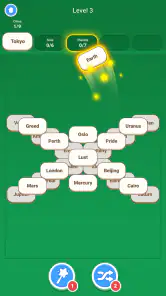
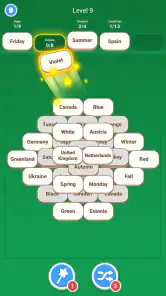
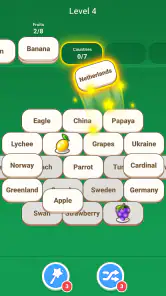
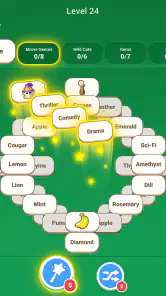
Analysis by Reviewed
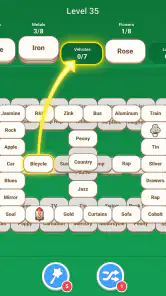
I went into Word Tiles expecting a small word game for filling a few spare minutes, and that is exactly where it makes the most sense. Developed by Hypervation, this free word puzzle game asks me to group words into categories. The idea is easy to understand, but the interesting part is deciding whether a connection is genuinely strong or merely tempting. That distinction gives each move a little weight without turning the experience into a stressful test.
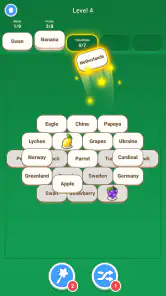
The first thing I notice is how quickly the game gets me to its central action. I look at a collection of words, search for a relationship, and select a group that seems to belong together. There is no lengthy explanation to work through before I can start thinking. For anyone who enjoys logic puzzles but does not want a complicated interface, that directness is a real advantage.
What keeps me playing is the rhythm after each choice. A correct group gives me confirmation that my reasoning is on track, while a wrong idea pushes me to reconsider the words from another angle. The pleasure is not only in finding an answer; it is in watching a messy set of possibilities become more organized. When the final connection falls into place, I get a satisfying sense of completion, then naturally wonder whether the next puzzle will be more deceptive.
How the word-grouping loop feels in practice
The first move is simple, but the clues can compete with one another
The opening action in Word Tiles is choosing a possible category from the words in front of me. That sounds straightforward until several words appear to share a loose connection. A word may fit a familiar theme, but it can also belong to a more precise group that only becomes obvious after I remove another possibility. This is where the game moves beyond basic vocabulary recall and into deduction.
I find it useful to begin with the most specific relationships rather than the broadest ones. If several words could describe something common, I avoid committing immediately and scan for a group with a cleaner definition. That small habit reduces careless selections and makes the puzzle feel more deliberate. It also gives the game a nice balance: I am not simply spotting matching words, but judging how well a proposed category explains the whole group.
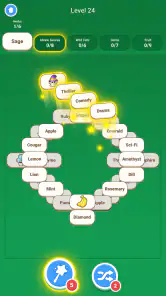
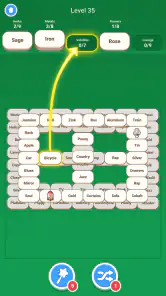
The interface is built around the word tiles rather than decorative distractions, which suits the concept. I can focus on the board, test an idea, and adjust my plan. That matters in a puzzle where one premature choice can change how every remaining word looks. The game is at its best when I treat the board as a process of elimination instead of trying to solve everything in a single glance.
For a realistic everyday example, I can imagine opening it while waiting for a coffee or taking a short break between tasks. I do not need to prepare a notebook or remember a long set of rules. I make an initial grouping, see whether the decision works, and either continue with confidence or use the result to rebuild my theory. That makes it more practical than a word game that requires a long uninterrupted session.
Feedback makes each decision useful
The feedback rhythm is the heart of the experience. A correct selection does more than tell me that I was right; it reduces the visual and mental clutter of the board. The remaining words become easier to interpret because one possible category has been removed. A mistake is also useful when I respond to it properly. Instead of treating it as a dead end, I use it as evidence that my category was too broad, incomplete, or based on a misleading association.
This creates a steady sequence of action and response: I propose a group, receive an outcome, revise my reading of the board, and try again. That cycle feels more satisfying than simply entering a word and waiting for a binary result. Every selection changes the next decision. Even when I am wrong, the puzzle gives me a reason to inspect the remaining tiles with more care.
One practical tip is to keep a mental distinction between “possible” and “convincing.” A possible group may contain words that share a casual connection, but a convincing group has a clear category that explains why those words belong together and why the alternatives do not. Waiting for that stronger relationship is often more effective than chasing the first pattern I notice.
Another useful approach is to protect the most ambiguous tile. If one word seems capable of fitting two categories, I leave it aside while examining the clearer groups. This prevents that tile from pulling me into an attractive but incorrect theory. In a game based on connections, uncertainty is not a problem to hide; it is information about where I should delay a decision.
The reward is mental clarity rather than a complicated progression system
Word Tiles earns its reward through the feeling of untangling a compact logic problem. The best moment comes when a category that seemed invisible suddenly becomes obvious because another group has been resolved. I enjoy that change in perspective more than I would enjoy a purely speed-based challenge. The game rewards attention, flexible thinking, and the willingness to abandon a weak assumption.
That makes it appealing to players who like word association with a logical edge. It can also work for someone who wants a quiet activity instead of a highly competitive game. The challenge comes from the puzzle itself, not from needing fast reactions or learning a large control scheme. I can play carefully, take a moment to compare possible meanings, and still feel that each move matters.
At the same time, the reward is intentionally modest. This is not the right choice if I want a deep role-playing progression, a long narrative, or a complex collection system. Its satisfaction comes from solving the current arrangement and then moving on. Players who need constant unlocks, elaborate customization, or a strong social layer may find the loop too focused.
I also appreciate that the game is free, because the format suits short, repeatable play. I can try it without treating the first session as a major commitment. Its content rating is Everyone, which matches the accessible word-and-logic concept and makes it a reasonable option for a broad audience. Adults who enjoy careful puzzles will find enough mental friction, while younger players with suitable reading ability can understand the basic objective quickly.
Why another session begins after the board is solved
Once I complete a puzzle, the natural reset is what gives the game its replay appeal. The board is no longer a problem to manage, so the pressure disappears. That clean ending makes it easy to stop after one round, but it also creates the familiar thought that I can handle one more. The next session promises a fresh set of relationships rather than a continuation of unfinished administration.
This reset works particularly well for short breaks. I can begin with no preparation, concentrate on a single board, and finish with a clear stopping point. That is different from games that leave me in the middle of a mission or encourage me to maintain several ongoing systems. Word Tiles feels more like a sequence of self-contained mental exercises, which is useful when my available time is unpredictable.
My best routine is to avoid rushing into the next puzzle immediately after a difficult solve. I take a few seconds to notice which assumption caused the trouble, then start the next board with a cleaner approach. That turns the reset into more than a simple restart. It becomes a chance to improve how I read categories, especially when I have been relying too heavily on obvious associations.
There is also a trade-off here. A self-contained puzzle loop can feel repetitive if I play for a long stretch without a change of pace. The same basic action remains central: inspect words, group them, respond to feedback, and solve the board. I think the game is better suited to several brief visits than to an extended evening session. Its design encourages focus, not marathon variety.
Who will get the most from it
I would recommend Word Tiles to someone who likes word puzzles but wants more reasoning than a standard clue-and-answer format. It is a good match for players who enjoy spotting categories, questioning first impressions, and using partial information to solve a larger arrangement. It is also suitable for anyone looking for a low-pressure game that can fit around ordinary routines.
It may be especially useful as a short attention reset. After a long stretch of repetitive work, a few minutes of deliberate categorization can feel more refreshing than endlessly scrolling. The game asks me to notice language carefully, compare meanings, and make a decision. That is a more active kind of break, even though the controls remain simple.
I would be more cautious recommending it to someone who dislikes ambiguity. Some word groups may feel obvious only after the correct alternative has been cleared away, and that can be frustrating if I expect every answer to be immediately apparent. The game also is not ideal for a player seeking action, competition, story, or a large set of systems to master. Its appeal depends on enjoying the central act of making connections.
Players should also consider their preferred reading experience. Because the challenge depends on recognizing words and their meanings, it is most comfortable for someone who reads the language used in the puzzle with confidence. That is not a flaw in the game, but it does define its audience more narrowly than a visual or reflex-based title.
How it compares with familiar word-game alternatives
Compared with a crossword, Word Tiles feels less dependent on recalling a specific answer from a clue. I am not filling a grid one entry at a time; I am evaluating relationships among several visible words. That makes it more approachable when I want a logic task without the commitment of a large puzzle layout. A crossword may offer richer clue variety, while this game gives me a tighter loop and faster feedback.
Compared with a word-search game, the emphasis is also different. Searching for hidden words rewards visual scanning, but grouping tiles asks me to interpret meaning and category boundaries. I prefer Word Tiles when I want to think about how words relate rather than simply locate them. Someone who enjoys hunting through letter grids may find the category-based structure less immediately rewarding.
Compared with a daily guessing game, it feels less tied to a single answer or a fixed routine. The satisfaction comes from resolving a whole set of connections, not from narrowing down one word through repeated attempts. That gives each board a broader reasoning arc, although it may lack the social ritual that makes daily games attractive to some players.
In my view, the closest alternative is another category-grouping puzzle, and the deciding factor will be presentation and puzzle quality. Word Tiles keeps the focus narrow and accessible. If I want a clean word-logic break, that is a strength. If I want extensive explanations, competitive rankings, or a wider range of puzzle types, I would look elsewhere rather than expecting this compact format to provide everything.
Practical details before downloading
Word Tiles is available free of charge, and its current version is 0.1.1. It runs on Android 6.0 or later, so it is compatible with many older devices as well as newer phones. Those details make it relatively easy to try on a spare handset, provided the device meets that minimum system requirement.
The game has an average rating of 4.3 from around forty-seven ratings, with nine written reviews, and has passed ten thousand installs. I read that as a modest but encouraging early audience rather than proof that it will suit everyone. The developer, Hypervation, is presenting a focused word puzzle rather than a broad platform, so I would judge it mainly by whether this particular loop matches my habits.
The version number also suggests that I should approach it as a compact game that is still at an early stage. I would not choose it for a long-established ecosystem or a huge catalogue of modes. I would choose it because the basic activity is clear, quick to start, and rewarding when I enjoy sorting out competing connections.
My verdict on the complete loop
Word Tiles succeeds because its five-part rhythm is easy to feel: I select a possible category, receive immediate feedback, enjoy the clarity of a correct connection, reset with a fresh board, and start again because the next arrangement offers a new reasoning problem. None of those steps is complicated on its own, but together they create a dependable little habit.
The strongest part is the feedback. Correct and incorrect choices both help shape the next move, so the board never feels completely static. The main limitation is equally clear: the game stays close to its core idea, and players who need variety or substantial progression may outgrow it. I also think it is better in short sessions than in long marathons.
My recommendation is simple: try it if you want a focused category puzzle that turns spare minutes into a small exercise in careful thinking. I would skip it if my priority were action, story, competition, or a large set of changing mechanics. For the right player, though, the clean reset after each solved board is exactly what makes another session tempting.
Pros
- Simple rules make it easy to start playing immediately.
- Short levels are convenient for quick breaks or casual sessions.
- Word challenges can help improve spelling and vocabulary.
- Clean tile-based gameplay works well on both phones and tablets.
- Progression offers a satisfying sense of achievement over time.
Cons
- Some puzzles may feel repetitive after extended play.
- Difficulty can vary noticeably between consecutive levels.
- Hints may reduce the challenge for players seeking pure wordplay.
- Requires a strong English vocabulary for later puzzles.
- Ads may interrupt the experience
- depending on the version.
- Category
- Word
- Version
- 0.1.1