Word Tiles GO
- 738.00
- 4.6
- Installs
- 100.00K
- Price
- Free
Screenshots
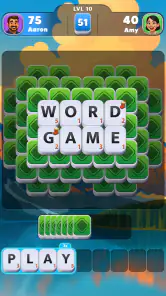
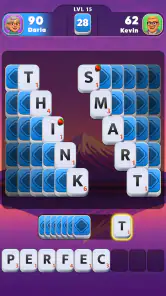
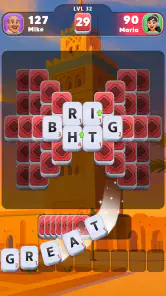


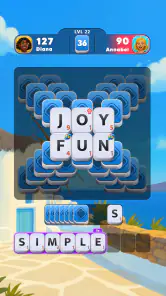
Analysis by Reviewed
I found Word Tiles GO easy to understand within a few minutes, but not so simple that it becomes disposable after a couple of rounds. It is a free word game from Gulliver's Games, built around short tile-based duels that can feel both mentally demanding and pleasantly calm. That combination is its main appeal: I can open it for a quick distraction, yet I still have to think carefully about letter choices and timing.
The game has already attracted over 100 thousand installs and holds a 4.6 average from around 15 thousand ratings, which matches my overall impression: this is a polished, approachable word title with a clear audience. It is not trying to replace a full crossword collection or a serious language-learning course. Instead, it works best as a compact challenge for people who enjoy arranging letters, spotting opportunities and testing themselves against another player or opponent.
What interested me most was not simply whether the wordplay was enjoyable. I also paid attention to how comfortably the game could be used in different situations: on a small screen, during a short break, with limited attention, or by someone who may find fast visual interfaces tiring. The result is positive, though not universal. The basic concept is welcoming, while the demands of tile selection and reading still create barriers for some players.
How the word-duel format feels in everyday play
A clear idea that needs little explanation
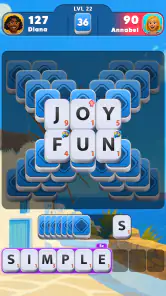
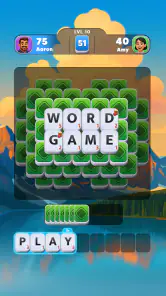
The central loop is straightforward. I work with word tiles, look for a useful combination and try to make better choices than the opposing side. That makes the first session accessible even if I have never played this particular title before. There is no need to learn a large rulebook before the game becomes meaningful; the value comes from examining the available letters and deciding whether to take a safe word or search for something more rewarding.
That simplicity is helpful for casual players, but it does not make the game empty. A strong move is not always the longest word I can see. I also have to consider what letters remain, how quickly I want to commit and whether a clever option is worth the mental effort. This gives the rounds a useful rhythm: recognition, hesitation, decision and then the desire to try again.
I would describe the mood as quieter than many competitive mobile games. There is still pressure because a duel suggests comparison, but the word format keeps that pressure focused on thought rather than reflexes. I can play while having coffee or during a commute without needing the same constant physical attention demanded by an action game.
Who gets the most from it
This is a good fit for people who like word puzzles but want more tension than a solo crossword. It also suits players who enjoy short sessions and do not want to commit to a long campaign. Someone who regularly plays word searches, anagrams or tile-based board games will understand the appeal quickly, although the duel structure gives each decision more urgency than a purely personal puzzle.
I would also recommend it to families looking for an Everyone-rated game that encourages language and concentration without relying on frightening imagery or mature themes. The age rating makes it broadly approachable, but younger players may still need help with vocabulary depending on their reading level. The game can be welcoming without every word being equally familiar to every player.
On the other hand, I would not choose it for someone who dislikes competition, feels frustrated by unfamiliar vocabulary or wants a completely open-ended creative writing tool. A traditional crossword may be better for a player who enjoys clues and a fixed solution. A word search may be preferable for someone who wants a more relaxed visual hunt without the pressure of an opponent. Word Tiles GO sits between those options: it is more interactive than a static puzzle, but less expressive than a writing-focused app.
The practical value of short sessions
One realistic use is a ten-minute break between tasks. I can start a round, concentrate on the available tiles and stop after the duel instead of being pulled into a large map or lengthy story. That makes the game suitable for waiting rooms, lunch breaks and quiet evening moments when I want stimulation but not a complicated commitment.
There is a trade-off, though. Short-session design can encourage repeated attempts. After losing because I missed a useful combination, I naturally want another chance while the pattern is still fresh. That is enjoyable when I choose it deliberately, but it can also turn a planned break into a longer play period. I recommend setting a personal stopping point if you are using it during work or study.
Reading the board without rushing
My most useful approach was to avoid grabbing the first acceptable word. I first scan the whole set of tiles, then look for unusual letters or combinations that could restrict later choices. This small pause improves decision-making because the game rewards awareness of the board, not just quick recognition.
Players who often miss opportunities may benefit from mentally grouping tiles by likely beginnings, endings and common letter pairs. This is more practical than trying to search for every possible word. It reduces visual clutter and gives the eyes a repeatable path across the board. For me, that made the game feel less like guessing and more like a manageable process.
Another useful habit is to treat a modest word as valuable information. A move can reveal how the available tiles are changing and help me understand the current direction of the duel. Chasing an ambitious word every time can create unnecessary hesitation. The better choice depends on the position, not on the length of the word alone.
Readability, control and access in different situations
Navigation that stays approachable
The game’s strongest accessibility quality is its plain premise. I do not have to navigate a dense productivity-style interface or remember several separate systems before playing. The word tiles are the focus, and that focus helps reduce the amount of explanation a new player needs.
For people who prefer predictable navigation, this kind of narrow structure is reassuring. I can concentrate on the current challenge rather than constantly switching between unrelated menus. That matters on a phone, where every extra screen competes with the actual puzzle. The uncluttered concept also helps when I am tired or sharing attention with something else.
Still, visual simplicity should not be confused with perfect readability. Tile-based play asks me to distinguish letters quickly and accurately. Anyone with reduced vision, difficulty separating similar shapes or sensitivity to dense layouts may need more time than the game’s normal rhythm seems to encourage. I found that increasing the phone’s general text size can help elsewhere on the device, but it should not be assumed that every in-game element changes in the same way.
My practical advice is to test the game in a calm setting before deciding whether it is comfortable. Use a bright but indirect light, hold the phone at a stable distance and avoid judging it from a hurried first round. If the letters still blur together or the board feels crowded, the issue is not a lack of skill; the visual presentation may simply not suit your needs.
Motor demands and touch accuracy
Word Tiles GO does not appear to depend on the rapid swipes and repeated reactions found in many arcade games. That is a meaningful advantage for players who prefer deliberate touch interaction. I can think about a move before committing, and the core challenge is linguistic rather than athletic.
However, tile selection still requires accurate finger placement. Players with tremors, limited reach, joint pain or reduced fine-motor control may find small targets tiring, especially during a longer session. The game’s slower mental pace does not automatically remove the physical demand of tapping the correct tile. A stylus or a larger device could feel more comfortable for some people, but that is a personal workaround rather than something I would treat as a guaranteed solution.
I also noticed a subtle trade-off between speed and confidence. Moving quickly keeps the duel lively, yet rushing increases the chance of selecting the wrong letter. For players with motor limitations, choosing accuracy over speed is the sensible approach. If the surrounding game flow makes that feel like a disadvantage, the experience may become stressful even though the game is not reflex-oriented.
Sensory comfort and concentration
The word-duel format is less visually aggressive than many mobile genres. There is no need to follow a constantly moving battlefield, and the main mental task remains stable from one decision to the next. That makes it a reasonable option for players who want a focused game without the sensory intensity associated with action titles.
Even a quiet puzzle can be tiring, though. Concentrating on letter shapes, possible words and the opponent’s progress creates cognitive load. Someone with dyslexia, attention difficulties or language-processing challenges may experience the game very differently from a confident reader. The challenge can be rewarding, but it can also become exhausting if the board demands too much scanning in a short period.
I recommend treating the game as a flexible mental exercise rather than a test of personal worth. Play when your attention is fresh, pause after a frustrating round and avoid using a poor result as evidence that you are “bad” at word games. A player who needs extra processing time may enjoy it more by slowing down and focusing on one promising group of letters at a time.
Playing with limited attention or changing conditions
This is where the format works particularly well. I can use it during a quiet pause without needing a large uninterrupted block of time. The game is also easier to understand when my attention is divided than a story-heavy title would be, because the immediate objective remains visible in the tile arrangement.
That advantage has limits. If I am walking, riding a bicycle or crossing a busy area, I should not play. The board still requires visual attention, and a word duel is not a safe substitute for awareness of traffic or surroundings. Likewise, playing in a dim room or under strong glare makes letter recognition harder and can turn a relaxing session into eye strain.
For commuters, the best situation is a seated journey with stable hands and enough light. For people in noisy environments, the visual nature of the game may be preferable to an audio-dependent app, but distractions can still cause missed opportunities. In a shared space, the small-screen format is discreet, although that does not solve the concentration problem when interruptions are constant.
Where the experience still creates barriers
The biggest remaining barrier is that word knowledge and visual scanning are inseparable from success. A player may understand the rules perfectly and still struggle because the vocabulary feels unfamiliar or because the tiles are difficult to distinguish. That is not a flaw unique to this game, but it is important when deciding whether the format is appropriate.
Another limitation is the lack of a genuinely relaxed alternative within the same basic activity, at least from my experience of the main play style. A player who wants to explore letters without comparison may prefer a solo crossword or an untimed anagram app. Here, the duel framing gives the game its energy, but it can also make mistakes feel more consequential.
There is also a financial consideration. The game is free to download, while optional purchases range from less than a dollar to nearly three hundred dollars per item. That is a very wide span, so I would approach any purchase screen carefully and make sure the device’s purchase controls are appropriate for the person using it. The free entry point is attractive, but “free” does not mean every optional element has the same cost.
For households, I would be especially cautious when a child is playing. The Everyone rating makes the content broadly suitable, but purchase awareness still matters. A parent or account holder should review the device’s purchase settings before handing over the phone. This is practical advice for protecting the budget, not a criticism of the wordplay itself.
Technical fit and expectations
The current release is version 3.1.7, and it runs on Android 7.0 or later. That gives owners of older supported Android devices a chance to try it without needing a recent phone. Even so, compatibility alone does not guarantee a comfortable experience: screen size, touch responsiveness and display quality can matter just as much for a tile game.
I would use a larger screen if reading small letters is difficult, provided the device remains comfortable to hold. A newer phone may also feel easier simply because touch input is more responsive, but I would not upgrade hardware solely for this title. The important question is whether the board remains legible and whether selecting tiles feels reliable on the device already available.
Because this is a focused word game rather than a broad utility, it is easy to understand what you are getting before installing it. You are choosing a competitive tile puzzle, not a full language curriculum, a social network or a collection of unrelated mini-games. That clarity helps people with specific needs make a more honest decision.
How it compares with familiar alternatives
Compared with a crossword, this game offers less clue-based deduction and more immediate tile manipulation. I prefer a crossword when I want a slower, structured puzzle with a clear grid to revisit. I prefer Word Tiles GO when I want each decision to feel active and when the possibility of an opposing player makes ordinary vocabulary more exciting.
Compared with a word-search game, it demands more planning. A word search often lets me scan until I find a target, while this format asks me to decide which available letters deserve attention and how a choice affects the duel. That makes it more mentally engaging, but less suitable when I want effortless relaxation.
Compared with a traditional board-game adaptation, the phone format is quicker to access and less dependent on setting up pieces. The trade-off is that the digital presentation may offer less tactile comfort for someone who enjoys physically handling tiles. Players who need large, high-contrast components may find a physical word game easier to customize.
My inclusive verdict
I came away viewing Word Tiles GO as a thoughtful choice for readers who want a compact word challenge with a competitive edge. Its clear concept, modest physical intensity and flexible session length make it more approachable than many fast mobile games. Gulliver's Games has focused the experience around a recognizable activity, and that focus benefits people who do not want to learn a complicated interface.
Its accessibility is practical rather than comprehensive. The game can work well for players who read comfortably, can select tiles with reasonable accuracy and enjoy making decisions under light competitive pressure. It is less convincing for anyone who needs very large visual targets, extensive reading support, a completely untimed experience or a noncompetitive way to explore vocabulary.
I would recommend trying it in the exact context where you expect to play: on your usual phone, in your usual lighting and with the amount of concentration you normally have during a break. That short test will reveal more than the store summary. Pay attention to whether the tiles remain comfortable to read, whether tapping feels dependable and whether the duel encourages you or simply makes you tense.
The game is free, carries an Everyone age rating and has enough strategic texture to reward repeated sessions, but the optional purchase range deserves careful handling. If you want a word title that sits between a crossword and a quick competitive puzzle, this is a worthwhile download. If you need maximum visual customization or a completely pressure-free vocabulary activity, I would choose a more specialized alternative instead.
My final recommendation is therefore selective but positive: choose it for focused, short word duels, not as a universal accessibility solution. When the tile size, reading demand and touch controls suit you, the result is a relaxing little contest that can sharpen attention without overwhelming the rest of your day.
Pros
- Quick word puzzles are ideal for short breaks.
- Simple tile mechanics are easy for beginners to understand.
- Daily challenges add a reason to return regularly.
- Progress tracking helps motivate continued play.
- Works well for players who enjoy vocabulary practice.
Cons
- Some puzzles may feel repetitive after extended play.
- Difficulty can vary noticeably between consecutive levels.
- Hints may reduce the challenge for experienced players.
- Ads can interrupt the flow between puzzle sessions.
- A stable internet connection may be needed for some features.
- Category
- Word
- Version
- 3.1.7