Unscrew Nuts Sort: Pin Puzzle
- 731.00
- 4.7
- Installs
- 10.00M
- Price
- Free

Screenshots


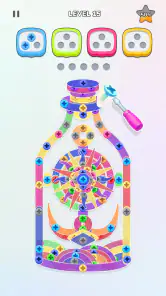

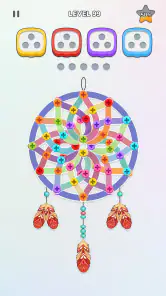
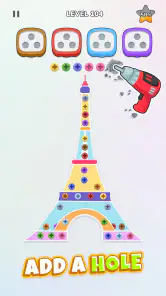
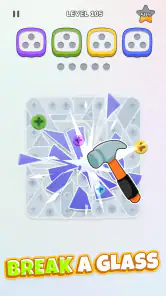
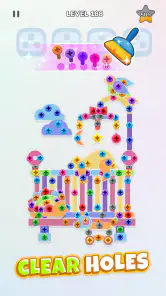
Analysis by Reviewed
I’m drawn to puzzle games that give me one clear problem to solve without asking for a long session or a complicated tutorial. Unscrew Nuts Sort: Pin Puzzle fits that mood: its central idea is to remove pins in an order that lets the pieces fall where they should. I like that the challenge comes from thinking ahead rather than managing a pile of systems. It is a straightforward game, but the best moves still ask me to pause and consider what will happen next.
Why the pin-and-bolt idea works
The satisfying part is the relationship between a tap and its consequence. Taking out one pin can change which pieces are free to move, so I try to read the arrangement before acting rather than tapping at random. A useful habit is to look for the piece that seems most constrained and ask what would need to move first. That small bit of planning makes the puzzle feel more deliberate, especially when the board grows less obvious.
This is also where the game differs from familiar match-three or word puzzles. Those often reward quick pattern recognition or a steady stream of small matches; this one asks me to reason about order and gravity. It is a better fit when I want a visual logic problem than when I’m looking for a score-chasing routine or a story to follow. The appeal is in watching a plan work—or realizing that my first choice has made the remaining arrangement awkward.
Short sessions, with a little patience
The levels suit small breaks because I can focus on a single arrangement and stop when I finish. For example, I could open it while waiting for a coffee, study the board, make a few careful moves, and put the phone away once the puzzle is done. I wouldn’t treat it as a game to play while distracted, though: a careless tap can turn a tidy problem into a harder one, and the fun depends on paying attention to the sequence.
If I get stuck, I find it more useful to reconsider the order than to repeat the same move pattern. Before tapping, I check which pieces may fall and whether that will open or block another route. This is a simple but effective way to avoid treating every level like trial and error. Players who enjoy patient, spatial reasoning are likely to get more from it than anyone hoping for a hands-off background game.
The Concept
At its core, Unscrew Nuts Sort: Pin Puzzle is about strategy and logic. The main objective is to untangle a series of nuts and bolts by removing pins in the correct order. It sounds simple enough, but as the levels progress, the complexity ramps up, and you’ll find yourself scratching your head in delightful frustration. The game’s simplicity is its charm; it doesn’t bombard you with unnecessary frills or distractions. Instead, it focuses on providing a clean, straightforward challenge.
Gameplay and Mechanics
What really sets this game apart is its intuitive mechanics. The controls are incredibly user-friendly; a simple tap on the screen allows you to remove pins and watch as gravity does the rest. It’s a satisfying experience to see the nuts and bolts tumble into place after a successful move. The levels are designed to be increasingly challenging, yet never impossible, ensuring that you’re always motivated to push through to the next puzzle.
More From Our News Desk

Clash of Clans Is Won Between the Battles

Android Auto Makes the Case for Quieter Car Software

MobiOffice: Transforming Mobile Productivity with Seamless Integration

EA SPORTS FC™ Mobile Soccer: Redefining Mobile Sports Gaming

How Microsoft OneDrive Became a Mobile Productivity Giant

How Google Translate Breaks Language Barriers Effortlessly
Another aspect worth mentioning is the game’s pacing. Each level is quick enough to complete in a few minutes, making it perfect for short bursts of play. Whether you’re waiting in line or need a quick break from work, this game fits seamlessly into any schedule.
Visuals and Sound
The visuals in Unscrew Nuts Sort: Pin Puzzle are clean and minimalistic. The design doesn’t overwhelm the senses, allowing players to focus entirely on the puzzles themselves. The color palette is easy on the eyes, which is a huge plus for extended play sessions. Meanwhile, the sound effects are subtle yet effective, adding a nice layer of immersion without becoming annoying or repetitive.
My Personal Take
Overall, I found Unscrew Nuts Sort: Pin Puzzle to be a thoroughly enjoyable experience. It strikes a perfect balance between challenging and relaxing, making it a great choice for puzzle enthusiasts and casual gamers alike. The game’s simplicity is its biggest strength, and it manages to provide a rewarding experience without the common pitfalls of mobile gaming, like intrusive ads or pay-to-win mechanics.
Who should give it a try—and who might not
Pleasure City’s puzzle game has a broad audience: its Everyone rating makes it suitable for all ages, and its simple tap controls are easy to understand. It is free to download, though optional in-app purchases range from $0.99 to $49.99 per item, so I’d keep that in mind if you’re setting spending limits on a shared device. The game has a 4.7 average from around 182,000 ratings and over 10 million installs, which suggests it has found a substantial audience, but popularity alone won’t make this particular style click for everyone.
I’d recommend it to someone who likes to solve a compact logic challenge at their own pace, especially if sorting and spatial puzzles appeal more than speed or competition. I’d skip it if I wanted a deep campaign, a strong narrative, or a game that keeps me entertained while my attention is elsewhere. The pin order is the point; if careful sequencing feels like a chore, the central loop may wear thin rather than become more satisfying.
Practical details and a fair expectation
The game is listed as a puzzle title, released on November 11, 2024, and its current version is 1.1.1; it requires Android 5.0 or later. Those details make it approachable for many Android devices, while the central appeal remains the same: a board, a sequence of choices, and the pleasure of seeing the pieces settle. I’d approach the purchase prompts with the same care I use in any free mobile game: enjoy the basic puzzle loop first, and spend only if an optional item genuinely seems worthwhile to me.
One small trade-off is that the clean, focused presentation leaves little room for variety beyond the puzzle itself. That focus is a strength when I want calm, readable boards, but it also means players who need changing modes or lots of extra activities may find the experience narrow. Compared with a more elaborate puzzle game, this one is easier to dip into, but it offers less reason to stay for a long, uninterrupted session.
In conclusion, if you’re looking for a game that offers both a mental workout and a bit of fun, Unscrew Nuts Sort: Pin Puzzle is definitely worth a download. It’s one of those rare games that you can pick up for a few minutes or get lost in for hours. I’d recommend trying it when you have a quiet moment and can give each arrangement your attention; that is when its small, satisfying decisions work best. Happy puzzling!
Reading a board before committing
For me, the most useful way to approach a difficult arrangement is to treat the first few seconds as observation time rather than wasted time. I look at which pieces appear to depend on another piece moving and trace a likely sequence from the most trapped area outward. That does not guarantee a solution, but it gives each tap a reason. In a pin puzzle, the visible move is only part of the decision; the important question is what the board will look like immediately afterward.
I also try not to confuse a move that looks productive with one that actually improves the position. A piece dropping is visually satisfying, yet it may occupy space needed by something else or leave fewer useful options. When I feel uncertain, I pause and compare the likely results of two possible first moves. This small check is particularly helpful when playing one-handed or in a noisy place, where rushing can make an otherwise manageable puzzle feel unfair.
A better fit for a specific kind of break
A realistic use case is a short wait that is long enough to focus but not long enough to start a larger game. I might open it during a delayed appointment, work through one arrangement, then stop without needing to remember a plot or manage a team. The puzzle gives that spare time a clear endpoint: solve the board, or leave it for later. That makes it a more natural fit for brief, self-contained play than for a commute where I need to keep checking announcements or responding to messages.
There is a trade-off, though. This is not an ideal choice when I have only a few seconds and my attention is divided. The game’s simplicity can make it look suitable for mindless tapping, but the order of actions is precisely what gives the puzzles their point. If I expect to be interrupted, I would rather wait until I can look at the whole layout than start and make careless moves. It works best as a small pause with attention, not as a substitute for background audio or an idle screen.
What kind of puzzle player will enjoy it
I’d put it in the hands of someone who likes physical-looking logic problems: objects, constraints, and a visible consequence when a choice goes right or wrong. It can also work for a younger or less experienced puzzle player because the basic interaction is easy to grasp, while the reasoning can provide a challenge. The Everyone age rating is reassuring for a shared family device, although I would still check the purchase settings if children can use it, since optional purchases are available.
On the other hand, I would steer a player who wants a long-term collection of distinct puzzle formats toward a broader puzzle game. This one centers on the same pin-removal idea, so the pleasure depends on enjoying that mechanic and its variations. If what someone wants is a narrative mystery, a daily word routine, or competition against other players, the core experience here is unlikely to replace those interests. Its focused design is a strength only when the central task is already appealing.
How it sits beside other mobile puzzles
Compared with match-three games, this asks for less rapid scanning and more prediction: there is no reason to chase a chain of matches when the key is choosing a safe order for the pins. Compared with word games, it relies on spatial relationships rather than vocabulary, so it may feel more accessible to someone who prefers visual reasoning. And beside large logic games with grids, clues, or multiple modes, it is easier to understand at a glance but has a narrower source of variety.
That distinction helps set expectations. I would not choose it as my main game if I wanted a deep progression system or a wide rotation of mechanics. I would choose it when I want a compact puzzle whose result is visible on the board and whose challenge comes from sequencing. The comparison is not about one style being better; it is about whether I want to manipulate objects in space or solve a different kind of pattern.
Small habits that make play smoother
One practical tip is to scan the whole board before touching anything, then focus on the dependency that seems to control the most movement. Rather than asking only, “Which pin can I remove?”, I ask, “Which removal leaves me with the fewest awkward choices?” That shift helps me avoid a common trap: making the easiest-looking move first and discovering that it has narrowed the remaining options.
I also find it useful to separate a genuine mistake from an uncertain outcome. If a move produces an unexpected fall, I take a moment to inspect the new layout instead of tapping again immediately. The changed board may reveal a route I had not noticed. This is a modest strategy, not a hidden feature, but it makes the game feel more like solving and less like guessing. It also gives a player a way to learn from a failed plan rather than repeating it.
Expectations around purchases and commitment
Because the game is free to download and offers optional purchases, I would start by deciding whether I enjoy the base puzzle loop before spending anything. The listed purchase range runs from $0.99 to $49.99 per item, a broad enough spread that I would not tap through a payment screen casually. On a family phone, purchase controls are worth checking in advance. A price label is not a reason to buy; the sensible test is whether an optional item solves a real inconvenience for you and feels worth its cost.
It is also reasonable to ask whether this can become a regular habit. The quick board format makes it easy to return for a brief session, but the game’s appeal is not the same as a substantial campaign with a continuing story. I’d treat it as a pocket puzzle to revisit when I want a focused mental break, rather than expecting it to provide a fresh activity for every mood. That expectation keeps the simple premise from feeling like a shortcoming.
My verdict after weighing the trade-offs
Pleasure City has made a puzzle game with a clear identity: remove pins thoughtfully, watch the pieces respond, and use the resulting layout to plan the next move. Its accessibility and short-session structure are real advantages, while its concentrated mechanic and limited breadth are the main reasons some players may move on quickly. I find that balance fair. It does not need to be a sprawling game to be worthwhile; it needs to make its small decisions engaging, and it often does.
If you are curious, I’d give it a try when you can focus on a board rather than tapping between other tasks. The release date is November 11, 2024, and version 1.1.1 is the current version; on Android, the minimum requirement is 5.0. Those practical details aside, my recommendation is uncomplicated: choose it for orderly, visual problem-solving in short bursts, and choose another puzzle game if variety, story, or competition matters more to you. That is the clearest way to tell whether this particular style will become a satisfying part of your phone’s games.
Unscrew Nuts Sort: Pin Puzzle Frequently Asked Questions
What kind of puzzles can I expect in Unscrew Nuts Sort: Pin Puzzle?
Unscrew Nuts Sort: Pin Puzzle is built around untangling pin-and-nut arrangements by choosing which nuts to unscrew and when. The central challenge is planning a sequence that clears the pieces without leaving the puzzle stuck. It suits players who enjoy visual logic problems and thinking a few moves ahead, rather than a story-driven or action-focused game.
Can I play Unscrew Nuts Sort: Pin Puzzle in short sessions?
The game’s puzzle format makes it a natural fit for picking up when you have a little time to spare. Each challenge centers on working through a board and finding a sensible order for removing its nuts, so you can focus on one puzzle at a time. The emphasis is on careful decisions rather than fast reactions.
Is Unscrew Nuts Sort: Pin Puzzle suitable for children and casual players?
Unscrew Nuts Sort: Pin Puzzle is a puzzle game with an Everyone content rating, so it is presented as suitable for a broad audience. Its focus on working out how to remove nuts in the right order makes it approachable for casual play, while the puzzles can still call for careful thinking. Players can take on the challenges at their own pace.
How much storage space does Unscrew Nuts Sort: Pin Puzzle need, and what devices can run it?
The game is available for Android devices running version 5.0 or later, making it compatible with a range of Android phones and tablets. Before downloading, it is sensible to check that your device has enough free storage for the installation and that it meets the operating-system requirement. The game is also available on iOS, so players can choose the platform they use.
What is Unscrew Nuts Sort: Pin Puzzle, and how does it work?
Unscrew Nuts Sort: Pin Puzzle is a captivating mobile game that challenges players to solve intricate pin puzzles by unscrewing nuts in the correct sequence. The goal is to free the nuts without causing the puzzle to jam. Players need to think critically and plan their moves carefully to succeed. The game offers various levels of complexity, ensuring a challenging experience for both beginners and seasoned puzzle enthusiasts.
Pros
- Engaging puzzle challenges
- Easy to learn mechanics
- Colorful graphics
- Suitable for all ages
- Frequent updates with new levels
Cons
- Some levels may be too easy
- Ads can be intrusive
- Requires internet connection
- Limited hints available
- Can be repetitive over time

- Category
- Puzzle
- Version
- 1.1.1