Star Realms
- 3.08K
- 4.6
- Installs
- 500.00K
- Price
- Free

Screenshots



Analysis by Reviewed
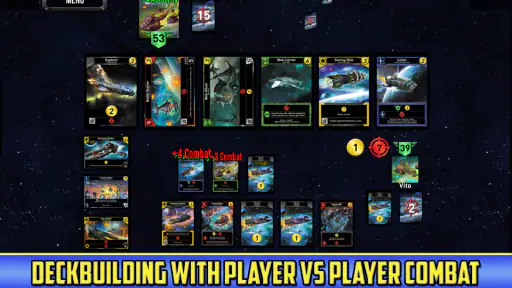
I keep coming back to Star Realms because it turns a card game into a compact space battle without making every match feel like a long commitment. I build a small deck, buy ships and bases, and try to reduce my opponent’s authority before my own disappears. The rules are approachable, but the decisions become sharper very quickly. One purchase can improve my next turn, weaken the opposing board, or leave me with an awkward hand that takes several rounds to recover from.
That balance makes it a particularly good fit for anyone who enjoys deckbuilding games but wants direct player-versus-player combat rather than a purely solo puzzle. Wise Wizard Games keeps the central idea focused: cards are both my economy and my weapons, so every improvement to my deck has a cost in tempo. I can play a powerful ship now, or buy a less exciting card that makes future turns more reliable. In my experience, that tension is the real reason the game remains interesting after the first few matches.
How the early turns create clear goals
The first games are easy to understand because the immediate goal is visible. I am not trying to complete a complicated quest chain or learn a large collection of unrelated systems. I am trying to assemble useful cards, survive the opponent’s attacks, and make my deck produce stronger turns. That clarity helps new players get started without removing the need to think.
Early progress comes from learning what a good purchase actually does for the deck. A card may look attractive because it has strong attack power, but it can be a poor choice if it does not work with the rest of the cards I am drawing. Likewise, a defensive base can buy time, yet spending too much on defense may allow the opponent to improve their deck uncontested. I found that the game teaches this lesson naturally: the consequences of a purchase usually appear within a few turns.
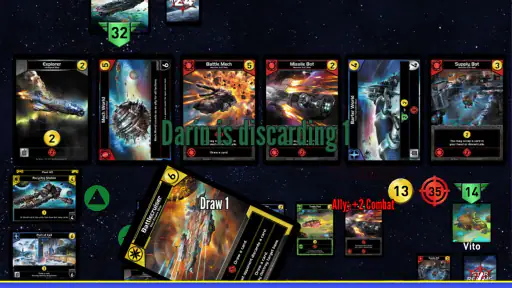
The trade row gives each turn a small planning problem. I have to consider what is available now, what might be replaced after a purchase, and whether I am helping my opponent by leaving a useful card within reach. That last point is easy to overlook during the opening matches. Buying a card is not only about improving my own deck; it can also deny an especially convenient option to the other player.
For a newcomer, I recommend setting a simple early objective: focus on making the deck more consistent rather than chasing the most dramatic card. A hand with several cards that work together is often more valuable than a collection of individually impressive purchases. This is one of the first meaningful goals the game gives me, and it remains useful even after I understand the basic rules.
The faction structure adds another layer to those early decisions. Cards from the same faction can support one another, while mixed purchases can give flexibility or create a less focused deck. Neither approach is automatically correct. Committing too early can make the deck predictable, but refusing to commit can leave it without a strong identity. I enjoy that the game lets me discover this through play instead of presenting a long tutorial lecture.
There is also a practical everyday use case here. If I have a short break and want something more thoughtful than a quick arcade round, I can play a match and still feel that the time had a purpose. The opening turns establish a plan quickly, so I am rarely staring at an empty board wondering what the game expects me to do.
What progress feels like during a match
Star Realms does not need a huge map or a long campaign to make progress visible. The deck itself is the progress signal. At the beginning, my draws can feel modest and uneven. After several purchases, I start seeing combinations, stronger economy turns, and better ways to convert resources into pressure. When that change happens, I can feel it directly in the hand rather than merely reading a number on a profile screen.
That makes the game’s progression satisfying but also demanding. A stronger deck does not guarantee a win, because the opponent is improving at the same time. I still have to decide when to attack, when to remove a weakness, and when to accept a less efficient turn in order to prepare for the next one. The most rewarding matches are usually the ones where I recognize that my deck has become more dependable without assuming I am safe.
The board state provides another useful signal. Bases can alter the rhythm of a battle because they remain in play and may need to be removed before the opponent’s authority can be attacked directly. This creates short-term priorities that compete with the long-term deck plan. I might have enough resources to buy a strong card, but ignoring a threatening base could make that purchase irrelevant.
I particularly like the way discarded cards become part of the learning process. A card that seems weak in isolation may become valuable once I understand how it affects the deck’s timing. Conversely, a purchase that looked powerful can reveal itself as a burden if it repeatedly arrives without the cards needed to support it. I began paying closer attention to the shape of my deck rather than judging every card by its printed strength.
This is also where the game differs from a simple digital version of a traditional card game. In a typical quick card game, I may mostly react to the cards in my hand. Here, I am constantly shaping the hands I will draw later. That delayed consequence gives even an ordinary purchase more weight and creates a clear sense of development from one turn to the next.
Why the difficulty rises without becoming confusing
The difficulty curve is gentle at first and then becomes more demanding through decision quality rather than a sudden rule dump. New players can understand the basic actions quickly, but experienced opponents expose mistakes that are easy to miss against a passive learning partner. Buying too many expensive cards, ignoring the opponent’s faction direction, or failing to remove a vulnerable base can all create problems several turns later.
That delayed punishment is fair, but it can be frustrating. A player may feel that a match was lost because of one unlucky draw when the real cause was an earlier deckbuilding choice. I had to learn to review the turns before a bad hand, not only blame the hand itself. The game rewards that kind of self-correction, although it does not always make the lesson obvious immediately.
Player-versus-player combat gives the difficulty curve much of its shape. A human opponent notices opportunities that a beginner overlooks, such as leaving a base alive for too long or buying a card that disrupts the deck’s balance. This means the game can feel relaxed in one match and extremely tense in another without changing its fundamental rules.
For someone coming from collectible card games, the learning curve may feel familiar, but the smaller decision space makes individual choices stand out. There are fewer distractions than in a very large card pool, so I can concentrate on timing, economy, and the relationship between factions. That simplicity is a strength for learning, though players who want endless card variety may eventually find the core structure more focused than expansive.
The game is not the best choice for someone who wants a completely passive experience. Even when the rules are familiar, I need to watch what the opponent is buying and adjust my plan. It is also less suitable for a player who dislikes losing because of strategic mistakes that only become clear after the match. I would choose a lighter, luck-forward card game for a group that wants conversation first and competition second.
One useful habit is to separate the match into two questions: what helps me this turn, and what improves the quality of future hands? Those questions often point to different cards. When I consciously ask both, I make fewer impulse purchases and understand the difficulty curve more clearly. The game is at its best when I am planning one or two turns ahead without pretending I can control everything.
Pacing, repetition, and the pressure to keep playing
The pacing is built around a steady exchange of small advantages. A match can begin quietly while both players improve their decks, then accelerate once stronger combinations appear and authority totals become more vulnerable. That change in tempo keeps the middle of a game from feeling like a routine shopping phase.
I appreciate that the tension usually comes from decisions rather than from a complicated presentation layer. The core loop is direct: draw, spend, attack, and prepare for the next cycle. Because each turn changes both decks and the available market, there is rarely a perfect pause where I can simply wait for the game to become interesting.
At the same time, the same focused loop can create repetition. If I want a large variety of modes, elaborate narrative progression, or a constantly changing battlefield, this may feel narrow beside bigger digital card games. Star Realms earns repeat play through the quality of its choices, not through a parade of unrelated activities. That is a strength for players who enjoy refinement, but a limitation for players who need constant novelty.
The free entry point makes trying it easy. The game is free, carries an Everyone content rating, and has attracted over 500 thousand installs. Its average rating is 4.6 from around 29 thousand ratings, which matches my impression that the central design has a strong following. Still, popularity should not be confused with universal appeal: the game’s competitive focus is more important than its broad age rating.
There are in-app purchases ranging from $0.99 to $119.99 per item. That matters when deciding how deeply to commit. I would start with the free experience and first determine whether the basic deckbuilding loop holds my attention. Spending makes more sense for someone who already knows they want additional content or a longer-term relationship with the game, not for a newcomer trying to solve an early frustration.
The purchase structure can also affect the feeling of progression for some players. If I prefer a single, clearly defined package with everything available immediately, a free-to-start card game may feel less straightforward than a premium alternative. On the other hand, the entry cost is low enough to let me test the combat and deckbuilding before making that decision.
For daily play, I find the strongest routine is not grinding match after match without reflection. I get more from playing a small number of games, noticing one recurring mistake, and changing my next deck accordingly. For example, if my hands are often full of expensive cards that cannot be used together, I can make consistency the next match’s goal rather than simply trying to buy the biggest attack value.
How it compares with familiar card-game alternatives
Compared with a traditional collectible card game, Star Realms is easier to approach because the deck is built during the match rather than requiring a large personal collection before I can compete. That reduces preparation and puts the emphasis on adapting to the cards available in the current market. I spend less time constructing a perfect list in advance and more time making the best of an imperfect shop.
Compared with a casual card game based mostly on matching symbols or playing sets, it demands more forward planning. I have to track economy, faction relationships, bases, authority, and the opponent’s likely intentions. The reward is greater control, but the cost is that a distracted player can lose the thread of the match quickly.
It also feels more immediate than a purely solo deckbuilding puzzle. The opponent’s purchases change the value of the market, and attacks force me to respond to a developing threat. If I want to experiment with a strategy without pressure, a solo-focused game may be more comfortable. If I want my decisions challenged by another person, this design has the stronger appeal.
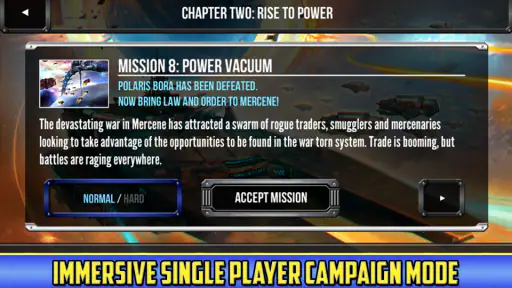
Players who enjoy long narrative campaigns may prefer a card game that ties progress to characters, chapters, or a persistent world. Star Realms is more abstract and more replayable in a competitive sense. Its story is the match itself: a weak opening, a developing engine, a sudden attack, and the attempt to recover before the opponent closes the gap.
Another trade-off is session intensity. The compact structure works well on a phone, but a short match can still demand full attention. I would not start one while waiting for an important call or trying to follow a conversation. For a commute with reliable concentration, it is a good companion; for a moment when I can only glance at the screen, it is a poor fit.
Who will enjoy it and who should skip it
I recommend it to players who like making a plan, watching that plan evolve, and adjusting when the market or opponent disrupts it. It is especially appealing if you enjoy card games where deck improvement is part of the battle rather than a separate preparation stage. Newcomers can learn the essentials without first studying a large rulebook, while experienced players have enough room to debate timing and deck focus.
I would be more cautious recommending it to someone who wants a relaxing game with minimal consequences. A poor purchase can affect several later turns, and a strong opponent can make that weakness visible. I would also skip it if the main attraction is collecting cards for their own sake. The cards matter because of how they function in a match, not simply because they are items to gather.
Families can appreciate the Everyone rating and the straightforward science-fiction theme, but younger or completely inexperienced players may still need help understanding why a seemingly powerful card is not always the correct purchase. The age rating describes the content, not the strategic difficulty. I would introduce it through a few open discussions about why each card was bought rather than expecting the first match to explain everything.
Device compatibility is worth checking before installing: the listed minimum operating system is Android 7.1. The current version is 20260814.1.2, so keeping the app updated is sensible when possible. The developer is Wise Wizard Games, a name closely associated with the physical card-game design, and that foundation is apparent in the emphasis on clean turns and meaningful card choices.
My verdict on its long-term progression
Star Realms sustains play through a strong chain of goals. First I learn to spend resources sensibly. Then I try to make my deck more consistent, recognize faction relationships, protect important bases, and read the opponent’s priorities. Later, the challenge becomes less about knowing the rules and more about choosing which advantage matters right now.
That is a convincing progression system even without relying on inflated rewards. The progress is visible in my decisions, my card combinations, and my ability to recover from an awkward market. I do not need every match to introduce a new mechanic; I need each match to teach me something about timing or deck quality. When it does, I am willing to play again.
The main retention pressure comes from the possibility of improvement. I often finish a close loss knowing exactly one moment I would handle differently. That feeling is productive when I treat it as a lesson, but it can become tiring if I keep replaying without changing my approach. The game rewards deliberate practice more than automatic repetition.
My biggest reservation is that the focused design may eventually feel limited to players seeking a broad, content-heavy card platform. The free model and optional purchases also deserve a careful look from anyone who prefers a one-time purchase. Those are not reasons to dismiss it, but they are real trade-offs that should shape expectations before investing much time or money.
For me, the final recommendation is clear: try it if you want a compact competitive card game where every purchase helps define the battle ahead. I would not choose it for a purely casual distraction, but I would gladly recommend it to a friend who enjoys tactical decisions, quick feedback, and the satisfaction of turning a messy opening deck into a reliable fighting machine. Its best quality is that the early goals remain useful later, while the later challenge grows from understanding the same elegant core more deeply.
Pros
- Fast matches make it easy to play during short breaks.
- Deck-building offers meaningful choices and varied strategies.
- Faction combos create satisfying tactical moments.
- Works well for both solo play and competitive matches.
- Simple rules make it approachable for new players.
Cons
- Some advanced content may require additional purchases.
- Luck of the draw can decide close matches.
- The interface feels dated on some devices.
- Competitive play can become repetitive after extended sessions.
- Online matchmaking may be inconsistent outside peak hours.

- Category
- Card
- Version
- 20260814.1.2