Solitaire Town Tycoon
- 1.26K
- 4.6
- Installs
- 100.00K
- Price
- Free

Screenshots



Analysis by Reviewed
I went into Solitaire Town Tycoon expecting a familiar card game with a slightly more ambitious presentation, and that is exactly where its appeal begins. It is a free solitaire title from Casual Skill Games, but its identity is not limited to arranging cards in the usual quiet way. The game frames each round around the possibility of earning rewards, so every move carries a little more weight than it would in a purely offline patience game.
That difference changes how I approach a session. I am not only looking for a clean win; I am watching the board, deciding whether a move keeps future options open, and judging whether it is worth starting another round after the current one ends. The basic card rules remain approachable, which makes the game easy to pick up, while the reward-focused structure gives the familiar format a more goal-oriented rhythm.
The game is listed as a mature experience for players aged 17 and over. That matters because the reward angle may not suit younger players or anyone who prefers card games without any monetized layer. For the right audience, though, it can turn a few spare minutes into a more engaging routine than a standard solitaire app.
How the first move sets the tone
The best part of the opening action is that it feels immediately recognizable. You begin by examining the available cards and choosing a move that improves the layout rather than simply taking the first legal option. That small distinction is important: a move can be valid now and still leave the board awkward later.
I found myself using a simple opening habit. Before committing, I scan for moves that uncover a hidden card or create a useful sequence. This is more effective than clearing whatever is easiest, because early decisions determine how much flexibility remains when the layout becomes tighter. The game rewards attention without demanding that I memorize complicated systems.
That accessibility makes it suitable for short breaks. I can start a round without needing a long tutorial or a large time commitment. At the same time, the possibility of rewards means I do not play entirely on autopilot. The familiar rules are the doorway, but the surrounding objective gives the first move a reason.
One practical tip is to delay moves that reduce your options unless they reveal something valuable. In solitaire, an empty space or a newly exposed card can be more useful than a quick sequence completion. I also try to preserve cards that can be moved in several ways, since flexibility becomes increasingly valuable once the obvious plays disappear.
Why the familiar format still works here
Solitaire has an advantage over many card games: the player understands the basic promise almost instantly. There is no opponent waiting for a response, no complicated deck-building phase, and no need to coordinate with other people. That makes this game a natural choice when I want something interactive but low-pressure.
Compared with a traditional solitaire app, however, this one places more emphasis on the outcome beyond simply finishing a layout. That can make a successful round feel more purposeful, but it also means players who want a completely neutral, distraction-free version may prefer a basic solitaire alternative instead.
The distinction is especially noticeable when I play while commuting or waiting for an appointment. A conventional game is easy to abandon because nothing outside the board is pulling me back. Here, the reward-oriented structure gives me a reason to finish one more round, provided I am comfortable with that motivation.
The feedback rhythm between moves
A good solitaire game depends on a steady rhythm: choose a card, see the layout improve, discover a new possibility, and then face a smaller set of choices. Solitaire Town Tycoon works best when that rhythm remains visible. Each useful move should feel like it has opened the board rather than merely shifted cards around.
For me, the satisfying moments are not only the final clear. They happen when a blocked section becomes available or when two separate sequences suddenly connect. Those moments provide immediate feedback that the previous decision was worthwhile. The board becomes a running record of whether I am preserving options intelligently.
The reward layer adds another beat to that process. A completed round is not just a visual finish; it leads into the larger reason for playing. That creates a repeating pattern of action, feedback, and motivation. The pattern is simple, but it is strong enough to make the game feel more involving than a purely decorative card pastime.
There is also a useful mental separation between progress and luck. Some layouts will naturally offer better openings, and not every unsuccessful round reflects poor play. I try to judge my decisions by whether they maintained alternatives, not only by whether the final result was a win. That approach keeps the game enjoyable when the board does not cooperate.
Small decisions that improve a round
My most useful adjustment was to stop treating every available move as equally urgent. If two cards can be played, I first ask which move exposes more information. Revealing a concealed card usually has greater strategic value than moving a card that could remain available for later.
I also avoid spending a flexible card simply because it fits. A card that can support several future sequences is a reserve. Using it too early may make the board look cleaner while quietly removing the move needed to escape a dead end. This is the kind of trade-off that gives the otherwise familiar format some depth.
Another good habit is to pause before the final stretch. When the board appears nearly solved, it is tempting to speed up, but an automatic-looking finish can still be spoiled by one careless order. I prefer to check which cards will remain movable after each placement. That extra second often prevents a restart.
These are not complicated tactics, and that is part of the appeal. The game does not require a specialist understanding of card theory. It rewards observation, patience, and a willingness to consider the second consequence of a move.
Rewards, purchases, and the reason to continue
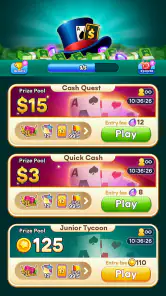
The reward promise is the feature that most clearly separates this game from a plain solitaire utility. I would not describe it as a reason to expect guaranteed results. Instead, it gives each completed session an extra objective and changes the emotional value of a win.
The game is free to install, while optional in-app purchases range from $0.99 to $199.99 per item. That is a broad range, so I would approach the reward system with a clear personal limit before spending anything. The sensible way to evaluate the game is to enjoy the free experience first and decide later whether any purchase is genuinely worthwhile for your own habits.
This is also where the mature age rating becomes relevant. A player who is uncomfortable with games that connect card play and potential rewards should probably choose a conventional solitaire app instead. The usual alternatives may offer fewer incentives, but they can be a better fit for someone who wants to play without thinking about purchases or reward progression.
I appreciate that the reward layer gives a completed round a stronger sense of closure. In an ordinary solitaire session, the end can feel like a quiet stop. Here, finishing creates a reason to check what comes next. That is effective design for people who enjoy a goal beyond simply arranging the cards.
At the same time, this structure can encourage longer sessions than intended. My practical advice is to decide whether I am playing for a single break or for several rounds before opening the game. If the goal is a five-minute distraction, the reward loop can make stopping less automatic. That is not a flaw for every player, but it is a real trade-off.
Who benefits most from the reward loop
This game is a good match for someone who already enjoys solitaire but finds standard versions too passive. The familiar card actions reduce the learning curve, while the reward focus adds a reason to pay attention. It also suits players who like repeated, self-contained rounds rather than a long campaign with a fixed storyline.
I would be more cautious recommending it to someone seeking a completely offline-feeling card experience, a child-friendly game, or a no-purchase environment. A basic solitaire alternative is likely better in those cases. Likewise, players who dislike repeating similar layouts may find the core loop too narrow, because the attraction comes from refining decisions across rounds rather than discovering a large variety of game modes.
For an everyday example, imagine having a break between errands. I can play a round while waiting, stop after the result, and return later without needing to remember a complex narrative. If the round ends in a loss, the reset is immediate enough to invite another attempt. If it ends in a win, the reward objective supplies the extra satisfaction that keeps the session from feeling disposable.
What happens when a session resets
The reset is central to the game’s design. A failed layout does not represent a long-term collapse; it simply sends me back to the familiar starting point with another chance to make better choices. That low cost of failure is one of the strongest reasons the game works for short sessions.
Still, a reset should not become an excuse to repeat the same opening automatically. I get more from the game when I identify the moment a round turned against me. Did I use a flexible card too soon? Did I ignore a move that would have exposed a hidden card? Did I rush the final sequence? Treating the reset as a quick review makes the next attempt feel purposeful.
The loop is therefore easy to describe: make a card decision, receive immediate board feedback, complete or lose the round, encounter the reward motivation, and decide whether to begin again. That structure is uncomplicated, but it gives the game a clear pulse. Each new session is not a completely different experience; it is another opportunity to handle the same familiar problem more carefully.
One limitation is that players looking for deep long-term variety may eventually want more than this loop provides. The reward goal can extend interest, but it does not replace genuinely different gameplay for everyone. If I want strategic variety, competitive matches, or a broader collection of card formats, another card game would be a better choice.
Everyday usability and overall judgement
Casual Skill Games presents this as a focused card experience rather than a sprawling game, and that focus is useful. The current version is 13.9.0, and the listed minimum operating system is iOS or Android 12, so I would check device compatibility before planning to use it on an older phone or tablet.
The game has built a visible audience, with over 100 thousand installs, a 4.6 average rating, and around 6 thousand ratings. Those figures suggest that the basic concept is connecting with many players, although they do not remove the need to decide whether the reward structure fits personal preferences.
Its release date, August 5, 2025, also places it among newer entries rather than a long-established classic. I see that as a reason to judge it by its current experience instead of assuming it has the depth or history of older solitaire brands. The important question is whether the action-feedback-reward cycle feels worthwhile during actual short sessions.
For me, the answer is yes, with conditions. The first action is easy to understand, the board gives useful feedback when a decision opens new possibilities, and the reward objective makes a win feel more meaningful. The reset is quick enough to support another attempt without making failure feel expensive in time.
My main recommendation is to treat it as a reward-oriented solitaire game, not as a guaranteed way to earn anything. That mindset keeps the card play at the center and makes it easier to judge the experience fairly. Play for the decisions and the satisfying completion first; consider purchases only with a firm budget and only if the free sessions already feel enjoyable.
In the end, I would recommend Solitaire Town Tycoon to mature players who want the calm familiarity of solitaire with a stronger reason to return after each round. I would skip it in favor of a simpler alternative if I wanted no monetized layer, a child-appropriate card game, or a much wider range of modes. For everyone else, its strongest quality is the clarity of its loop: one thoughtful move leads to visible progress, progress leads to a result, and the result makes the next session feel tempting rather than obligatory.
Pros
- Relaxing solitaire gameplay suitable for short sessions.
- Town-building adds progression beyond standard card games.
- Simple controls make it accessible for casual players.
- Frequent goals provide motivation to keep playing.
- Works well for players who enjoy collecting and upgrading.
Cons
- Progress may slow down when resources become scarce.
- Random card layouts can make some levels feel frustrating.
- In-game events may require regular play to complete.
- The town-building layer may feel repetitive over time.
- Some rewards can take considerable time to unlock.

- Category
- Card
- Version
- 13.9.0