Rummy Rush - Classic Card Game
- 3.46K
- 4.8
- Installs
- 1.00M
- Price
- Free

Screenshots






Analysis by Reviewed
Rummy Rush - Classic Card Game is the kind of mobile card game I can open without preparing for a long session. Its appeal is immediate: familiar rummy rules, live multiplayer, and a bright presentation designed to make a traditional card table feel active on a phone. After spending time with it, I found that its strongest quality is not simply that it lets me play rummy anywhere. It gives each round a clear rhythm, making the small decisions feel more urgent than they usually do in a quiet, offline card game.
Developed by Beach Bum Ltd., this free card game is aimed at players who enjoy the social side of rummy as much as the rules themselves. It is rated for Everyone, runs on devices using Android 7.0 or later, and has reached over a million installs. Those details make it approachable, but the real question is whether the presentation improves the card experience or distracts from it. In my view, it mostly succeeds, although players who prefer a completely calm, private game may find the live format and purchase options less comfortable.
My first impression of a fast, social card table
The first thing I noticed was how quickly the game communicates its purpose. There is no need to learn an unfamiliar world, build a character, or understand a complicated collection system before playing. The cards are the focus, and the interface pushes me toward a match rather than burying the main activity under menus. That directness matters on mobile, where a game can lose me before the first round if it asks for too much setup.
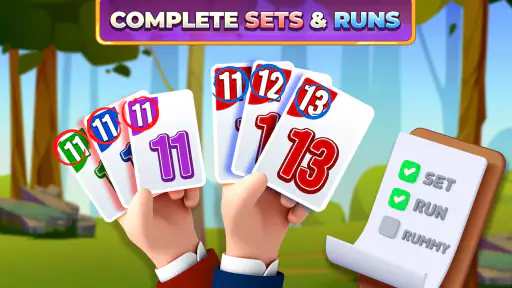
The basic concept is classic rummy played in a live multiplayer setting. That combination gives the game a different feel from a solitary card app. I am not only arranging cards according to my own plan; I am also watching the pace of another player and trying to read the consequences of each discard. Even when the rules are familiar, the human element makes the same opening hand feel different from one round to the next.
The game has a 4.8 average from around 46 thousand ratings, with roughly 3.5 thousand written reviews. I do not treat those numbers as a substitute for playing, but they do match my impression that the core idea is easy to understand and broadly appealing. Its free entry point also makes it simple to try before deciding whether the live format suits you.
One useful detail for a new player is that the game works best when approached as a short-session activity rather than as a replacement for a full evening of tabletop rummy. I can play a round during a break, while waiting for an appointment, or when I want something more engaging than scrolling. The compact structure gives each decision weight without demanding the same commitment as a long strategy game.
A welcoming start, with a competitive edge underneath
Although the surface is friendly, the game is not mindless. Rummy rewards attention to patterns, and the live setting makes careless decisions more visible. I have found that the most important early habit is not rushing to form a combination. It is keeping track of what has already appeared and considering what the other player might be collecting. That small change in focus makes the game feel more thoughtful than its cheerful presentation first suggests.
The approachable design is particularly useful for people returning to rummy after a long break. I do not need to remember every tactical idea before starting. The cards themselves provide the immediate information, and the short rounds create room to learn through repetition. At the same time, experienced players can still find depth in timing, discards, and risk management rather than simply relying on the luck of the draw.
There is a trade-off here. A player who wants a slow, conversation-friendly table may prefer a physical deck or a more traditional offline app. Rummy Rush is built around momentum. It feels better when I am ready to make decisions continuously, not when I want to leave a game sitting open while talking to someone else.
How the art direction gives familiar cards a playable mood
The visual language is designed to make the card table feel lively rather than formal. The presentation has a playful mobile-game character, which helps the activity feel less like a dry rules exercise. That matters because rummy can look visually static on a small screen: cards, a discard area, and a hand do not naturally provide much movement. The game needs a sense of occasion around those elements, and its art direction supplies that energy.
I like that the visual treatment supports recognition instead of competing with it. The cards remain the objects I need to read, sort, and evaluate. Decorative touches can make a mobile game memorable, but they become a problem if they obscure the hand or make the next action unclear. Here, the overall impression is of a bright social table where the atmosphere frames the mechanics rather than replacing them.
The setting is not a deep narrative world, and it does not need to be. Its purpose is to establish the feeling of joining a casual but competitive card session. That is a sensible choice for this type of game. A dramatic story would be unnecessary baggage, while a completely plain interface could make live play feel lifeless. The middle ground works because it gives the match personality without asking me to follow a plot.
One of the more practical strengths of this approach is that the mood helps distinguish a meaningful moment from routine handling. Drawing, arranging, and discarding are simple actions, but the surrounding presentation gives them a little more presence. I become more aware of the point at which a hand changes from uncertain to promising, or when a discard may reveal too much about my plan.
Where the visual style helps, and where it may not
The cheerful look will appeal to players who enjoy card games with a modern mobile identity. It makes the experience feel social and accessible, especially compared with a bare-bones digital deck. However, anyone who wants the quiet visual restraint of a classic card table may find the presentation more animated than necessary. The art is not trying to imitate a serious tournament room; it is trying to keep the mood active.
That distinction affects who should choose it. I would recommend it to someone who wants familiar rummy with a sense of occasion, particularly if playing against other people is part of the attraction. I would point a minimalist player toward a simpler card app instead, especially if the goal is concentration without extra visual personality.
The strongest design decision is keeping the visual identity connected to the playable table. It would be easy for a card game to add decoration that has no relationship to decision-making. Rummy Rush feels more coherent when the setting, card layout, and match flow all point toward the same idea: a quick, friendly contest where every discard can matter.
Sound, pacing, and the feeling of a live match
Sound and timing are important in a game with such simple physical ingredients. A deck of cards does not produce much variety on screen, so the rhythm of actions has to carry some of the excitement. In my experience, the game’s pacing makes the match feel more immediate than a turn-based offline session where I can pause indefinitely. The live structure encourages me to stay mentally present.
That pacing creates a useful tension. I have enough time to inspect my hand and think about possible combinations, but I cannot treat every turn as an unlimited puzzle. The result is a balance between planning and instinct. I am not making decisions blindly, yet I am also not endlessly calculating every possible outcome. For mobile play, that is an effective rhythm because it keeps a short session from becoming sluggish.
The sound design contributes to the sense that actions are happening at a shared table. Small audio responses can make a draw or discard feel more definite than a silent tap, while the broader presentation reinforces the idea that I am participating in an event rather than manipulating a spreadsheet. I would not describe the audio as the main reason to play, but it supports the game’s social, upbeat tone.
Players who often play in public should think about how they want to handle that atmosphere. A quiet mode of play is more comfortable for some people, especially during work breaks or travel. I usually keep the volume low when I am outside, because the visual feedback is enough for me to follow the round. The game remains understandable when sound is not the focus, but the overall mood is stronger when the audio and animation are working together.
Why the tempo changes the strategy
The live pace is not merely a presentation choice; it changes how I play. In an offline game, I can hold a risky card for a long time while studying every possibility. Against another person, hesitation has a cost, and a quick discard may be safer than an elaborate plan that depends on several perfect draws. This makes the game a test of judgment under light pressure rather than only a test of pattern recognition.
A useful approach is to decide what information I am willing to reveal. Discarding a card that looks harmless may still tell an opponent which part of a sequence I do not need. Conversely, holding too many speculative cards can leave the hand inflexible. The live rhythm encourages me to choose a workable route instead of waiting for an ideal one, which is one of the more interesting strategic differences from relaxed solo rummy.
This is also where the game may frustrate players who dislike time pressure or unpredictable opponents. A poor hand can feel more irritating when another person is advancing quickly, and a mistake cannot always be undone. If I want to experiment with unusual plays, I prefer a slower environment. If I want a focused contest with clear momentum, the live format is a better fit.
How the mechanics, presentation, and multiplayer format fit together
The central mechanics are familiar enough that the game does not need a long explanation to become enjoyable. The challenge comes from managing a changing hand, building useful combinations, and deciding what to keep or release. Because the opponent is active, every card has two roles: it may help my own plan, and it may become information or material for someone else.
That dual purpose is what keeps the experience from feeling like simple sorting. I am constantly balancing progress against concealment. A card that completes a promising group may be valuable, but holding it can also prevent me from adapting when the next draw changes the situation. The best turns are often not the flashy ones; they are the quiet decisions that preserve several options without giving away too much.
The presentation supports this mechanical loop by making the match easy to read at a glance. A mobile card game has limited space, so clarity is more important than decorative ambition. When I am deciding whether to draw, hold, or discard, I want the table to communicate the state of play without forcing me to search through the interface. The game’s strongest moments come when the visual mood adds energy while the hand remains the unquestioned center of attention.
For newcomers, I suggest playing conservatively during the first few rounds. Rather than chasing every possible combination, I watch which cards the opponent ignores and which discards seem to change their behavior. This is a more useful learning method than trying to memorize a fixed opening strategy, because rummy depends heavily on the evolving hand and on what becomes available.
Practical habits that improve a short session
My first concrete tip is to sort the hand mentally by both suit and sequence potential, not just by matching values. A hand can look promising because several cards share a number, yet a near-sequence may offer a more flexible route. Checking both possibilities before discarding reduces the chance of throwing away a card that quietly supports multiple plans.
My second tip is to treat the discard pile as information rather than a supply of attractive cards. Taking a visible card may complete a combination, but it also exposes what I am building. I consider whether the immediate gain is worth showing that direction to the opponent. Sometimes drawing elsewhere keeps my plan less obvious, even if it delays completion.
My third tip is to set a stopping point before starting a session. Because rounds are short and the multiplayer format creates a desire to recover after a loss, it is easy to continue longer than intended. I get more enjoyment when I decide in advance whether I am playing one round, a brief break, or a longer session. That small boundary keeps the competitive mood from turning into automatic repetition.
A fourth useful insight concerns purchases. The game is free to download, but its in-app purchases range from $0.99 to $319.99 per item. I would not treat spending as part of the basic requirement for trying the card play. Anyone considering a purchase should first decide whether they enjoy the actual match loop, then set a personal limit before browsing optional items. The wide price range is a reason to be deliberate, particularly on a shared device or account.
Who benefits most from this particular format
This is a strong choice for someone who already knows the broad idea of rummy and wants a more active way to play it. It also suits a beginner who learns best through quick practical rounds rather than reading a long rulebook. The combination of familiar mechanics and a lively table makes the learning curve gentle without making every match feel passive.
It is less suitable for players seeking a purely offline experience, a deep narrative campaign, or a highly controlled practice environment. Someone who wants to pause after every move and analyze possibilities may prefer a traditional solo card app. Likewise, a player who dislikes social competition, animated presentation, or purchase prompts should think carefully before choosing a live mobile version.
In everyday use, I can imagine opening it during a commute when I have enough time for a complete round but not enough attention for a large game. I can also see it working well as a casual challenge between friends who already enjoy rummy, provided everyone is comfortable with the game’s pace and mobile format. It is not the same as sitting around a physical table, but it captures the part that matters most: watching a hand develop while another person tries to do the same.
My verdict on the atmosphere and the card play
Rummy Rush works because its art direction, sound, and pacing all support one clear purpose: making familiar rummy feel like a live mobile event. The setting is light rather than elaborate, the presentation keeps the table from feeling static, and the tempo gives ordinary card decisions a little pressure. Most importantly, those choices do not erase the mechanics. The hand, the discard, and the opponent’s behavior remain the reasons to stay engaged.
Beach Bum Ltd. has made a free card game that is easy to approach but not entirely shallow. Its 3.22.11 version is available for Android devices from 7.0 onward, and its Everyone rating reflects the straightforward nature of the activity. I would still remind new players that live competition can feel more demanding than the friendly visuals suggest, and that optional purchases deserve sensible limits.
My overall opinion is positive. I recommend Rummy Rush - Classic Card Game to players who want quick multiplayer rummy with a bright, coherent mood rather than a silent digital deck. I would skip it in favor of a simpler alternative if I wanted complete solitude, unlimited thinking time, or a strictly traditional table. For everyone else, it offers a convincing middle ground: recognizable card strategy, enough social tension to keep rounds interesting, and a presentation that makes short sessions feel like genuine play rather than filler.
Pros
- Quick matches make it easy to play during short breaks.
- Simple controls are suitable for beginners and casual card-game fans.
- Multiple modes provide variety beyond standard rummy rounds.
- Clear card layouts make combinations easy to follow on small screens.
- Offline play can be convenient when an internet connection is unavailable.
Cons
- Some features or rewards may require watching frequent advertisements.
- Progression can feel repetitive after extended play sessions.
- Advanced players may find the computer opponents predictable.
- Limited customization may reduce long-term appeal for dedicated players.
- Online features may depend on a stable connection and active matchmaking.

- Category
- Card
- Version
- 3.22.11