Puzzle & Dragons
- 29.87K
- 3.9
- Installs
- 5.00M
- Price
- Free

Screenshots


Analysis by Reviewed
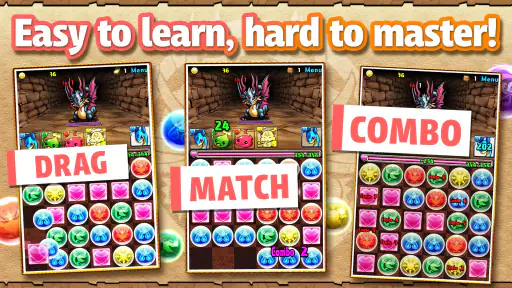
My first impression of Puzzle & Dragons was that it looks approachable, but it does not stay simple for long. The basic idea is easy to understand: move puzzle pieces, create matches, and use those matches to fight through an adventure. What takes more time is learning how the puzzle board, team building, creature choices, and battle decisions fit together. That gradual increase in depth is the reason I kept coming back, although it also means new players should not expect to understand every system immediately.
This is a free puzzle game from GungHo Online Entertainment, Inc., available for Android devices running at least Android 9. It is aimed at Everyone 10+, and its large player base is reflected in more than five million installs, with an average rating of 3.9 from roughly one hundred thirty thousand ratings. Those numbers suggest a long-running game with plenty of appeal, but they also hint at a divided experience: some players enjoy the collection and strategy, while others may find the learning curve and in-app purchases distracting.
What to Expect Before You Start
The central rhythm is more thoughtful than a typical match-three game. You are not simply clearing a fixed number of pieces and moving on. Matching colors affects attacks, and the way you arrange those matches can matter as much as the number of pieces removed. I found that the most satisfying moments came when I stopped making the first obvious match and instead looked at the whole board for a better sequence.
That makes the game a good fit for short sessions with a little concentration. I can imagine playing it while waiting for an appointment, but I would not describe it as something to play absent-mindedly. A careless move can waste a useful board arrangement, and later encounters ask for more planning than the opening stages. If you want a puzzle game that can be played entirely on autopilot, this is probably not the best choice.
The adventure layer gives the puzzle battles a sense of direction. Rather than solving disconnected boards forever, I felt that each successful encounter was part of a larger journey. The collection side also gives me a reason to think beyond the current battle: a creature that is not useful in one situation may become valuable when I change my team or face a different challenge.
One important expectation to set is that progress is not only about quick reflexes. The game rewards recognizing patterns, managing your available options, and making sensible decisions about which characters to use. That combination separates it from simpler alternatives where every level has one obvious solution. It also means that players who dislike managing a growing collection may eventually feel that the puzzle itself is no longer the entire experience.
The game is free to download, but it includes purchases ranging from $0.99 to $74.99 per item. I would approach those purchases carefully, especially at the beginning. A new player can learn much more by understanding the board and building a dependable routine than by immediately spending money. The most useful early habit is to treat every battle as practice for decision-making, not as a reason to chase every available upgrade.
Installing It Without Feeling Lost
After installing, I recommend giving yourself a few uninterrupted minutes rather than opening it for the first time during a rushed break. The opening experience introduces several ideas close together, and the game is easier to appreciate when you can pay attention to what each screen is asking you to do. I would also keep the first session focused on learning the battle flow instead of trying to understand the entire collection at once.
When the game presents new characters or rewards, resist the urge to judge everything immediately. Early on, the important question is whether a creature helps you form a team you can actually use comfortably. A collection can look impressive while still being difficult to manage if you keep changing your lineup without learning what each member contributes.
My practical setup advice is simple: begin with the default path the game offers, read the short explanations, and avoid skipping through every instruction. The first few lessons are not just formalities. They establish the relationship between matching pieces and dealing damage, which is the foundation for everything that follows. If you miss that connection, later menus can feel more complicated than they really are.
You should also expect the game to introduce terms and choices before you have enough context to appreciate them. That is normal here. I found it more useful to remember the purpose of a feature than its name. For example, when a screen asks me to manage a team, I first think about whether the lineup gives me a reliable way to attack, rather than trying to memorize every category at once.
Finding Your First Meaningful Success
The first satisfying breakthrough comes when you deliberately create a chain of matches instead of settling for one quick pair. Before moving anything, scan the board from corner to corner and identify several possible colors. Then imagine where the pieces will travel as you move one of them. This small pause is more valuable than rushing, because the board often offers a better arrangement than the first match you notice.
My preferred beginner routine is to choose one safe match first, then use the remaining movement to prepare another. I do not try to create an elaborate sequence every turn. Consistency is more useful at the start. Once I can reliably make one or two good matches, I begin experimenting with longer routes and more ambitious arrangements.
A realistic everyday example would be playing during a short train ride. I might complete one battle, stop before the next, and use the following session to think about why a previous board worked or failed. That stop-and-start style suits the game better than trying to force a long marathon session. It also gives me time to notice whether my team is struggling because of poor puzzle choices or because the lineup itself needs attention.
One non-obvious tip is to watch the empty spaces created by a match, not just the pieces you remove. New pieces can fall into those spaces and produce additional matches. Even when the result is not a dramatic chain, learning to predict the board after a clear helps you make better decisions on the next turn. I found this more useful than memorizing a single favorite move.
Another useful habit is to separate experimentation from serious attempts. When the cost of a mistake feels low, try unusual movement paths and observe how the board changes. When you are trying to finish a difficult encounter, return to the safest patterns you know. This prevents the common beginner mistake of testing a risky idea at the exact moment when a careful move would be better.
Where New Players Commonly Get Confused
The biggest source of confusion is the difference between simply matching pieces and matching them with a purpose. A match may be valid but still be a poor choice if it leaves the rest of the board disorganized. I initially focused too much on completing a match immediately. With practice, I learned to ask what that move would leave behind and whether it would help my next turn.
Team building can also feel unclear because the strongest-looking character is not automatically the best choice for every situation. I prefer a team I understand over a collection of impressive but unfamiliar options. If I know how my chosen members contribute, I can make better decisions during a battle and recognize when a loss came from the lineup rather than my puzzle movement.
It is easy to assume that every reward should be used at once. I would not do that. Keep your early choices deliberate, and take a moment to see how a new addition fits with what you already use. The game becomes less confusing when you make one change at a time. If you replace several team members together, it becomes difficult to tell which change helped or caused a problem.
The collection aspect may also create pressure to keep checking menus. For me, that became distracting when I treated every notification or new item as urgent. A better workflow is to finish the current learning goal first, then review your team between battles. This keeps the puzzle action at the center and prevents the management screens from taking over the experience.
In-app purchases are another point worth considering early. Because the game is free but offers paid items, players who are sensitive to spending prompts should decide on a personal rule before they begin. I would play through the opening stages without buying anything, learn the basic systems, and only then decide whether the extra convenience is worth it. A purchase cannot replace understanding how to use the board.
How It Compares With Other Puzzle Games
Compared with a straightforward match-three title, Puzzle & Dragons asks more from me after each match. The puzzle is tied to combat, and the team gives my decisions a longer-term consequence. That added structure is its main strength for players who want a game with progression rather than a sequence of isolated rounds.
Compared with a pure role-playing game, it gives me a more active way to influence a battle. I am not only selecting commands from menus; I am physically arranging the board and trying to turn a good position into useful damage. Players who enjoy collecting characters but want more involvement than automatic battles may find this balance appealing.
On the other hand, someone looking for a calm, minimalist puzzle experience may prefer a game with fewer menus and no collection layer. A traditional match-three game is easier to explain to a casual player and usually lets you understand the complete objective within seconds. This title is better for someone willing to learn a broader system over time.
I also would not recommend it as the first choice for a player who dislikes uncertainty around free-to-play design. Even if you never spend money, the presence of purchasable items can affect how the overall experience feels. My opinion is that the game is most enjoyable when I treat purchases as optional and focus on improving my own decisions, but not everyone finds that separation comfortable.
Making Progress Without Turning It Into Work
My next-step advice is to establish a small learning target for each session. One day, focus on making cleaner matches. Another time, examine whether your team has a sensible balance. This approach keeps the game manageable and gives you a way to measure improvement that is more meaningful than simply collecting another reward.
When a battle goes badly, replay the decision in your head before changing everything. Did you move too quickly? Did you leave the board with poor follow-up options? Did your team fail to support the way you were playing? Answering those questions helps you improve faster than replacing characters at random.
A particularly useful trade-off appears when choosing between a safe short match and a more complicated setup. The safe option may produce immediate progress, while the setup can create a stronger turn if it works. I usually choose the safe move when I am close to losing and experiment when I have room to recover. That simple rule reduces frustration without removing the strategic side of the game.
The current version is 23.3.2, and the game has been available since December 9, 2012. Its long history is noticeable in the amount of material and the depth of the systems, but that longevity can also make the first experience feel less streamlined than a newly designed puzzle game. I would give it a fair trial beyond the opening tutorial before deciding, while still accepting that the accumulated complexity may not suit everyone.
For a first-time user, the clearest path is to learn the board, keep a stable team for a while, and review new options only after understanding the battles you are already playing. That sequence answers the practical questions most beginners have: yes, you can start without paying; yes, the puzzle is the main skill to practice; and no, you do not need to master every menu before enjoying the early adventure.
After spending time with it, I see Puzzle & Dragons as a strong choice for players who want a puzzle game with a real sense of progression and a collection system that rewards patience. Its best moments come from turning a messy board into a planned attack, then learning from the result. Its weakest moments are the busy learning curve, the amount of management, and the fact that free-to-play decisions may not appeal to everyone.
I would recommend it to a friend who enjoys match-based battles, character collecting, and games that become deeper with practice. I would steer a friend toward a simpler puzzle title if they want instant clarity, very short uncomplicated rounds, or no interest in team management. For everyone else, the smartest way to begin is to play slowly, make deliberate moves, and let the systems reveal themselves one layer at a time. That is when the game stops feeling like a crowded collection of features and starts becoming an engaging puzzle adventure.
Pros
- Deep team-building system with many monsters and strategic combinations.
- Frequent events add new challenges
- rewards
- and limited-time content.
- Simple match-three controls make battles easy to learn on mobile.
- Large monster collection encourages experimentation and long-term progression.
- Cooperative features let you tackle difficult dungeons with other players.
Cons
- Energy limits can interrupt longer play sessions.
- The gacha system may require luck or spending to obtain top monsters.
- Later dungeons become highly demanding and may feel frustrating.
- The interface can feel overwhelming for new players at first.
- Some events and rewards depend heavily on regular daily play.

- Category
- Puzzle
- Version
- 23.3.2