Poople
- 10.00
- 3.5
- Installs
- 10.00K
- Price
- Free

Screenshots
Analysis by Reviewed
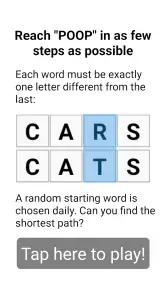
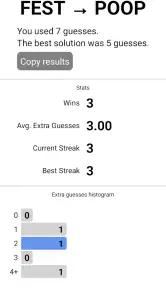
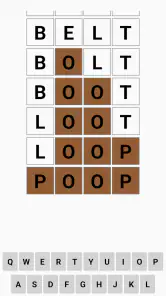
I went into Poople expecting a tiny joke disguised as a word puzzle, and that first impression is still the fairest way to describe it. The game takes a random four-letter word and asks me to turn it into “poop,” creating a deliberately silly daily challenge rather than a serious vocabulary workout. It is free, rated for Everyone, and made by MsAsterisk, so the basic invitation is easy: open it, solve a small word problem, smile at the result, and move on.
That simplicity is also the main reason I can imagine recommending it. Poople does not demand a long session, a complicated tutorial, or a large commitment. I can picture playing it while waiting for a coffee, taking a short break from work, or sending the day’s puzzle to a friend who enjoys childish humor. At the same time, the game’s narrow idea means it will not satisfy somebody looking for a deep word-game system with extensive progression, a large dictionary, or a serious competitive scene.
The game is listed in the Word category, but its personality is much more specific than that label suggests. It is not trying to be a traditional crossword, a spelling lesson, or a broad word-building sandbox. Its appeal comes from the contrast between a familiar daily-puzzle format and an intentionally ridiculous destination. That contrast gives every small success a comic payoff, even when the underlying action is modest.
How Poople turns a tiny idea into a playable mood
A first session built around curiosity
The strongest part of the opening concept is the question it creates: how can an unrelated four-letter word be changed into poop? That wording gives the player an immediate mental target. I do not need to learn a fictional setting or understand a collection of menus before I know what I am trying to do. The joke is the premise, and the premise is also the tutorial.
That kind of directness works especially well for a daily game. A daily puzzle has to be understandable almost instantly, because its role is often to fit into a routine rather than replace a full gaming session. Poople’s short-word focus supports that routine. I can approach it casually, make a few attempts, and decide whether the puzzle has earned another minute of attention.
There is a useful trade-off here. The game’s humor lowers the barrier to entry, but it also sets a limit on how long the novelty can carry the experience. Players who enjoy absurd presentation may find the small scale charming. Players who need increasingly difficult systems, elaborate rewards, or a sense of a larger journey may find the same small scale restrictive.
My practical advice is to treat it as a brief daily word ritual, not as a replacement for a full puzzle game. That expectation makes the design feel intentional. If I judge it by the standards of a large word-game collection, it seems slight. If I judge it as a quick burst of playful word manipulation, its focus becomes an advantage.
A visual language that keeps the joke readable
Poople’s setting is less about building a detailed world and more about establishing a clear comic language. The central idea already tells me what emotional register to expect: playful, immature, and knowingly ridiculous. That matters because a more solemn or elaborate presentation would fight against the mechanic. The game works best when the visual direction lets the joke stay uncomplicated.
In a small word game, every visual decision has extra weight. There are not many layers competing for attention, so the way the target word is presented becomes part of the experience. A clean arrangement can make the transformation feel like a tiny performance: I see the starting word, consider the possible changes, and wait for the final silly result. The presentation does not need a large fictional universe when the word itself is the stage.
This is also where the game’s age rating makes sense. The humor is childish rather than threatening, and the concept is easy to understand without mature themes. I would still describe the tone accurately to someone choosing games for a particularly formal environment: the joke is bodily and intentionally juvenile. That is not a flaw, but it is central to whether the game will feel funny or merely annoying.
One useful way to play is to notice how much of the atmosphere comes from restraint. I would not approach each puzzle expecting a flood of visual effects or a dramatic narrative reveal. The pleasure is in the small mismatch between an ordinary word task and an absurd goal. When the presentation stays focused on that mismatch, the game has a coherent identity instead of feeling like a standard word app with a random joke attached.
Sound, silence, and the pace of a daily puzzle
Sound matters differently in a game this compact. A noisy, aggressive audio design would make the experience feel larger and more demanding than it needs to be. Poople is better understood as a game that should fit around the player’s day. Whether I play in a quiet room, on public transport, or during a short pause, the pacing should support quick attention rather than insist on a long dramatic session.
The rhythm comes primarily from the sequence of thought and response. I look at the random four-letter starting point, test an idea, and see whether the transformation moves toward the comic goal. That loop has a natural beat: prompt, attempt, correction, payoff. It is a much smaller rhythm than the escalating rounds of a word arcade game, but it can be satisfying precisely because it does not overstay its welcome.
This makes the game a good candidate for low-volume or silent play. I can imagine using it when I do not want a soundtrack competing with a podcast, conversation, or work. The experience depends more on the timing of the puzzle than on a large audio identity. That is a strength for convenience, though it also means players looking for memorable music or a rich soundscape should choose a different kind of game.
The daily structure can create a healthy stopping point. Once I have dealt with the day’s word, there is less pressure to keep grinding for hours. That is a welcome contrast with word games built around endless levels, streak anxiety, or constant score chasing. The trade-off is that somebody who wants a substantial session may finish feeling that the game has only opened the door before asking them to leave.
Why the mechanics and the mood belong together
The central mechanic is simple enough to explain in one sentence, but the exact appeal comes from how the mechanic supports the tone. A random four-letter word feels ordinary and neutral. The destination is deliberately silly. The player’s task sits between those two points, turning a basic word exercise into a joke with a small amount of problem-solving attached.
That is a better fit for the game’s mood than a conventional score attack would be. If Poople pushed too hard on speed, rankings, or complex progression, the humor could become secondary. The charm comes from having enough friction to make the transformation feel earned, without turning the joke into homework. In my experience, this kind of balance is difficult: too little challenge and the punchline arrives empty; too much challenge and the player starts thinking about optimization instead of the absurdity.
A useful approach is to resist rushing. I would first inspect the starting word as a shape rather than immediately guessing. Look for letters that can be changed, moved, or interpreted according to the game’s rules, then make one deliberate attempt at a time. That slower approach helps preserve the comic rhythm and prevents the puzzle from becoming a random tapping exercise.
Another practical tip is to play it with a friend who likes wordplay but does not mind silly humor. The small premise is naturally shareable in conversation: one person can suggest a route, while the other decides whether it actually moves toward the target. This does not turn the game into a formal multiplayer title, but it gives the daily puzzle a social use without requiring a large feature set.
There is also a subtle difference between this and ordinary word alternatives. A crossword usually rewards knowledge and clue interpretation. A spelling game often rewards speed, vocabulary size, or accuracy. A word ladder focuses on controlled transitions between words. Poople sits closer to playful transformation: the destination and the joke are inseparable. That makes it less educational and less broadly strategic, but more distinctive than a generic word grid.
Where the small format helps, and where it gets in the way
The compact concept is ideal for people who want a quick mental reset. I can use it as a palate cleanser between demanding tasks, especially when I want something more active than scrolling but less involved than a full game. The four-letter starting point keeps the entry cost low, while the silly objective makes the exercise feel lighter than a conventional vocabulary challenge.
It is also suitable for players who dislike complicated interfaces. There is no need to understand a large campaign structure before engaging with the core idea. Someone who enjoys wordplay but is intimidated by dense puzzle instructions may find the premise approachable. The Everyone rating supports that broad accessibility, although personal taste in toilet humor still matters more here than age alone.
The main limitation is replay depth. A game centered on one daily word and one comic destination has a naturally narrow range of experiences. I would not install it expecting a large collection of modes or a long-term mastery path. If my priority is building vocabulary, a dictionary-based word game would be more useful. If I want increasingly demanding logic, a word ladder or crossword app would probably offer more variety. If I want fast competition, a timed word game would be a better match.
That does not make Poople unsuccessful. It means the game needs to be judged as a focused novelty with a puzzle core. The right question is not whether it can replace every other word game. The right question is whether its particular combination of a daily format, a four-letter prompt, and childish payoff is enough to earn a small place in my routine. For me, it can be, provided I accept the deliberately limited scope.
Everyday use and the questions I would ask before installing
In a realistic day, I would open Poople during a five-minute break after finishing a task. I would look at the day’s random word, try to identify the transformation path, and either solve it or leave with the problem still amusing me. Later, I might show it to a friend because the premise is easier to share than a long explanation of a complex puzzle system. That scenario captures the game better than imagining a long evening session.
Someone deciding whether it is suitable for a child should know that the formal age rating is Everyone, while the humor is still centered on poop. Families who enjoy silly bathroom jokes may find that harmless and funny. Families looking for a neutral educational word tool may prefer something more focused on spelling, definitions, or vocabulary practice.
Device compatibility is also straightforward for older supported hardware: the game requires Android 7.0 or later. The current version is 1.0.4, and the title has passed the early discovery stage with over ten thousand installs. Those details make it easier for me to see Poople as an accessible small release rather than an obscure experiment that nobody has tried.
The store presence is modestly positive but not overwhelming, with a 3.5 average from around forty ratings and ten reviews. I read that as a reason to keep expectations measured. There is enough public response to show that the concept has reached real players, but not enough to treat the rating as a definitive verdict. For a joke-driven game, personal tolerance for the humor will strongly influence the experience.
As a free game, it is easy to try without turning the decision into a purchase calculation. That matters because the concept is unusually specific. I can recommend installing it when curiosity is the main motivation, then removing it if the joke does not land. I would not recommend making it the only word game on a device, because its appeal depends on wanting exactly this kind of short, silly challenge.
My atmosphere verdict
What I like most about Poople is that its mood and mechanics point in the same direction. The random four-letter prompt gives me a small puzzle, while the crude destination keeps the stakes low. The setting does not pretend to be grand, the pacing does not demand a marathon, and the wordplay remains the center of attention. That coherence is more valuable than a long feature list would be for this particular idea.
What holds it back is the same narrowness that gives it character. The daily format may leave me wanting more after a single puzzle, and the bathroom humor will divide players immediately. People seeking serious language practice, extensive progression, or a rich audio-visual world should look elsewhere. Poople is not a universal recommendation; it is a recommendation for a very particular mood.
My final take is simple: I would suggest it to a friend who enjoys quick word puzzles and is comfortable with deliberately childish comedy. I would describe it as a small, free daily diversion rather than a deep word-game platform. Its best feature is the match between a tiny transformation mechanic and an unmistakably silly atmosphere. When I want a brief laugh with just enough thinking to make the punchline feel earned, Poople understands exactly what it is trying to be.
Pros
- Simple interface that is easy to understand from the first use.
- Lightweight design should work smoothly on many Android and iOS devices.
- Useful for discovering and interacting with other Poople users.
- Quick access to the app’s main features without complicated menus.
- Regular use can make the experience feel more personalized over time.
Cons
- The user community may be small
- depending on your location.
- Some features may require an internet connection to work properly.
- Privacy options should be checked carefully before sharing personal details.
- The app may feel limited if you expect many advanced customization tools.
- Performance and available features can vary between Android and iOS versions.

- Category
- Word
- Version
- 1.0.4