Forestory-Charm of Stories
- 81.00
- 4.5
- Installs
- 10.00K
- Price
- Free

Screenshots



Analysis by Reviewed
Forestory-Charm of Stories is an unusual puzzle game from ALO.Institute because its central appeal is tied to reading and sharing novels rather than the quick rounds, matching boards, or logic grids I normally expect from this category. I approached it as a game, but the experience feels closer to a quiet literary space with interactive elements around it. That difference is important: if you want a fast, highly competitive puzzle challenge, this may not be the right download. If you enjoy discovering fiction and discussing it with other readers, the concept has a much warmer pull.
The app is free to start, carries a Mature 17+ content rating, and has reached over ten thousand installs. Its average rating sits at 4.5 from around three hundred ratings, which suggests that the idea is connecting with a focused audience even though it is not trying to be a mainstream blockbuster. I found that the best way to judge it is not by asking whether it replaces a conventional puzzle game, but whether its reading-centered approach gives me a better reason to return.
Why the reading-and-sharing capability matters
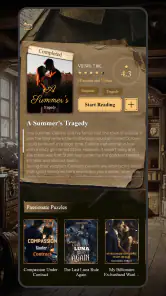
The defining capability is the way Forestory places novels at the center of the experience. The store summary presents it as a place to discover, read, and share novels, and that focus shapes how I use it. Instead of opening the app only when I have a few spare minutes for a puzzle, I can treat it as a destination for finding something to read and then deciding whether it is worth passing along to someone else.
That sounds simple, but it changes the role of the application. A standard puzzle title usually rewards concentration on a self-contained problem. Here, the content itself becomes the reason to stay. I am not only looking for a solution; I am deciding which story deserves my attention, whether I want to continue reading, and how I might introduce it to a friend. The strongest part of Forestory is this shift from solving alone to discovering fiction socially.
For me, that makes the app more appealing during slower moments: a commute, a waiting room, or the last few minutes before bed. I can approach it with a reader’s mindset instead of expecting constant action. The experience is especially suitable for people who like sampling new novels but often do not know where to begin. The sharing angle gives discovery a personal layer, because a recommendation can feel more meaningful when it comes from a story I have actually opened and explored.
There is also a useful distinction between sharing a title and sharing a generic entertainment link. When I recommend a novel through a reading-focused app, the recommendation carries context. I can think about the mood, the writing style, or the type of reader who might enjoy it. Even without turning the process into a formal review, the app encourages me to treat fiction as something to exchange rather than consume in isolation.
How I use the discovery flow
I begin by browsing with a deliberately narrow question: do I want something easy to dip into, or am I ready to spend longer with one story? This small habit prevents the app from becoming an endless scrolling exercise. When I find a promising novel, I read enough to decide whether its voice works for me, then I keep it in mind for a later session or share it with someone who might appreciate the same style.
This is one of the less obvious strengths of the concept. The app can work as a filter for my attention. Rather than downloading several separate reading tools and forgetting why I saved each title, I can use one place to discover and evaluate stories. I would not call that a replacement for every dedicated reading service, but it is a convenient starting point for readers who prefer exploration over arriving with a fixed book already chosen.
My practical tip is to avoid judging a novel only by its first few moments. A discovery app encourages quick decisions, but fiction often needs a little patience. I use the opening to check whether the tone interests me, then give the story enough room to establish its direction before deciding whether to recommend it. This makes the sharing feature more useful and avoids sending friends titles based on a shallow first impression.
Another helpful workflow is to separate private discovery from public enthusiasm. I do not share every story I open. I first ask whether I would genuinely mention it in conversation. That extra pause keeps recommendations more selective and makes the social side feel less like broadcasting and more like talking to a friend about a book I enjoyed.
A realistic everyday scenario
Imagine that I am waiting for an appointment and have no interest in starting a long game session. I open Forestory, browse through available novels, and read until I find a passage that catches my attention. Instead of losing that discovery in a crowded browser history, I can keep the title associated with the app and decide whether a friend who enjoys similar fiction should see it. Later, I return when I have more time and continue exploring from the same reading mindset.
That scenario shows where the app makes the most sense. It does not demand the kind of uninterrupted concentration required by a complex logic puzzle, yet it offers more substance than mindless scrolling. The value comes from turning a small idle period into the beginning of a reading choice. If I already know exactly which novel I want, a dedicated reading app may be quicker. If I want help finding something new, Forestory has a clearer purpose.
It can also suit a small group of friends who regularly exchange recommendations. One person can discover an interesting novel, another can try it, and the conversation can continue outside the app. I would not use it as a full replacement for a book club’s organization, but it can provide a shared starting point. The important trade-off is that the quality of the experience depends heavily on whether the available stories match my tastes and whether the people I want to share with are interested in reading them.
Where the game label helps and where it misleads
Calling Forestory a puzzle game may attract people who enjoy thoughtful, low-pressure interaction, but it may also create the wrong expectation. I would not install it expecting the constant feedback loop of a traditional puzzle title. The reading capability is the real center of gravity, and the game classification feels secondary to the literary experience.
That is not necessarily a weakness. Some players want an app that gives them a reason to slow down. However, anyone searching for timed challenges, level-based progression, or a clear stream of increasingly difficult problems should compare it with a conventional puzzle game first. Forestory is better understood as a reading-and-discovery experience presented through a game-oriented doorway.
This distinction also affects when I use it. I choose Forestory when I want curiosity and atmosphere. I choose a standard puzzle title when I want a measurable challenge that I can finish in a few minutes. Having both types of app on a phone is perfectly reasonable, but expecting one to behave like the other leads to disappointment.
Trade-offs that deserve attention
The first trade-off is focus. The app’s appeal depends on my willingness to read. If I am tired, distracted, or looking for immediate stimulation, the slower literary approach may feel less rewarding than a familiar matching or brain-training game. The same quality that makes it distinctive can make it feel restrained for players who prefer rapid interaction.
The second is recommendation quality from a personal point of view. A novel that works beautifully for one reader may be a poor fit for another. Sharing makes discovery more enjoyable, but it also raises the cost of a weak recommendation: I may send a friend something that does not suit them. My solution is to include a short explanation when I share a story, such as the mood or writing style that appealed to me, rather than presenting it as an automatic must-read.
The third trade-off concerns spending. The app is free, but it includes optional purchases ranging from less than a dollar to nearly one hundred dollars per item. That wide range means I would review any purchase screen carefully before confirming anything, especially if I were handing the phone to a younger family member. The Mature 17+ rating is another reason to treat the app as an adult-oriented reading experience rather than assuming it is suitable for every household.
I also think the version matters when troubleshooting. The current release is 2.1.5, so I would make sure the app is updated before deciding that a behavior is a permanent limitation. That is practical advice rather than a promise that every device will behave identically. The minimum operating-system requirement is Android 7.0, which keeps it accessible to many older phones, although the smoothness of reading and browsing will still depend on the device itself.
How it compares with familiar alternatives
Compared with a dedicated e-reader, Forestory feels more exploratory and social. A specialist reading app is usually the better choice when I already own a large library, need advanced reading controls, or want a highly organized long-term collection. Forestory’s advantage is the moment before that commitment: discovering a novel, trying it, and deciding whether it deserves a place in my routine.
Compared with social reading platforms, it appears more focused on the act of finding and sharing novels than on building a broad discussion network. That can be a benefit if I do not want a crowded feed. I can approach the app with a specific intention instead of being pulled into unrelated posts. On the other hand, readers looking for extensive community conversation, detailed annotations, or a large public review culture may prefer a more established social reading service.
Compared with ordinary puzzle games, Forestory wins on atmosphere and literary curiosity but loses if the main goal is a clear challenge loop. I would recommend a classic puzzle title for someone who wants to improve pattern recognition through repeated levels. I would recommend Forestory to someone who wants their phone time to lead toward stories and conversations.
Who gets the most from Forestory
The best audience is an adult reader who enjoys browsing, sampling, and recommending fiction. It is particularly suitable for someone who often asks friends what they are reading, or who wants a gentle way to turn spare time into literary discovery. The free entry point makes it easy to test the concept before deciding whether the reading-and-sharing approach fits personal habits.
It could also work for casual readers who struggle to choose their next novel. Instead of treating that uncertainty as a problem, I use it as the reason to open the app. The process is more satisfying when I accept that not every discovery needs to become a full read. Sometimes the useful result is simply learning what kind of story I do not want today.
I would be more cautious about recommending it to children because of the Mature 17+ rating. I would also steer away from it for players who specifically want competitive scores, demanding logic, or a large collection of conventional puzzle mechanics. Those users are likely to feel that the app’s literary focus gets in the way of the challenge they came for.
One further tip is to use sharing selectively and personally. Rather than sending every interesting title, I would build a small habit around matching stories to people: a thoughtful novel for the friend who likes reflective fiction, something lighter for someone who reads during short breaks, and a more unusual discovery for the person who enjoys taking chances. That approach makes the app’s central capability feel useful instead of decorative.
My final take after living with the concept
Forestory-Charm of Stories is most convincing when I stop comparing it with ordinary puzzle games and judge it as a reading discovery tool with a game identity. Its strongest idea is not speed or difficulty; it is the connection between finding a novel, spending time with it, and passing that discovery to another reader. ALO.Institute has built the experience around a niche, but that niche is clear enough to be valuable.
I would recommend trying it if you want a free way to explore novels and share recommendations, especially if your reading habits are social and informal. I would skip it if you want a traditional puzzle progression, a mature e-reader library, or a guaranteed fit for every story you open. The optional purchase range also deserves attention before spending, and the age rating should guide who uses it.
For the right person, the app turns an ordinary idle moment into a small literary search. That is a modest promise, but it is a worthwhile one. I like Forestory because it gives reading discovery a more active role than a simple list of titles, while still leaving room for personal judgment. If your favorite part of reading is finding the next story and telling someone about it, this is where the app earns its place.
Pros
- Gentle
- storybook-inspired visuals create a relaxing reading atmosphere.
- Short chapters make it easy to enjoy a story during brief breaks.
- Charming character designs add personality to each narrative.
- The calm presentation suits users looking for a low-pressure experience.
- Stories can appeal to readers who prefer cozy fantasy themes.
Cons
- Some stories may feel too simple for readers seeking complex plots.
- The app may have limited appeal outside its specific fantasy style.
- Reading progress could feel slow for users who prefer faster pacing.
- Repeated visual elements may reduce variety during longer sessions.
- Some content or features may require patience before becoming available.

- Category
- Puzzle
- Version
- 2.1.5