CodeWords Cryptogram Puzzles
- 205.00
- 4.6
- Installs
- 100.00K
- Price
- Free
Screenshots



Analysis by Reviewed
I started playing CodeWords Cryptogram Puzzles expecting a familiar word-game routine: read a coded sentence, test a few letters, and gradually turn nonsense into something readable. That is exactly the central idea, but the experience feels more deliberate than a quick anagram or crossword round. Every move asks me to balance pattern recognition with patience, and the most satisfying moments come when one correct letter suddenly makes several other guesses possible.
This is a free word game from QuriousBit Games, aimed at anyone who enjoys decoding hidden messages rather than simply filling empty squares. It is listed for Everyone, so its basic concept is easy to understand, while the puzzles can still give adults enough resistance to make a quiet break feel worthwhile. The store summary describes its purpose clearly, but after spending time with it, I found that the appeal is less about one dramatic reveal and more about the steady chain of small deductions leading toward it.
How the puzzle loop feels in actual play
The first action is simple, but the choice matters
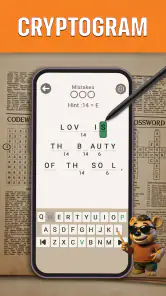
A round begins with a cryptogram: letters have been substituted so that a readable message is hidden beneath the surface. My first task is not to guess the entire sentence. I look for short words, repeated patterns, familiar endings, and places where a common letter might unlock more than one position. That opening scan is important because a careless guess can make the board look more confusing than it really is.
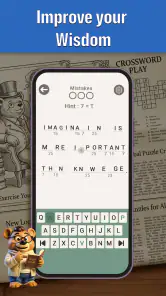
I like that the game encourages a layered approach. Instead of treating every blank as an isolated question, I can use the structure of the whole message. A repeated coded word may represent a repeated ordinary word, and a short word can provide a useful anchor for longer phrases. The result feels closer to solving a compact logic problem than to tapping through a vocabulary quiz.
For a first-time player, my practical advice is to resist filling letters just because they seem plausible. I get better results by identifying a pattern I can defend, entering it, and then checking whether the rest of the sentence becomes more coherent. If it does not, I revisit the assumption early. That habit saves time and keeps the puzzle from becoming a pile of guesses that I no longer trust.
The controls are approachable enough for casual play, but the mental work is real. This is not the kind of word game where I can rely on speed alone. Players who enjoy language patterns, quotations, and deduction will probably settle into the format quickly. Someone looking for a purely reflex-based challenge may find the opening too quiet.
Feedback arrives through the changing message
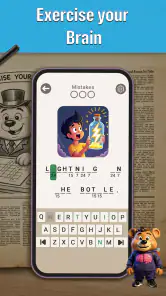
The strongest feedback is visual and logical: each correct letter makes the hidden sentence more legible, while an incorrect choice creates tension because it conflicts with the surrounding pattern. I do not need a loud reward after every move to know whether I am progressing. The message itself becomes the response, and that makes the puzzle feel more thoughtful than a simple correct-or-incorrect quiz.
My preferred rhythm is to make a small deduction, enter it, pause, and read the updated phrase as a whole. That last step is easy to skip, but it is where much of the solving happens. A newly revealed word may suggest a grammatical structure, a likely phrase, or a repeated letter relationship. In other words, the board gives feedback not only through individual entries but through the meaning that gradually emerges.
There is also a useful trade-off between momentum and certainty. Entering a likely letter can open the puzzle quickly, but waiting for stronger evidence reduces the chance of building on a mistake. I found the best approach depends on the difficulty of the message: when several patterns support the same guess, I move quickly; when the wording is ambiguous, I slow down and search for another anchor.
This feedback rhythm gives the game a different character from a standard crossword. In a crossword, crossing answers often provide direct confirmation. Here, the confirmation is distributed across a substitution pattern and the sentence’s language. That makes the payoff less immediate, but it also makes a breakthrough feel more personally earned.
Why the reward is the reveal itself
The main reward is reaching the point where the hidden message stops looking like code and starts reading naturally. I enjoy the moment when a phrase becomes obvious before every position is complete. The remaining entries then feel like a controlled finish rather than a blind search. That transition from uncertainty to recognition is the reason I usually want to solve one more puzzle.
There is a second kind of reward in learning how to read the code more efficiently. After several rounds, I became more attentive to repeated symbols and word shapes. The game does not need to teach a long rulebook for this; the puzzle format itself trains the eye. Each solved message gives me a little more confidence when approaching the next one.
That said, the reward is primarily intellectual rather than social or competitive. I would not choose this as my main game if I wanted action, elaborate progression, or constant spectacle. Its satisfaction comes from understanding a message that initially resists understanding. For me, that makes it a good companion to coffee, commuting downtime, or a short evening break when I want something active but calm.
One useful way to play is to stop immediately after a major breakthrough instead of forcing the entire puzzle in one sitting. I sometimes leave the last few stubborn letters for later, and returning with a fresh view can make the solution obvious. That is a small but effective strategy because cryptograms can become harder when I stare at the same uncertain pattern for too long.
The reset is what makes another session tempting
Once a message is solved, the mental slate is clean. The reset works because the next challenge asks me to repeat the same basic action under a different arrangement of letters and language. I am not simply replaying a memorized sequence; I am applying the same decoding skill to a new problem. That variation is what gives the loop its staying power.
The short-session nature also makes the game easy to fit around ordinary routines. I can begin with the intention of solving one message during a break, then decide whether I have enough attention for another. It does not demand the commitment of a long story campaign, and it does not punish me for treating it as an occasional puzzle rather than a daily obligation.
Still, the reset will not appeal equally to everyone. Players who need a strong narrative between rounds may feel that the experience is too focused on the puzzle itself. Likewise, anyone who dislikes revisiting a familiar format may find the core loop repetitive over time. The question is whether decoding remains enjoyable after the novelty of the first few messages fades. In my case, the changing wording keeps it engaging, but I can see why someone seeking broad gameplay variety would prefer a larger word-game collection.
The game is free to download, which makes trying the format straightforward. It includes in-app purchases ranging from $0.99 to $199.99 per item, so I would approach optional spending thoughtfully rather than assuming every player will want the same extras. The free entry is useful for testing whether cryptograms suit you, while the purchase range is a reason to review any transaction carefully before confirming it.
Small techniques that improve the experience
My first concrete technique is to mark mental “anchors” rather than chase the most visible word. A repeated two- or three-letter pattern can be more valuable than a long word with many unknowns because it may reveal the structure of several places at once. Once I find a likely anchor, I check it against every occurrence before committing.
Second, I read for grammar as much as vocabulary. A coded phrase still has the shape of a sentence, so articles, connecting words, and common endings can narrow the possibilities. This is especially helpful when the message contains a word I do not recognize immediately. I do not need to know every word in advance; I can often infer its role from what surrounds it.
Third, I use contradiction as information. If one guess makes a familiar pattern impossible elsewhere, I do not keep defending it simply because it looked promising at first. I remove that assumption and return to the strongest confirmed relationships. This reset within the puzzle is faster than trying to repair a chain of weak guesses.
A fourth habit is to read the emerging message aloud in my head. Cryptograms are language puzzles, and a sentence that sounds unnatural can expose an incorrect letter sooner than a visual inspection. This is a surprisingly practical way to separate a genuine phrase from a collection of words that merely happen to fit individual spaces.
Who will enjoy it, and who should choose something else?
I would recommend this game to people who like word puzzles but want more deduction than a basic word search. It suits players who enjoy working independently, spotting patterns, and receiving a gradual payoff instead of an instant answer. It can also work well for families because the premise is easy to explain, although younger players may need help with unfamiliar vocabulary or indirect phrasing.
It is less suitable for someone who wants a fast game with constant action, a large social component, or a strong competitive ladder. A traditional crossword may be better if you prefer clue variety and intersecting answers. A word-search game is a better choice if you want immediate visual scanning with minimal uncertainty. An anagram game may be preferable when you want short bursts of rapid vocabulary testing.
Compared with those alternatives, CodeWords has its own clear strength: the answer is not just a word but a message. That gives each solved entry a wider context and makes partial progress meaningful. Its weakness is the same feature viewed from another angle: when the sentence does not offer enough obvious anchors, progress can slow down more than it would in a crossword with several crossing clues.
I also would not choose it as a language-learning replacement. Solving a coded sentence can encourage attention to spelling and grammar, but the game’s purpose is deduction, not a structured course. It may complement language practice, especially for recognizing common sentence patterns, yet anyone seeking lessons, pronunciation work, or vocabulary tracking should use a dedicated learning app instead.
Practical details before installing
The game is currently listed as version 1.138.0 and requires iOS or Android 11 or later. That requirement is worth checking before downloading, particularly if you keep an older phone for puzzle games. On a compatible device, the low-pressure format makes it a reasonable choice for a spare-device library or a quick mental workout.
Its average rating is 4.6 from around five thousand ratings, with over two hundred written reviews and more than one hundred thousand installs. Those figures suggest that the concept has found a substantial audience, but I would still treat popularity as a starting point rather than proof that every player will enjoy the format. Cryptograms are naturally more appealing to patient word-game fans than to people who want immediate rewards.
The Everyone age classification also matches the straightforward nature of the concept. I can imagine recommending it to a parent looking for a quiet word activity, while still explaining that the challenge comes from reading patterns rather than from colorful action or a large variety of modes. The important question is attention span: the game is gentle in presentation, but solving well requires concentration.
My verdict on the complete loop
CodeWords Cryptogram Puzzles builds its experience around a clean sequence: inspect the code, make a reasoned entry, watch the sentence become clearer, enjoy the completed message, and begin again with a fresh arrangement. I appreciate that the loop does not pretend to be more complicated than it is. Its depth comes from the decisions inside each puzzle, not from unnecessary layers around them.
The best sessions are the ones where I begin with one small pattern, receive enough confirmation to expand my guess, and eventually see the whole message click into place. The weaker sessions are those where an uncertain early assumption sends me in circles. That unevenness is part of the genre, but it means the game rewards a careful method more than random tapping.
For me, the free entry point, accessible premise, and satisfying reveal make it worth trying if you already enjoy cryptograms or thoughtful word games. I would skip it if my priority were speed, competition, or a constantly changing set of mechanics. Otherwise, QuriousBit Games has created a focused puzzle experience that gives each new session a clear reason to begin: there is another hidden message waiting, and the next solution may be just one well-tested letter away.
My recommendation: install it when you want a calm but genuinely engaging word challenge, and approach each puzzle as a chain of evidence rather than a guessing contest. That mindset brings out the game’s strongest quality—the feeling that the message was uncovered by your reasoning, not simply handed to you by the interface.
Pros
- Large collection of cryptogram puzzles for regular play.
- Hints help players progress without revealing the entire answer.
- Simple interface makes the game easy to learn.
- Useful for improving vocabulary and pattern-recognition skills.
- Playable at your own pace without requiring quick reflexes.
Cons
- Some puzzles may feel repetitive after extended play.
- Difficulty can vary noticeably between individual puzzles.
- Frequent hint use may reduce the challenge for experienced players.
- Small text or symbols may be uncomfortable on smaller screens.
- Progress can feel slow when a puzzle contains unfamiliar quotes.
- Category
- Word
- Version
- 1.138.0