Black Spades - Jokers & Prizes
- 1.16K
- 3.5
- Installs
- 100.00K
- Price
- Free

Screenshots




Analysis by Reviewed
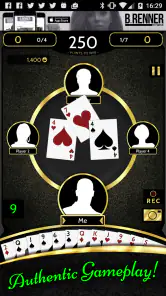
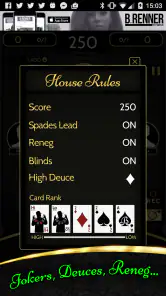
I picked up Black Spades - Jokers & Prizes expecting a familiar trick-taking card game, but its first hand quickly showed me that it is aiming for a more dramatic table. The standard goal of reading the suit and managing tricks is still here, yet the extra card rules make each decision feel less automatic. A Joker or a Wild Deuce can change the value of a hand, while Blinds and Reneges create more ways for a comfortable lead to become a problem.
That combination makes this a card game for players who enjoy making plans with incomplete information. I am not simply counting spades and hoping my bid survives. I am watching what has already been played, estimating what my partner may hold, and deciding whether a powerful card should be used now or protected for a later trick. The result is a more unpredictable version of spades than the usual casual alternatives.
How a hand starts and why the first decision matters
The game comes from Konsole Kingz, LLC and is presented as a free card game for mobile devices. It is aimed at a Teen audience, which fits the more competitive tone and prize-focused presentation. The current version is 3.16.2, and the listed minimum operating-system requirement is 11, so I would check that point before trying to install it on an older phone or tablet.
My first useful habit was to slow down before playing the opening card. In ordinary spades, a strong hand can sometimes be handled by following a familiar pattern: count likely tricks, make a bid, and preserve control. Here, the special cards make that shortcut unreliable. A hand that looks weak in regular play may gain leverage from a Joker, while a promising hand can become awkward if its key card is spent too early.
The opening action is therefore less about showing strength and more about defining the shape of the hand. I try to identify which suits I can safely shed, which cards might force an opponent to spend something valuable, and whether my strongest option is actually useful at the present moment. This is one of the game’s better lessons: the most powerful card in your hand is not always the best card to play first.
Blinds also encourage a different kind of preparation. They make the start of a hand feel less comfortable because the normal information available from the cards is not the whole story. I found myself thinking about risk before the first trick rather than reacting only after the table had revealed its intentions. Players who like a slow, completely predictable opening may find that irritating, but players who enjoy uncertainty will probably appreciate the tension.
Reading the table instead of chasing every trick
The most important adjustment for newcomers is learning not to treat every winning card as a reward. Sometimes taking a trick is useful because it protects a bid. Sometimes it forces you to lead next, which can expose a weak suit. A winning play can create a new problem immediately after the applause of the result has faded.
I also recommend tracking the special cards mentally, even when the action becomes busy. You do not need perfect memory to benefit. Simply remembering whether a Joker or Wild Deuce has appeared can change how boldly you lead a suit later. This small discipline gives the game more depth than a quick tap-through experience and is one of the concrete reasons it feels different from a basic spades app.
Reneges add another layer to that attention. A player who fails to follow suit can alter the balance of the hand, whether through error or deliberate risk. That means I pay closer attention to what each opponent is able to play, not just to the card that wins the current trick. If you prefer a relaxed game where rules fade into the background, this level of observation may feel demanding. For me, it is part of the appeal.
The feedback rhythm: play, reveal, adjust
The satisfying part of a round comes from the quick feedback between an action and its consequence. I choose a card, see how the table responds, and immediately revise my plan. A successful trick gives me information as well as progress; a failed play tells me which assumption was wrong. That rhythm keeps the game moving even when the score is not going my way.
Special cards make the feedback more dramatic. A Joker can turn a carefully prepared trick into a sudden contest, while Wild Deuces make it harder to assume that a suit will behave exactly as expected. I like that these cards do not merely decorate the rules. They change the timing of decisions, especially when several players are holding back their strongest options.
The game is at its best when I am balancing immediate control against future flexibility. Spending a premium card to secure one trick may protect the current hand, but it can also leave me without an answer when the table changes direction. Conversely, holding everything back can mean watching a manageable position disappear. That tension gives each trick a purpose beyond filling a progress bar.
There is also a useful emotional rhythm to the feedback. A good play feels rewarding because it usually reflects a judgment call, not just a high card. When the result goes against me, I can often identify the mistake: I misread a suit, assumed a special card was gone, or valued a possible trick more than the position it created. That makes losses easier to learn from than losses in a purely luck-driven card game.
What to do when the table turns against you
My practical advice is to treat a bad opening as a damage-control problem. Do not automatically spend every strong card to recover one lost trick. First decide whether the hand can still support the original plan. If it cannot, preserve the cards that may limit further losses and avoid making a desperate play simply because it looks impressive.
This is especially helpful when prizes are part of the motivation. A reward-focused player may be tempted to chase a dramatic comeback every time. I found that a calmer approach works better: protect the next realistic objective, learn which card changed the hand, and use the remaining tricks to improve the final result. The game becomes less frustrating when I stop treating every round as something that must be rescued at any cost.
Another useful workflow is to use early tricks as information-gathering opportunities. If the hand allows a low-risk lead, I use it to discover how opponents respond before committing a Joker or Wild Deuce. This will not guarantee a win, but it can reduce guesswork. It is a small tactical habit that a generic store description would never explain, and it makes the special-card system feel more manageable.
Rewards, competition, and the cost of chasing another hand
Prizes give the game a clear reason to continue after a close hand. Winning is not only about satisfying the rules of the trick-taking round; it also creates a sense of progress that encourages another attempt. I understand why that structure works. A narrow loss can feel like unfinished business, while a clever win makes me want to test the same approach against a different hand.
At the same time, the reward layer is where I would encourage a little restraint. The game is free to play, but it includes optional purchases priced from $0.99 to $24.99 per item. I would approach those purchases as optional spending rather than part of the basic requirement for enjoying the card mechanics. Anyone who is easily drawn into buying something after a losing streak should decide on a limit before playing.
The reward system works best for me when I keep the focus on decision quality. If I win because I managed the special cards well, the result feels earned. If I start measuring every session only by what I gained, the unpredictable nature of the hands becomes more stressful. This is not a criticism of the core game so much as a reminder that prize-driven play can change how a person experiences an otherwise thoughtful card challenge.
Players should also know what kind of competition they are choosing. This is not the right pick if you want a stripped-down spades table with only familiar rules and minimal surprises. A traditional alternative may be better for learning basic bidding or playing a quiet hand with friends. Black Spades is more suitable when you already understand the foundations of spades and want additional uncertainty, special cards, and a stronger push toward replaying.
Who will enjoy it most
I would recommend it to someone who likes card games that reward memory and timing but does not mind a changing rule environment. It suits the player who enjoys asking, “What is still possible from this hand?” rather than relying on a fixed sequence of moves. It can also work well for short breaks, because a single round gives enough immediate action to feel complete while leaving room for a rematch.
A realistic everyday scenario would be a commute or a waiting-room break. I might start a hand with only a few minutes available, make an opening plan, and then decide whether to continue once the reward and result appear. The game’s strongest hook in that setting is the reset: each new deal offers a fresh puzzle, so a disappointing hand does not permanently define the session.
I would skip it if I wanted a purely social card table, a calm solitaire experience, or a game where luck is kept as far away as possible. The Jokers, Wild Deuces, Blinds, and Reneges make outcomes less predictable than standard spades. That uncertainty is interesting when I am ready to adapt, but it can feel unfair if I expect every result to follow conventional card logic.
Resetting the session without repeating the same mistakes
The end of a hand is more important than it first appears. Once the result is shown and the reward has been collected, the game invites me to begin again with a clean set of possibilities. That reset is what keeps the loop alive: action creates a result, the result offers a reward or a lesson, and the next deal gives me a chance to apply what I learned.
I get more from the reset when I review one decision before moving on. I ask myself whether I lost because of the original bid, the timing of a special card, or a failure to notice a possible renege. Limiting the review to one or two moments keeps it practical. If I try to reconstruct every card in detail after every round, the game starts to feel like homework rather than entertainment.
For longer sessions, I would also vary the objective. One hand can focus on protecting a bid, another on learning when to lead a vulnerable suit, and another on observing how the special cards affect late tricks. This prevents the reward from becoming the only reason to continue. It also turns repeated rounds into genuine practice instead of identical attempts at the same outcome.
The reset is less appealing when a player feels pressured to recover immediately from a loss. In that situation, I would stop after a hand or two rather than chasing the next result. Because the game includes in-app purchases and a prize-oriented loop, knowing when to close it is part of using it well. The most enjoyable sessions are the ones I end because I am satisfied, not because I am trying to erase frustration.
How it compares with ordinary spades apps
Compared with a standard spades game, this version puts more weight on surprise and tactical adaptation. Conventional apps are often easier to recommend to beginners because their rules are more familiar and their card values are simpler to read. They are also better when the goal is practicing traditional bidding without extra variables.
Here, the appeal is the altered balance. Jokers and Wild Deuces can make a familiar hand behave differently, while Blinds and Reneges demand more attention to the table. The result is not necessarily a better version of spades for everyone; it is a more eventful version for players who want their plans challenged. I would choose the usual alternative for a relaxed learning session and this one when I want a sharper, less predictable contest.
The rating sits at around a 3.5 average from roughly 2.2 thousand ratings, with about 1.2 thousand written reviews, so the reception appears mixed rather than universally enthusiastic. That matches my impression: the unusual rules are the main attraction, but they can also be the main source of friction. The game has passed 100 thousand installs, which suggests it has found an audience, yet its appeal depends heavily on whether a player enjoys this particular style of spades.
My verdict on the complete play loop
Black Spades - Jokers & Prizes succeeds when its loop is viewed as a chain of decisions rather than a simple win-and-repeat cycle. The first action asks me to interpret an unfamiliar hand. The feedback shows whether my reading was sound. The reward gives the result some extra weight, and the reset offers a new puzzle before the previous one has completely cooled down.
Its best quality is the way special cards create meaningful timing questions. I am rarely thinking only about whether I can win the current trick. I am thinking about what that win will force me to do next, whether a better card may be needed later, and how much information the table has already revealed. That is a stronger experience than a basic card app when I want active decision-making.
Its limitations are equally clear. The extra rules raise the learning curve, the unpredictability will not suit purists, and the optional purchase structure means prize-focused players should manage their spending carefully. The minimum OS requirement of 11 also matters for anyone using an older device. These are not reasons to dismiss it, but they are good reasons to know what kind of experience you are choosing.
For me, this is a worthwhile free card game for experienced spades players who want Jokers, Wild Deuces, Blinds, Reneges, and prizes to disturb the usual rhythm. I would not use it as my first introduction to trick-taking games, and I would not recommend it to someone seeking a quiet, predictable alternative. But if you enjoy making a plan, watching it change, and starting another hand because one decision still bothers you, this version has a convincing reason to keep dealing.
Pros
- Simple rules make it easy for new players to start quickly.
- Jokers add variety and create more tactical decision-making.
- Prize-focused gameplay gives matches an extra sense of purpose.
- Short rounds suit quick sessions on phones and tablets.
- Card visuals and controls are generally easy to understand.
Cons
- Progress may feel repetitive after playing the same modes for a while.
- Prize mechanics can make the experience feel more luck-dependent.
- Some features may require an internet connection to function properly.
- Players seeking traditional Spades may dislike the added Joker rules.
- Competitive elements can encourage longer play sessions than intended.

- Category
- Card
- Version
- 3.16.2