Tap Away
- 26.92K
- 4.3
- Installs
- 50.00M
- Price
- Free
Screenshots
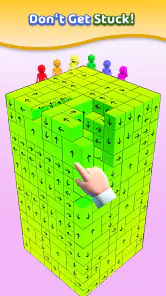
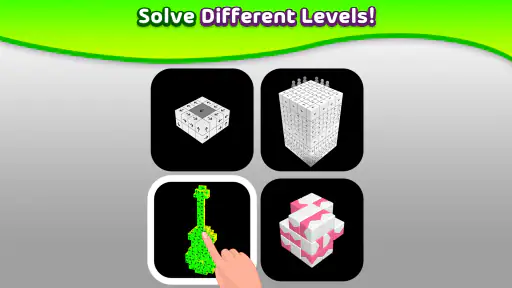
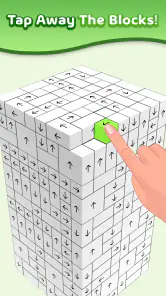
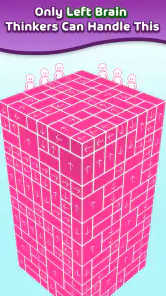
Analysis by Reviewed
I reach for Tap Away when I want a puzzle that asks for attention without demanding a long stretch of uninterrupted time. It suits the small gaps in a day: a few minutes before an appointment, a quiet break between tasks, or a commute where I can safely look at my phone. The appeal is immediate, but the better question is whether its simple tapping stays satisfying once the puzzles ask for more thought.
How the block puzzles feel in practice
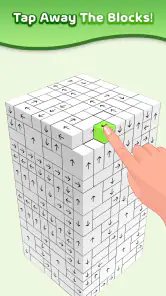
Each board is a three-dimensional arrangement of blocks, and a tap removes a block only when its direction is clear. That turns a seemingly obvious move into a small planning problem: I need to read the shape, spot which pieces are exposed, and think about what will become accessible next. Clearing whatever looks easiest can leave an awkward cluster behind, so I get more out of the game when I pause to inspect the whole formation before tapping.
A useful habit is to rotate the structure and check its sides before committing to a run of moves. A block that looks trapped from one angle may have a clear path from another, and a quick scan can prevent unnecessary taps. This makes the game feel less like random clicking and more like a compact spatial-reasoning exercise. I also treat a level as a short session rather than something to rush through; that keeps the puzzle relaxing instead of turning every mistake into frustration.
Who will enjoy it, and who may not
This is a good fit for players who like visual puzzles, gradual problem-solving, and controls they can understand at a glance. It can also work well as a low-commitment choice for someone who wants to pick up a game, solve a board, and put the phone away. If you prefer word puzzles, story-driven adventures, or games built around action and fast reactions, this may feel too focused on one repeated idea. Players who dislike revisiting a board mentally after a poor move may also find the trial-and-error rhythm less appealing.
Compared with many familiar puzzle games, Tap Away is more about spatial inspection than matching colors, fitting pieces into a grid, or answering clues. That narrow focus is both its strength and its limitation: it gives each level a clear purpose, but it does not offer much variety in the basic kind of thinking it asks from you. I would choose a word or logic game instead when I want changing rules or a different mental challenge from one round to the next.
The Concept of Tap Away
At its core, Tap Away is a simple yet engaging puzzle game that challenges players to clear a board filled with colorful blocks. The objective is straightforward: tap the blocks in the correct sequence to remove them from the board. But don't be fooled by its simplicity. As you progress, the game's difficulty ramps up, introducing different block shapes and layouts that require strategic thinking and planning.
Engaging Gameplay Mechanics
What I love most about Tap Away is its intuitive gameplay. The controls are as simple as tapping on your screen, making it accessible to players of all ages. The game starts with a brief tutorial that guides you through the basics, ensuring you’re equipped with the knowledge to tackle the more challenging levels.
More From Our News Desk

Clash of Clans Is Won Between the Battles

Android Auto Makes the Case for Quieter Car Software

MobiOffice: Transforming Mobile Productivity with Seamless Integration

EA SPORTS FC™ Mobile Soccer: Redefining Mobile Sports Gaming

How Microsoft OneDrive Became a Mobile Productivity Giant

How Google Translate Breaks Language Barriers Effortlessly
Each level presents a unique puzzle that requires careful deliberation. You’ll find yourself tapping away, trying to figure out the best sequence to clear the board while the clock ticks away, adding a layer of excitement and urgency.
Visuals and Soundtrack
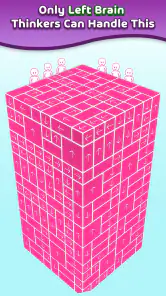
The developers have done a fantastic job with the game's aesthetics. The blocks are vibrantly colored, and the transitions are smooth, providing a visually pleasing experience. The accompanying soundtrack is a mellow tune that complements the gameplay perfectly, keeping you relaxed and focused as you play.
Replayability Factor
One of the standout features of Tap Away is its replayability. With numerous levels to conquer, each offering a fresh challenge, you’ll find yourself coming back to the game time and again. Plus, the game’s developers regularly update it with new levels and features, ensuring that boredom is never an option.
Additionally, there’s a leaderboard feature where you can compete with friends or other players globally. This adds a competitive edge to the game, pushing you to improve your skills and climb the ranks.
Tap Away is not just a game; it’s a fun and engaging way to give your brain a workout. Whether you’re a casual gamer or a puzzle enthusiast, it offers something for everyone. So, next time you find yourself with a few minutes to spare, why not give Tap Away a try? You might just find yourself hooked!
What the current release means
Popcore Games developed this free puzzle game, which first appeared on May 18, 2021. Its current version is 151.2.6, a sign that the game has continued through many numbered releases since launch; that alone does not tell me exactly which mechanics changed, so I would not treat a version number as proof that the core experience has been redesigned. The game is rated Everyone, works on Android 6.0 and up, and has optional in-app purchases priced from $0.99 to $99.99 per item. I’d keep that range in mind if you prefer games with no purchase prompts or spending choices.
How to fit it into an ordinary day
For a practical routine, I’d open it while waiting for a drink or sitting through a short pause, solve one board, then stop before the session expands into idle scrolling. If a layout stalls me, I rotate it, identify which blocks have an unobstructed direction, and work outward rather than tapping at random. That small workflow makes the puzzle more deliberate and helps keep a brief break brief. It is less suitable when I have only one hand free, need to keep my attention on the surroundings, or want a game that can be played without looking closely at the screen.
One trade-off is the difference between a satisfying puzzle and a predictable routine: the familiar block-clearing goal makes it easy to learn, but players who want a steady stream of new mechanics may eventually want a broader puzzle collection. The game’s 4.3 average rating across 1.1 million ratings, alongside 27,000 reviews and over 50 million installs, suggests it has reached a large audience, though popularity does not guarantee that its focused format will suit every player. I’d treat it as a compact, specific puzzle choice rather than an all-purpose game.
Choosing the right kind of puzzle break
In a typical puzzle-game rotation, this is the option I’d pick when I want to inspect a shape rather than chase a score, match a run of pieces, or solve a clue. Those alternatives can offer more variety from one round to the next, but they often ask me to learn different rules or react to a changing board. Here, the central question stays legible: which block can move, and what will that expose? That clarity is a real advantage when I’m tired and do not want to relearn a system, although it also means the game is a poor substitute for a collection of distinct puzzle types.
A realistic use case is a short wait in a quiet place, such as sitting for an appointment with enough time to focus on the screen. I can examine a formation, rotate it, and make a few considered moves without needing to remember a plot or coordinate a long session. I would not use it while walking, crossing a street, or doing anything that needs my eyes; the spatial puzzle rewards looking closely, so it is not a safe background activity. It is also not my pick for a noisy social moment when I want to glance up frequently and keep a conversation moving.
Small decisions that make boards easier to read
When a board seems stuck, I find it more useful to change my viewpoint than to repeat the same taps. I scan the outer edges first, then look for blocks whose direction is unobstructed, and only then consider how a removal changes the routes for nearby pieces. Thinking in terms of access, rather than simply choosing the most visible block, helps me avoid turning a clear puzzle into a sequence of guesses. This is especially helpful when several pieces appear available at once: I can choose the move that opens the most useful part of the shape instead of clearing a convenient corner just because it is easy to see.
I also try to separate a deliberate mistake from a bad habit. If I make a move that leaves the structure harder to understand, I pause and rotate again rather than tapping faster in the hope that the board will resolve itself. That pause is part of the puzzle, not wasted time. It suits players who enjoy quietly testing a spatial idea, but anyone who expects every tap to produce immediate progress may find that careful inspection slows the game down more than they like.
What to expect from the purchase model
The game is free to download, with optional in-app purchases ranging from $0.99 to $99.99 per item. I’d approach that as a reason to make a simple choice before handing the phone to a child or letting someone else play: decide whether purchases should be restricted through the device’s settings. The Everyone age rating makes the game broadly suitable, but it does not mean every household will want spending enabled. If you only want to try the core block puzzle, you can start without treating a purchase as part of the basic decision to install it.
For players who keep a close eye on spending, the broad range is worth noticing before they settle into a long-term routine. I would not assume that buying something is necessary to enjoy a short session, and I would not spend just because a board takes longer than expected. The better test is whether the puzzle itself is holding my attention. If it is not, a different free puzzle with rules I enjoy more is a more sensible choice than paying in the hope that the basic loop will change.
Returning players and the limits of version numbers
The release history gives existing players a reason to check what is current, but a large version number is not a changelog. The known version, 151.2.6, indicates that the game has passed through many numbered builds; it does not establish which additions or adjustments are present now. I would therefore judge the current experience by the puzzles I actually encounter, not by assuming that every update has expanded the mechanics or addressed a particular frustration. That distinction matters if you left the game earlier and are wondering whether it has become a different kind of puzzle.
For someone already playing, the useful question is whether the newer boards still make them inspect space in fresh ways. More levels can extend the time the game remains useful, but quantity alone does not guarantee variety. I would watch for changes that make a formation feel meaningfully different to solve, while keeping the straightforward tap-and-inspect rhythm intact. If the challenge starts to feel repetitive, that may be a sign that the format has reached its personal limit rather than a reason to keep waiting for an update to transform it.
Where its focused design can fall short
The same consistency that makes the game easy to return to can also make longer sessions feel samey. Players looking for narrative stakes, a changing set of mechanics, or the satisfaction of building a strategy across many rounds should look elsewhere. This is a focused spatial puzzle, not a broad puzzle suite, and I would rather be clear about that than present its simplicity as universal appeal. The boards can still ask for thought, but the main activity remains centered on reading blocks and clearing them in a workable order.
There is also a difference between accessible controls and effortless play. Tapping is simple, but solving a crowded arrangement requires visual attention and patience. If you have only a moment to spare, you may prefer a puzzle that can be understood with a quick glance; if you want a game to play while listening closely to someone or watching what is happening around you, this one competes for your attention. Its strongest setting is a calm pause where you can give a board your eyes for a little while.
A measured recommendation
Popcore Games’ puzzle has a clear audience: people who enjoy spatial reasoning, like working through a visible problem, and want a free game that can fit into short breaks. Its 4.3 average across around 1.1 million ratings and over 50 million installs show that many players have tried it, but I would use that reach only as context, not as a promise that it will suit my tastes or yours. The more helpful question is whether the central task—studying a block arrangement and finding a sensible order—sounds satisfying enough to repeat.
I recommend giving it a try if that kind of focused, visual challenge appeals to you and you are comfortable with optional purchases being part of the app’s environment. I would skip it if I wanted action, story, wordplay, or a broader range of puzzle rules, and I would choose a different activity whenever I could not safely keep my attention on the screen. For me, the game works best as a small, intentional break: familiar enough to start quickly, thoughtful enough to hold my attention, and narrow enough that I know when I want something else.
Tap Away Frequently Asked Questions
Can I play Tap Away offline?
Tap Away is built around individual block-clearing puzzles, so its central challenge is suited to short solo sessions. If you are considering playing while travelling or away from a connection, check how the game behaves on your device before relying on it; online-dependent features, ads, or purchases may work differently without internet access.
Does Tap Away offer a relaxing experience or a challenging one?
Tap Away has an approachable premise: tap blocks to clear them. The puzzle element means it is not only a matter of tapping quickly; you need to consider the arrangement and plan which pieces to remove. That makes it easy to start while still giving players a reason to pause and think as they work through the challenges.
Is Tap Away suitable for children and casual players?
Tap Away is a puzzle game with an Everyone age rating, making it suitable for a broad audience. Its simple premise—tapping blocks to clear them—can be easy to pick up, while solving each arrangement calls for thought and planning. It can be a good fit for casual play, though younger players should have an adult’s guidance around optional in-app purchases.
What is Tap Away and how does it work?
Tap Away is a puzzle game designed to challenge your spatial awareness and problem-solving skills. Players are tasked with tapping blocks to remove them and clear the levels. The objective is to strategically plan your moves to ensure all blocks are removed. The game offers hundreds of levels with increasing difficulty, making it both engaging and addictive for players of all ages.
Is Tap Away free to play, or does it require any in-game purchases?
Tap Away is free to download and play, offering a wide range of levels and features without any initial cost. However, the game does include in-app purchases that can enhance your gaming experience. These purchases are optional and range from $0.99 to $99.99 per item, allowing users to enjoy the game according to their preferences.
Pros
- Intuitive controls make gameplay easy to learn.
- Visually appealing with vibrant graphics.
- Offers a variety of challenging levels.
- No intrusive ads during gameplay.
- Suitable for all age groups.
Cons
- Limited customization options for players.
- Requires internet for certain features.
- Can become repetitive over time.
- Occasional in-app purchase prompts.
- Some levels may seem overly difficult.
- Category
- Puzzle
- Version
- 151.2.6