Growing Fire
- 37.00
- 3.7
- Installs
- 50.00K
- Price
- Free

Screenshots
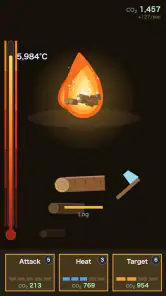
Analysis by Reviewed
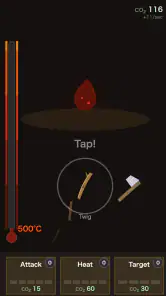
I approached Growing Fire expecting a quick arcade distraction, and that is where it makes the most sense: a small, focused game built around tapping and watching a fire grow. The central idea is easy to grasp, but its appeal depends on whether you enjoy repeating a simple action for the pleasure of seeing its scale expand. I found it best as a brief break rather than a game to settle into for a long session.
A simple arcade loop with an unusual sense of scale
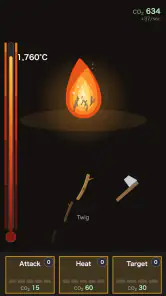
The premise starts with chopping and feeding a fire, then pushes the image far beyond an ordinary campfire. That progression from something modest toward something enormous gives the game its identity. It is less about mastering a complicated ruleset and more about enjoying the contrast between a tiny beginning and an increasingly outsized result.
What the current version offers
At its core, the interaction is deliberately uncomplicated: tap to chop, then keep the fire going. That makes Growing Fire easy to pick up without a tutorial-heavy commitment. I can imagine opening it while waiting for a drink, sitting through a short commute, or taking a quick pause between tasks. The low barrier to entry is a strength, especially for players who do not want to memorize controls or follow a long story before the fun begins.
The trade-off is that a simple input can become repetitive. If you need varied controls, tactical decisions, or a steady stream of distinct challenges, the basic loop may wear thin. The spectacle of growth can hold attention for a while, but it cannot replace mechanical variety for every player. I would treat it as a compact arcade diversion, not as a deep action game.
KAYAC Inc. is the developer, and the game is listed as free. Its current version is 005, which gives existing players a clear point of reference when discussing what they have installed. The release date is Sep 10, 2026; those details establish the game’s current timeline, but they do not by themselves show what changed between releases. I would avoid assuming that a particular mechanic or improvement arrived in a specific update unless the game itself makes that clear.
How its scale shapes the experience
The most interesting design choice is the jump in scale. A fire that grows from a small, familiar object toward something as vast as a galaxy is a playful exaggeration, and that shift is more memorable than the act of tapping by itself. It gives the repeated action a visual goal: you are not just chopping endlessly, you are helping an increasingly absurd spectacle take shape.
That scale also creates a useful way to pace a session. Rather than expecting a complete, story-like arc in one sitting, I would play in short bursts and treat each return as another chance to see how far the fire has developed. This is a practical approach for an arcade game whose appeal comes from gradual growth. It reduces the pressure to grind through a long stretch at once and makes it easier to stop when the repeated taps stop feeling satisfying.
Who is likely to enjoy it
I would recommend it to casual players who like tactile, immediately understandable arcade games and find satisfaction in visible escalation. It also suits someone who wants a game that can be started quickly without requiring concentration on a complex plot or a crowded interface. The age classification is Teen, so it is sensible for families to check that rating against the player they have in mind rather than relying only on the cartoonishly broad idea of a growing fire.
The game has an average rating of 3.7 from around 230 ratings, with about 40 written reviews. I see that as a modest, mixed signal rather than a verdict. It suggests there is interest, but a prospective player should still consider whether a repetitive tap-based loop is personally appealing. More than 50,000 installs indicate that people have tried it, though popularity alone cannot tell you whether its particular rhythm will suit you.
Where it sits beside other arcade choices
Compared with reflex-based arcade games, where success often depends on timing, dodging, or reacting to hazards, this one sounds more focused on steady interaction and growth. That difference is important. If you enjoy a tense score chase or a game that constantly changes the demands placed on your hands, a conventional action arcade title is likely a better fit. If you prefer a calmer loop with an exaggerated visual payoff, Growing Fire is closer to the kind of game you can dip into without preparing for a challenge.
It also differs from puzzle games, which reward planning and finding a solution, and from story-driven games, where the next scene or character interaction can carry a session. Here, the draw is the physical simplicity of tapping and the promise of a bigger spectacle. I would not choose it when I want to make strategic choices or feel that every move has a distinct consequence. I would choose it when I want the opposite: one clear action and a playful result to watch accumulate.
Practical ways to get more from short sessions
One useful habit is to decide in advance how long you want to play. Since the central action is repetitive, a small time limit can keep the experience enjoyable instead of turning it into a chore. I would also pay attention to whether the growing fire itself still feels rewarding. If I am tapping mechanically while no longer caring about the visual progression, that is a good moment to close the game and return later rather than forcing a longer session.
Another reasonable use is as a transition between activities. A few minutes with a straightforward arcade loop can be more fitting than starting a game that demands a continuous block of attention. That said, I would not use it as a substitute for a game that offers meaningful progress through skill or decisions. Its strongest use case is a casual pause, not a commitment to a long-term competitive routine.
For someone deciding whether to install it, I would ask one simple question: do you enjoy repeating a small action when the payoff is visual growth? If the answer is yes, the concept has a clear chance of working for you. If you need frequent new mechanics to stay engaged, the same simplicity that makes it accessible may be the reason you move on quickly.
What is established, and what remains to be seen
Reading the version and release context
The current version, 005, is a concrete marker of the build available now, while the Sep 10, 2026 release date indicates when the game entered its current public timeline. Those facts are useful for identifying the product, but they are not a changelog. I cannot responsibly claim that this version added a particular feature, fixed a problem, or reworked progression without evidence of that change. For players already familiar with it, the sensible approach is to compare the version they have with the one shown on their device and judge the actual experience rather than infer an update history.
That distinction matters because a version number can look like proof of a long sequence of improvements when it is only a label. If you are new, version 005 is simply the current reference point. If you are returning, pay attention to what you can directly observe in play: whether the tapping feels responsive, whether the growth remains enjoyable, and whether the game gives you a reason to keep coming back. Those are more useful measures than guessing at invisible changes.
How existing players should approach it
For a returning player, the best test is not whether the game has become a different genre, but whether its central loop still fits the kind of break you want. The premise remains centered on feeding an ever-growing fire, so anyone who liked that clear focus has a reason to revisit it. On the other hand, if you left because the repetition became tiring, a version label alone is not a reason to expect a completely new experience.
I would recommend keeping expectations proportional. Approach a return as a chance to enjoy the same broad arcade idea, not as a guaranteed overhaul. If the current build feels fresher to you, that is a welcome personal discovery; it should not be confused with a confirmed product change. This is especially helpful for players who have been away and are deciding whether to reinstall it for a short, low-pressure session.
Gaps that affect the buying decision
The main limitation I can judge from the game’s defining loop is its reliance on repetition. A player who needs precise skill tests, complex upgrades, or a sequence of different objectives may not find enough variation in a game organized around tapping, chopping, and feeding a fire. That does not make the design unsuccessful; it means the experience has a narrower audience than a more varied arcade package.
There is also a difference between a striking premise and sustained depth. Growing toward a huge scale is an appealing hook, but the hook is only as satisfying as the moment-to-moment interaction around it. I would therefore avoid downloading it expecting a lengthy campaign or a high-stakes challenge. It is a better match for someone who enjoys the uncomplicated rhythm itself and does not need every session to introduce a new system.
Because the game is free, trying it is a low-commitment way to see whether that rhythm works for you. Free does not automatically mean frictionless or universally suitable, though, so I would still make the decision based on your taste in arcade games and the Teen age rating. If you are choosing something for a younger player, check the rating and the game’s presentation yourself before handing it over.
What I would watch as it evolves
Going forward, I would watch for clearly communicated changes that add meaningful variety without diluting the simple central idea. New reasons to make each tapping session feel distinct would address the most obvious weakness for players who tire of repetition. At the same time, adding complexity just for its own sake could undermine the easy, pick-up-and-play quality that makes the game approachable. That balance is the important thing to look for, not a larger feature list by itself.
I would also watch whether the game gives returning players a fresh reason to come back, while remaining easy for first-time players to understand. The best possible direction would preserve the immediate action and make longer-term play feel less mechanical. Those are expectations, not claims about what the current build already does, and I would wait for an observable change before treating them as features.
My recommendation
Overall, Growing Fire is a specific kind of arcade game: straightforward, visual, and built around the pleasure of helping a small fire become something wildly oversized. I would recommend it to a friend who enjoys simple tapping games and wants a brief distraction with a clear central image. I would steer a friend who wants strategy, constantly changing challenges, or substantial story toward a different game.
Its best quality is that you can understand the basic appeal immediately; its biggest risk is that the same repeated action may stop being engaging once the novelty fades. Go in expecting a casual arcade loop rather than a deep progression experience, and the decision becomes easier. If watching the scale grow sounds satisfying to you, it is worth a try; if you need every minute to test a new skill, you will probably be happier elsewhere.
Growing Fire Frequently Asked Questions
What is Growing Fire?
Growing Fire is a mobile game whose name suggests a focus on fire-themed growth or progression, but the title alone does not reliably identify its developer, genre, or gameplay. Check the store listing, screenshots, description, and publisher before downloading so you can confirm you have found the intended game. These details also help set expectations about its controls, objectives, and suitability for your device.
Is Growing Fire free to download, and does it include in-app purchases?
The price and payment options for Growing Fire can vary by platform, region, and version. Before installing, review the Google Play or App Store listing for the download price and any disclosed in-app purchases, subscriptions, or advertisements. If the game offers optional purchases, check whether they affect progression or provide cosmetic extras, and use your device’s purchase controls to prevent accidental spending.
Can I play Growing Fire offline?
Whether Growing Fire works without an internet connection depends on how the game is designed and on the version available in your region. Look for an offline-play note in the store description, and check recent player feedback for reports about connection requirements. Some games allow offline play for core stages but still require internet access for account sign-in, updates, rewards, or multiplayer features.
Which devices are compatible with Growing Fire?
Compatibility depends on the specific Android or iOS release, your operating system version, and your device’s available storage and hardware. Check the official store page for the minimum requirements before downloading, especially if your phone or tablet is older. Keeping your operating system updated can help, but it does not guarantee compatibility, and performance may differ between devices even when they meet the listed requirements.
Is Growing Fire safe to download, and what permissions or data should I check?
For a safer download, install Growing Fire only through its official Google Play or App Store listing, and confirm that the publisher matches the source you intended to use. Review the store’s privacy information and the requested permissions before installing; permissions should make sense for the features offered. Avoid unofficial APK files, and remember that privacy labels and data practices can change with updates, so check them again when needed.
Pros
- Quick
- straightforward battles make it easy to play in short sessions.
- Progression offers a clear sense of growth as your character becomes stronger.
- Combat rewards choosing upgrades that suit your preferred play style.
- Its simple controls are approachable for players new to the genre.
- A lightweight presentation keeps the focus on action and advancement.
Cons
- Repeated battles can start to feel similar over time.
- Progress may slow down
- encouraging frequent grinding.
- Some upgrades may feel less useful than others.
- The straightforward gameplay may not offer much depth for experienced players.
- It may take time to reach later content without consistent play.

- Category
- Arcade
- Version
- 005