Doodle God™
- 1.93K
- 4.6
- Installs
- 500.00K
- Price
- $1.49

Screenshots

Analysis by Reviewed
Some puzzle games ask me to solve a neat sequence of challenges; Doodle God™ asks me to wonder what might happen if I combine two things that do not obviously belong together. That difference is the heart of its appeal. It turns a small collection of starting elements into a growing set of possibilities, and the fun comes less from speed than from noticing connections. I’d reach for it when I want a quiet, curious diversion rather than a race against a clock.
Who will enjoy this kind of puzzle?
I’d recommend this puzzle game to anyone who enjoys testing ideas without needing quick reflexes or a complicated rulebook. It suits short breaks especially well: I can try a few combinations, put it aside, then return when I feel like puzzling over another possibility. If you prefer a clear sequence of levels, a brisk action game, or puzzles with one carefully signposted solution, this open-ended mixing premise may feel too loose.
A useful way to play is to treat each discovery as a clue rather than randomly testing everything. When a new item appears, I pause to think about what it represents and which existing elements might plausibly connect to it. That small habit makes experimentation feel more deliberate and can cut down on aimless tapping. I also find it helpful to revisit combinations that seemed unlikely earlier; a later discovery can change how I interpret an old ingredient.
Making progress without turning it into guesswork
When I get stuck, I don’t immediately tap through every possible pairing. I first look for a theme in the things I have already discovered: whether two objects share a material, belong to the same broad idea, or suggest a cause-and-effect relationship. This isn’t a guaranteed recipe, but it gives each attempt a reason and makes a successful combination feel earned. It also helps me notice when I’m repeating a guess simply because I’ve run out of patience.
That approach is especially useful once the list of available elements grows. I’d work in small batches, testing a few promising ideas and then pausing to review what changed, rather than trying to remember every possibility at once. If a new discovery points toward a different line of thought, I can follow it while the connection is fresh. For me, that is a better rhythm than treating the game like a checklist to clear as quickly as possible.
Unleashing Your Inner Deity
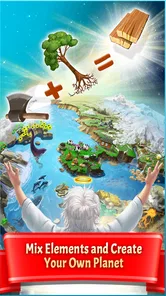
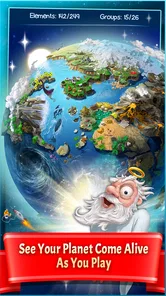
At its core, this game is all about mixing and matching different elements to create new ones. You start with the basic elements like water, fire, earth, and air, and it’s up to you to combine them in creative ways to discover over 300 new items! It’s like a puzzle but with an almighty twist.
Gameplay Mechanics: Simple Yet Addictive
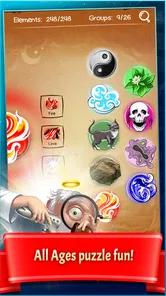
The interface is super user-friendly. You simply drag and drop elements onto each other to see if they form something new. It’s that simple! But don’t be fooled, the combinations can get quite intricate. There were moments I found myself scratching my head, wondering what combination could lead to creating a unicorn or a vampire. It’s a game that keeps you guessing and encourages you to think outside the box.
More From Our News Desk

Weather by Xiaomi Review: Clear at a Glance, Less Clear Up Close

X Under Pressure: Can It Recover When Posting Goes Wrong?

Clash of Clans Is Won Between the Battles

Android Auto Makes the Case for Quieter Car Software

MobiOffice: Transforming Mobile Productivity with Seamless Integration

EA SPORTS FC™ Mobile Soccer: Redefining Mobile Sports Gaming
What I really loved was the sense of reward you get when you finally crack a tough combination. There’s a satisfying "aha" moment that keeps you coming back for more. Plus, the game’s quirky humor and clever descriptions for each new element are the cherry on top.
When experimentation gets slow
The pace depends more on how quickly I can form a promising idea than on reflexes. Early discoveries can feel lively because basic elements invite obvious tests; later, the growing set of possibilities can make progress slower. I wouldn’t call that a flaw for everyone—the pause to reason is part of the appeal—but it can become frustrating if I’m trying to finish a session quickly. Rather than repeat the same guesses, I take a short break and return with a fresh angle.
For an everyday example, this is the sort of game I’d open while waiting for a meal or sitting through a quiet commute, then close when I reach my stop. It works better as a small thinking diversion than as something I’d rely on to fill a long stretch with constant new surprises. Compared with a conventional level-based puzzle, it gives more room to experiment but less of a visible step-by-step route; if I want a defined challenge and a clear endpoint, another puzzle style may suit me better.
Choosing a session that fits the moment
That short-break use also suits the way I’d handle a stalled run. I can make a few considered attempts, stop before the puzzle turns into mindless tapping, and come back later with a clearer head. There’s no need to treat every pause as failure: this game’s open-ended structure makes stepping away a reasonable way to reset my thinking. If I’m looking for a puzzle that tells me exactly what to do next, though, this freedom can feel more like a lack of direction than a benefit.
It also helps to distinguish “I want to discover something” from “I want to complete a challenge.” Doodle God is stronger at the first. A traditional logic puzzle or a level-based match game usually gives me a bounded problem and a visible finish line; here, I’m making my own hypotheses about what belongs together. I’d choose this when curiosity is the point, and choose a more structured puzzle when I want a crisp task that can be finished in one sitting.
Graphics and Sound: A Quirky Delight
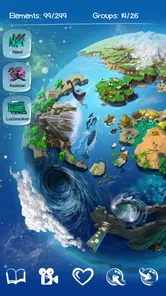
The art style of Doodle God™ is charmingly simple, with bright colors and cartoonish designs that suit the game’s playful nature. The sound effects and background music add to the fun, creating a lighthearted atmosphere that’s both relaxing and engaging.
One of my favorite parts is the witty commentary from the narrator. It adds a personal touch and makes the whole experience feel like a collaborative effort between you and your divine guide.
Small details that shape the experience
The light presentation supports the game’s relaxed mood, but the main reward remains the relationship between an idea and the result it produces. I wouldn’t come here expecting elaborate visual spectacle to carry a session. Instead, the simple look keeps attention on the elements and their combinations, while the humorous descriptions give discoveries a bit of personality. If I’m playing somewhere quiet, I can enjoy the puzzle without needing to follow a fast stream of action.
One practical trade-off is that a drag-and-drop puzzle asks for a screen and touch interaction that feel comfortable to me. On a smaller or older device, I’d pay attention to whether selecting and moving elements feels easy rather than assuming the same experience on every screen. That’s not a claim about a particular device problem; it’s simply the part of this style of play I’d check first, because frequent combinations are less pleasant if the basic gesture feels fiddly.
Practical expectations for a paid puzzle
JoyBits Ltd. developed the game, which has an average rating of 4.2 from around 18,000 ratings, with roughly 1,900 written reviews and more than 500,000 installs. It costs $1.49, and in-app purchases range from $0.99 to $99.99 per item, so I’d check the purchase screen carefully before tapping anything beyond the initial download. The Everyone age rating makes its general audience clear, while the current version is 3.3.9 and the minimum operating-system requirement is 7.0.
For performance, I’d set expectations modestly: the simple presentation doesn’t suggest a game built around demanding visual effects, but that alone can’t promise identical speed on every device. I’d try a brief session first, especially on an older phone, and notice whether dragging elements feels comfortable on its screen. If an interruption breaks a session, I’d reopen the game and check what progress remains before assuming a particular recovery behavior. That’s a sensible precaution for any puzzle where an unfinished chain of experiments is easy to lose track of.
Costs, audience, and what to check
The initial price makes this a paid game rather than a free download, and the listed in-app purchase range is broad enough that I’d be deliberate around any optional purchase prompt. I’d decide whether the basic experience is worth the upfront cost to me before spending more. That matters most if I’m buying it for a younger player: the Everyone rating describes its general audience, but I’d still make purchase choices with them rather than assume every on-screen option is part of the original price.
The minimum operating-system requirement is 7.0, which gives a useful first check before installing, but it doesn’t tell me how the game will feel on a particular handset. I’d consider both compatibility and touch comfort: an older device might meet the requirement yet still make repeated dragging less pleasant than it would be on a newer screen. A quick first session is a better test of personal fit than guessing from the game’s modest visual style.
Why You Should Give It a Try
If you’re a fan of puzzle games, or if you just enjoy games that let your creativity run wild, Doodle God™ is definitely worth a try. It’s perfect for those moments when you want to unwind and immerse yourself in a world where you control the elements. And hey, who doesn’t want to say they’ve created life from scratch?
I’d especially point it toward someone who likes asking “what if?” and doesn’t mind making a few unproductive guesses along the way. It can work as a shared conversation starter, too: one person can suggest a pairing while another thinks through what the result might be. That makes the puzzle approachable for casual play without changing its basic rhythm. Someone who wants multiplayer competition, a daily checklist, or a tightly guided campaign should look elsewhere rather than expecting this open-ended concept to provide those things.
In conclusion, Doodle God™ offers a delightful mix of creativity, challenge, and humor. It’s a game that’s easy to pick up but hard to put down. Whether you’re a seasoned gamer or just looking for something fun to pass the time, this app is a divine choice. So go ahead, unleash your inner deity and see what you can create!
My performance verdict
I see this as a lightweight-feeling idea in presentation, not a performance guarantee: I can’t infer exact loading times, battery use, or stability from the art style alone. The practical test is whether it responds comfortably on your device and whether you enjoy the slower stretches between discoveries. With that caveat, I’d choose it for relaxed, curious play, and skip it if I needed a tightly guided puzzle or a reliably fast burst of action.
Who should pass, and who should keep it installed?
I’d skip it if my favorite puzzles are compact logic grids, timed rounds, or carefully staged levels where each step teaches a specific mechanic. Those formats give clearer direction and often make progress easier to measure. Here, a good session can end with a hunch to try next rather than a tidy completed stage. That open-endedness is an advantage for a curious player, but it won’t satisfy someone who needs frequent, unambiguous milestones.
For me, the best reason to keep it around is that it asks for attention without demanding a high-energy mood. I can open it for a few combinations, enjoy the odd discovery, then leave it alone without needing to remember a complex control scheme. The compromise is that the later search can feel less rewarding if I’m not in the mood to reason through possibilities. My advice is to treat it as a flexible idea game, not as a guaranteed source of rapid progress.
A final word on reliability and fit
I would not judge stability, recovery, battery use, or loading speed from a simple art style, and I wouldn’t promise identical behavior across devices. I’d start with a short session, see whether the interface feels responsive, and make sure I’m comfortable with how progress carries across interruptions before beginning a long chain of experiments. That cautious approach is useful whenever a puzzle session depends on remembering which ideas I have already tested.
Overall, this is a distinctive choice among casual puzzle games because discovery, not speed or a fixed sequence, supplies its momentum. I’d recommend it to patient tinkerers, creative thinkers, and anyone who likes making connections during an idle moment. I’d steer a friend toward a structured alternative if they want clear levels and quick closure. For the right mood, though, its unusual premise and playful discoveries make it an easy game to return to.
Doodle God™ Frequently Asked Questions
Does Doodle God™ focus on quick reactions or thoughtful puzzle-solving?
Doodle God™ is better suited to players who enjoy taking their time than to those looking for action that depends on quick reactions. Its puzzle format centers on combining elements and seeing what new creations result, so the appeal comes from experimenting, noticing possibilities, and gradually expanding your collection. The imaginative premise gives each discovery a playful feel, while the relaxed pace makes it easy to dip into a puzzle when you have a little time.
What is Doodle God™’s age rating, and is it suitable for family play?
Doodle God™ has an Everyone content rating, making it a broadly accessible choice for players of different ages. Its central activity is a creative element-combination puzzle, which can encourage younger players to think through possibilities and may also appeal to adults who enjoy casual brain teasers. Families can take turns suggesting combinations or work through discoveries together, though younger players may appreciate a little help when a puzzle leaves them unsure what to try next.
Is Doodle God™ a paid game, and are there optional purchases?
Doodle God™ is listed at $1.49, and it also offers optional in-app purchases ranging from $0.99 to $99.99 per item. The download price and in-game purchase options are separate, so consider both when deciding whether the game suits your budget. You can enjoy the element-combination puzzle without assuming that purchases are required; if children play on your device, device-level purchase controls can help manage spending.
What kind of game is Doodle God™?
Doodle God™ is a puzzle game built around experimentation and discovery. Rather than following a fast-paced action format, you combine elements and think through what new creations those combinations might produce. Its central idea is summed up by the invitation to unleash your imagination and be a god, so it is a good fit for players who enjoy trying possibilities and solving puzzles at their own pace.
Who developed Doodle God™, and what devices can run it?
Doodle God™ was developed by JoyBits Ltd. The current version is 3.3.9, and it requires Android 7.0 or later on Android devices. It is also available for iOS, so players can choose the platform that suits their device. Before downloading, check that your operating system meets the requirement and that you are selecting the edition intended for your device.
Pros
- Creative puzzle-solving experience
- Wide range of elements to discover
- Regular updates with new content
- Engaging and addictive gameplay
- Intuitive and user-friendly interface
Cons
- Can become repetitive over time
- Some elements hard to discover
- Limited hints for challenging puzzles
- Occasional in-app purchase prompts
- Requires internet for some features