Deal or No Deal
- 135.00
- 4.3
- Installs
- 100.00K
- Price
- Free
Screenshots
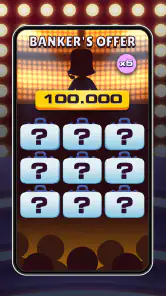

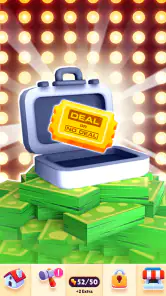



Analysis by Reviewed
Deal or No Deal is a trivia game built around the familiar tension of choosing an offer or taking another risk. I found it most enjoyable in short sessions, especially when I wanted something lighter than a full strategy game but more engaging than simply answering disconnected questions. The presentation aims at the atmosphere of the television format, while the actual appeal comes from the decisions made between rounds: do I protect a decent result, or keep going for a better one?
Developed by Senior Games, this free game is listed for Everyone and works on Android devices starting with version 7.1. It has attracted over one hundred thousand installs and holds an average rating of 4.3 from around two thousand ratings, so it has already found an audience without feeling like an obscure experiment. The current version is 2.0.13, and that matters because a game built around repeated rounds benefits from ongoing maintenance and a reasonably current installation.
How the deal-making format works in practice
A simple idea that depends on pressure
The basic attraction is easy to understand. You make choices, watch the possible outcomes narrow, and then face the central question: accept the deal or continue. That structure gives each decision more weight than a standard trivia question. Even when the round is quick, I found myself thinking about risk rather than tapping automatically.
That makes it a good fit for small gaps in the day. I could imagine playing while waiting for an appointment, taking a short break, or passing a phone around with family members. It does not demand the long concentration of a traditional quiz campaign, and it is easier to explain to another person than a game with several menus, currencies, or complicated rules.
The important distinction is that this is not primarily a knowledge test in the usual sense. Trivia is part of its identity, but the emotional hook is uncertainty. A player who enjoys making probability-based choices may get more from it than someone looking for a large bank of carefully categorized questions. If your ideal trivia game lets you answer hundreds of factual prompts and track subject mastery, this format may feel comparatively narrow.
Why short sessions suit it
The deal-making loop works best when treated as a compact challenge rather than a game that must occupy an entire evening. I recommend beginning with a few rounds and paying attention to how often the decisions feel meaningful. If you keep playing after a disappointing outcome, it is usually because the risk itself is entertaining, not because the game has delivered a deep progression system.
One useful habit is to separate the excitement of a lucky result from the quality of your decision. A good outcome does not automatically mean that continuing was wise, and a bad outcome does not prove that accepting the earlier offer would have been correct. Looking at the remaining possibilities before choosing helps keep the experience thoughtful instead of turning every round into an emotional reaction.
More From Our News Desk

Weather by Xiaomi Review: Clear at a Glance, Less Clear Up Close

X Under Pressure: Can It Recover When Posting Goes Wrong?

Clash of Clans Is Won Between the Battles

Android Auto Makes the Case for Quieter Car Software

MobiOffice: Transforming Mobile Productivity with Seamless Integration

EA SPORTS FC™ Mobile Soccer: Redefining Mobile Sports Gaming
This also gives the game a small social advantage. One person can hold the phone while others debate the next move, making it suitable for a casual family setting. The Everyone rating supports that broad audience, although younger players may still need guidance around the idea of virtual spending if they use a shared device.
Where spending enters the experience
The game is free to install, which makes trying it straightforward. It includes in-app purchases ranging from $0.99 to $20.99 per item. That is the key spending context I would want a new player to understand before starting: the download does not require an upfront purchase, but optional paid items are part of the experience.
I would approach those purchases as convenience or entertainment spending, not as a necessary route to becoming better at the game. A sensible first session is to play without buying anything and see whether the core deal-or-continue decisions are enjoyable on their own. If the free loop already feels satisfying, there is less reason to spend impulsively after a frustrating round.
For families, I would also recommend checking the device’s purchase controls before handing the game to a child. The age classification is Everyone, but that label describes suitability of the content rather than a guarantee that every player will understand optional purchases in the same way. Keeping payment decisions with the account owner is a practical safeguard.
I appreciate that the purchase range is visible rather than hidden behind vague wording. At the same time, a price range alone does not tell me how often a player may feel encouraged to buy, how much value each item provides, or whether spending changes the pace of progress. I therefore would not treat the paid options as a reason to recommend the game more strongly. The fair test is whether it remains enjoyable when played within a personal budget of zero.
Progress without letting pressure decide for you
The most interesting tension comes from the moment an offer feels good enough to protect. That pressure can make a modest reward seem more important than it did at the start of a round. My advice is to decide in advance what kind of player you want to be: cautious, aggressive, or simply experimental. Having that approach in mind makes the result easier to accept.
A cautious approach is useful when you are playing for a clean, low-stress session. An aggressive approach is more entertaining when the objective is excitement rather than consistency. The middle ground is to continue only while the remaining possibilities justify the risk in your own mind. None of these styles is universally correct, which is part of what keeps the format from becoming a simple answer-and-repeat routine.
There is also a practical reason not to chase a lost round with a purchase. A disappointing result can make the next decision feel urgent, but the game’s central loop is designed around uncertainty. Spending immediately after a setback can blur the line between enjoying the challenge and trying to undo it. I found the experience healthier when I treated every round as separate and stopped when the decisions no longer felt fun.
Fairness in a competitive setting
Deal or No Deal is not the kind of trivia game I would choose for a serious leaderboard contest. Its central outcomes depend on risk and chance as much as knowledge, so a player who makes a clever decision can still finish behind someone who simply received a more favorable sequence. That does not make it unfair as casual entertainment, but it does limit how meaningful a direct comparison between players can be.
For friendly competition, I would use it as a conversation starter rather than a definitive test of skill. Friends can compare whether they accepted an offer or continued, then discuss the reasoning. That is more interesting than declaring one person the best player after a single lucky result. If you want a trivia experience where accuracy, speed, or subject expertise clearly determines the winner, a conventional quiz app is likely a better choice.
Spending is another reason to be careful with competitive comparisons. Optional purchases are available, but the available information does not establish that buying an item guarantees a better result or creates a fair advantage. I would not assume that a player who spends more has demonstrated greater skill. Until you understand exactly what a purchase changes in your own play, it is better to keep money and competition separate.
That separation is especially important in a group. If several people share one device, set the rules before beginning: no purchases during the challenge, or purchases allowed only outside the agreed contest. This keeps the result focused on decisions made in the round instead of turning the session into an argument about who had access to more paid options.
What I would check before committing time or money
The game’s public information gives a clear picture of its identity, price to download, age classification, developer, and current version. It also tells me that optional items can cost between $0.99 and $20.99. Those facts are enough to decide whether the concept interests you, but they are not enough to judge every part of the spending experience.
In particular, I would personally inspect the purchase screen before confirming anything and note what each item actually offers. I would also play several free rounds first, because the value of an optional item depends entirely on whether the underlying loop remains enjoyable over repeated sessions. A purchase that seems attractive after one exciting round may feel unnecessary once the novelty fades.
I would use the same cautious approach to progress. The game is built around repeated deal decisions, but the practical importance of any longer-term advancement should be judged during use rather than assumed from the format. If you need a clearly documented campaign, detailed statistics, or a deep achievement structure, check whether the current version meets that expectation before making it your main trivia game.
Another unknown worth handling sensibly is how the experience feels across different phones. Android support begins with version 7.1, which covers a wide range of devices, but compatibility on paper does not tell me how smoothly every handset will run it or how comfortable the interface will feel on a smaller display. I would install it on the device you intend to use and judge the controls directly before recommending it to a group.
The same principle applies to updates. Version 2.0.13 is the current version I reviewed, but an update can alter balance, presentation, or the way optional items are shown. If spending or competitive fairness matters to you, recheck the in-game details after a major update instead of relying only on an older impression.
Who will get the most from it
I would recommend it to players who like recognizable game-show tension, quick rounds, and decisions that become harder as the possible results change. It is also a good casual option for someone who wants to involve a friend or family member without teaching a complicated rule set. The broad age classification makes the concept approachable, and the free entry point lowers the barrier to trying it.
It is less suitable for someone who wants a pure knowledge challenge. If your enjoyment comes from learning facts, selecting a subject, or measuring improvement through accuracy, this game may leave you wanting more structure. It is also not my first pick for players who dislike uncertainty, because a carefully considered decision can still lead to an unsatisfying result.
I would skip it if you are specifically looking for a competitive game where paid options can be confidently ruled out as a factor. The existence of purchases does not prove that competition is compromised, but it does mean that I would establish my own boundaries before treating the game as a contest. For a relaxed guessing session, that concern is manageable; for serious ranking, it is more significant.
My trust verdict after weighing the trade-offs
My overall view is positive but deliberately limited. Deal or No Deal succeeds when I want a compact, familiar risk-and-reward experience with a trivia flavor. The strongest part is the decision pressure: accepting an offer feels safe, while continuing keeps the round alive. That simple conflict is enough to make short sessions more involving than a passive quiz.
Its weaknesses come from the same design. Chance and risk reduce the value of competitive comparisons, and the presence of optional purchases means I would not spend casually or assume that paid items improve skill. The free download is a useful invitation, but it should be treated as a trial rather than a promise that every part of the experience will suit every player.
My practical recommendation is to install it, play several rounds without paying, and decide whether the choices themselves hold your attention. Set a spending limit before exploring any optional items, keep purchases out of serious competitions, and use the game as a short social challenge rather than a replacement for a deep trivia library. The fairest way to enjoy it is to judge your decisions, not just your results.
For me, that makes this a worthwhile casual trivia game, especially for fans of deal-making drama who enjoy taking calculated chances. I would recommend it to a friend with those expectations clearly stated: it is a light, accessible game for moments of uncertainty and conversation, not a rigorous knowledge benchmark or a guaranteed path to better outcomes through spending. Senior Games has a focused concept here, and when I keep the sessions short and the budget controlled, the format delivers exactly the kind of quick tension I was looking for.
Deal or No Deal Frequently Asked Questions
What age rating does Deal or No Deal have?
Deal or No Deal is rated Everyone, making it suitable for a broad audience. Its simple briefcase-picking format is easy to follow, and the focus is on choosing between the Banker’s offer and the chance to continue. Parents may still want to review the game’s purchase settings and supervise younger players, particularly if they share a device with saved payment details.
Which devices can run Deal or No Deal?
Deal or No Deal requires an operating system of version 7.1 or later, so it is worth checking your device’s software before downloading. The game is available for Android and iOS, and compatibility can vary with the device and platform. Keeping your operating system up to date can also help avoid installation or performance issues.
Who developed Deal or No Deal, and how well is it rated?
Deal or No Deal is developed by Senior Games and is listed in the Trivia category. It has an average rating of 4.3 from around 2.2 thousand ratings, with around 135 written reviews and over 100 thousand installs. These figures offer a general sense of player response, though individual experiences can differ depending on the device and expectations.
What is Deal or No Deal?
Deal or No Deal is a game-show-style app based on the popular television format. You choose briefcases containing hidden cash prizes and try to select the case with the highest value. After each round, the Banker makes an offer to buy your case. You must decide whether to accept the deal or continue playing for the chance of winning more, while risking a lower final prize.
How do you play Deal or No Deal?
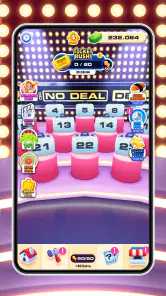
At the beginning of a round, you select one briefcase to keep as your personal case. You then open other cases one at a time, revealing their hidden amounts and removing those prizes from the board. After several cases are opened, the Banker presents an offer. Choosing “Deal” ends the round with that offer, while “No Deal” lets you continue until another offer or the final case selection.
Pros
- Simple rules make it easy for new players to start quickly.
- Short rounds suit casual play during brief breaks.
- The tension builds well as valuable cases are gradually removed.
- Bright visuals and familiar presentation make it accessible for all ages.
- Offers a fun risk-versus-reward experience without complex strategy.
Cons
- Gameplay can become repetitive after several rounds.
- Luck has a much greater influence than player skill.
- Some versions may include frequent ads between rounds.
- The best rewards may require in-app purchases or extra progress.
- Older devices may experience slower loading or reduced performance.
- Category
- Trivia
- Version
- 2.0.13