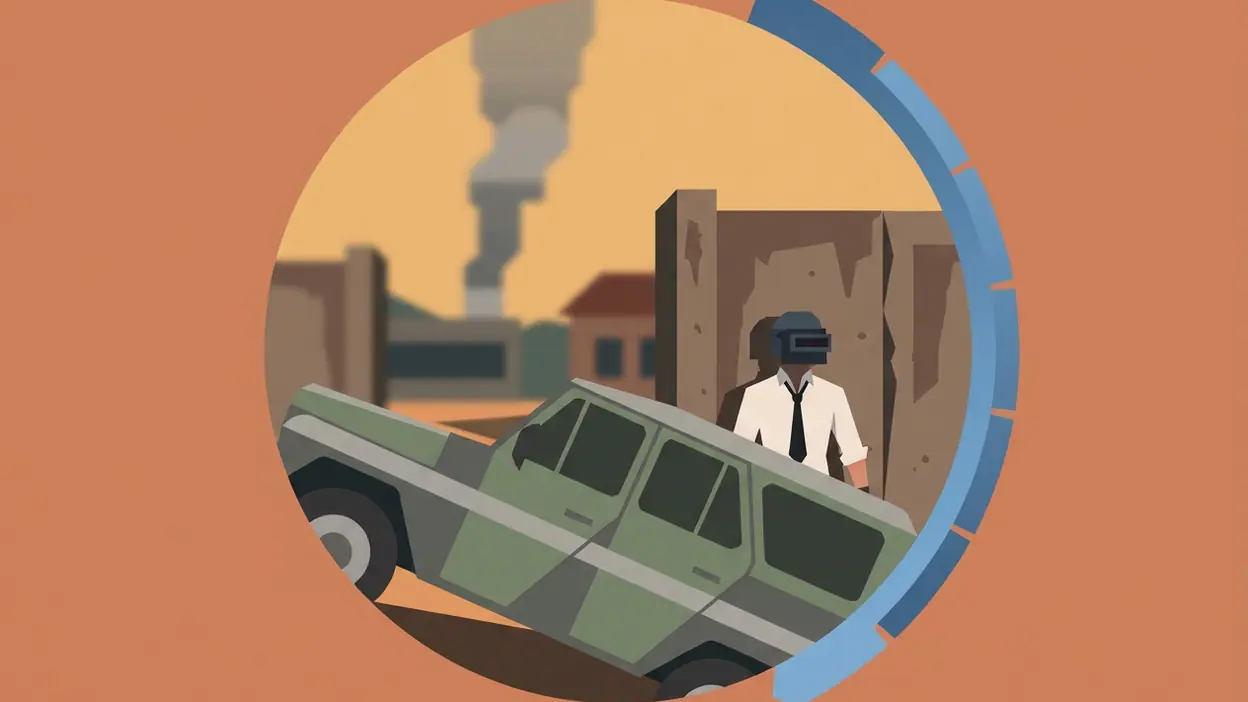
 About PUBG MOBILE
PUBG MOBILE Shows What Battle Royale Must Get Right
Battle royale used to sell a simple fantasy: drop into a huge map, find a gun, and outlast everyone. That still powers PUBG MOBILE, but it no longer explains why the genre holds attention. The standard has shifted toward a harder promise: every match should create a story through choices, pressure, and player-made surprises, while staying fair enough that a loss feels earned. PUBG MOBILE remains a useful measure of that shift because its best feature is not sheer scale. It is the way a familiar survival loop keeps producing decisions that matter.
The appeal begins with a plane crossing the map and a jump made under pressure. Choose a busy landing spot and the opening becomes a scramble; steer toward quieter buildings and trade early danger for time to loot. Then the safe zone starts shrinking, turning a landscape into a sequence of deadlines. A vehicle can rescue a squad from a bad rotation, but its engine announces the arrival. A crate may offer a powerful weapon, but reaching it can expose the team. The loop is easy to describe and difficult to solve twice in the same way.
The category has moved beyond the shrinking circle
That structure has become the genre’s baseline rather than its whole pitch. Players expect quick matchmaking, maps with distinct rhythms, responsive shooting, readable equipment, and enough modes to fit both a short session and a night with friends. They also expect progression that gives routine play a purpose, plus regular changes that make familiar routes feel newly contested. A battle royale that merely drops players into a large space and waits for the circle to close now feels incomplete.
There is a tension in those expectations. More systems can deepen a match, but too many can bury the central contest beneath menus, currencies, and event rules. Mobile players also need a clear sense of what is happening on a small screen: where fire came from, whether a teammate can be revived, and how much time remains before the next zone move. The category’s current test is not how much it can add. It is whether each addition creates a decision players can understand in the moment.


PUBG MOBILE’s strongest signal is its commitment to the match as a shared, consequential space. The map is not just scenery around a shooting gallery. Buildings, ridgelines, roads, and open fields shape how squads approach one another, and the zone makes delay costly. A team that holds a compound has cover but risks being trapped; a team moving early may claim position but arrive before it knows where the next fight will form. The suspense comes from incomplete information, not from a scripted sequence of encounters.
That design gives the game a particular rhythm. The opening is noisy and opportunistic, the middle becomes a study in movement and information, and the final circles compress everything into a few seconds of judgment. A quiet stretch can feel tense rather than empty because the player is listening for engines and distant shots, checking the map, and guessing which route is safe. Then a single sightline turns the silence into a firefight. That contrast is the game’s most durable source of replay value.
It also follows conventions the audience knows well. Looting creates an immediate ladder of improvement, weapon classes reward different ranges, and survival is the final score that matters. Squad play adds familiar jobs: one player scouts, another covers, and someone else keeps the group moving. The shrinking zone converts a sprawling map into a compact arena, while the last team standing provides a clean, legible conclusion. These are not stale simply because they are old. They are stale only when a game treats them as sufficient.
Latest News


The convention PUBG MOBILE challenges is the idea that a battle royale must make every match feel like a sprint toward constant combat. Its pacing leaves room for caution. A squad can avoid a fight, reposition, and arrive at the end with resources intact; another can chase every gunshot and risk being caught outside the zone. Neither approach guarantees a win. That uncertainty gives restraint a real place in the action, even if some players will find a long rotation or a slow early game less exciting than a denser, faster format.
Related games show how broad the category has become. Free Fire: 9th Anniversary and Free Fire MAX lean toward a quicker, more immediately legible flavor of battle royale, where brisk encounters and accessible action are part of the appeal. They sharpen the contrast: speed can make a match easier to fit into a short break, but it can also leave less room for the prolonged uncertainty that defines PUBG MOBILE. Neither tempo is automatically better. The important standard is that a game should know which one it is pursuing.
The comparison reaches beyond direct rivals. Temple Run 2: Endless Escape and slither.io are built around compact, instantly understood survival loops rather than a full-scale match. Their persistence demonstrates a basic truth that larger action games can overlook: replayability depends on a clear action, immediate feedback, and the feeling that the next attempt might go better. Sniper 3D: Gun Shooting Games, meanwhile, represents a more task-driven kind of shooting, where discrete objectives provide the structure. PUBG MOBILE asks for a different investment: learn the space, read opponents, and make your own objective as the match changes.
The emerging standard, then, is not simply more maps or more content. It is meaningful variation inside a familiar loop. Players want a match they can understand quickly but not master completely, and updates that alter choices rather than merely repainting rewards. They want short routes into play, reliable controls, fair encounters, and enough social texture for a squad to remember a narrow escape later. PUBG MOBILE meets much of that standard through its map-driven decisions and the unpredictable mixture of strangers, teammates, and timing.
Its weaknesses reveal where mobile battle royale still lags. The full experience can demand substantial storage, steady connectivity, and a device capable of keeping performance stable during crowded fights. Touch controls offer extensive customization, but shooting, movement, camera control, and communication still compete for screen space; comfort often depends on practice and personal layout. The game’s many events and progression layers can also make the surrounding interface feel busier than the core match deserves. These are not minor details when the category depends on quick access and reliable play.
There is a broader design cost, too. As live-service games add modes, cosmetics, seasonal tasks, and limited-time activities, the burden of keeping up can grow. New content can bring friends back, but it can also make the game feel like a schedule rather than a place to play. The strongest updates are those that refresh the actual decisions of a match. If a change only adds another reward track, it may increase activity without making the experience richer.
For players, this shift changes what a good recommendation should promise. Not every battle royale needs the same speed, scale, or complexity. Someone looking for a quick burst may prefer a more compact format; someone who enjoys planning a route and surviving a tense late game may welcome PUBG MOBILE’s longer arc. The useful question is no longer just whether a game has a large map or many weapons. It is whether its systems make time spent in that map feel purposeful, and whether a defeat leaves a lesson rather than only frustration.
PUBG MOBILE still makes the genre’s central bargain compelling: you enter with little, improvise under pressure, and watch a simple plan unravel into something memorable. Its future depends less on expanding that bargain than on protecting it from clutter, uneven performance, and repetition. Battle royale has grown up; it needs more than a shrinking circle to hold attention. The next standard will belong to games that make every choice legible, every match distinct, and every return feel like a fresh risk rather than another task.